Top 10 AI Marketing Tools Chinese Teams Actually Pay For
The paid stack in China does not look like the Western one. It is platform-native, WeChat-shaped, and metered by audience rather than by seat.
The short version
- Chinese teams rarely buy an AI marketing stack as a stack. They buy media, and the software arrives attached to the invoice.
- Four working layers do most of the labor: creative production, AI livestream and digital humans, private-domain SCRM, and measurement.
- Two of the ten tools below bill per seat. The rest meter contacts, clones, exposure or events.
- The hinge was 2023, when WeCom started charging merchants on external-contact volume. Private domain stopped being free CRM and became a metered utility.
- Baidu’s FY2025 results stopped breaking out online marketing revenue. That is not a reporting quirk. It is the search-era P&L being retired.
1. How this list was built: invoices, not downloads
Download counts are a terrible proxy for anything in China. Enterprise buyers do not install software. They sign things, and the signature is usually attached to a media commitment that was already being negotiated.
So the filter here was commercial, not technical. Three tests, all of which a tool had to pass.
First, money has to change hands at contract level: an annual framework agreement, a prepaid ad account, or a per-asset license. Free trials and freemium funnels do not count, however clever the model underneath.
Second, the tool has to sit inside a workflow that a platform already owns. This is the part Western readers find hardest to accept. In China, the most useful marketing software is the software that shortens the distance between a brand and an ad slot.
Third, there has to be evidence of scale that a skeptical CFO would accept: a listed vendor’s disclosure, a platform’s own product and pricing documentation, or consistent trade reporting from outlets that cover the sector seriously.
What got cut? Plenty. The AI-SDR category that dominates Western conference stages barely exists as a paid line item here, because the first sales conversation happens in WeChat, not in a sequenced email cadence. Standalone CDPs are mostly a data team’s science project. And a long tail of generative-content startups has impressive demos, no invoices.
One caveat before the list. China’s marketing software vendors rarely publish list prices. Almost every serious deal is quoted, and the quote depends on volume, term and what else you are buying from the same salesperson. So this article describes billing units, not invented price tags. If you need a number, you need a quote, and knowing which unit you are being quoted on is most of the negotiation.
2. The four-layer structure, and the substrate underneath
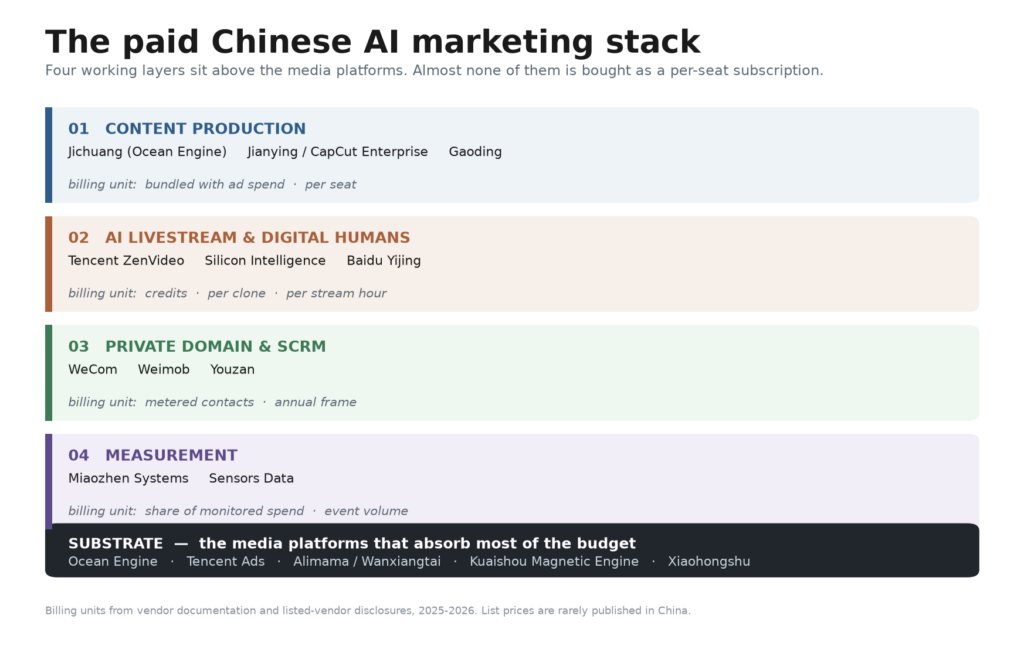
Draw the Chinese stack as five horizontal bands. The bottom band is not a tool. It is the media.
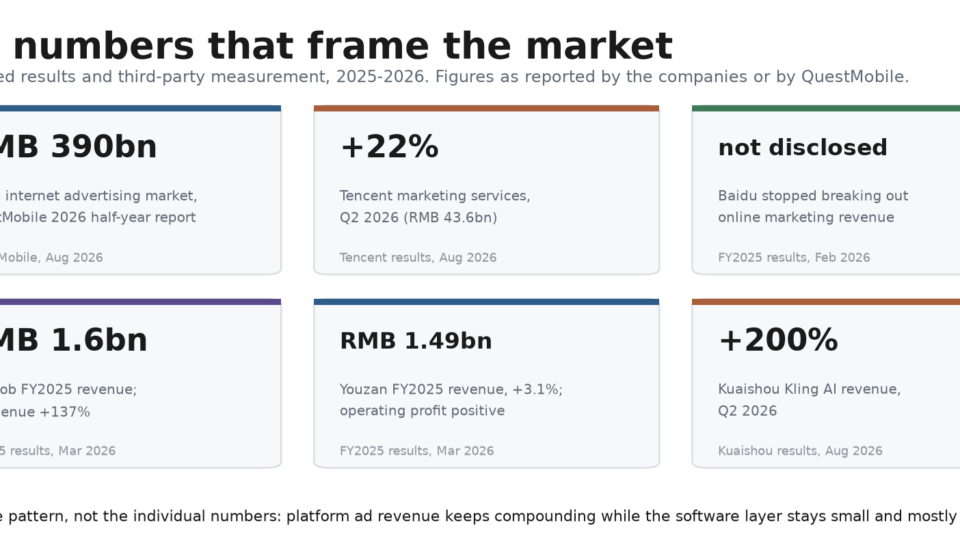
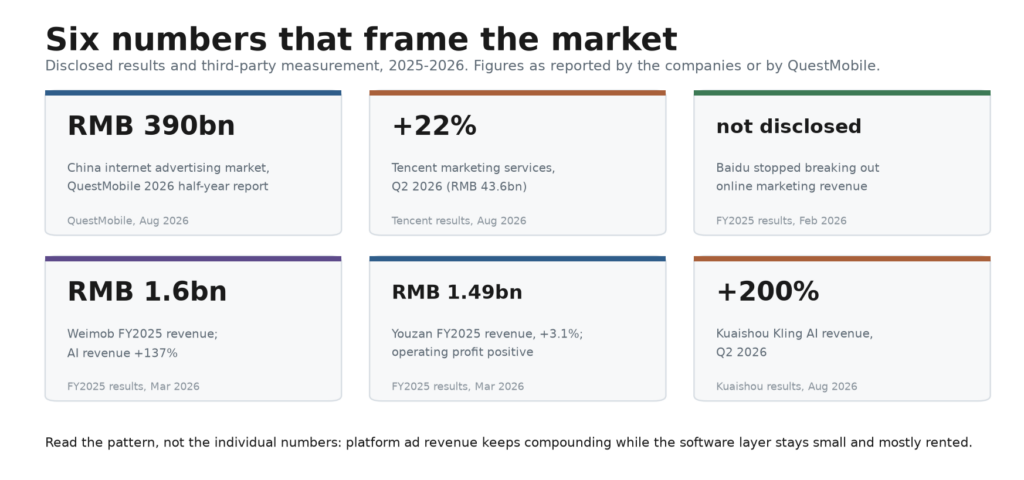
That band is Ocean Engine, Tencent Ads, Alimama with its Wanxiangtai buying console, Kuaishou’s Magnetic Engine, and Xiaohongshu’s commercial platform. It absorbs the overwhelming majority of the money. QuestMobile put China’s internet advertising market at close to RMB 390 billion in its 2026 half-year advertising report, published in August.
Tencent’s numbers show the same gravity. Marketing services revenue reached RMB 43.6 billion in the second quarter of 2026, up 22 percent year on year, inside total revenue of RMB 204.8 billion. Kuaishou’s second quarter revenue came in at RMB 35.5 billion, with its Kling AI business growing more than 200 percent, even as net profit fell roughly 30 percent.
The four bands above the substrate are where vendors actually compete: content production; AI livestream and digital humans; private domain and SCRM; measurement.
Each layer exists to serve inventory the platform already sells. That is why the tools look odd when you evaluate them on their own. They are not products in a category. They are attachments to a distribution channel.
3. Content production: the tool that ships inside the ad account
Start with the strangest fact in this market. The most widely used AI creative tool for Douyin advertisers has no meaningful subscription line. Jichuang, Ocean Engine’s AI creative suite, generates scripts, short-video cuts, avatars and product images, and it is distributed to advertisers essentially as an operating aid on top of ad spend.
Why would a platform give away creative AI? Because creative throughput is the binding constraint on its own inventory. Douyin does not need another editing app. It needs more distinct ad variants, faster, from more advertisers. Free creative software is a supply-side investment with a measurable return: more assets, more auctions, more spend.
That economic logic explains the whole layer. When the platform gives the model away, a vendor’s moat cannot be the model. It has to be workflow, asset governance, or a channel the platform does not control.
Two of these three are genuine seat businesses, which is rare enough to be worth noting.
Jianying, sold outside China as CapCut, is the closest thing the market has to a default editing seat. The enterprise tier sells the boring things that matter at scale: shared asset libraries, brand kits, multi-account management, and audit trails for who published what. It is billed per editor, per year, and it is one of the few tools on this list a Western procurement team would recognize instantly.
Gaoding occupies the batch-design niche that e-commerce created: hundreds of SKUs, dozens of marketplaces, one small team. Per-seat annual plans, team tiers, template libraries tuned to platform specs. Unglamorous, and quietly profitable because the alternative is hiring designers.
The pattern to remember: in this layer you are buying throughput per editor, and the ceiling on price is a designer’s salary.
4. AI livestream and digital humans: sold by the clone
Livestream commerce is the one channel where China runs structurally ahead of everyone else, and it produced a pricing unit you will not find in a Western rate card: the clone.
Tencent ZenVideo sells AI video and digital-presenter production on a credit-and-seat basis. Silicon Intelligence sells digital human clones with a setup fee per persona plus usage priced on streaming hours or an annual license. Baidu Yijing sits at the other end of the spectrum, bundled into Baidu’s own commercial ecosystem.
The billing logic is asset-based, not seat-based, and that tells you how buyers think. A clone is capital. You commission it once, and it works nights. The marginal cost is inference and stream minutes, which is why the negotiation is always about hours, resolution and concurrency rather than headcount.
Here is where I would push back on the hype, because the field evidence is more interesting than the pitch. IDC published a benchmark test report on AI livestream digital humans in April 2025, and the industry has been iterating on those results ever since. But 36Kr’s consumption review of the 2026 mid-year shopping festival concluded that AI has not taken over the marquee sale events. It has colonized the hours nobody wanted, 2 a.m. to 7 a.m., plus overflow traffic on secondary accounts and the long tail of SKUs that cannot justify a human host.
That is a real business, and a much smaller one than the deck suggests. Digital humans fix coverage, not charisma. If your unit economics depend on prime-time conversion, a clone will disappoint you. If they depend on being open when your competitor is asleep, the math works.
5. SCRM lives inside WeChat, and WeChat bills you
Now the layer that decides whether any of this compounds. In China, customer ownership is not a database you own. It is a relationship hosted on somebody else’s rail.
WeCom is that rail. The base product is free, which is exactly why it became universal: it is the sanctioned way to message customers at scale from inside WeChat without tripping the platform’s anti-spam machinery. Then, in 2023, WeCom introduced charging tied to external contacts, a change that trade press covered as a watershed for the merchants relying on it.
Read that again, because it is the most under-reported structural fact in this market. When the billable unit becomes the external contact, your CRM cost stops scaling with headcount and starts scaling with audience. A brand with five operators and four million followers pays a very different bill from one with fifty operators and forty thousand. Retention acquires a carrying cost per follower, and every follower who stops buying becomes a line item you can no longer ignore.
Above the rail sit the operating systems. Both listed vendors published FY2025 results that read like a sector in transition.
Weimob reported revenue of about RMB 1.6 billion for FY2025 with a net loss around RMB 240 million, and AI-related revenue growth of 137 percent. By the first half of 2026 it was reporting a return to topline growth with AI application revenue up roughly 90 percent year on year.
Youzan reported FY2025 revenue of RMB 1.487 billion, up 3.1 percent, with operating profit turning positive. Through 2026 it moved its listing to the Main Board, and the strategic language shifted explicitly from online storefronts to offline chain retail. Read the pivot as an admission: the online merchant market is saturated, and the next paying customer runs shops.
What does this mean for a buyer? The SCRM decision is really a rail decision. You are choosing whose metering you will live under, and how much audience you intend to accumulate.
6. Measurement you rent, not own
Here is the uncomfortable part. Most Chinese measurement is not independent, and the industry knows it.
The platform data consoles — Cloud Atlas on Douyin, Magnetic Ark on Kuaishou, Guanxingpan on Baidu — are free at the point of use but gated by spend tier. They are generous with the numbers that help you spend more and quiet about the numbers that would help you spend elsewhere. That is not a conspiracy. It is what a free product owned by the seller looks like.
The genuine third-party referee is Miaozhen Systems, which sells ad verification and cross-platform reach measurement priced against monitored spend. Its commercial logic is familiar to anyone who has bought verification elsewhere: a percentage of the media you want watched. In practice it is a campaign-level line item, renewed annually, and its influence depends on whether the brand’s procurement team insists on it.
On the in-house side, Sensors Data sells behavior analytics as an annual license scaled to event volume and deployment scope, plus implementation. This is the tool a Chinese growth team buys when it wants a truth layer it controls, and the reason it survives procurement is that it answers questions the platform consoles structurally cannot.
The tell that the old frame is finished came in February 2026, when Baidu’s FY2025 results showed revenue of RMB 129.1 billion, AI new businesses up 48 percent, advertising down for a second consecutive quarter, net profit down 76 percent, and online marketing revenue no longer broken out as its own line. A company stops disclosing a number when the number has stopped explaining the business. By the first quarter of 2026, AI businesses were more than half of Baidu’s revenue.
Attribution in China is therefore negotiated, not computed. Whoever owns the console sets the definition, and the independent referee is only as strong as the clause you paid for.
7. The ten, and what each invoice looks like
| Layer | Tool | What it does | Billing unit | Who signs |
|---|---|---|---|---|
| Content | Jichuang (Ocean Engine) | AI scripts, cuts, avatars, product imagery for Douyin inventory | Bundled with ad spend; no separate seat fee | Performance marketing lead |
| Content | Jianying / CapCut Enterprise | Editing, templates, shared asset library, brand kits | Per editor, per year | Content studio lead |
| Content | Gaoding | Batch design for SKUs and marketplace specs | Per seat, per year, team tiers | E-commerce operations |
| Livestream | Tencent ZenVideo | AI video and digital presenter production | Credits plus seat; enterprise annual | Brand content team |
| Livestream | Silicon Intelligence | Digital human clones for always-on streams | Setup per clone, then stream hours or annual license | Livestream operations |
| Livestream | Baidu Yijing | Digital human livestream inside Baidu’s ad ecosystem | Bundled with Baidu commercial packages | Media agency or brand |
| Private domain | WeCom | The customer rail: messaging, contacts, archive | Free base, then metered external contacts plus archive seats | Operations and IT |
| Private domain | Weimob | Retail SaaS on WeChat: stores, CRM, campaigns | Annual subscription tiers plus implementation and services | Retail IT or CMO |
| Private domain | Youzan | Commerce SaaS, increasingly offline chain retail | Annual subscription by plan plus add-ons | Merchant owner |
| Measurement | Miaozhen Systems | Third-party verification and cross-platform reach | Share of monitored spend, campaign or annual frame | Brand media team |
| Measurement | Sensors Data | Behavior analytics and event-level truth | Annual license by event volume plus implementation | Data or product team |
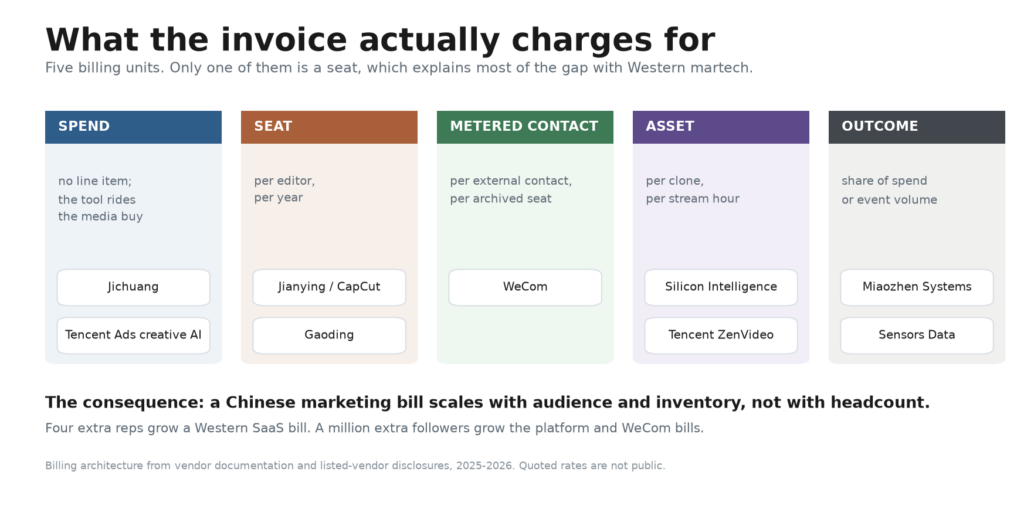
Count the rows that are true seat subscriptions and you get two: the editing seat and the design seat. Both replace a person at a desk. Every other invoice in this table charges for something the platform or the audience owns.
That is the structural difference, and it is not cosmetic. A Western marketing stack is a set of tools that a department subscribes to. A Chinese marketing stack is a set of meters attached to distribution, and the software is how you read the meter.
8. Where the Chinese stack gaps against the Western one
Four gaps matter, and each one changes how you should staff a China team.
There is no Chinese HubSpot. The horizontal marketing-automation category never formed at scale. It could not. Email is not the spine of Chinese B2C, lifecycle messaging happens inside WeChat under platform rules, and lead scoring is a weak instrument when the first conversation is a chat message. What exists instead is a rail plus a set of vertical SaaS layers, which is a different architecture with different failure modes.
There is no public price list. In the West, the pricing page is a product. In China it is a negotiation aid that often does not exist. Procurement therefore runs on relationships and annual frames, and a buyer who cannot get a quote in writing is not being stonewalled; that is the market.
Attribution is political. The independent measurement layer is thinner, campaign-scoped and easier to defund. If nobody in the room has bought verification, the platform’s number becomes the truth by default.
Data cannot travel. Cross-border transfer of personal information is regulated, and the compliance path is an assessment, not a checkbox. A global warehouse that unions Chinese customer records with the rest of the world is not a design choice you can make unilaterally.
9. Procurement reality: annual frames, real-name verification, data that stays
The three things that surprise foreign teams most are all administrative, and all of them can stall a launch.
Annual frames. A niankuang is an annual framework agreement that bundles media commitment, software licenses and services into one negotiated envelope, with rate cards that improve as commitment rises. It is efficient and it is sticky. The consequence is that software rarely gets bought on its own merits; it gets bought because it was thrown into a package that was already being signed. If you want a specific tool, you usually have to argue for it inside a media conversation.
Identity and eligibility. Ad accounts and commercial content require real-name verification of the entity, and regulated categories face additional review. This is why the invoice, not the interface, is the real barrier for a foreign brand. You either have a Chinese entity, or you work through an agency of record that does.
Data localization. Personal information collected in China is expected to stay in China, with a defined path for any cross-border transfer. Practically, that means your China stack is a separate instance, with its own identity model and its own reporting definitions, and reconciling it upward is a monthly manual exercise rather than a nightly job.
10. Build or buy
The rule that survives contact with reality is narrower than the usual advice.
Buy when the tool’s value depends on privileged access to a platform surface. Creative AI that plugs into Douyin’s ad system, a digital human optimized for a livestream API, an SCRM that is sanctioned inside WeCom. You cannot build your way past an API policy, and the vendors in this list are, functionally, licensed access.
Build when the value depends on your own data model. Content operations calendars, cross-platform creative testing logic, the stitching layer that reconciles platform consoles with your warehouse, and increasingly the agent orchestration that decides which tool to call. This is work no vendor will do for you, because your workflow is the only thing in the room that is actually yours.
There is a middle category that trips teams up: analytics. Buying an event-level tool is sensible. Assuming it settles arguments with the platform is not. Budget for the argument, which means budget for people.
11. Three things changing in 2026
Creative AI has become table stakes. When the platform hands out creative generation to protect its own inventory, production cost collapses and the constraint moves downstream, to distribution and to the quality of your audience data. Expect the editing and design seats to defend themselves on governance, not on models.
Audience-metered billing turns retention into a P&L line. Once the external contact is the billable unit, an unengaged follower is a cost with no revenue attached. That single change makes list hygiene, consent and lifecycle messaging financially material in a way they were not when private domain was free. CFOs will find this before CMOs do.
The paid unit is drifting from impression to outcome. Kuaishou’s Kling revenue growing more than 200 percent in a quarter while group net profit fell is the clearest signal in the sector: the money is moving toward AI-native inventory and away from the old auction. As shopping agents take over discovery, the thing you buy stops being attention and starts being a completed task. Nobody has priced that yet, which is precisely why it is the most interesting line item to watch.
12. The minimum viable stack for a foreign brand
If you are entering from outside, resist the temptation to replicate your home stack. You need five contracts, not fifteen.
- One platform ad account, chosen by category rather than by preference, with its native creative AI switched on. The creative suite is the cheapest leverage you will get.
- One content seat. Jianying or CapCut Enterprise, sized to the number of people who actually publish, not the number who ask for access.
- One private-domain rail. WeCom if you sell into a relationship, Xiaohongshu if you sell into aspiration, with a seated SCRM on top and a clear internal owner of the contact list.
- One measurement line. The platform console for daily decisions, plus independent verification on your single largest campaign. Buy the referee once, and buy it where the money is.
- One agency of record. For the invoice, the verification of entity, the licensing and the media negotiation. This is not a nice-to-have; it is the legal and commercial interface.
A workable budget shape, based on how these contracts are normally structured: roughly eight parts media, one part services, one part software. If your plan is software-heavy and media-light, you have imported a Western cost structure into a market that will not reward it.
Bottom line
The ten tools Chinese teams pay for are not a smaller version of the Western martech landscape. They are a different financial instrument. Media is the product, software is the attachment, and the meter runs on audience, assets and exposure rather than on seats.
Understand the meter and the market becomes legible. Ignore it and you will spend a year buying tools that nobody in the building needed, while the platform quietly charges you for the only thing that actually compounds: the relationship with a customer you are allowed to keep talking to.
FAQ
Do Chinese marketing teams actually pay for AI software, or is it all bundled?
Both, in a specific ratio. Creative AI and platform analytics tend to be bundled into media commitments, which is why they feel free. The paid software lines that survive procurement are the ones with a meter the brand controls: editing seats, design seats, SCRM on top of WeCom, event-level analytics, and third-party verification. If a Chinese vendor cannot point to a meter, assume the product is a feature of somebody else’s invoice.
Why is Jichuang effectively free for Douyin advertisers?
Because Ocean Engine is not selling software, it is defending inventory. More creative variants per advertiser means more auctions and better fill. The tool is priced as a supply-side investment, which is also why competing creative tools cannot win on model quality alone.
How does WeCom charging work in practice?
The base product is free and the customer-facing capability is metered. Since 2023 WeCom has charged merchants on external-contact volume, with separate paid capability around conversation archiving. The practical effect is that private-domain cost scales with audience size rather than with the number of operators, which changes how you justify retention spend.
Can a foreign brand buy these tools directly?
Rarely, and not because the products are restricted. Ad accounts and commercial content require real-name verification of a local entity, regulated categories face extra review, and personal information collected in China is expected to stay in China. Most foreign brands therefore buy through an agency of record or a local joint venture, and the agency becomes the contracting party for media, software and services alike.
What replaces HubSpot in a Chinese stack?
Nothing one-for-one. The functions are split: WeCom plus an SCRM layer handle relationship and lifecycle, the platform data console handles audience and attribution, and vertical SaaS handles commerce. Teams that try to buy a single suite usually end up with an expensive dashboard that nobody opens, because the actual work happens inside platform surfaces the suite cannot reach.