Tech Keeps Cutting the Same Jobs Twice
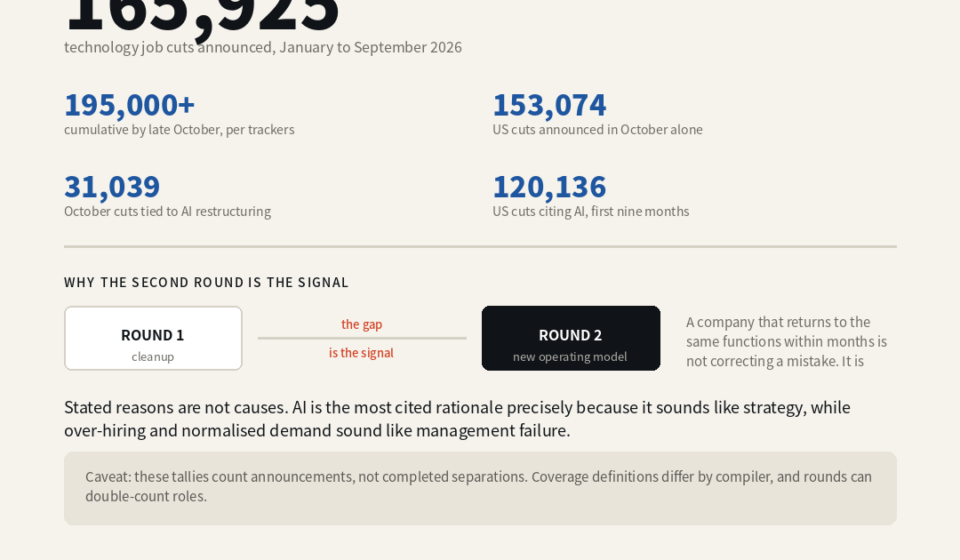
Tech layoffs in 2026 have arrived in repeated waves rather than single restructurings — 165,925 announced tech cuts through September, 153,074 US job cuts in October alone, and AI now the most frequently cited reason employers give — a figure that measures narrative as much as mechanism.
A company that cuts once is doing arithmetic. A company that cuts again four months later is telling you what it now expects its organisation to look like.
That is the pattern worth watching, and it is easy to miss because every announcement is reported as an event.
The numbers, with their seams showing
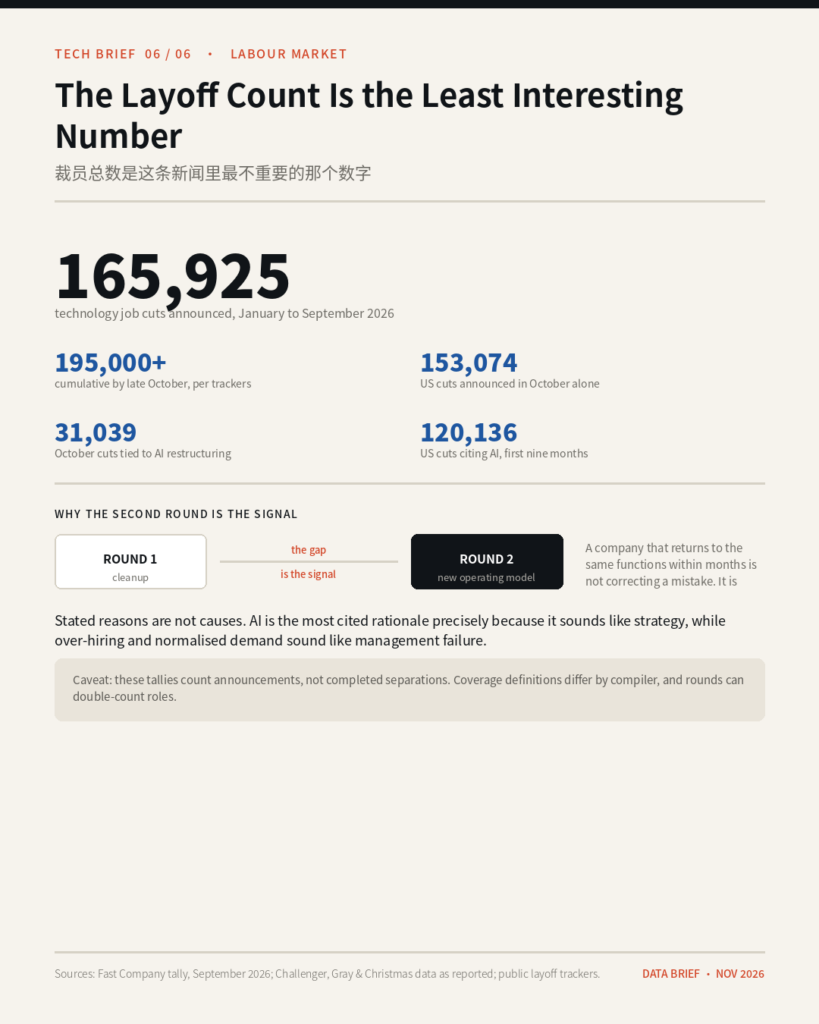
Through September, technology companies had announced roughly 165,925 job cuts in 2026, according to a widely cited compilation of announcements.
In October, US employers announced 153,074 cuts — the worst October since 2003 — of which 31,039 were tied directly to AI restructuring. Over the first nine months of the year, AI was cited in 120,136 announced US job cuts.
Three caveats before any of that travels. These count announcements, not completed separations. Coverage definitions vary by compiler. And rounds overlap, so some roles get counted twice.
Even so, the direction is unambiguous, and it arrived in a year when most of these companies reported healthy revenue. Overall US cuts were down sharply in the first half — around 40% — which makes the tech concentration, not the aggregate, the interesting part.
Why the second round carries more information
The first round of any restructuring is defensible. Duplicated functions after an acquisition, a product line that did not work, a region that never reached scale. That is cleanup.
The second round is different. It says the first round did not produce the organisation the company wanted, and the target keeps moving.
When a company cuts roughly a ninth of its staff within months of an earlier reduction, the reasonable inference is not that it miscalculated the first time. It is that headcount is now managed as a variable, reset each quarter against a plan that is itself revised each quarter.
For employees, that changes the nature of the risk. A one-off restructuring is an event you can survive. A recurring cadence is a condition.
The category error in “AI layoffs”
Two claims get merged constantly.
Claim one: a specific company eliminated specific roles because a specific system now does that work. Verifiable in principle, often true — support triage, first-line content operations, certain reconciliation work.
Claim two: AI is the general cause of technology-sector job losses. Much harder to establish, and the data does not currently support it as the primary explanation.
What the data supports is messier: a correction to pandemic-era hiring, capital expenditure shifting from payroll toward compute, financing costs that make long-duration projects expensive, and genuine automation of a narrow band of tasks — all arriving at once. AI is the most legible of those forces, and the easiest to put in a press release.
Why the stated reason is not the cause
Challenger, Gray & Christmas, which has tracked US job-cut announcements for decades, reports that AI has become the most frequently cited reason employers give. In May 2026, US employers announced just over 97,000 cuts.
That is a fact about stated reasons. It is not a fact about causes.
A company saying AI drove a reduction is making a claim about its own decisions, and it has incentives to make it: AI sounds strategic, whereas “we over-hired in 2021 and demand normalised” sounds like a management failure.
None of which makes the claim false. It makes the number a measure of narrative as much as of mechanism.
Small rounds, large signals
Amazon’s recent reduction of around a thousand corporate roles, concentrated in retail and stores functions across the United States, the United Kingdom and India, is tiny against a workforce of that size.
The composition is the point. These are corporate and support functions, not warehouse or logistics roles. When a retailer trims coordination layers while its operational footprint grows, it is making an argument about span of control: fewer people, better tooling, more supervision per manager.
Every large company is running that experiment. Very few will publish the results.
The bellwether is billed headcount
India’s large IT services firms are the most exposed indicator in the world, because their business model is priced per seat. Recruitment-intelligence estimates have pointed to net headcount reductions across the major providers over the past year even as revenue held.
Treat those carefully — they are not company-confirmed, and quarterly disclosures move in both directions. But the logic is clear. If you sell engineering hours by the seat and your clients believe a smaller team with better tooling delivers the same output, revenue per employee has to rise. That is an operating-model transformation wearing a headcount costume.
The counter-evidence nobody quotes
Two things are consistently omitted.
The first is rehiring. Reductions announced with strategic justification are sometimes partially reversed when the work turns out harder than the model suggested, and the reversal is rarely announced.
The second is simultaneous hiring elsewhere. Net headcount can fall while demand for specific skills rises sharply — which is what a reshaped organisation looks like, as opposed to a shrinking one.
What to do about it
If you are hiring, stop writing job descriptions around activities and start writing them around decisions. The roles that survive repeated rounds are the ones where a person’s judgement changes an outcome and cannot be reconstructed from a specification.
If you are looking for work, assume a two-round market. Notice periods, severance terms, vesting schedules and internal mobility rights are worth more when reductions recur than a marginally higher base salary.
And keep an auditable record of what you personally decided and shipped. In an environment where employers are comfortable attributing change to systems, being legible as a decision-maker is the durable asset.
What to watch in the next two quarters
Watch whether the AI-attribution share keeps climbing while total cuts fall. That combination — fewer layoffs, more AI explanations — would confirm that the label is doing rhetorical work.
Watch whether any large employer discloses net headcount alongside gross cuts. Almost none will.
And watch the interval between rounds. If companies that cut in the first half of 2026 are cutting again before mid-2027, the recurring-cadence thesis is settled, and the policy conversation about retraining needs a different premise.
FAQ
How many tech jobs were cut in 2026? Around 165,925 announced cuts through September, per a widely cited compilation. October added 153,074 US cuts across all sectors, per Challenger.
Does the data prove AI caused the layoffs? No. The AI figure reflects the reason employers give, which is not a causal finding. Hiring corrections, capital reallocation and financing costs are concurrent factors.
Why do second rounds matter more than first rounds? A first round can be cleanup. A second within months suggests the target organisation keeps moving, turning redundancy from an event into a condition.
Are companies rehiring after AI-driven cuts? Some are, quietly and at smaller scale. Reversals are rarely announced, which biases the public record toward cuts.
What should employees negotiate for? Notice periods, severance and vesting. In a market with recurring reductions, contractual protection beats a small increase in base pay.