One Capital Wants Preference, the Other Wants Google. Both Are EU Policy.
France’s AI minister says Paris and Berlin will propose strengthening European preference in public procurement under the EU’s proposed Cloud and AI Development Act, weighting European research spending, European employment and headquarters location — while Germany’s chancellor told a Berlin summit that Google Cloud is sovereign enough for intelligence agencies.
Two statements, roughly the same week, from the two governments that decide what European digital policy becomes.
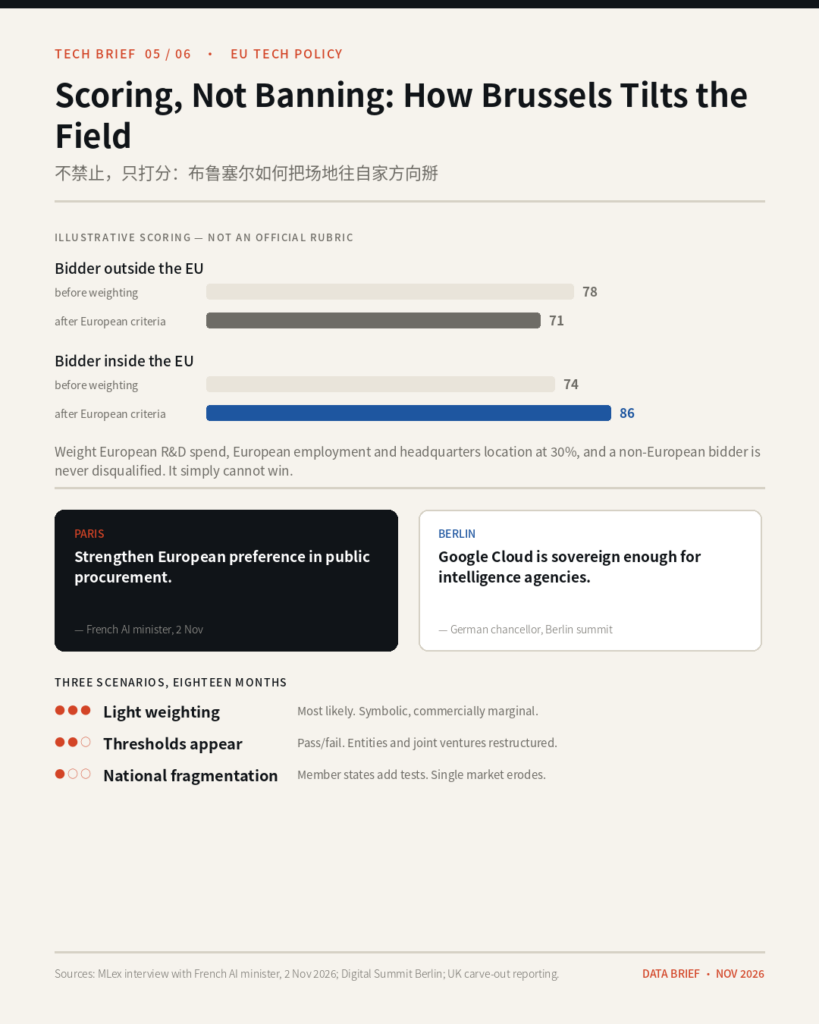
In Brussels, France’s AI minister said Paris and Berlin would put forward concrete proposals to strengthen European preference in public procurement under the EU’s proposed Cloud and AI Development Act. The criteria that should carry more weight, she suggested, are European research spending, European employment, and where the company is headquartered.
At the Digital Summit in Berlin, Chancellor Friedrich Merz said Google Cloud is sovereign enough for intelligence agencies.
Read that as contradiction if you like. It is more accurate to read it as the shape of the policy: a scoring system that tilts the field, wrapped around a political reality that cannot afford to close it.
What Paris is asking for
Not a ban. A weighting.
EU public procurement runs on published criteria and scored tenders. Make “European research investment” and “European employment” scored criteria and a non-European hyperscaler is not disqualified — it is outscored on a fraction of the total. That is a softer instrument than exclusion, and a much harder one to challenge, because the rule never has to mention nationality.
The proposals are described as forthcoming, not tabled. That matters for anyone modelling outcomes: there is no text to lobby against yet, only a direction of travel.
Criteria are where sovereignty gets decided
Watch the weighting, not the wording.
Add a 15% criterion for European R&D contribution and you have signalled intent. Add 30%, plus a threshold below which a bid is non-compliant, and you have built an industrial policy without writing the word “European” into an eligibility rule.
The same logic applies to headquarters. A company can run European data centres, employ European staff and serve European customers while being domiciled elsewhere. Score headquarters and the supplier that invested most locally can still lose to the supplier that moved its legal address.
That is the fight to expect in trilogue: not whether preference exists, but what counts as European.
What Berlin actually said
Merz’s remark lands differently in Berlin than it will in Paris.
The argument is pragmatic: if the alternative is no capability at all, a sovereign-enough foreign cloud beats an unsovereign absence. Intelligence services need compute now, and a European equivalent is a decade-long project at best.
There is an unstated concession in that position. Once a member state’s security apparatus runs on a foreign hyperscaler, the switching cost stops being a procurement decision and becomes a national security constraint.
The two positions are compatible, which is the problem
Preference in public procurement and tolerance of American cloud for intelligence work can coexist. One governs contracts; the other governs capability.
What cannot coexist indefinitely is the narrative. If the Commission sells the Act as digital sovereignty while the largest member state says the sovereignty question is already settled for its most sensitive workloads, then the legislation’s stated purpose and its actual function diverge — and every enforcement decision afterwards gets read through that gap.
Britain is already negotiating its way out
The UK is pressing for a carve-out from the EU’s new tech-sovereignty rules, arguing the framework as drafted would damage British digital companies.
Follow the logic. If European preference is expressed through procurement scoring, a British cloud provider bidding for an EU contract is, by construction, not European. The Trade and Cooperation Agreement grants market access; it does not grant a scoring bonus. London wants an exception, and Brussels has every reason to refuse one, because the exception would define the boundary of “European” for everyone.
Washington has a different instrument
The American response has not been a legal challenge to procurement rules. It has been pressure on an adjacent file, with warnings about consequences if Brussels limits spectrum access for non-EU satellite operators.
That is the reminder worth keeping: Europe’s sovereignty agenda spans cloud, chips, satellites and standards, and the leverage available to the other side is not confined to the file being negotiated. Expect the same logic in cloud. Retaliation will not target the Act directly. It will target something Europe needs.
Why the Commission is boxed in
Three constraints, pulling in different directions.
It must produce something that looks like industrial policy, because member states and the European Parliament have demanded it. It must stay compatible with WTO commitments and the EU’s own internal market rules, which makes explicit nationality criteria legally hazardous. And it must avoid letting national capitals write their own sovereignty tests — the risk critics have flagged, warning that the language could favour selected national champions and stifle pan-European providers.
That last risk is underrated. A rulebook designed to favour European providers can end up favouring the largest European providers, in the countries that have them.
What it costs a non-EU vendor
Three costs, in the order they bite.
Bid cost: documenting European R&D spend, local employment, data residency and control evidence, per tender, across dozens of agencies. Structural cost: decisions about where to incorporate subsidiaries and book research, made for procurement reasons rather than commercial ones. Architectural cost: building genuinely separated, locally governed environments rather than a region with a European label on it.
None of these are fatal. All of them raise the floor on selling into the European public sector, which is the point.
Three scenarios for the next eighteen months
Light scoring. Preference enters as a modest criterion with no threshold. Symbolically significant, commercially marginal. Most likely.
Scoring with thresholds. A minimum European contribution becomes pass-or-fail. This is where multinationals restructure entities and joint ventures become the cheapest route to compliance.
National fragmentation. Member states add their own tests on top. Compliance cost multiplies and the single-market argument collapses from the inside.
The tell is not the Commission’s communication. It is whether thresholds appear in the Council’s general approach.
FAQ
Is the Act law yet? No. It is a proposal, and the Franco-German contribution is described as forthcoming rather than tabled.
Does “European preference” ban American providers? Not in the version under discussion. It is expressed as weighted procurement criteria, which disadvantages non-European bidders without excluding them.
Why does headquarters matter more than data location? Because residency can be bought — build a region, hire staff — while headquarters reflects where control and profit sit. Scored on headquarters, investment alone does not close the gap.
How does the UK fit? It is seeking a carve-out on the grounds that the rules would disadvantage British firms bidding for EU contracts. A carve-out would effectively define who counts as European.
What is the realistic commercial impact? Higher bid costs and entity restructuring. Symbolically large, financially modest, unless thresholds appear.