Anthropic’s $895 Billion Bet: Inside the Compute Contract It Can’t Walk Away From
Two numbers that sit next to each other, and the gap between them
On 2 November, Anthropic filed an amended S-1 with the US Securities and Exchange Commission. Buried in the risk factors — and repeated four times across the document — is a figure that deserves more attention than the revenue line: $895.4 billion of purchase commitments and lease agreements, substantially all of it related to compute and infrastructure.
Now hold that against the other number. As of 30 September 2026, Anthropic’s remaining performance obligations — the revenue already contracted but not yet recognised — stood at $13.8 billion.
One is a bill. The other is a promise of income. Anyone valuing this company has to decide how much weight each deserves, and the filing itself is unusually candid about which way the risk runs.
A commitment is a signed order, not a budget
This is the distinction that trips up most commentary. People read “$895 billion” and hear “capital expenditure plan,” something a CFO can trim in a bad quarter. That is not what the document describes.
Anthropic writes that it has entered, and expects to keep entering, long-term agreements for compute that carry minimum purchase commitments, take-or-pay provisions and other terms that obligate payment regardless of actual utilisation. It then adds the sentence that matters: “These commitments represent substantial fixed obligations.”
A budget is a plan you can change. A take-or-pay contract is an invoice you can’t. If demand for tokens disappoints in 2029, the money is still owed. That single clause converts what looks like an infrastructure strategy into a balance-sheet-like liability with a very long tail.
The $320 billion you can see, and the $575 billion you mostly can’t
Anthropic is good enough to publish a contractual obligations table. Read it carefully, because it covers barely a third of the total.
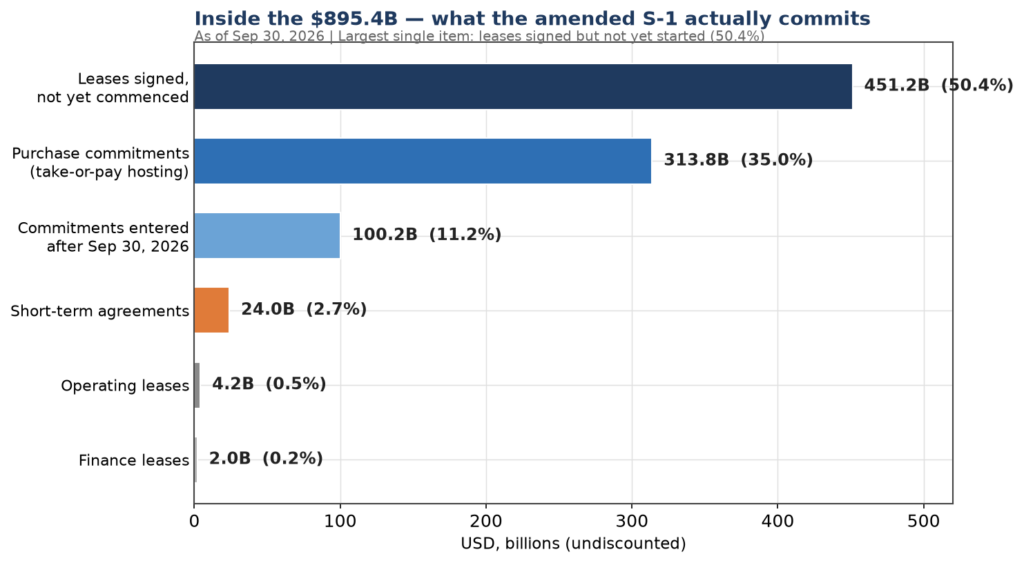
The conventional table — the tidy four-column presentation most readers skim — captures only the obligations with fixed payment schedules that have already commenced. It holds $313.8 billion of purchase commitments (mostly minimum payments under cloud and third-party hosting agreements), $4.2 billion of operating leases and $2.0 billion of finance leases. That subtotal is $320 billion, or about 36% of the aggregate.
The other 64% sits outside the table, and one category dwarfs everything else: $451.2 billion of leases that have been signed but have not yet commenced. These are data-centre and compute-capacity leases for capacity that has not yet been delivered, expected to start between 2026 and 2028 and to run for up to twenty years. Add $100.2 billion of commitments entered into after 30 September, plus another $24 billion of short-term agreements, and you arrive at the $895.4 billion.
Nothing improper is happening here; the disclosure is right there in the text. But a reader who only skims the table will underestimate the number by roughly $575 billion — and will miss that the single largest obligation is rent on data centres that do not yet exist.
The risk is in the shape, not the size
Divide $895.4 billion by the roughly nineteen years the payments span and you land near $47 billion a year. Against annualised revenue of about $68 billion, that isn’t obviously reckless. On average, the arithmetic works.
Then look at the schedule, and the average stops being comforting.
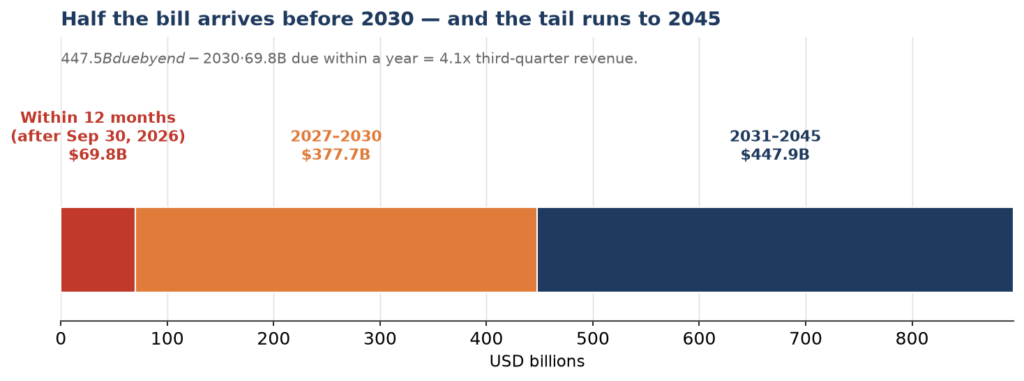
$447.5 billion — half the total — falls due before 31 December 2030. $69.8 billion is due in the twelve months following 30 September 2026, which is 4.1 times the third quarter’s revenue, all of it payable inside a single year. Substantially everything else lands between 2031 and 2045.
Two things follow from that. First, the bill arrives faster than the revenue that has to service it. Second, the tail runs to 2045 — while the accelerators being financed have useful lives measured in a handful of years. You are signing a two-decade payment stream against assets that will be obsolete three or four times over. That mismatch is not a modelling detail; it is the core structural bet.
One quarter of the book has a door in it
Here is the mitigating fact, and it is a big one. Anthropic states that about $213.8 billion of the aggregate — roughly 24% — relates to arrangements that carry either exercisable termination rights or contingent conditions that must be satisfied before they commence, such as the counterparty securing financing, facilities or regulatory approval. If those conditions fail, the arrangement can be terminated. Elsewhere the filing notes remedies for counterparty non-delivery: service credits, timing adjustments, and in some cases the right to walk.
So the honest characterisation is not “$895 billion of inescapable debt.” It is closer to: about $680 billion that behaves like a fixed obligation, and roughly $214 billion that is contingent on someone else’s execution — including, in several structures, on financing partners and data-centre developers delivering on time.
There is, however, a number that runs the other way. Outside the $895.4 billion sits a further $150 billion to $175 billion of compute arrangements that carry no fixed dollar amount, payable only as capacity is delivered. Add those in and the real order book edges past a trillion dollars. The headline figure, enormous as it is, understates the ambition.
Meanwhile, the revenue side of the ledger
The amended filing finally fills in the blanks that the October draft left as placeholders, and the operating numbers are genuinely remarkable.
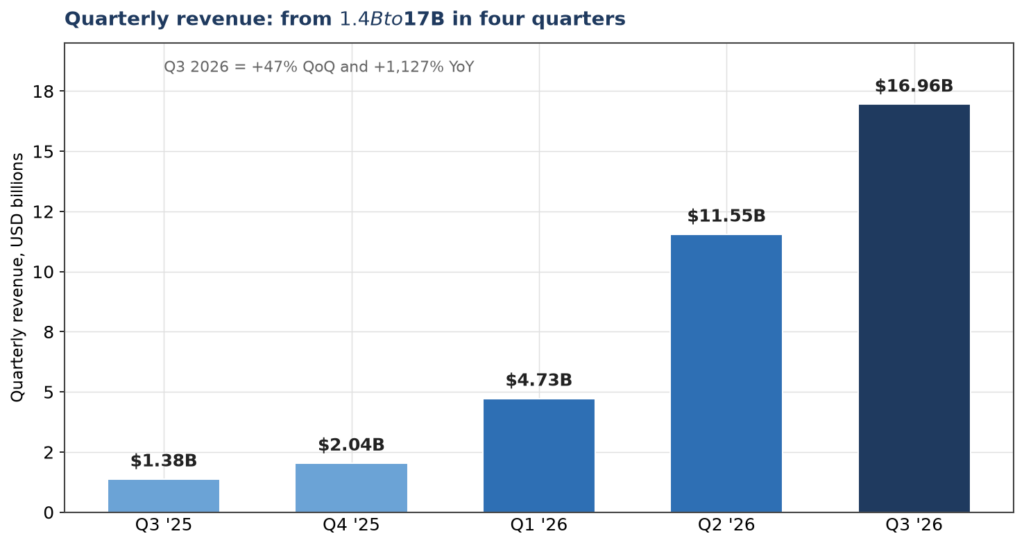
Third-quarter revenue was $16.956 billion, up 47% from $11.555 billion in the second quarter and more than twelvefold from $1.382 billion a year earlier. Nine-month revenue reached $33.242 billion, against $2.545 billion in the same period of 2025. For context, full-year revenue was $41 million in 2023, $386 million in 2024 and $4.6 billion in 2025.
The customer base has depth as well as scale: more than 11,900 accounts billed at least $100,000 over the trailing twelve months, more than 1,900 at $1 million or more, and about 250 at $10 million or more. The $100,000-plus cohort alone produced $26.1 billion of trailing revenue, or 74% of the total — and net revenue retention runs at roughly 900%, meaning existing customers are spending far more than they did a year ago.
Growth of that speed on that base is why the commitment book exists. You cannot sell tokens you have no capacity to serve.
$13.8 billion of contracted revenue against an $895 billion order book
Now the uncomfortable arithmetic.
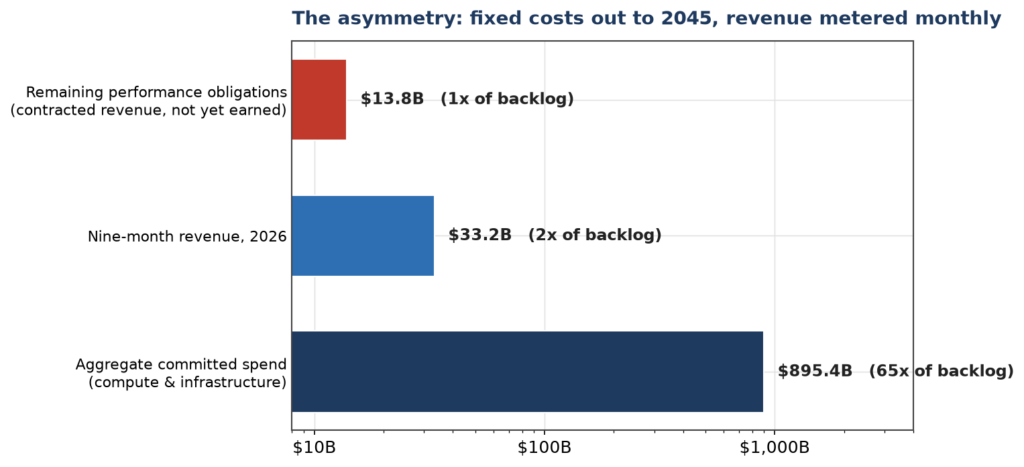
Remaining performance obligations of $13.8 billion cover about 1.5% of the committed spend. Put differently, the purchase book is roughly 27 times nine-month revenue.
That ratio is not a verdict — consumption-based businesses generate most of their revenue from customers who never sign a multi-year contract, and 75% of the $13.8 billion is expected to convert within twelve months anyway. But it does tell you where the asymmetry lives. On the cost side the company has signed for two decades. On the revenue side, the overwhelming majority of income is still metered monthly and cancellable in practice.
When a business pairs long-dated fixed costs with short-dated variable revenue, it is running an operating-leverage trade in both directions. Good quarters look spectacular. Bad ones don’t need to be catastrophic to hurt.
Compute is 58% of revenue, and $5 billion of it is bought at the wrong price
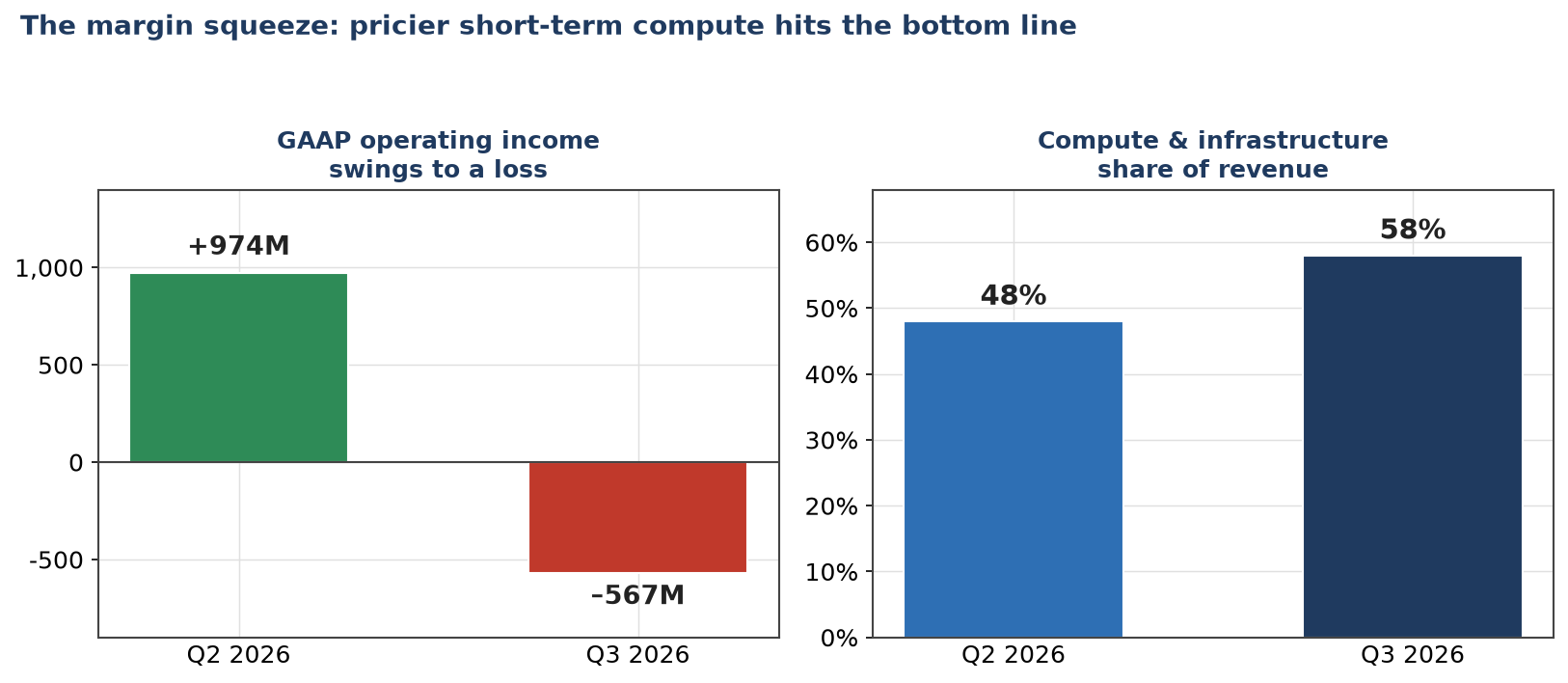
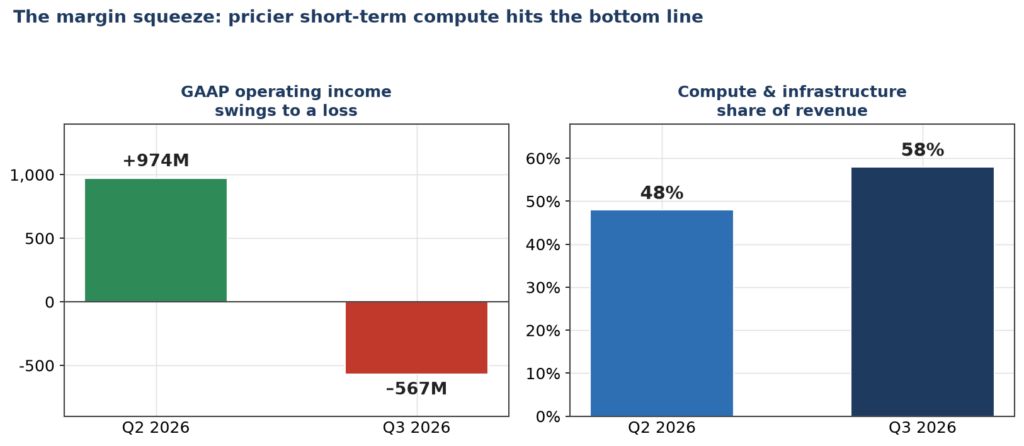
Third-quarter compute and infrastructure expense reached about $9.9 billion, or roughly 58% of revenue. Within that, approximately $5 billion came from short-term capacity that Anthropic itself describes as substantially more expensive than comparable long-term arrangements.
That is the transitional cost of a strategy shift. Historically the company rented compute as a cloud service under fixed-time arrangements. It is now moving to a hybrid model — branded Anthropic Direct — in which it leases accelerators directly and runs them in dedicated facilities operated on its behalf, splitting the commitment to data-centre capacity from the commitment to the chips inside it. The logic is sound: data centres take longer to build but cost less, so secure the shell early and defer the expensive silicon.
The bill for running both models at once shows up in the margin. GAAP operating result swung from $974 million of operating income in the second quarter to a $567 million operating loss in the third. On the company’s adjusted measure — which strips out stock-based compensation and a $2 billion employee donation-matching charge — operating income was $2.463 billion and the adjusted operating margin slipped from 19% to 15%.
The $104 billion loss is mostly accounting, and that matters
The headline net loss for the nine months to September was $104.0 billion, and the third quarter alone lost $23.3 billion. On a GAAP basis that looks like a business detonating.
It isn’t — not in cash terms. More than $94 billion of the nine-month figure comes from non-cash fair-value charges on convertible notes, derivative liabilities and SAFEs. When a private company’s valuation climbs, the conversion rights embedded in its debt become more valuable, and accounting rules require that increase to be booked as a loss. The company got more valuable, so the income statement got worse. Anyone quoting $104 billion without that context is quoting a valuation event as if it were an operating result.
The lines that actually describe the business are the operating result, the compute line, and the cash flow statement — and the cash flow is positive. Everything above them is a story about the cap table.
The counterparties are also shareholders, customers and rivals
Anthropic runs a deliberately multi-chip estate — AWS Trainium, Google TPUs, Nvidia GPUs, AMD GPUs — precisely so no single supplier holds a choke point. That diversification is real. So is the entanglement.
The disclosure shows financing arrangements totalling up to $77 billion with three of its largest counterparties: up to $20 billion from Google, $15 billion from Amazon and $42 billion from Broadcom, each conditional on revenue targets or on the partner delivering capacity. Google’s $20 billion comes with a footnote: it can shrink by as much as $10 billion if Google buys Class N shares — an option of up to $10 billion that it holds alongside the IPO. A further $5 billion comes from AMD, which has committed to purchase Class N common stock tied to delivery and deployment milestones. Several of Anthropic’s largest infrastructure providers are simultaneously investors, commercial partners, customers and potential competitors, and the filing flags the obvious conflict: a provider’s duty to Anthropic can collide with its own AI ambitions.
There is a sharper clause underneath. Certain financing arrangements require Anthropic to enter exclusive or preferential supply commitments with particular chip suppliers for the compute being financed. That is money with a string attached — financing that quietly narrows your future procurement options, potentially locking you to platforms that later prove suboptimal for your workloads.
What the contract says about the industry’s cost curve
Step back and the document stops being about one company.
A $895 billion purchase book is the demand side of the accelerator supply chain made legible. It tells you that a single lab expects to consume compute at a scale measured in hundreds of billions of dollars, that it is willing to pre-commit two decades out to get capacity — Microsoft’s take-or-pay arrangement alone obligates at least $44.9 billion of spending between November 2026 and June 2033, regardless of usage — and that it believes falling price-per-token will be more than offset by volume. That is a bet on inference becoming the dominant workload: agents running for hours, not chatbots answering once.
If that bet is right, the commitment is cheap optionality on a market that dwarfs today’s. If it is wrong — if model progress plateaus, if efficiency gains outrun demand, if customers route around expensive frontier inference — then the industry has built a fixed cost base against elastic demand, and the mismatch propagates outward: to the cloud providers who signed the hosting agreements, to the chip vendors who tooled capacity against those orders, and to the data-centre developers who borrowed against them.
Anthropic says it has underestimated its compute needs before, and that capacity constraints have already delayed product work. That is a credible argument for committing early. It is also the argument every capital-intensive industry makes right before the cycle turns.
Three tests worth running in 2027
Forget the narrative and watch three numbers.
First, does contracted revenue grow faster than the commitment book? If remaining performance obligations climb toward the tens of billions while the $895 billion stays roughly fixed, the company is filling capacity it has already paid for. If the gap widens, it is buying capacity on faith.
Second, does compute fall below half of revenue? Fifty-eight per cent is the transitional number. A path toward the low forties would mean Anthropic Direct is delivering the promised economics. A path that stays flat or rises means the hybrid model is costing more than the cloud model it replaced.
Third, does the short-term, premium-priced slice shrink? That $5 billion of expensive spot capacity is the clearest evidence that the long-term build-out isn’t keeping pace with demand. If it persists through 2027, either the build-out is slipping or demand forecasting is still broken.
What this document is really telling you
Anthropic has not hidden anything. The $895.4 billion is stated plainly, broken down by maturity, qualified by termination rights, and paired with an explicit warning that revenue may not keep up. That level of disclosure is why the filing is worth reading rather than skimming.
But disclosure is not reassurance. What Anthropic has done is convert a strategy into a contract: it has promised to buy an enormous quantity of compute, at prices and on schedules it cannot revisit, to serve a demand it cannot fully see. The revenue growth justifies the ambition. The $13.8 billion of contracted backlog does not yet justify the scale.
Both things are true at once, and the IPO price is where the market gets to vote on which one it believes.