Record-Low Sentiment, Record Ad Spend: The Disconnect Driving the 2026 Holidays
Here’s the story making the rounds: AI stocks crack, households holding them feel poorer, holiday spending softens, brands trim fourth-quarter budgets, and the ad market catches a cold. Neat, plausible, and wrong in its timing.
The chain is real. I’d just argue it is slower, narrower, and much less mechanical than the version above — and that the 2026 numbers say so rather than the other way round. What actually moved ad budgets this autumn wasn’t household wealth. It was a platform’s own monetisation problem.
Let’s walk each link and see where it holds.
Link one: what broke in October was concentration, not the market
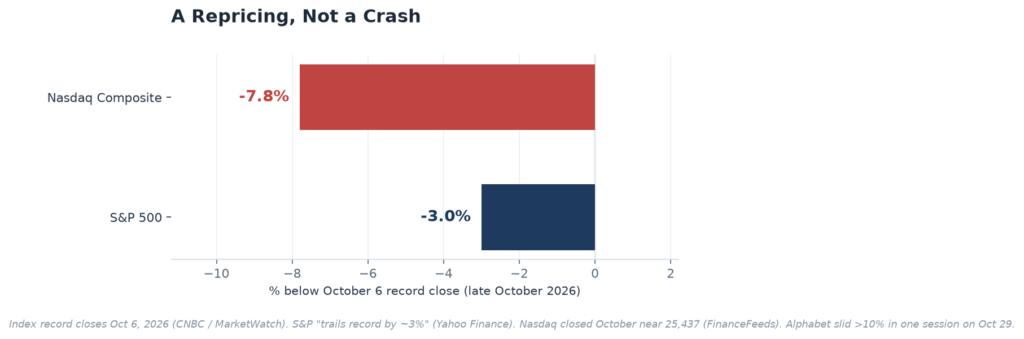
Start with what actually happened. The S&P 500 closed at a record 7,818.93 on 6 October. By the final sessions of the month it was trading roughly 3% below that high — a pullback, not a crash. The Nasdaq Composite, which had also closed at a record that same day (27,599.79), took more of the damage as the month wound down.
And the damage was lopsided. On 29 October, Alphabet slid more than 10% in premarket trading after its third-quarter results fell short of Wall Street’s forecasts, and after executives disclosed that AI Mode queries are monetising at a lower rate than conventional search. One company carried a large share of the pain; the average household’s portfolio barely registered it.
So the first correction to the tidy story: “the AI bubble deflating” and “the stock market falling” are not the same event. The first is a story about a handful of very large, very AI-exposed balance sheets. The second would require a move nobody has seen so far.
Link two: the wealth effect exists, but it is a thin pipe
The wealth effect is a real phenomenon. Households that feel richer do spend more, and the academic literature is not ambiguous about direction, only about magnitude. The magnitude is where the tidy chain breaks, for two reasons.
Ownership is concentrated. Equities are held disproportionately by high-income households — the cohort whose spending is least sensitive to a change in the value of a portfolio, because it is funded by income and not living hand to mouth. A single-digit markdown in an AI-heavy account is a line in a spreadsheet, not a decision about whether the family goes to grandma’s house for Christmas.
Most holiday spending is income-financed, not wealth-financed. Look at the flow data rather than the portfolio data. The personal saving rate was 3.8% in September 2026 — a thin cushion by any historical standard. Over the same month, personal consumption expenditures rose 0.5% in current dollars, but real, inflation-adjusted PCE was essentially flat, because the PCE price index was up 3.6% from a year earlier. Real disposable personal income — the number that actually funds a family’s Christmas — slipped 0.3% on the month.
Consumers are not spending because they feel wealthy. They are spending because wages and prices are both higher, and — the uncomfortable part — because they are saving less. A wealth effect that runs through the top decile cannot explain a saving rate pinned at 3.8% while real disposable income falls. That is a broad-based squeeze, and it argues that households are maintaining consumption by drawing down the buffer, not by banking a bull market.
The mood and the till have come apart
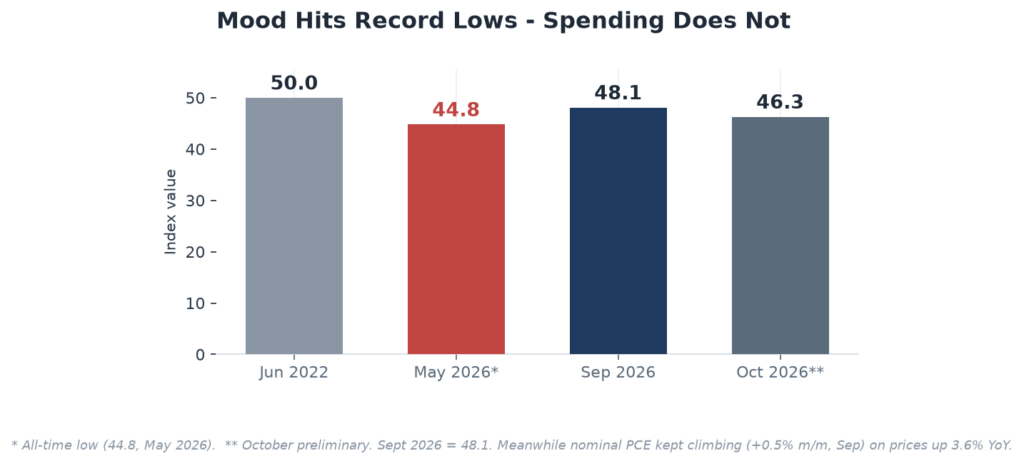
The strongest counter-evidence to the tidy chain is this pairing: the University of Michigan consumer sentiment index read 48.1 in September 2026 — continuing a slide that took it to an all-time low of 44.8 in May and left October’s preliminary print at 46.3, the second-lowest on record. In the same stretch, nominal consumer spending kept climbing on higher prices.
Sentiment at a near-record low, spending at a record high in dollar terms. If mood drove budgets, the fourth quarter would already be cancelled. It isn’t. What we’re watching is the difference between how people feel about the economy and what they do at the checkout — and for the past two years, those two have been running on separate wires.
I’d bet on behaviour over sentiment every time, particularly in a quarter where retailers have trained shoppers to expect discounts.
Link three: dollars up, units flat — the split is distributional
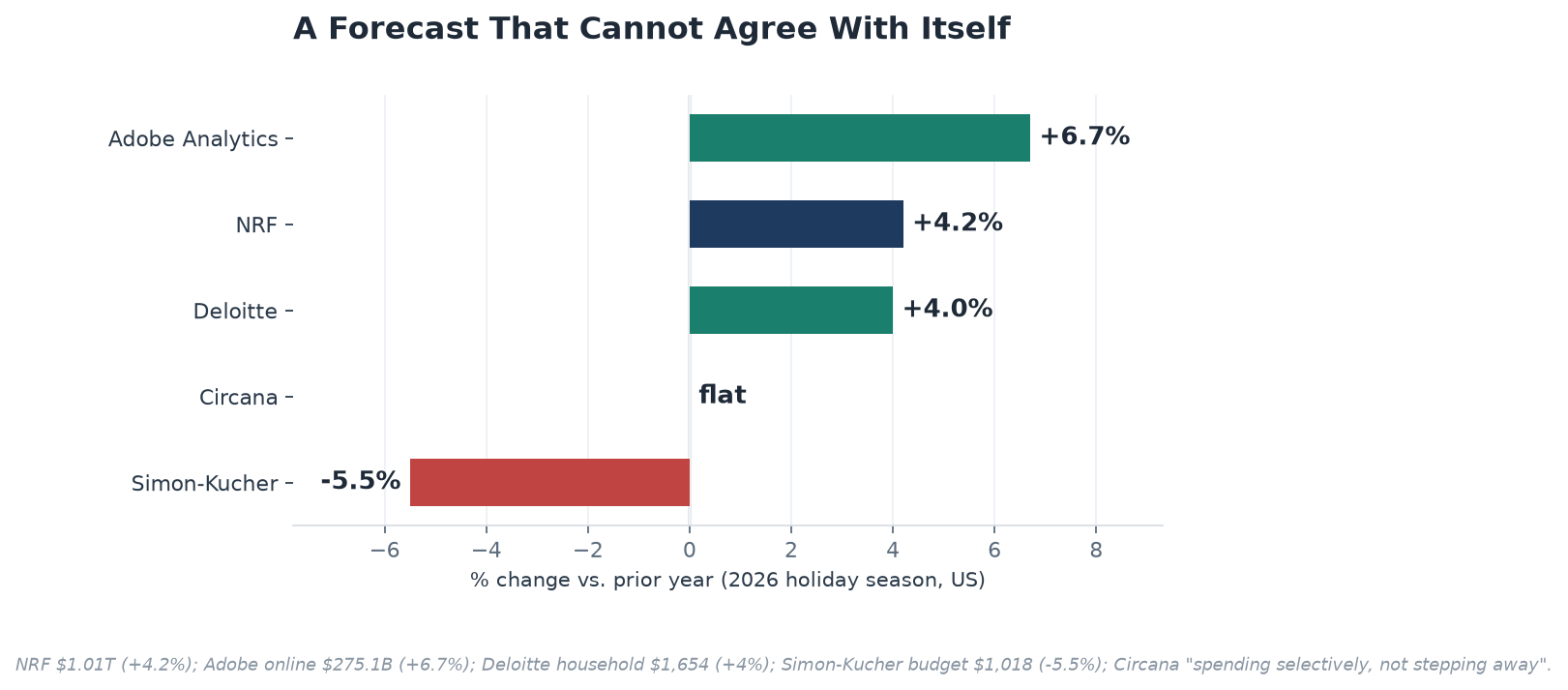
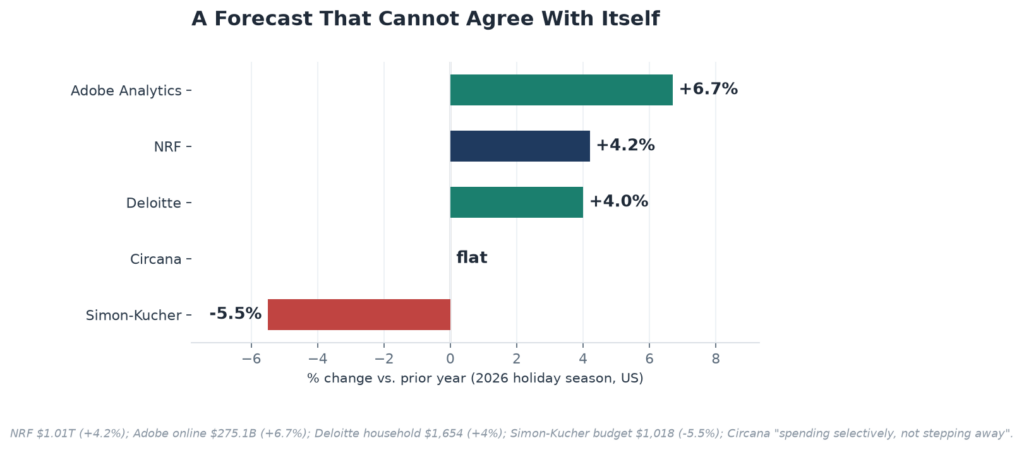
The holiday forecasts don’t agree, and the disagreement is the most informative thing in the dataset.
| Source | 2026 holiday measure | Direction |
|---|---|---|
| National Retail Federation | November–December sales, about $1.01 trillion | +4.2% |
| Adobe Analytics | US online spend, $275.1 billion | +6.7% |
| Deloitte | Average household spend, $1,654 | +4% |
| Circana | Household budgets, spending “selectively, not stepping away” | flat to cautious |
| Simon-Kucher | Budget $1,018, back to 2024 levels | −5.5% |
Read the top three and bottom two together and you get the real picture: aggregate dollars rise, per-household budgets don’t. Inflation supplies a large share of the nominal growth — the PCE price index ran 3.6% year on year — and the average disguises a widening split between households that are fine and households that are stretched. Retailers will book a record quarter and still describe a value-seeking customer, because both are true.
For an advertiser, that means addressable demand is not shrinking. It is moving. Volume migrates to discount events, to value tiers, and to retail media placements closest to the transaction.
Link four: ad budgets are set against nominal sales, so they didn’t blink
Here’s where the tidy chain really fails its audition. If the wealth effect were transmitting, the ad market would be downgrading 2027 right now. It is upgrading.
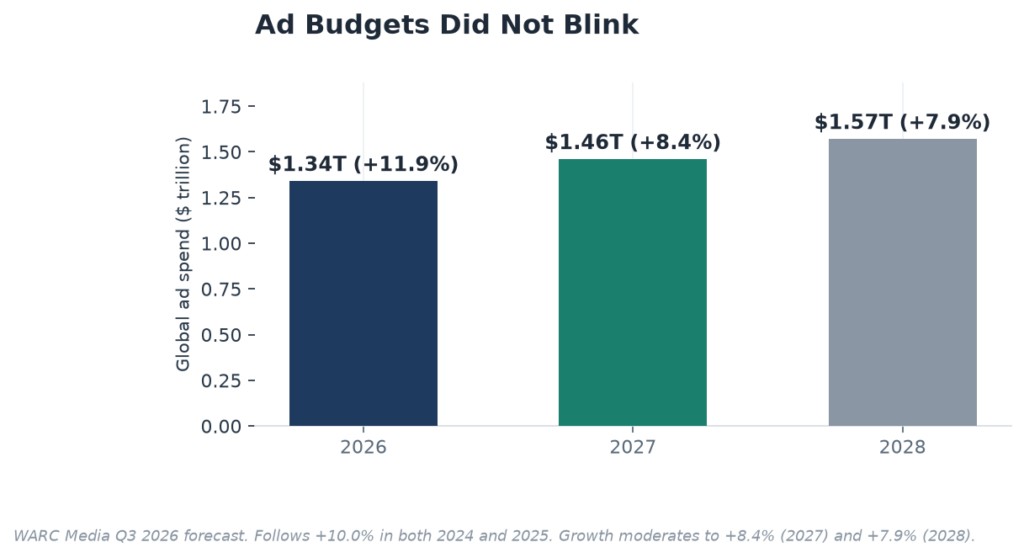
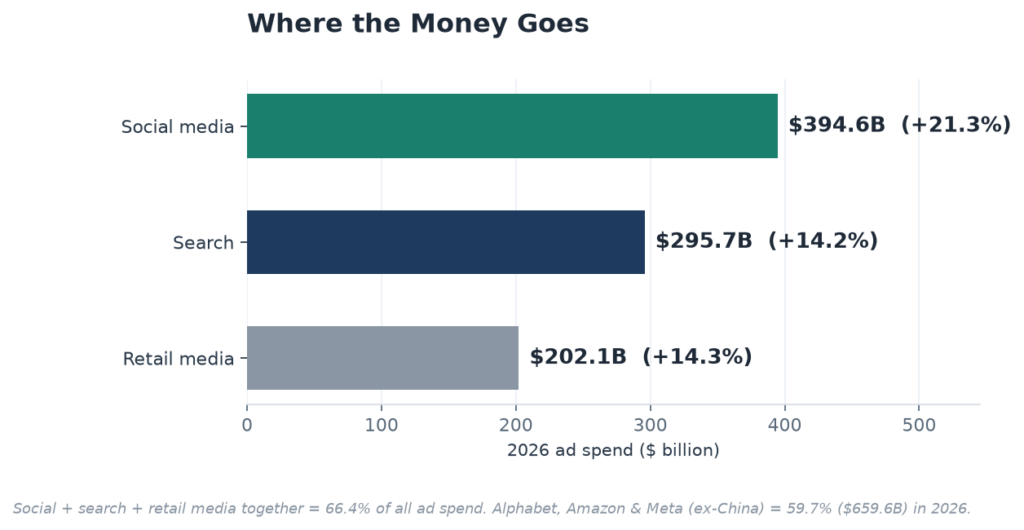
WARC’s third-quarter 2026 forecast puts global ad spend at $1.34 trillion this year, up 11.9% — following consecutive 10% gains in 2024 and 2025 — and projects growth of 8.4% to $1.46 trillion in 2027 and a further 7.9% to $1.57 trillion in 2028. The channels doing the heavy lifting are all performance-adjacent: social media grows 21.3% to $394.6 billion, the fastest channel, on course to pass half a trillion by 2028; search rises 14.2% to $295.7 billion; and retail media climbs 14.3% to $202.1 billion. Those three together take 66.4% of all ad spend. The market also keeps concentrating: Alphabet, Amazon and Meta, excluding China, capture 59.7% of global spend — about $659.6 billion — and are projected to reach 61.5% by 2028.
Why is the ad market so calm while the equity market is jittery? Three mechanical reasons.
Budgets follow nominal revenue, not portfolios. Marketers plan against the sales forecast, and the sales forecast is plus 4% to plus 6% in dollars. Cutting media spend into rising nominal demand is how you lose share, not how you protect margin.
Fourth-quarter money is already committed. Holiday media is bought in September and October. A selloff in late October cannot retroactively unbuy it. Whatever damage the wealth effect does, it shows up in January planning, not December delivery.
Performance spend is gated by return, not by mood. Always-on bidding expands while marginal return holds. Brand and upper-funnel budgets are the shock absorber — the part of the plan with the weakest attribution and the least immediate defence.
The signal that actually mattered: AI eating its own ad model
If you want the real transmission mechanism from the AI trade to advertising, it isn’t the wealth effect at all. It’s Alphabet’s own disclosure.
Search revenue growth decelerated to its slowest pace in five quarters, while query volume reported its fastest growth in five years — a strange pairing that only makes sense when the new answer format carries fewer or cheaper ad units per session. Executives were explicit on the call: adoption of AI Mode is strong, but those queries are being monetised more slowly than traditional search. Alphabet’s shares slid more than 10% in premarket, and the market repriced the whole “AI expands the ad business” assumption in an afternoon.
There’s a second, quieter signal buried in the same report. Capital expenditure hit $51.4 billion for the quarter and $132 billion year to date, while free cash flow turned further negative. The company is spending ahead of the revenue that AI is supposed to generate — the exact tension a Deutsche Bank note captured after the print, when it asked whether the payoffs would come “fast enough” to justify the spending.
This is the important asymmetry: AI is not reducing advertiser demand. It is reducing the platform’s ability to convert that demand into revenue at the old rate. Demand is intact; the pipe got narrower.
For buyers, the second-order effects are predictable and worth planning for. Ad inventory inside AI answers will be scarcer than the inventory it replaced, so pricing per impression drifts up. Retail media and creator inventory absorb the overflow. And every platform now has an incentive to prove its AI formats convert, which means more measurement access and more performance guarantees on offer than a year ago.
Where budgets would actually get cut if this drags on
Suppose the selloff isn’t a one-month event. What breaks first?
Not performance budgets. Those are tied to sales, and sales are up. What breaks is discretionary brand investment: long-lead sponsorships, brand lifts with no last-click proof, experimental formats, and the agency retainers supporting them. Procurement also gets braver about fees and scope, because a falling share price makes every line item look negotiable.
The exposure is uneven across categories, too. Advertisers whose demand is genuinely wealth-elastic — high-ticket electronics, premium travel, luxury — will feel a portfolio effect before anyone else, because their customer is the one holding the AI stock. Mass retail, everyday CPG and value-tier apparel sit much further from the blast radius.
Five indicators I’d watch through the first quarter
- Platform bookings commentary in January earnings calls. If AI-heavy platforms guide cautious on 2027 ad revenue while the WARC-type forecasts still say plus 8–9%, the gap will tell you who blinked.
- Nominal versus real retail sales. Nominal growth is not the same as volume growth. If the deflator does the work — as it did in September — budgets get cut quietly in the second half.
- The saving rate. At 3.8%, there is very little buffer left. Another point of decline turns “resilient consumer” into “leveraged consumer” in one quarter.
- Buying-conditions sub-indices, not the headline sentiment number. Intentions to buy large household goods are where wealth effects actually register.
- Compute capex guidance versus ad revenue growth at the same companies. When capex outruns ad growth for two consecutive quarters — Alphabet just spent $51.4 billion in one — the market stops treating AI as an ad-business multiplier. That is when budgets, not just share prices, get repriced.
What I’d actually conclude
The chain from AI valuations to holiday ad budgets exists, but it runs through a narrow pipe and with a long lag. In the fourth quarter of 2026, the link that carried the current was not household wealth — it was platform monetisation. Advertisers kept spending because nominal sales are rising and their commitments were already made. Households kept spending because they have income, not because they feel richer.
Two conclusions worth acting on. First, don’t hedge media plans against an index. Hedge them against your own category’s elasticity to the cohort that owns the assets in question. Second, watch the platforms’ unit economics rather than their share prices: what an ad slot inside an AI answer costs, and whether it converts, will move your budget long before a household’s portfolio does.
FAQ
Does a stock market fall actually reduce holiday spending?
Only at the margin, and mostly for households that hold equities and were planning large discretionary purchases. Holiday spending is overwhelmingly income-financed, so the effect is small in aggregate and concentrated in high-ticket categories. The saving rate matters more than the index.
Why are holiday sales forecasts so far apart — from −5.5% to +6.7%?
Because they measure different things. The optimistic numbers are typically nominal totals or online-only figures; the cautious ones are per-household budgets. Add inflation — the PCE price index was up 3.6% year on year — plus a widening income split, and both sets of numbers can be right at the same time.
If the AI selloff continues, when do ad budgets actually fall?
Not this quarter — the money is committed. Expect the first real signal in January planning cycles, and expect it in brand and experimental budgets first. Performance spend will hold as long as it returns more than it costs.
Is AI good or bad for total ad spend?
Net positive for demand, ambiguous for monetisation. AI creates more inventory and better targeting, which supports spend. But AI answer formats carry fewer ad units per session, which compresses platform revenue per query — and platforms are pouring record capex into closing that gap. That is why they are racing to place ads inside AI surfaces.
What should a marketer do differently in the next two quarters?
Shift the hedge from macro to category. Stress-test your plan against a cohort effect — what happens if the top-income, equity-holding customer pulls back 10% — rather than against an index forecast. And secure measurement terms now, while platforms are eager to prove AI formats perform.