Your Brand Is Missing From the Answer: Audit AI Visibility Before You Optimize It
Run an AI Visibility Audit on Your Brand This Week (20 Prompts, One Spreadsheet)
Before you optimize for AI, find out whether AI knows you exist. It takes about forty minutes.
Why AI visibility is a leading indicator, not a vanity metric
Everyone wants to know where their brand shows up in ChatGPT. Fair question. But “I saw us mentioned once” is not a metric, and a screenshot is not a strategy.
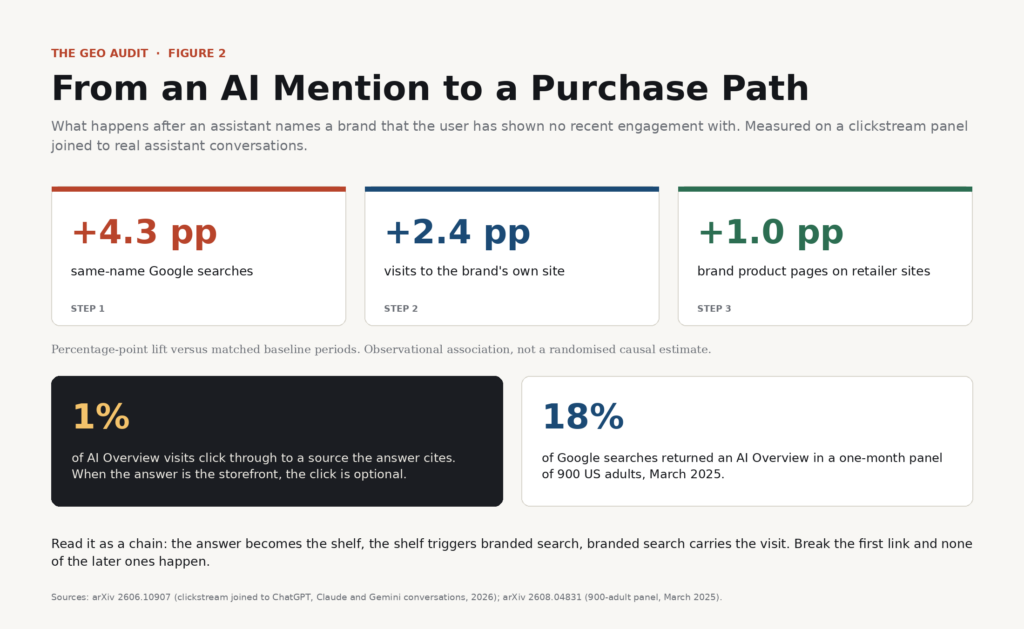
Here is the mechanism that makes this worth measuring at all. In 2026, a research team took clickstream data from real people and matched it against the same people’s conversations in ChatGPT, Claude, and Gemini. When an assistant recommended a brand to someone who had shown no recent engagement with it, that person’s same-name Google searches rose by 4.3 percentage points. Visits to the brand’s own site rose 2.4 points. Brand-specific product pages on retailer sites rose 1.0 point. None of that behavior was attributable to an ad, because no ad ran.
Now set that against another number. A second 2026 study, tracking 900 US adults across a month of browsing, found that visits to AI Overviews produced a click on one of the cited sources about 1% of the time. Roughly 18% of Google searches returned an AI Overview at all.
Read those two findings together and the shape of the problem becomes obvious. The answer is the shelf. The click is optional. If you are not on the shelf, you do not lose a ranking — you lose the entire chain that starts with a name and ends with a branded visit.
One more number, for scale. On Alphabet’s Q3 2026 earnings call, Google said its Gemini models had helped advertisers generate more than 1.5 billion campaign assets in the quarter, up more than sevenfold year on year. Supply is now machine-scale. Attention inside an answer is not. That asymmetry is the whole reason a citation is worth auditing.
The Reddit finding, and what it really tells you
You may have seen the claim that Reddit is the internet’s verification layer. It is a sharper observation than most, but the evidence underneath it is narrower than the headlines suggest.
Using a quirk in Google’s content policy — some Reddit communities can be cited in AI Overviews, others cannot — a 2026 difference-in-differences study found that AI Overviews raised daily comments in eligible communities by 12.0% and the number of commenting users by 12.4%. The effect showed up in experience-based discussion: opinions, advice, personal experience. Not facts. And when Google’s conversational AI Mode arrived, it largely erased that gain in experiential content.
What that tells you: when the buyer’s question is “is this actually any good,” the machine reaches for lived experience, not for your feature page. Your spec sheet does not answer it. That is a content problem, and it is measurable.
One caveat, because it matters. That study measures engagement on Reddit. It does not prove Reddit is the most-cited domain across AI answers, and no dataset I could verify supports that claim cleanly. Treat it as a directional signal about what kind of evidence these systems prefer.
What this audit measures — and what it refuses to
The audit answers four questions and only four:
- Are you named when a buyer asks?
- When you are named, is the description accurate?
- Who gets named instead of you?
- Which sources are doing the persuading?
It does not measure revenue, traffic, or ranking. It will not tell you your ROI. It also will not produce a stable number you can put in a board deck without a caveat — answers change between runs, and pretending otherwise is how audits lose credibility. So we design around the variance instead of wishing it away.
The four prompt classes
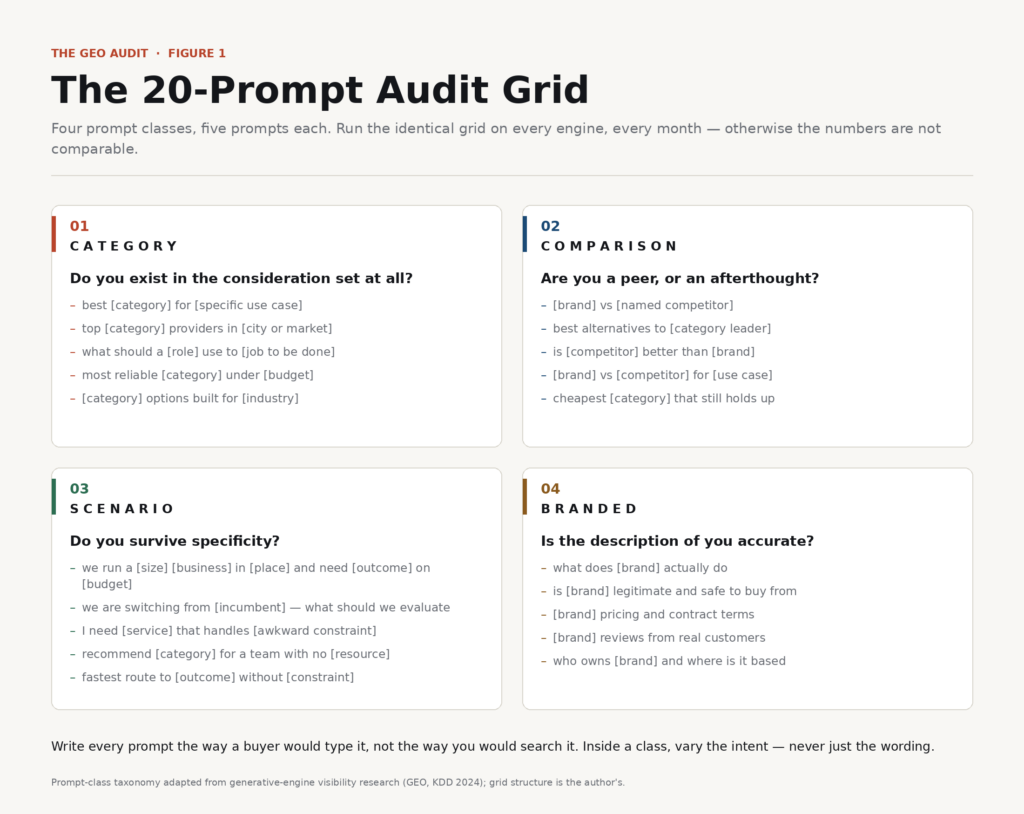
Everything hangs on getting the prompts right. Twenty prompts, four classes, five each. Same grid every month, or your numbers mean nothing.
Category. Five ways a stranger asks who the options are. This is the existence test: are you in the consideration set before anyone has a preference?
Comparison. Five ways a buyer checks you against an incumbent. Are you a peer, or a footnote in someone else’s answer?
Scenario. Five fully specified briefs — size, place, budget, constraint. This is where weak positioning dies. A vague brand disappears the moment the question gets specific.
Branded. Five questions about you by name. This is the accuracy test: what does the machine believe about your category, your price, your ownership, your legitimacy?
The full 20-prompt grid, with the exact stems, is laid out in the workbook that comes with this piece. Fill in the brackets with your category, market, and competitors. Do not rewrite the intent.
The scoring sheet: five fields, one row per answer
For every answer you record, capture five things:
- Mentioned — yes or no. A description without your name counts as a no.
- Position — first brand named, second, third. Blank if absent.
- Cited sources — the domains the answer actually links to.
- Tone — positive, neutral, negative. Judge the sentence, not your feelings about it.
- Competitors co-named — everyone else in the same answer.
That last field is the one people skip, and the one that pays. Co-occurrence tells you whether you are being considered alongside the right set, or quietly grouped with the cheap option you spent three years distancing yourself from.
Derive four metrics from the sheet: mention rate, mean position, source mix, description accuracy.
Run it across four engines, not one
ChatGPT, Perplexity, Google AI Mode, and whichever engine owns your home market — Doubao or DeepSeek in China, Yandex in Russia, Seznam in the Czech Republic.
Then follow four rules that keep the data honest:
- Fresh, logged-out session for every run. No memory, no personalization.
- Log the model version and the date on every row. A silent model update will ruin a comparison you thought was clean.
- Run the prompts in the same order each time.
- Never merge runs from different weeks into one baseline.
Run every prompt five times. Here is the math.
This is the part most audits get wrong, and the good news is that someone has now done the arithmetic.
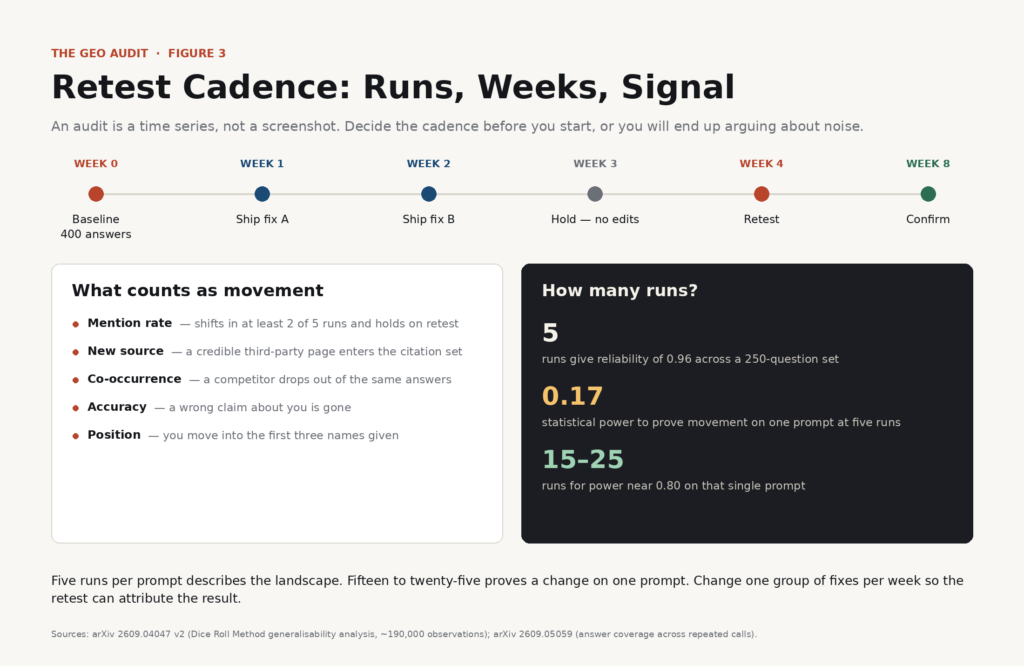
A 2026 protocol study — the Dice Roll Method — pulled together five brand-auditing studies covering roughly 190,000 observations and more than 270 brands. Its conclusion is uncomfortable for anyone selling a one-shot audit: there is no fixed number of runs that works for every question. Across a 250-question set, five runs were enough to reach a generalizability coefficient of 0.96. For five phrasings of a single question on one model, the same five runs produced 0.27 — which is to say, nothing.
The practical translation:
- Five runs per prompt describes the landscape. Use it for your baseline and your description.
- Fifteen to twenty-five runs give you statistical power near 0.80 to prove that one specific prompt moved.
So twenty prompts, four engines, five runs: 400 answers. That is your baseline, and it is one afternoon of copying and pasting, not a quarter of work.
What a citation gap looks like
Three failures show up again and again, and they need different fixes.
The absence gap. You are not named at all. This is an entity problem, not a content-volume problem.
The description gap. You are named and described wrongly — wrong category, stale pricing, the wrong parent company. This is the most urgent of the three, because a confident wrong answer is worse than silence.
The source gap. The answer is right, but it is assembled from directories, listicles, and competitors’ comparison pages instead of anything you control or earned. Muck Rack’s May 2026 analysis of more than 25 million cited links across ChatGPT, Claude, and Gemini found that 27% of citations came from journalism, spread across more than 20,000 outlets. Under a deliberately broad definition that also counts government, academic, and encyclopedic sources, 84% of citations were earned rather than paid or advertorial; paid and advertorial content accounted for 0.3%. The definition is doing a lot of work inside that 84% — read it as “not your own marketing site,” not as “PR has won.”
The four-week retest cadence
Week 0 is the baseline. Then ship one group of fixes per week, hold in week 3, retest in week 4, confirm in week 8. Change one thing at a time or you will never know which change did the work.
Movement counts when a metric shifts in at least two of five runs and holds on the retest. Five things qualify: mention rate, a new credible source entering the citation set, a competitor dropping out of the same answers, a wrong claim disappearing, or a move into the first three names.
Three fixes that move the needle fastest
1. Make the entity legible. One name, one category, one sentence that defines what you do — repeated identically on your site, your profiles, your press boilerplate, and your directory listings. Machines resolve entities. Ambiguity reads as absence.
2. Close the description gap before you write anything new. If the answer gets your price, your location, or your ownership wrong, no amount of new content will fix it. Go to the pages that are currently being cited and correct them at the source.
3. Build the third-party record, and make your own pages quotable. The original GEO research — 10,000 queries, nine source categories, published at KDD 2024 — found that quoting sources, citing them, and adding statistics produced the largest visibility gains, up to about 40% in their benchmark and 37% in a live deployment. Structure helps too: a 2026 follow-up measured a 17.3% improvement in citation rate from structural changes alone. In plain terms, write sentences that survive being lifted out of context.
Three things not to do
Do not panic-publish fifty pages of AI-written filler. Do not chase “ranking number one in ChatGPT” — there is no such thing. Do not present a single screenshot as evidence in a meeting. And do not buy citations; it works right up until it is detected, and then it becomes the story.
The forty-minute version
If all you have is forty minutes, run four prompts — one from each class — on three engines, once each. Twelve answers. It is a diagnostic, not a measurement, and it will tell you whether you have an existence problem or an accuracy problem. Most brands discover it is the second, which is the cheaper of the two to fix and the more embarrassing to have missed.