Why Shein Cut Its European Ad Spend — and Why Every Cross-Border Seller Is Next
One Tax Change Just Rewrote the Unit Economics of Selling Into Europe
Standfirst: The model was never about the product. It was about a tax exemption and a shipping rate. One of them is gone.
For fifteen years the cheapest way to sell into Europe wasn’t a supply chain. It was a loophole with a customs code attached. You flew a €6 dress out of Guangzhou, cleared it into Rotterdam duty-free because the parcel was worth under €150, and priced it at €19.90 against a €39.90 high-street equivalent. Nobody in that chain was optimising for brand. They were optimising for a threshold.
The threshold is gone. And the interesting part isn’t the tax. It’s what happens to your acquisition maths when €5 of unavoidable cost lands on a €19.90 order.
What actually changed: three dates, one direction
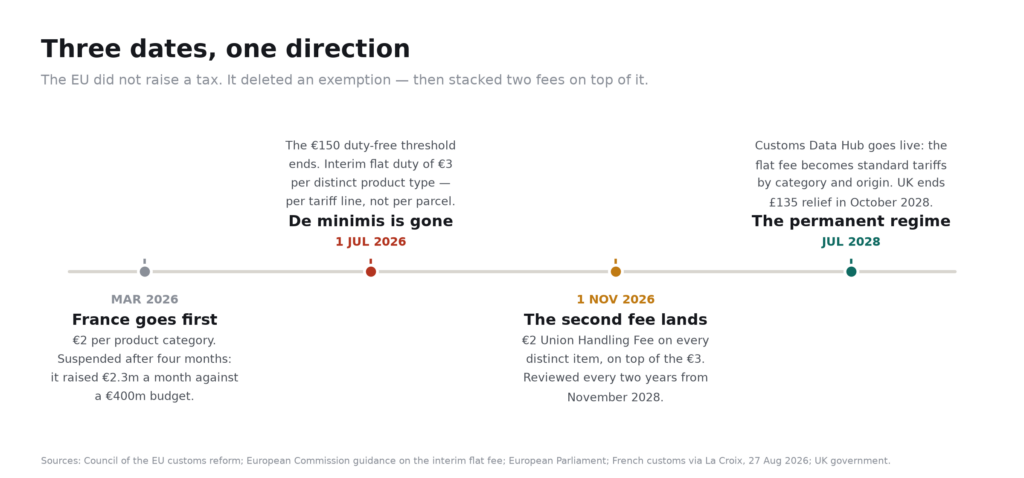
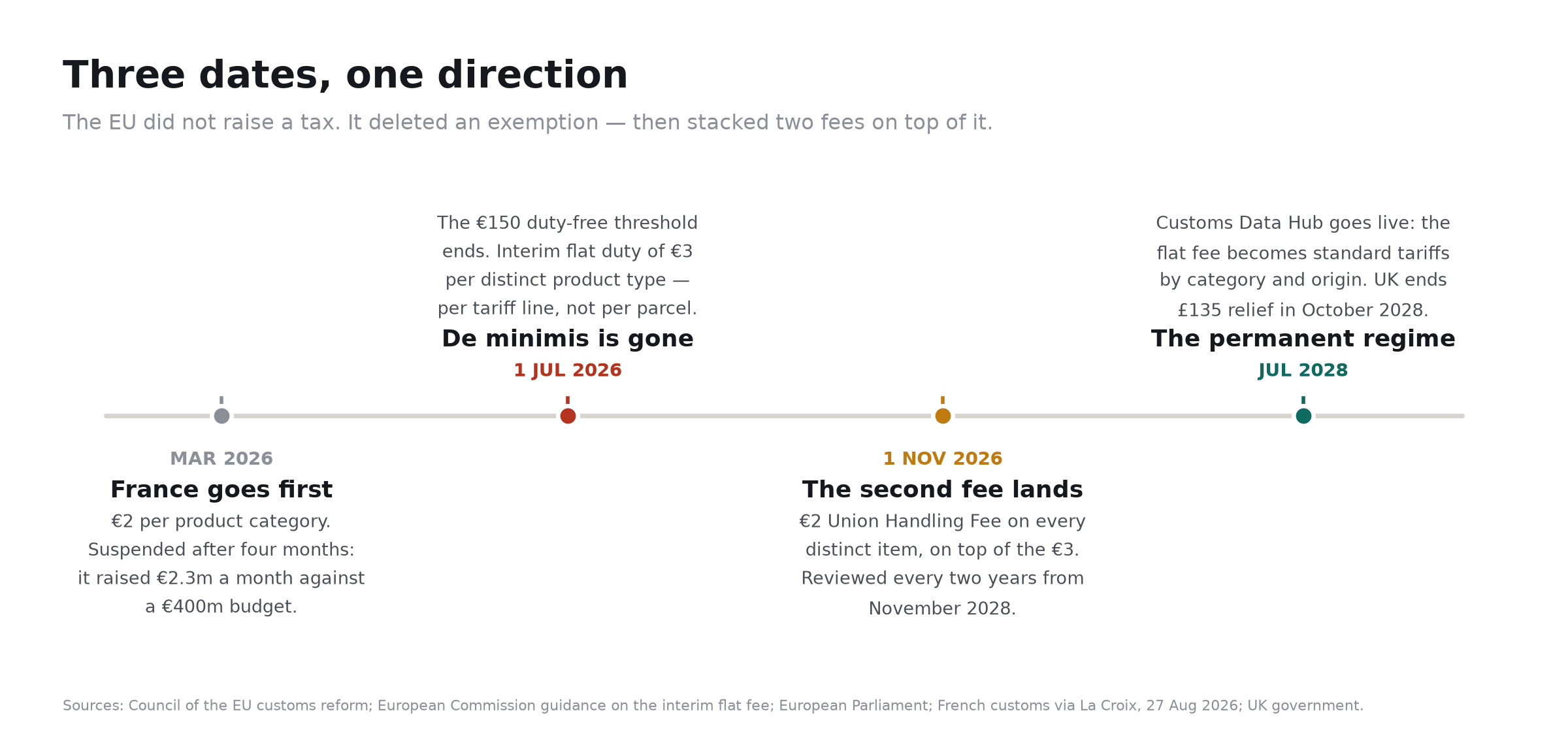
Since 1 July 2026, parcels below €150 no longer clear EU customs duty-free. In place of the exemption sits an interim flat duty of €3 per distinct product type — per tariff line, not per parcel and not per unit. Five identical T-shirts in one bag trigger one €3 charge. A dress, a phone case and a hair clip in the same bag trigger three: €9.
On 1 November 2026 a second charge landed on top: the Union Handling Fee, €2 per distinct item. A €10 order containing a pen, a notebook and a key ring now carries €15 of charges before VAT is even mentioned. For scale, 5.9 billion low-value parcels entered the EU in 2025 — more than four times the 2022 figure — and roughly 93% of them came from China.
Two details matter more than the headline numbers. First, this is explicitly temporary: the flat fee runs until the EU’s Customs Data Hub is operational, expected July 2028, at which point standard tariffs by product category and origin take over. For cheap apparel and accessories that is a harsher regime, not a softer one. Second, the charges are levied on the declaration, which makes basket shape a pricing decision. Bundling three cheap categories into one parcel used to be a conversion trick. Now it is a multiplier.
There is an instructive failure in the run-up. France introduced its own €2 levy in March 2026, then suspended it four months later, having raised about €2.3 million a month against a €400 million budget: platforms simply routed parcels into neighbouring countries and trucked them across the border. A national tax was porous. A bloc-wide one, enforced at the point of declaration, is not.
The €5 wedge
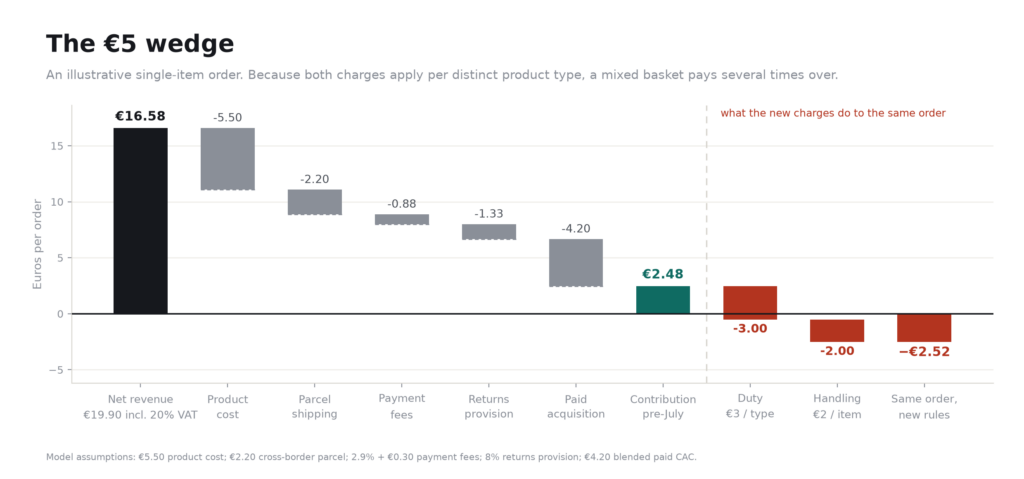
Here is the order that built this category, costed properly: one item, €19.90, VAT-inclusive.
Strip the 20% VAT and you hold €16.58 of net revenue. Product cost €5.50. Cross-border parcel €2.20. Payment fees €0.88. An 8% returns provision, €1.33. Blended paid acquisition €4.20. Contribution: €2.48, or 15% of net revenue — thin enough that it only survived at industrial volume.
Now apply the new charges. €3 duty. €2 handling. €5 on an order that generated €2.48.
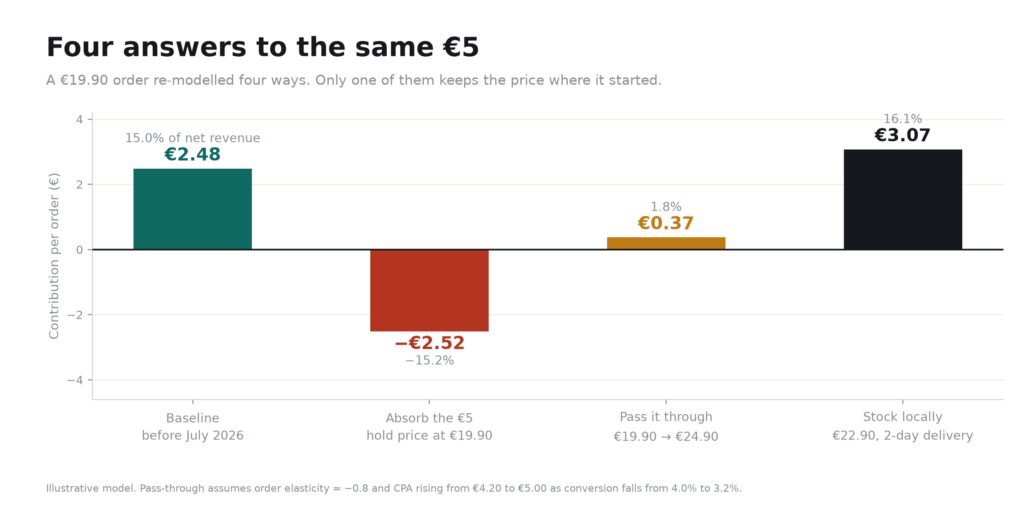
At this point the arithmetic stops being arithmetic and becomes a strategy question. Absorb the €5 and the same order contributes −€2.52: every sale becomes a small, deliberate loss funded from the balance sheet. Pass it through, price to €24.90, and you keep 37 cents — assuming conversion only falls from 4.0% to 3.2%. That assumption is doing an enormous amount of work, and it is where most operators under-model.
The transmission chain, link by link
Most teams treat duty as a cost line. It isn’t. It is a five-link chain, and the damage hides in the last link.
Duty → landed cost. €5 on a €5.50 product is a 90% increase in landed cost; on €16.58 of net revenue it is 30%. Either way, the “cheap” half of your price advantage is gone.
Landed cost → price. You have two options and both hurt: hold price and lose money, or raise price and lose the position. There is no third door marked “negotiate with customs”.
Price → conversion. Cheap-goods demand is price-elastic. If €19.90 was the product — and in this category it largely was — a 25% price rise does not buy a 25% revenue rise. It buys fewer orders at a worse mix.
Conversion → CAC. This is the link almost nobody models. Your cost per acquisition is your cost per click divided by your conversion rate. Nothing happened to the auction; your CPC is unchanged. But a 25% price rise that costs you a fifth of your conversion rate raises CAC by a quarter, without a single competitor bidding more — at a €0.16 CPC, dropping from 4.0% to 3.2% lifts CPA from €4.00 to €5.00. Then comes the compound: the merchant who absorbs duty keeps conversion but bleeds contribution, while the merchant who passes it through protects contribution and watches CPA climb. Both end up with a worse blended ratio, and both respond the same way — by bidding less.
CAC → demand for attention. Scale that across a category and you get a measurable fall in auction demand. Which is what the platforms reported.
The number that matters: €27.80
To restore that €2.48 at the new cost base, the price has to reach about €27.80 — roughly 40% above where it started. At €27.80 you are no longer a €19.90 impulse purchase. You are in a consideration set with Zara, with mid-market DTC, with retailers who own a brand, a returns experience and a delivery promise you cannot match from 9,000 km away.
That is the whole story in one number. The exemption was never subsidising your product. It was subsidising your price point. Remove it, and the price point leaves with it.
The sell side has already said it out loud
Shein’s Q2 2026 results are the cleanest natural experiment available. Revenue $11.08 billion, up 0.9%. European revenue down 13.9%. The company’s own explanation: it raised prices and cut online advertising ahead of the EU duty. Adjusted net margin fell to 2.1% from 6.2%; fulfilment costs rose 18.1%.
Read that sequence again, because it is the transmission chain in a public filing: duty anticipated, prices raised, demand softened, ad spend cut. And the strategic response was not to defend the price point. It was to climb — management has said it will push into higher-priced brands and is weighing acquisitions to lift average selling prices. When the low-price model’s most efficient operator abandons the low-price position, that is not a tactic. It is a verdict.
Google named the other end of the pipe
Alphabet’s Q3 2026 call gave the demand side a label. Search ad revenue grew 12% to $63.4 billion, YouTube ads 9%, total Google ad revenue 10.6% — against 15% for search and 15% for YouTube a year earlier. Management pointed to currency headwinds and to “pressures in specific categories, like retail in Asia-Pacific”.
Be careful with causation: no executive said the EU parcel duty did this. But the direction is unambiguous. Asia-Pacific retail advertisers are the cohort most exposed to European landed-cost changes, and they slowed first. Meanwhile AI Mode monetises below classic search, so recovering query volume does not buy back the revenue.
Why this compounds instead of stabilising
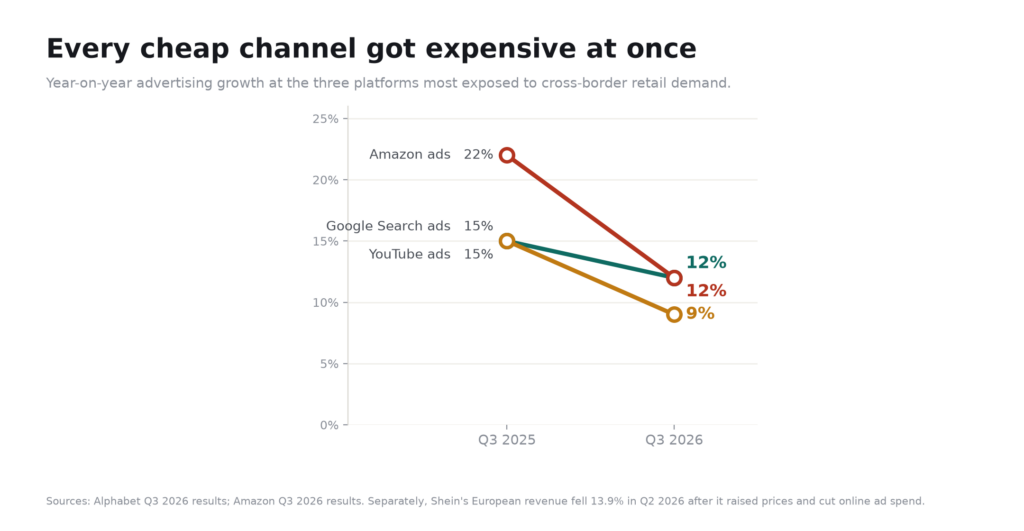
Look at advertising growth across the platforms most exposed to cross-border retail demand, in the same quarter. Google Search: 15% to 12%. YouTube: 15% to 9%. Amazon ads: 22% to 12%, with Q4 guided to high teens — a slowdown against a 22% comparison.
Three auctions, three mechanisms, one direction. Amazon attributes part of its deceleration to the timing of Prime Day. Google attributes its own to currency and to how AI Mode monetises. Both explanations are true and both miss the point: the marginal advertiser willing to pay the highest CPM for a €19.90 cross-border order can no longer afford that CPM. When the most aggressive bidder leaves an auction, everyone else’s prices soften and then volumes follow.
Reddit is the purest illustration. Revenue up 53% in Q3 — healthy on the surface — but search referral traffic from Google fell materially and Q4 guidance came in below consensus. The free half of the funnel, the part everyone treated as a constant, is now a variable.
The volume didn’t vanish. The route did
French customs reported that low-value parcel imports into the EU fell 30% to 40% in the two months after 1 July. That is not 30–40% less demand. It is 30–40% fewer parcels, which is a different statement: goods increasingly arrive as bulk consignments, cleared once, then fulfilled from inside the bloc. Shein is expanding warehouse capacity in Poland. That is where the volume went — and it is why the ad spend went with it, because bulk import does not need a parcel-level acquisition funnel.
Three responses, honestly ranked
1. Raise price and build a brand. The only response that restores margin instead of relocating it. It also demands something to be premium about — design, fit, delivery, returns, a reason to pay €27.80. Most catalogues engineered for €19.90 don’t have one, which is why this option is open to fewer operators than claim it.
2. Stock locally and treat duty as a one-off. On the same model at €22.90 with two-day delivery, contribution recovers to about €3.07 — better than the pre-July baseline. It is not free: you now carry inventory risk, markdown exposure and working capital, and you can only stock what you can forecast. For most of these catalogues that is the head of the range, perhaps a fifth of SKUs. The long tail — the exact thing that made the assortment feel infinite — cannot be warehoused. Local stock fixes the unit economics and caps the catalogue.
3. Move the map. Gulf, Latin America, Southeast Asia, and the UK until October 2028. Cheap to say, expensive to execute: you are rebuilding a demand engine in markets with different payment rails, different return norms, lower CPMs and lower AOVs. And every competitor reads the same spreadsheet on the same day, which compresses the advantage inside two quarters.
Recalculate your CAC in twenty minutes
- Net revenue = gross price ÷ (1 + VAT rate).
- Charges per order = (€3 + €2) × number of distinct product types in the basket. Types, not units.
- New contribution = net revenue − COGS − freight − charges − payment fees − returns provision − CAC.
- Breakeven price = (target contribution + fixed costs) ÷ [(1 ÷ (1 + VAT)) − payment rate − returns rate × (1 ÷ (1 + VAT))].
- New CPA = CPC ÷ new conversion rate. Run it at −10%, −20% and −30% conversion.
- The only number that counts = contribution × orders. A higher contribution per order at half the orders is not a win.
Then run step 2 on a three-item basket. That is where it gets uncomfortable: €15 of charges on a €24 basket is 62% of the price before you have paid for the goods.
What to watch in the next 30 to 90 days
- Black Friday pricing. Whether the big cross-border players absorb the fee to defend volume or let prices drift. Their choice sets your ceiling.
- EU auction CPMs in Q1. If Asia-Pacific retail demand stays soft, cheap reach returns for everyone else — a short, exploitable window.
- Shein’s Q3 print in November. The first quarter with both charges fully live. Watch European revenue and ad spend together, not separately.
- The 2028 tariff schedule. When category-level rates are published, some product lines will discover that the interim €3 was the good old days.
Bottom line
The exemption was never a discount on your costs. It was the foundation of a price architecture, and price architecture sets acquisition economics, and acquisition economics decides how much you can bid for attention. Pull one out and the other three move.
You have two viable futures. One is a smaller catalogue, stocked nearer the customer, priced 40% higher, sold to people who know your name. The other is a different map. What you don’t have is the 2024 model on a 2026 cost base — and no amount of creative testing buys that back.