Your Buyer Asks an AI Now: Reading China’s 546 Million-User Signal Before It Reaches Your Market
China’s AI Apps Crossed 546 Million Monthly Users. The Slide in Your Deck Is Out of Date.
Every quarter, somebody walks into a boardroom with a China slide that is a year and a half out of date. This quarter that slide is wrong by roughly a hundred million people.
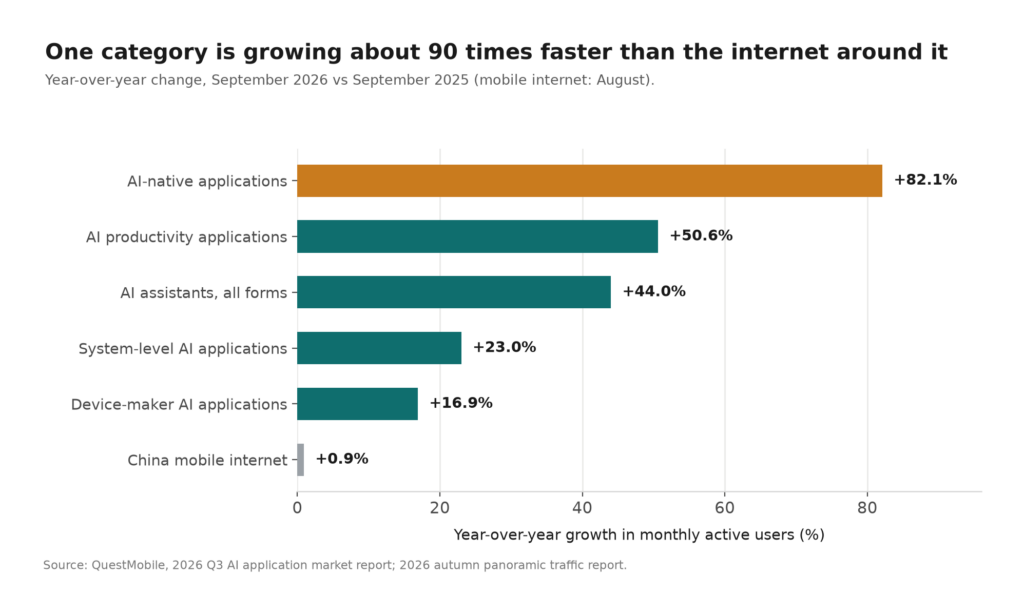
As of September 2026, China’s AI-native apps reached 546 million monthly active users, up 82.1 percent year over year, according to QuestMobile’s third-quarter AI application market report published on 20 October 2026. The 446 million figure still circulating through Western marketing decks is not a fabrication. It is a photograph of an earlier moment. When a category grows 82 percent in twelve months, a number from six months ago is no longer conservative. It is simply wrong.
The size of the number is the least interesting part. The shape of the behaviour underneath it is where the marketing implications live.
The Numbers, Stated Plainly
| Measure | Reading | As of | Source type |
|---|---|---|---|
| AI-native apps, monthly active users | 546 million | Sep 2026 | Third-party measurement |
| AI-native apps, year-over-year growth | +82.1% | Sep 2026 | Third-party measurement |
| AI assistants, all form factors | 1.157 billion | Sep 2026 | Third-party measurement |
| Device-maker AI applications | 783 million | Sep 2026 | Third-party measurement |
| System-level AI applications | 592 million | Sep 2026 | Third-party measurement |
| AI productivity applications | 142 million | Sep 2026 | Third-party measurement |
| China mobile internet, monthly active users | 1.278 billion | Aug 2026 | Third-party measurement |
| Generative AI users, all products | 700 million-plus | H1 2026 | Official statistics |
The four AI categories are separate measures. QuestMobile does not define them as mutually exclusive, so they should not be added together.
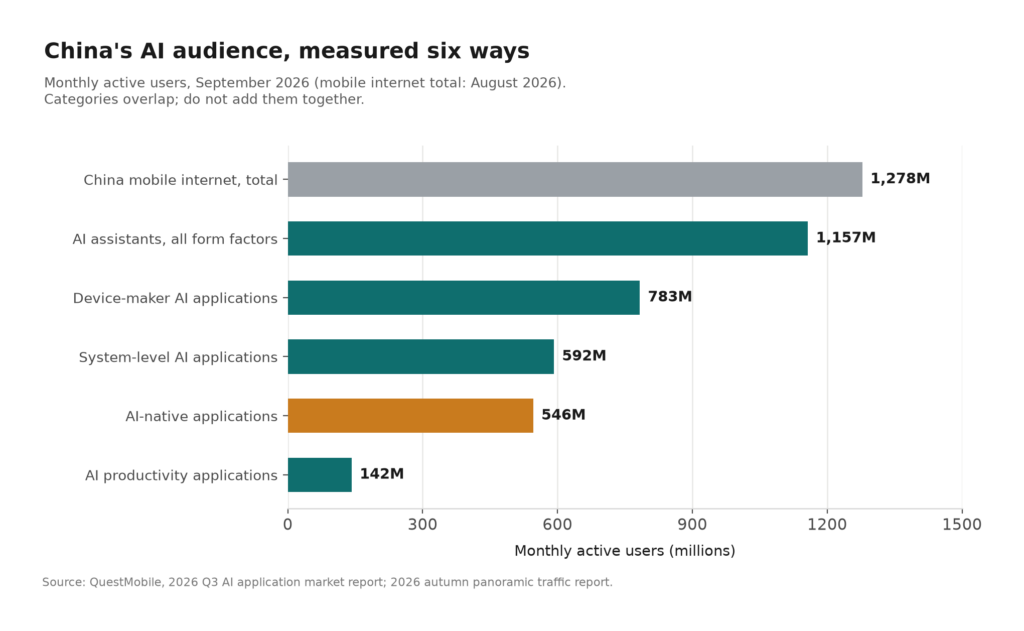
Measured against that 1.278 billion mobile internet base, 546 million comes to 42.7 percent. That is arithmetic, not a penetration rate, and the two reports do not establish that their counting units are directly comparable. It is still enough to retire the old claim of “one in three”. Two in five is the better working number, and the distance between those two fractions is the distance between a niche channel and a mainstream one.
Size Is the Less Interesting Number
Eighty-two percent against 0.9 percent. Two numbers describing the same country in the same year.
China’s mobile internet base is mature. Nothing grows 82 percent in a market that is adding under one percent a year by finding new people. It grows by taking time away from something else, which is exactly what the next set of numbers shows.
Three Institutions, Three Totals, One Argument
Ask three reputable organisations how many people in China use AI and you get answers that differ by hundreds of millions. None of them is lying. Definitions are doing the work, and if you quote the wrong one in a client meeting, someone will catch you.
The China Internet Network Information Center, the state-backed body that produces the country’s official internet statistics, counts 700 million-plus generative AI users as of the first half of 2026 and puts the penetration rate above 50 percent. Its release note does not say what that rate is measured against. If set beside the 1.125 billion internet users the centre recorded for December 2025, 700 million works out to roughly six in ten.
QuestMobile’s 546 million counts something much narrower: standalone AI applications with their own icon on a home screen.
The 1.157 billion assistant figure is the loosest of the three. It aggregates every form the assistant takes, from native app to device-maker integration to plug-in within another product. Useful for arguing that AI has become infrastructure. Useless for media planning.
Here is the working rule. Buying media against an app? Use 546 million. Sizing a habit? Use 700 million. Wanting the biggest defensible number for a keynote? Use 1.157 billion, and say out loud what it includes.
What Actually Sits Inside Those 546 Million
The demographic read is more useful than the headline. Users born in the 1980s, 1990s and 2000s form the core, with the deepest engagement concentrated among the youngest cohort. Older users arrived later and mostly through content rather than tools, meaning they met AI as a topic before they met it as a product.
The gender split has flattened across the four usage segments QuestMobile tracks. Among heavy users, women now index slightly above men, which was not true a year ago.
Geography matters too. Heavy usage skews toward tier-one and tier-two cities, while the audience that merely consumes AI-related content spreads into tier-three cities and below. That split has a commercial consequence. The people who use AI daily are the same people with the strongest stated willingness to spend online. Heavy users are not simply the most engaged segment. They are the most valuable one.
One more behavioural detail worth carrying into any plan. Roughly one in five heavy users runs five or more AI apps in parallel. No single super-app has swallowed the category, and users still switch tools by task.
Eighty-Five Sessions a Month Is a Habit, Not a Trial
In August 2026, the average AI-native app user opened one 85.1 times, up 67.1 percent year over year. Time spent per user reached 173.5 minutes in the third quarter. The session figure above is the August reading.
Put those two figures side by side and something specific appears. Chinese users are not experimenting. They are checking in, several times a day, the way people check a messaging app.
That rhythm is what turns a technology story into an advertising story. Trial usage produces novelty metrics. Repeated usage produces inventory, intent signals and a place to put a brand.
There is a caveat, and it deserves to be stated rather than buried. Per-user session counts in the third quarter fell back from their second-quarter peak to an average of 86.6 sessions. QuestMobile reads the decline as the retreat of agent-style products and a natural sorting of the user base rather than as churn. Time spent per user did not fall. A reasonable person could read the same data as the first sign of a ceiling. Both readings are defensible, and which one you believe should change how aggressively you build.
Search Did Not Die. It Was Absorbed.
The cleanest evidence of behaviour change is not the AI number. It is the thing AI is eating.
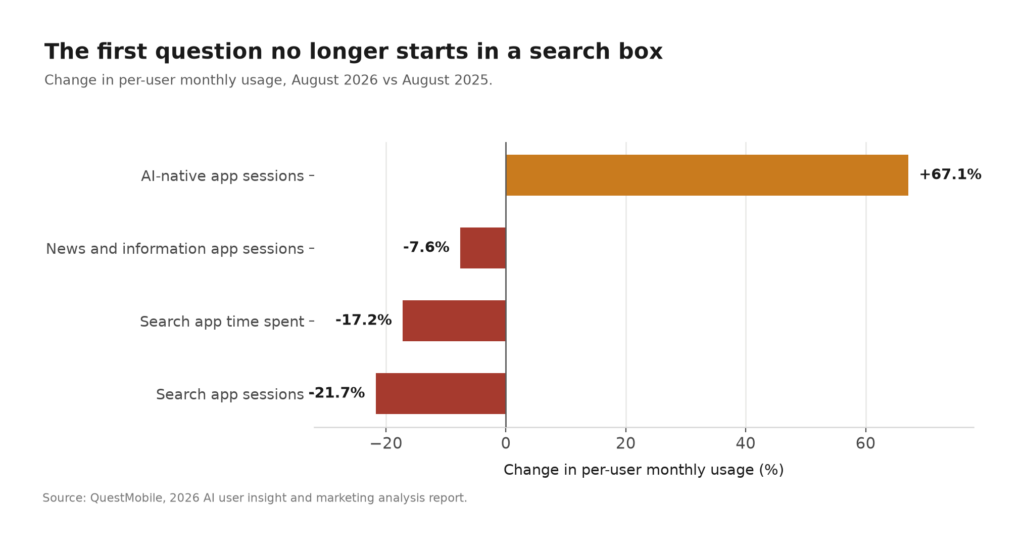
Search apps lost 21.7 percent of their per-user session frequency and 17.2 percent of their per-user time between August 2025 and August 2026. General news and information apps lost 7.6 percent of session frequency over the same window. These are the two products that historically owned the moment when a purchase question forms.
What replaced them is a conversation box that answers instead of listing.
For marketers, the practical consequence is uncomfortable but simple. A search result gives you an impression, a click and a measurable session. An AI answer gives you a mention, or nothing at all. Traffic that used to arrive with a referrer header now arrives as a sentence you are not in.
Three Apps Hold Most of the Attention
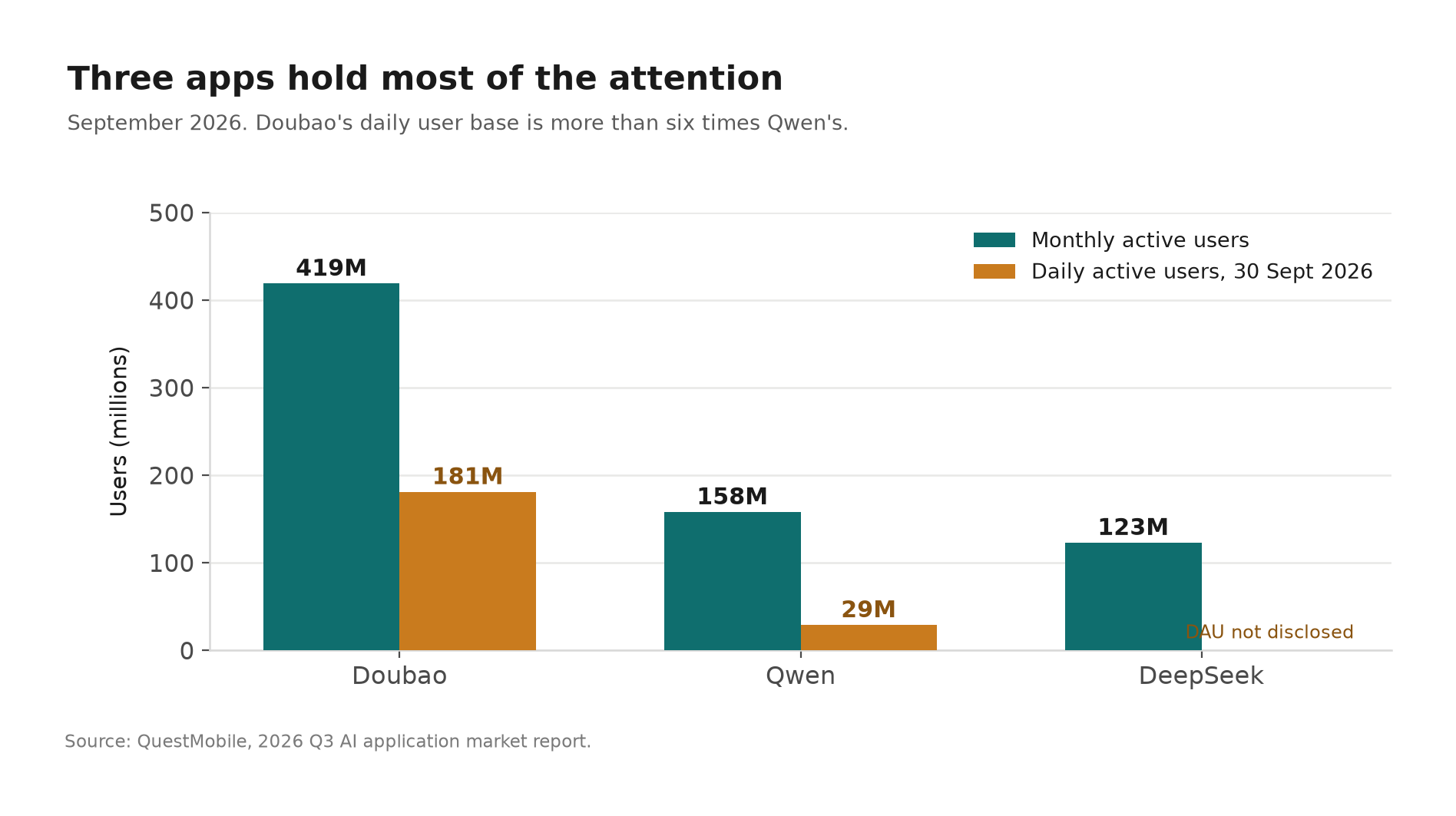
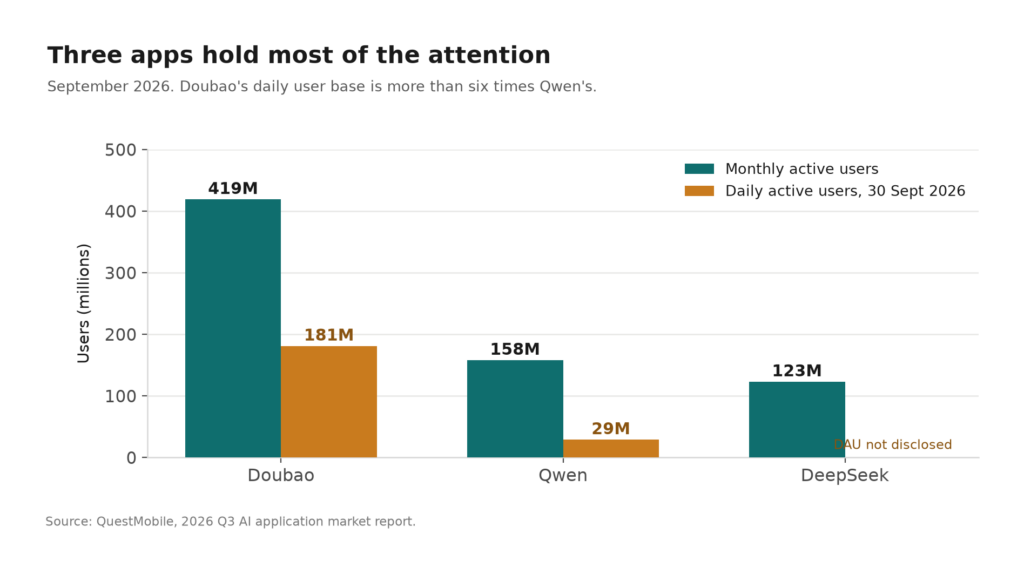
The market has stratified. In September 2026, Doubao reached 419 million monthly active users, Qwen 158 million and DeepSeek 123 million. Doubao alone carried 181 million daily active users at the end of September, against 29 million for Qwen.
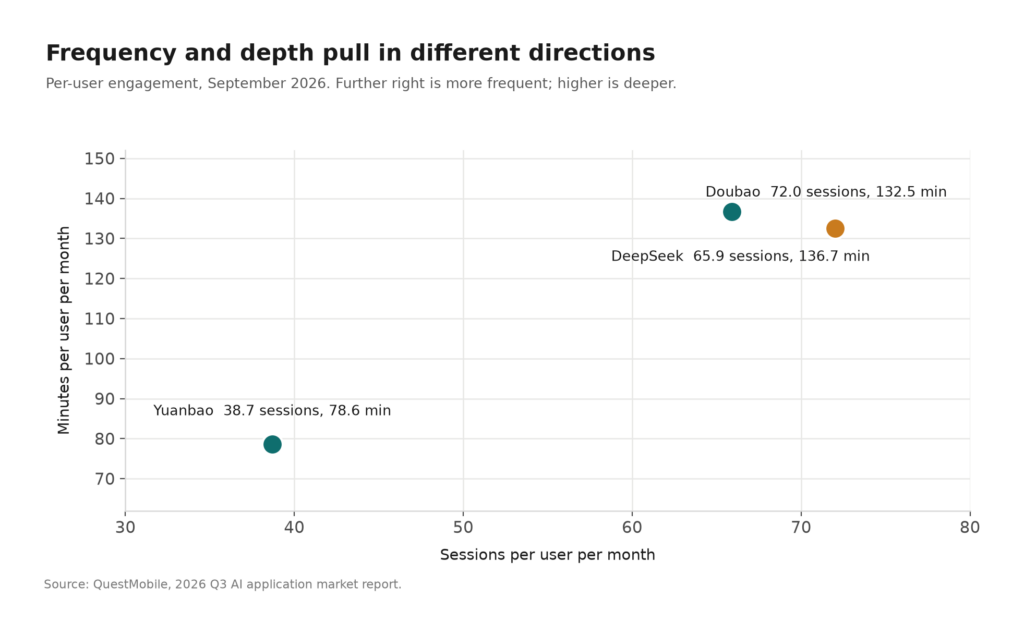
The engagement profiles differ in ways that matter for creative strategy. Doubao users open the app 72 times a month and stay for 132.5 minutes. DeepSeek users open it slightly less often, 65.9 times, but stay for longer, at 136.7 minutes. One behaves like a utility you check constantly. The other behaves like a workbench you sit at. A message built for a thirty-second check-in will fail on a workbench, and the reverse is also true.
Citation Is the New Distribution
The mechanism behind all of this deserves a precise statement, because it is the part most marketing teams still model incorrectly.
AI answers are produced in two stages: retrieve, then generate. The retrieval step decides which facts are even available to be stated. Whatever the model fails to retrieve, it cannot cite. Whatever it cites, it effectively endorses.
QuestMobile tested this directly in a high-consideration purchase category, running 28 standardised intent questions across six AI platforms between June and August 2026. The findings were blunt. The most stable source in the study was cited in 78.0 to 95.6 percent of tested questions, depending on the platform, which sounds dominant until you notice that roughly a fifth of the questions did not cite it at all. Below that top tier, stability collapsed. Among mid-ranked sources, cross-platform volatility ran from 62.8 percent to 200.5 percent depending on the buying stage. In that category, AI-mediated reach accounted for more than half of total reach for the leading specialist publishers.
Two conclusions follow. First, citation is a distribution channel with its own ranking logic, and it does not reward what a search engine rewards. Second, being cited is not a content-marketing byproduct. It is a media buy you are not currently invoicing.
The Real Divergence With the West Is on the Consumer Side
Western teams tend to read China’s AI numbers as a technology story. They are better read as a consumer-behaviour story.
Stanford’s 2026 AI Index puts generative AI at 53 percent population adoption within three years, faster than either the personal computer or the internet managed. That is a different measure from the 88 percent organisational adoption the same report records, and the two should not be quoted as one figure. Yet on the population measure, the United States sits at 28.3 percent and ranks twenty-fourth, behind Singapore at 61 percent and the United Arab Emirates at 64 percent.
Those survey instruments differ, so treat the exact gap with caution. The direction is hard to argue with. On the enterprise side, Western firms are adopting fast. On the consumer side, Chinese users are simply further along the habit curve, and consumer habits are what media money follows.
Capital has not stopped arriving either. CNNIC put AI-related financing at about 250.1 billion yuan in the first half of 2026, already 182 percent of the whole of 2025.
What This Changes About Budget
Three shifts are defensible on the evidence.
Discovery moves from ranking to retrieval. If a large share of category questions are answered inside a chat window, the briefing document stops being a brief about ranking for keywords and becomes one about being the source the retrieval step trusts on those intents.
Measurement has a hole in it. AI referrals frequently arrive without a clean referrer, get bucketed into direct, and disappear from attribution reports built for a click-based web. A model that credits only observable clicks will systematically undervalue the channel that is growing fastest.
Content gets an answer shape. Pages built to be skimmed by a human lose to passages built to be quoted by a model: one claim per paragraph, a number with a date attached, a definition that survives being lifted out of context.
Four Moves Worth Making This Quarter
Run a prompt audit, not a keyword audit. Write the twenty questions your buyer actually asks before purchase, in the buyer’s own phrasing, and check what six AI platforms say about your category. Look for two things: whether you appear at all, and which competitor appears in your place.
Fix the source layer before the page layer. Models cite documents, databases and reference pages. If your facts live only inside campaign landing pages, the retrieval step has nothing to hold onto.
Instrument the invisible. Add a self-reported “how did you hear about us” field and a branded-search lift check. Neither is precise. Both beat pretending the traffic does not exist.
Decide what you want to be. There are two positions in an AI-mediated category: the source that gets cited, and the footnote that gets summarised by somebody else. Most brands drift into the second by default.
Where This Argument Breaks
Three things would seriously weaken the case above, and they are worth watching rather than dismissing.
If monthly sessions keep sliding for two more quarters while time spent also falls, the habit thesis is in trouble, and the third-quarter dip will have been the signal, not the noise. If paid conversion among heavy users stalls while free usage keeps climbing, the commercial case weakens regardless of the user count. And if system-level AI keeps growing faster than standalone apps, the 546 million figure becomes a shrinking slice of a bigger pie. Device-maker AI applications grew 16.9 percent, about a fifth of the native-app growth rate, which suggests the fight over default placement has barely started.
The Short Version
China’s AI-native apps passed 546 million monthly users in September 2026, growing 82.1 percent year over year against 0.9 percent for the mobile internet as a whole. Usage is habitual rather than experimental, concentrated in three apps, and has already taken measurable frequency away from search and news. The commercial consequence is that AI answers now sit between a buyer and a brand, and the brands inside those answers got there because a retrieval system trusted their sources. That is a distribution problem, and it is being solved with content and structured data, not with media weight alone.
FAQ
Is 546 million the same as China’s generative AI user base?
No. The 546 million figure counts standalone AI apps only. CNNIC’s 700 million-plus includes anyone who used a generative feature inside any product, from a map to a shopping app. The app number is smaller because it excludes embedded usage, not because fewer people use AI.
Why did AI app usage grow 82 percent while the whole mobile internet grew under 1 percent?
AI apps took time from other apps rather than adding internet users. China’s mobile internet base is mature at 1.278 billion, growing 0.9 percent a year. Nearly all of the category’s growth came from reallocating existing attention, with search and news apps losing session frequency in the same period.
Are Chinese users actually abandoning search engines?
Not abandoning. Reordering. Search apps lost roughly a fifth of their per-user frequency and time in a single year while remaining enormous in absolute terms. The change is about which product gets the first question, not about which products still exist.
I do not sell in China. Why should this matter to me?
Two reasons. Consumer AI habits have historically reached Western markets within twelve to twenty-four months of appearing in China’s mobile ecosystem, so this reads as a preview rather than a foreign curiosity. And the retrieval-and-citation mechanism described here already operates on every major AI platform. The behaviour is local. The mechanism is not.
What is the most misleading number in this dataset?
The 1.157 billion assistant total, precisely because it is the most impressive. It aggregates native apps, device-maker integrations and plug-ins, so it measures the reach of a capability rather than the audience of a product. Quoted alone, it implies a market far more consolidated than it is.