The Economics Behind the Rationed Slot: Why a Brand Day Is a Queue, Not a Campaign
Every marketing format in China gets copied within a quarter. Brand days did not. The reason is not creative difficulty. It is arithmetic that the platforms control on purpose.
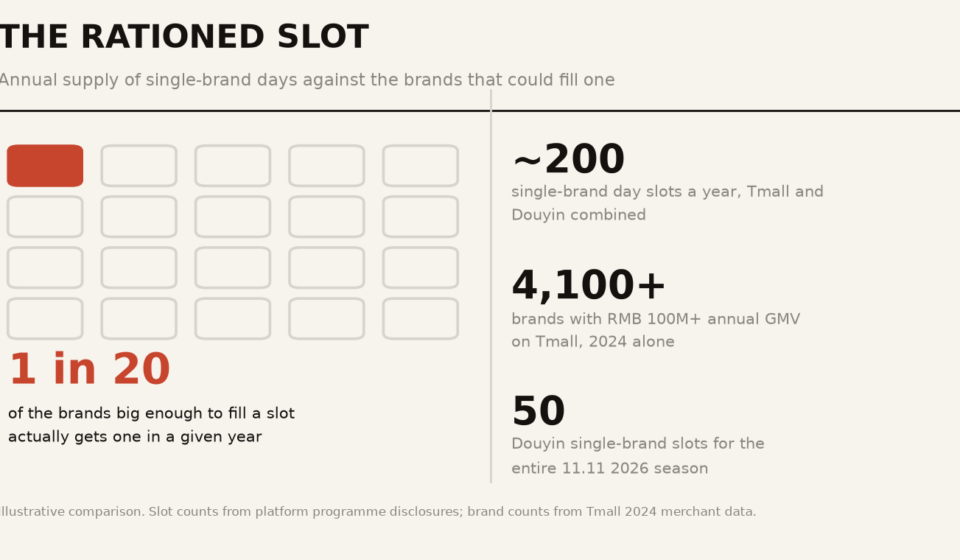
Count the supply first. Tmall runs one single-brand day at a time, a schedule of perhaps ten to twenty a month, or 120 to 240 in a year. Douyin’s Mall program worked with more than eight hundred brands across its first five years, roughly 160 a year. Put them together and the country’s entire single-brand-day capacity is a few hundred slots annually.
Now count the demand. Tmall alone had more than 4,100 brands selling over 100 million yuan on the platform in 2024. Roughly one in twenty of them could plausibly fill a day. That is before counting the thousands more who would like to try.
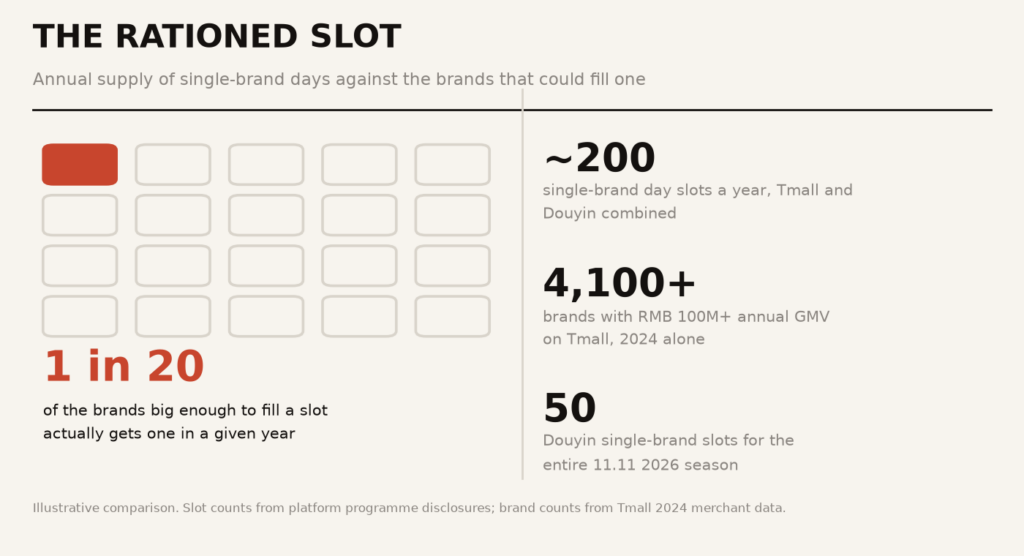
That gap is the product.
A brand day’s value comes from two things multiplied: the platform’s traffic, and the absence of competitors inside that traffic. Scaling supply changes the second term. Sell ten thousand brand days a year and each one becomes a category page. The format would not be diluted gradually. It would collapse on contact.
So the platforms ration, and the ration explains almost everything odd about how these days are sold.
The currency is not money. When supply is fixed, the buyer’s leverage moves from budget to inventory. Tmall wanted more than two thousand platform-exclusive products for 11.11 in 2026 precisely because exclusivity is what makes a slot worth defending. A brand that arrives with a launch and a product nobody else can sell gets the date. A brand that arrives with a media budget gets a coupon page.
The ration is also the quality control. A platform cannot afford a bad brand day, because a slot that flops teaches the audience that the date does not matter. Restricting supply to brands with the operational depth to fill it protects the meaning of the platform’s own calendar. Tmall’s early pitch — that 80 percent of participants hit their second-highest sales peak of the year — is not a coincidence. It is a selection effect.
And scarcity pushes the format outward. Every brand that cannot get a slot has an incentive to invent its own date, which is why self-made anniversaries have multiplied while platform slots have not. The ration is the reason the brand day spread as a technique rather than as a product.
Which produces the strangest fact in Chinese retail marketing: the most reliably effective promotional instrument of the last decade is the one its owners refuse to sell more of. In an industry that scales everything until it breaks, someone finally worked out that the moat is the queue.
The implication for a brand is uncomfortable and useful. You are not choosing between a brand day and a bigger media budget. You are applying for a limited allocation, and the application is judged on what only you can put on the shelf.