Live First, Not Live Only: Reading China’s Two New TV Rules
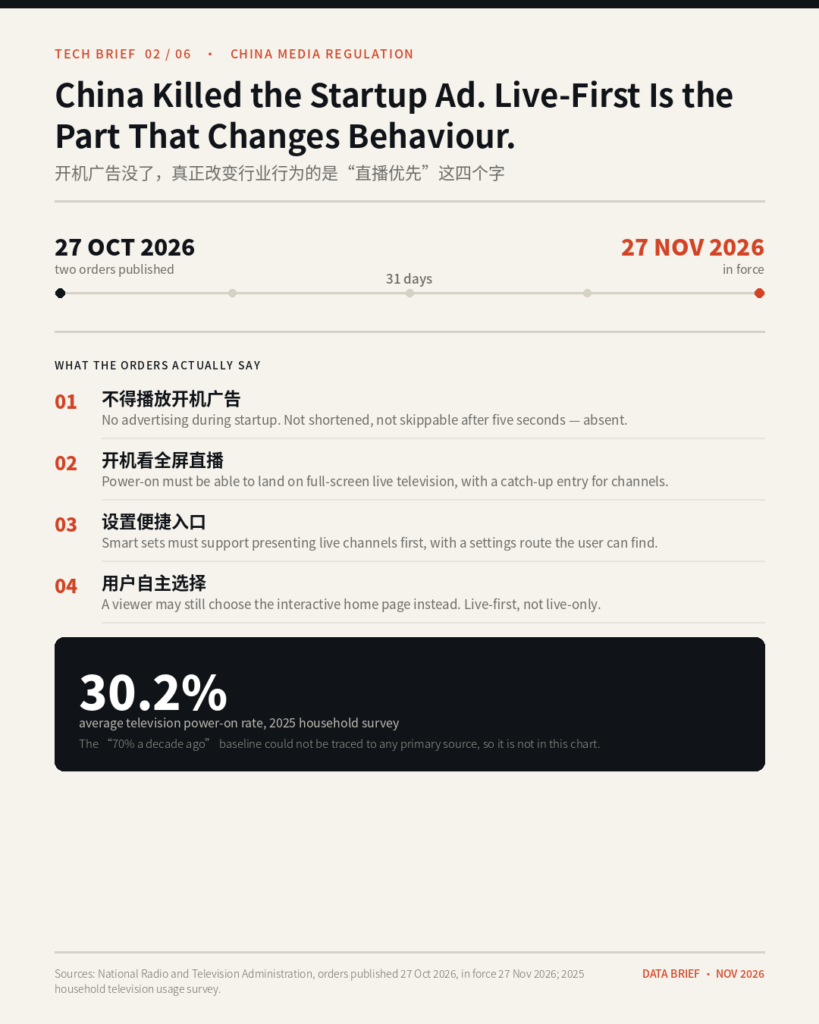
On 27 October the National Radio and Television Administration published the Provisions on the Administration of Cable Broadcasting and Television Operation Services, alongside a companion rule for interactive network television — the category that covers IPTV — issued as Order No. 18. Both take effect on 27 November.
Putting cable and IPTV on the same clock is the structural move. For years the two were policed through different channels, and a complaint that fell between them tended to die there.
What the text actually requires
Four obligations, in the order a viewer meets them.
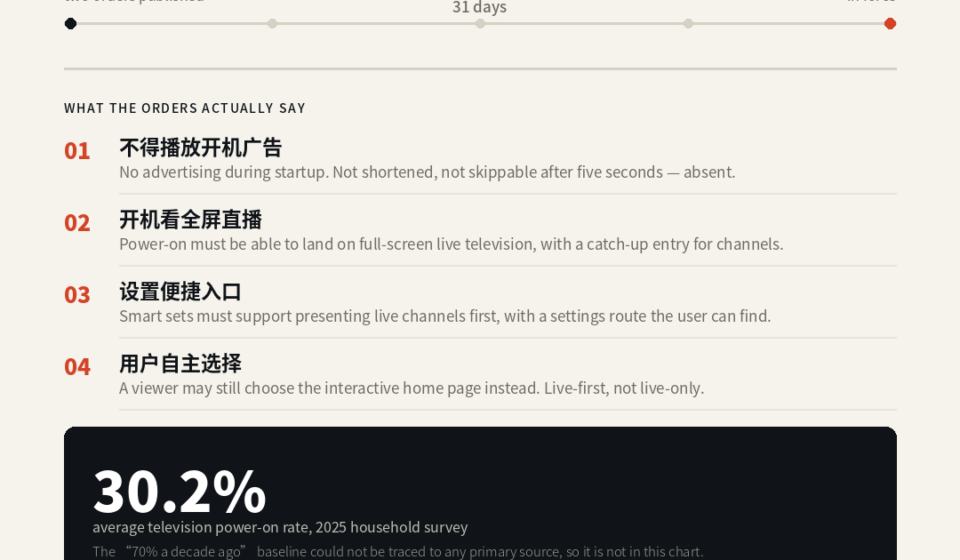
Startup advertising is prohibited. Not shortened, not skippable after five seconds — absent. The television must be able to open onto full-screen live broadcasting, with an entry point for catching up on channels. Smart sets must support prioritising the live channel and must provide a convenient settings entry. And the viewer, not the manufacturer, chooses whether the set opens onto live TV or onto an interactive home page.
That last clause is the one the headlines flattened. This is live-first by default, not live-only by force. The home page survives. It just has to earn the second tap.
The commercial provisions are the real constraint
Each home page must give prominence to free, quality content. The number of paid sections must be cut. Charges for paid programming must be clearly disclosed, and the ordering and deduction process is to be more tightly controlled.
Read together, that is a constraint on the business model rather than on the interface. Chinese pay-TV economics leaned on layered upsells because revenue per user was thin and churn was high. Remove layers and the money has to come from somewhere: advertising that survives the ban, sponsorship, or a harder push on broadband bundles.
Two small clauses worth more than they look
Operators may not cut CCTV-1 during a service suspension for arrears, and must restore the signal within 24 hours of payment.
Neither will make a headline. Both convert a billing dispute into a regulated service failure, and both are trivially auditable — which is what makes them enforceable in a way that “improve user experience” never is.
The rules also encourage voice remotes, phone-based control and AI-assisted navigation, and require shorter startup times without specifying a ceiling in seconds. That omission is deliberate or careless; either way it leaves the target negotiable.
The statistic that is half-traceable
Coverage has leaned on a striking claim: that China’s daily television power-on rate fell from around 70% a decade ago to between 27% and 30%.
Half of it holds up. A 2025 survey of Chinese household television usage put the national average power-on rate at 30.2%, described as the lowest in roughly a decade. That is a named report with a stated figure, and it lands inside the quoted range.
The “70% a decade ago” half is harder. We could not trace it to an official statistical release or a methodology that defines what is being counted. Treat the direction as real and the decade-ago baseline as unverified.
What it costs an operator
Three costs, and only one is obvious.
Lost startup inventory, which was cheap to sell and impossible to skip. Engineering work: live-first defaults, a working catch-up entry, a one-button route back to live, simplified remotes, and support for control methods the installed base of televisions may not have. And organisational work — a complaints function with an obligation attached.
What it means for set makers and advertisers
Smart TV manufacturers have spent a decade monetising the boot sequence and the home page, often through revenue-sharing with content partners. Those arrangements need re-papering in the world’s largest television market, and the phrase “convenient settings entry” will be read strictly at certification.
If you bought startup inventory in China, that line item is gone under this framework. Budget does not disappear; it relocates to in-content pre-roll, home-page free-zone adjacencies, and connected-TV formats that sit inside a chosen stream. The strategic loss is larger than the media shift: startup inventory was the last impression that reached every household regardless of what it watched.
FAQ
Does this ban all television advertising? No. It bans advertising during startup on cable and IPTV. In-content pre-roll, sponsorship and home-page placements remain.
Must the set always open onto live TV? No. The principle is live-first; the rules require the capability and a convenient setting, and let users choose an interactive home page instead.
What is the free zone? A clearly marked area on the home page promoting quality free content, required alongside fewer paid sections and clearer pricing disclosure.
Is there a fixed limit on startup time? No ceiling in seconds is specified. Operators are required to shorten it, which leaves enforcement discretionary.
What is the most underrated clause? The requirement not to cut CCTV-1 during arrears suspension, and to restore service within 24 hours of payment.