The Xiaohongshu Playbook for Non-Chinese Brands
Xiaohongshu , known outside China as RedNote or Little Red Book, is a note-first discovery platform. Users publish short posts about products, places and experiences, and other users read those posts to decide what to buy or try next. Marketing on the platform runs in four steps: seed honest notes through small creators, capture the search demand those notes create, close the sale inside the app or in a live room, and measure saves and comment questions instead of impressions.
That is the whole model. Budget follows the same order. Nearly every failed program I have seen ran it backwards, starting with a store, a livestream and a media budget, and then wondering why none of it carried any weight.
Why Xiaohongshu should come first for a discovery-led brand
It behaves like a research engine with a social feed attached
Open the app and you get a two-column feed. Open the search bar and you get something closer to a shopping assistant. The two halves do different jobs, and the platform is unusual in how seriously it treats the second one. A person who has seen a serum in the feed will type “sensitive skin serum, oily T-zone” into that box a few days later, and the notes that answer that phrasing will keep collecting readers for months.
The save is the signal that matters
Likes are politeness. Comments are attention. A save means the reader decided the post was worth keeping for a decision they have not made yet. On a platform built around saving, the metric hierarchy is already sorted for you, which is a gift most channels do not offer.
Scale, without the marketing department’s version of it
The company does not publish audited user counts, so treat every figure as directional. The estimate most often cited, including by WIRED’s reporting in 2026, is roughly 300 million monthly active users. That places Xiaohongshu among the largest platforms in the world by domestic audience, while leaving it far smaller than WeChat or Douyin. Smaller matters here. A platform that has not yet been optimized to death still rewards a well-written note from an account with two hundred followers.
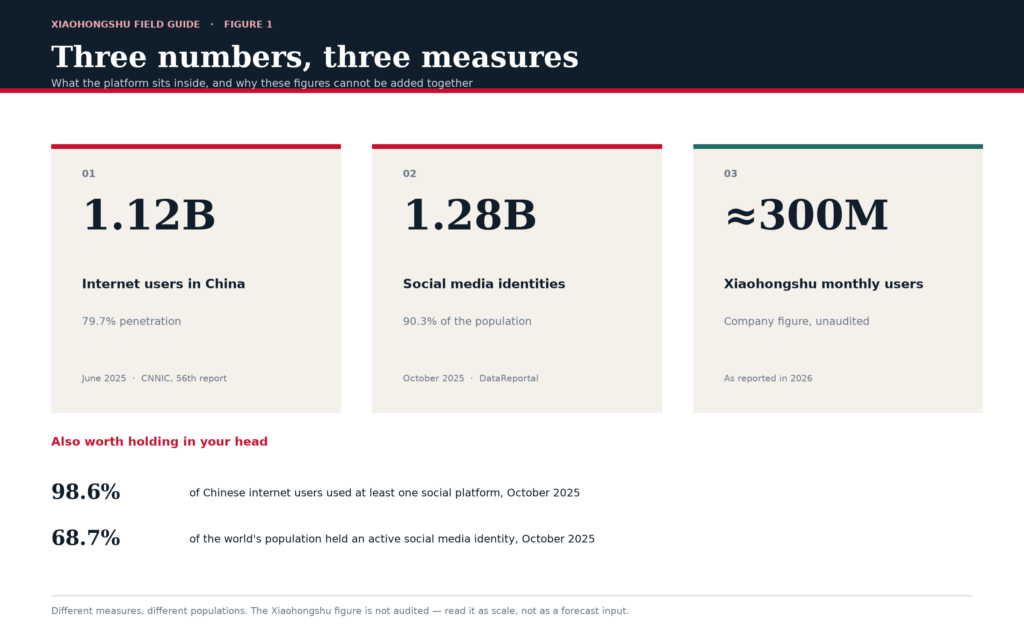
For a global team, the useful framing is this. China had 1.12 billion internet users and 79.7 percent penetration as of June 2025. Within that population, 1.28 billion social media user identities were active in October 2025, equal to 90.3 percent of the population, and 98.6 percent of Chinese internet users used at least one social platform. Worldwide, 5.66 billion social identities were active in the same period, or 68.7 percent of everyone alive.
One caution on the Chinese figures, because readers outside the country will meet both versions. CNNIC’s headline count covers internet users on its core definition. The same report publishes a broader adoption measure in an annex, covering people who use the internet or internet-based services, and Kepios, the research firm behind the DataReportal series, applies that measure to arrive at roughly 1.30 billion users and 91.6 percent penetration. Both numbers are defensible. They are not measuring the same thing, and quoting either without the definition invites an argument you cannot win.
Either way, discovery-first behavior is not a Chinese quirk. It is the default state of a market where almost nobody reaches the internet except through a feed.
What you are actually marketing into
Before writing a brief, learn the four surfaces. They are not interchangeable, and most wasted budget comes from using the wrong one.
The feed
Two columns of notes, ranked by predicted engagement rather than by follower count. A new account can reach thousands of people with one post if the note holds attention and collects saves. Follower count is a weak predictor of reach, which is why buying a large account and expecting guaranteed distribution keeps disappointing people.
The search bar
A second front door, and for considered purchases the first one. Web search receives open questions. In-app search receives narrowed ones, because the person typing has usually seen something already. Their queries look like category plus constraint, or brand plus verdict.
The store and the product link
Notes can carry product links, and the platform has spent several years building a native commerce stack around them. This matters because it removes the drop-off between reading a recommendation and buying the thing.
The live room
A question desk, not a billboard. Live works when someone already wants the product and has one unresolved doubt about size, shade or delivery. It fails when it is the first time anyone has heard of you.
Before you publish anything: the 30-day listening pass
Skip this and everything downstream is guesswork. The most expensive mistake in Xiaohongshu marketing is writing notes for phrases nobody searches.
Read 300 notes across your category and two adjacent ones. Log the questions people ask in comments, in their own words, without cleaning up the grammar. Group them by decision stage: What is this? Is it worth it? Which one? Is it safe? Where do I buy it? You should finish with a working map of 60 to 100 real phrases.
Then check one thing before you spend a yuan. Do the phrases you planned to target appear in that map at all? If they do not, your category may describe itself differently from your brand, and the translation problem is yours to solve, not the platform’s.
Seed: How to plant grass actually works
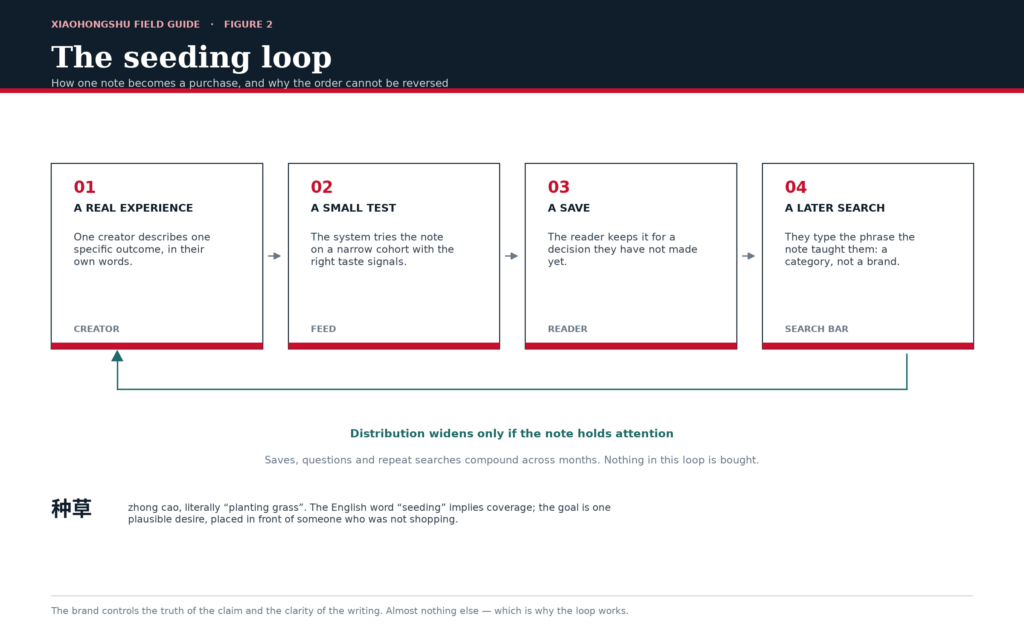
The Chinese term is plant grass, literally planting grass. The closest English word is seeding, which undersells the intent. Seeding implies coverage. The goal here is to place a plausible desire in front of someone who was not shopping, through someone they can actually trust.
Choose creators by product usage, not by follower count
Small accounts with real usage carry the seeding load, because their recommendations still read as peer advice rather than as inventory. Build a first wave of ten to twenty creators whose existing posts show they already use the category, not creators whose audience happens to be large. Larger accounts come second, to amplify a claim that smaller ones have already validated.
Write the brief, not the copy
Give the creator the product, the one outcome you want described, and the disclosure requirement. Do not give them sentences. Phrasing that sounds native is precisely the phrasing your brand team would never have written, and rewriting it into brand voice is the fastest way to make a note forgettable.
Product handling has a supply chain
Samples get lost, arrive late, or arrive without the usage instructions that make a specific outcome possible. Assign one owner to shipping and follow-up, or a third of your creator wave will quietly publish nothing.
Disclose, every time
Paid partnerships are supposed to be arranged through the platform’s official creator marketplace and labeled as commercial content. Off-platform cash for on-platform praise is the one shortcut that reliably ends in a restricted account, and it is now the first thing enforcement looks for.
Capture search: writing notes that keep working
Seeding creates demand. If nothing answers the query that demand produces, you have paid to warm up a customer for whoever ranked for it.
Titles are the ranking surface
A note titled around the phrase a buyer would actually type keeps collecting readers for months. A note titled as a mood collects likes for a week and then stops. Put the category noun and the constraint in the title, and leave the poetry for the caption.
Answer in the first two lines
In-app search results show a title, a thumbnail and a fragment of text. If the fragment does not contain the answer, the reader swipes on. State what the product is, who it suits and what it does not do before you get to how it felt.
Build for the long tail on purpose
The high-volume phrases are crowded and expensive. The narrow ones (a specific skin condition, a specific body type, a specific budget) have small volume, almost no competition, and the closest match to an actual purchase. Ten notes answering ten narrow questions will out-earn one note chasing a head term.
Defend your brand word
People search your brand name with the word “review” attached, and what appears for that query is effectively your reputation, written by strangers. The way to influence it is to publish plain, specific answers to the questions that phrase implies, and to answer in public when what is already there is wrong.
Convert: closing inside the app
Notes with product links do the quiet work
A note that has already been saved converts at a higher rate once it carries a link, because the reader is returning to something they kept rather than discovering something new. Attach links to the notes that earned saves, not to the ones that earned likes.
Live is for the last doubt
Run a live session when you have an audience with a specific unresolved question. Prepare the four things people always ask, demonstrate them on camera, and keep the room short. A long room with no question to answer is a television channel with no viewers.
Do not try to move the audience off-platform
Pushing contact details or external payment links into notes is a fast route to having reach throttled. The platform’s commerce tools are imperfect and they are also the only ones that keep your distribution intact.
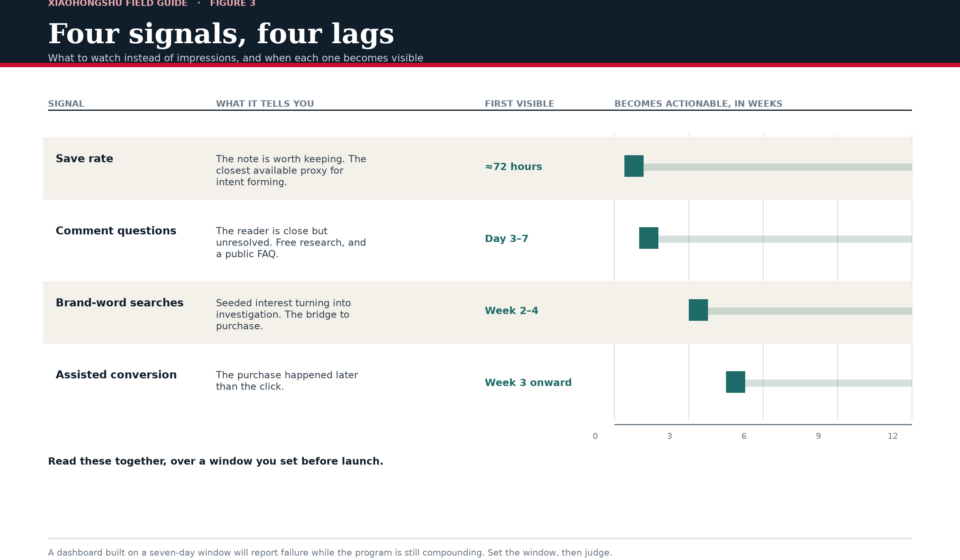
Measure: the four numbers that matter
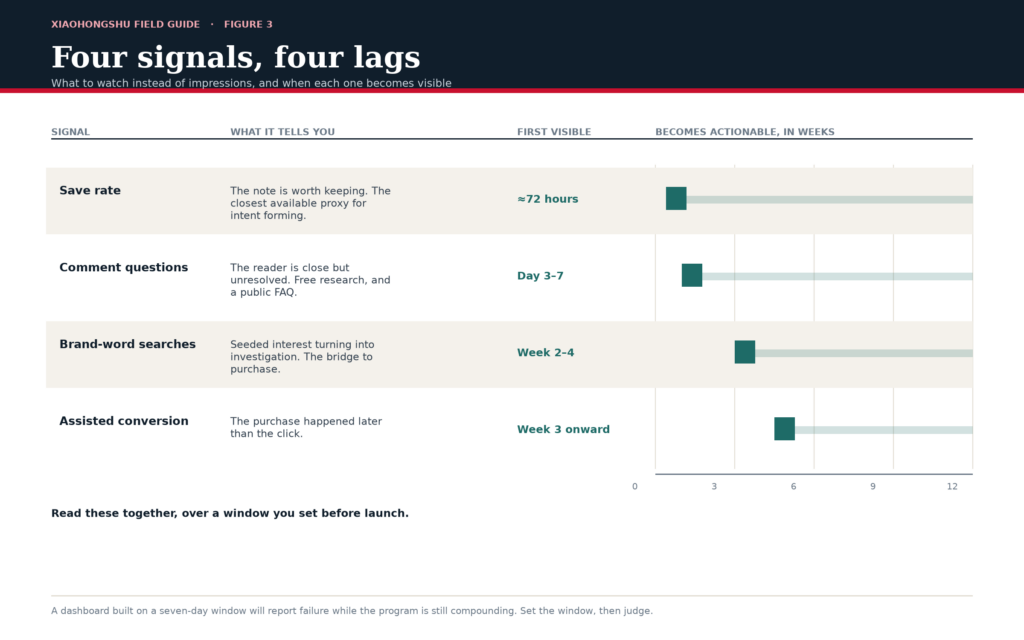
Save rate
Saves divided by impressions, per note. This is the closest available proxy for a decision forming. Compare your notes against the category median rather than against last month.
Comment questions
Count questions, not comments. “Does it pill under sunscreen?” is a purchase signal. “So cute” is not. The count is also a free research feed, and a public FAQ that ranks.
Brand-word search volume
If seeded interest is real, people start typing your name. Flat brand-search volume alongside rising impressions means the notes were enjoyed and not believed.
Assisted conversion on a long window
Discovery-led programs convert weeks after first contact. A dashboard built on a one-day or seven-day window will systematically understate the effect. Set the window before launch, or the attribution argument gets settled by whoever owns the spreadsheet.
Two caveats about counting. First, third-party analytics tools built for this platform are useful for category benchmarking, but their estimates are directional. Second, the platform’s own ad and creator dashboards report on their own inventory, which is a subset of what happened.
The content mix, stage by stage
| Stage | Format | Share of effort | What it has to prove |
| Discovery | Creator notes, photo-led | Half | That a specific person had a specific result |
| Consideration | Comparison notes, brand-side answers | A third | That you can name your own weaknesses |
| Closing | Linked notes, short demo video | A tenth | That the thing works the way the note said |
| Recovery | Live sessions, comment replies | A tenth | That the remaining doubt has an answer |
The proportions are a starting point, not a law. The useful part is the order: discovery first, closing last. Brands that invert it spend their money telling people who already decided to buy.
Compliance: the floor you cannot negotiate
China’s Advertising Law requires commercial messages to be identifiable as advertising. The Internet Advertising Measures that took effect in May 2023 extend that principle to influencer content and livestream selling, and place obligations on the platform as well as the advertiser.
In practice this means four habits. Label paid content. Do not write medical or therapeutic claims for products not registered for those claims. Do not use before-and-after imagery on categories where it is prohibited. Keep the substantiation for every number you put on a note.
There is a commercial argument for the same behavior, and it is not a small one. A note that reads as advertising gets scrolled past. The disclosure costs you a fraction of reach and buys you the only thing that makes the format work at all.
One more rule, easy to miss from outside China: the domestic terms of service ask users under 18 not to use the platform, while the international version sets the line at 13. If your product appeals to teenagers, that difference decides which version of the app you are actually planning for.
Common mistakes, in the order they cost money
Treating the platform as a billboard
Imported ad creative announces itself in the first second, in a place people came to be helped. The format is not the problem. The announcement is.
Over-producing
Studio gloss removes the imperfection that made the note believable. Polish is not the constraint. Specificity is.
Skipping the search layer
Seeding without matching search content is a bucket with a hole in it. You create the interest and hand the query to a competitor.
Judging at week three
Paid bursts spike and die. Discovery work starts slowly, holds its shape, and keeps returning readers for months.
Buying reach first
A large account with no prior validation behind it converts worse than ten small ones that agree with each other. Sequence beats size.
Chasing every trend format
The platform rewards novelty, and novelty decays. A category that needs explaining is better served by twenty plain answers than by one viral format you cannot repeat.
A 90-day plan
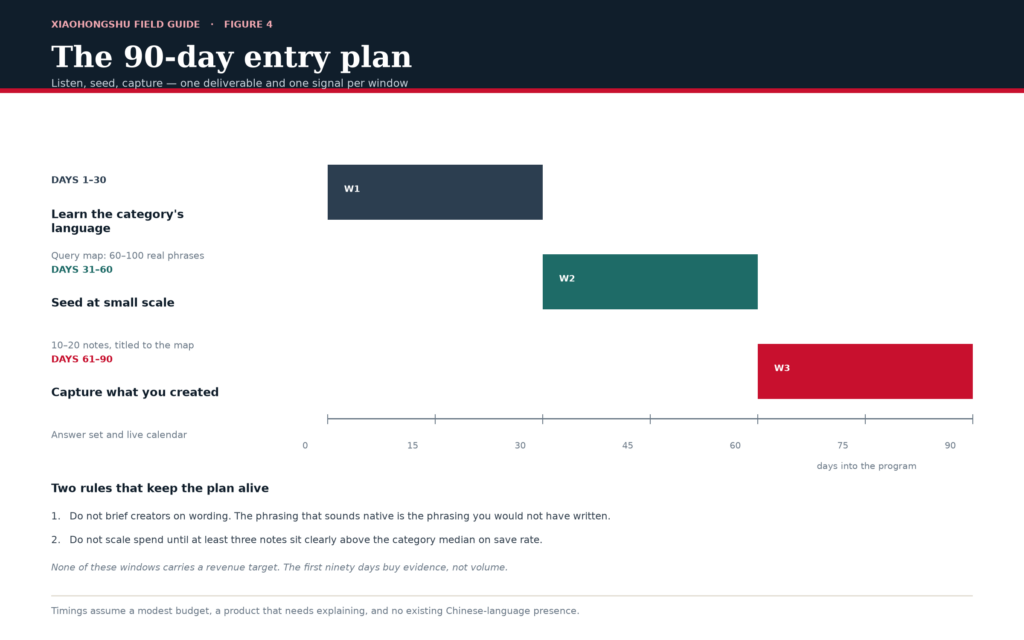
| Window | Objective | Main work | Deliverable | Signal to watch |
| Days 1 to 30 | Learn the category’s language | Read 300 notes, log questions verbatim, build query map | 60 to 100 real phrases grouped by decision stage | Whether your planned phrases appear at all |
| Days 31 to 60 | Seed at small scale | Brief 10 to 20 creators with genuine usage, one outcome each | Published notes titled against the query map | Save rate and question volume per note |
| Days 61 to 90 | Capture what you created | Publish answers to the top 20 questions, run live for unresolved doubts | A search-facing answer set and a live calendar | Share of target queries where your notes appear |
Two rules keep the plan alive. Do not brief creators on wording. Do not scale spend until at least three notes sit clearly above the category median on save rate, because scaling a flat note only buys more silence.
What a non-Chinese brand should take from this
The mechanism transfers. The platform does not.
Since January 2025, when TikTok was briefly shut down in the United States and a wave of American users installed Xiaohongshu overnight, the company has been building a separate international business. It launched a distinct web domain for overseas users, published separate terms of service for domestic and foreign audiences, registered an international entity in Singapore in mid-2025, and has been hiring staff in the United States to open regional offices. Those two audiences are being deliberately pulled apart, which means anything you learn from the Chinese side has to be re-tested rather than transplanted.
What survives the translation is the sequence. Interest forms in a feed, before a keyword exists. A save records the intent. A search arrives later to confirm it. Wherever those three things happen in that order, the same four steps work, whether the app is called Xiaohongshu, Instagram, Pinterest or something that has not launched yet.
Summary
Xiaohongshu is a note-first discovery platform, and the marketing sequence is fixed: seed honest usage through small creators, write for the search the seeding provokes, close inside the app or in a live room, and measure saves, questions, brand-word searches and late conversions. The platform does not publish audited user counts; the estimate most often cited in reporting is roughly 300 million monthly active users. The surrounding market is the argument for taking it seriously, with 1.12 billion internet users in China at 79.7 percent penetration as of June 2025 and 98.6 percent of them using social platforms. The discipline is less glamorous than the numbers. Brief for one specific outcome, leave the wording alone, label the commercial content, and give the effect a window long enough to show up.
Frequently asked questions
What is Xiaohongshu marketing in one sentence? It is the practice of planting honest, specific product experiences in a discovery feed so that the search a buyer runs later lands on your notes instead of a competitor’s.
How is Xiaohongshu different from Instagram? Instagram rewards a brand that already looks desirable. Xiaohongshu rewards evidence that a person used the thing and can describe what happened. The ranking systems also differ: saves and search matching carry more weight than likes.
Do I need a Chinese entity or local agency to run this? For the domestic platform, yes in practice. Commerce, payment, creator contracts and advertising review all assume a local operating entity, and the official creator and ad marketplaces are built around it. The international version of the app is a separate business, and it is still being built out.
How long before a program shows results? Plan on 90 days to learn whether the mechanism works at all, and expect a conversion window measured in weeks rather than days. Programs judged on a seven-day window will look like failures while they are compounding.
What is the single most common reason these campaigns fail? They buy reach before they earn a save. A large account with no prior validation behind it converts worse than a small wave of creators who agree, because the audience has no prior exposure to lean on.
Why do two sources give different internet-user figures for China? Because they answer different questions. CNNIC publishes a core count of internet users, which puts the country at 1.12 billion and 79.7 percent penetration as of June 2025. The broader adoption measure in the annex of the same report, which Kepios uses, puts it near 1.30 billion at 91.6 percent. Quote whichever you need, but quote the definition with it.