Structure, Cite, Verify: A Five-Step Playbook for AI-Search Visibility
AI visibility is not a writing problem. It is an evidence problem — and most content teams are still buying the wrong fix.
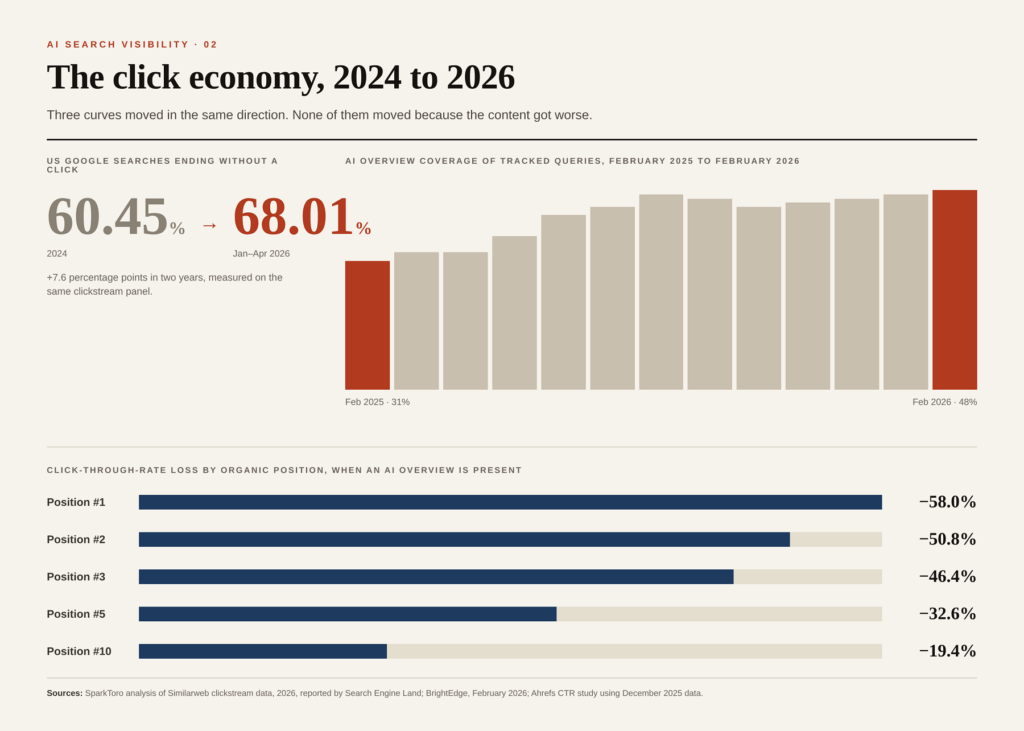
Sixty-eight percent of Google searches in the United States now end without a click. Google’s AI Overviews cover roughly half of tracked queries and, when they appear, they are taller than the visible screen. Only about one in six sources cited inside those summaries also ranks in the organic top ten. Read those three numbers together and a conclusion follows that nobody in content marketing enjoys: the paragraph that gets quoted is almost never the paragraph you worked hardest on. It is the paragraph a machine could parse, place, and check.
That is the whole argument of this piece. What follows is a five-step operating routine for making your pages quotable, not prettier, plus the part most playbooks skip: what to stop doing, and how to tell whether any of it worked.
1. The “write better” trap
Copywriting advice transfers poorly to retrieval. A human reads your opening, feels the rhythm, and decides whether to keep going. A reranker does none of that. It takes a rewritten sub-query, scores passages against it, and hands the winner to a generator that decides whether the passage deserves a citation. Elegance is invisible at every step of that chain.
So when a team says its AI visibility is weak and the response is a voice-and-tone workshop, the diagnosis is wrong. The likely failure is upstream: a claim with no owner, a number with no population, a definition that shifts between two pages. Would you cite a paragraph you could not verify? Neither will a model with four competing sources and one slot.
The uncomfortable corollary: the skills that made your content good for readers — narrative, hedging, context-building — are the exact skills that make extraction hard. You do not have to abandon them. You have to separate them. Prose for humans, evidence blocks for machines, one page, both jobs done.
2. What a retrieval engine actually reads
Strip the branding off and the mechanism is four moves. The engine rewrites your question into several sub-queries. It fans out across them. It retrieves candidate passages. Then it selects a handful to support the sentence it has already drafted.
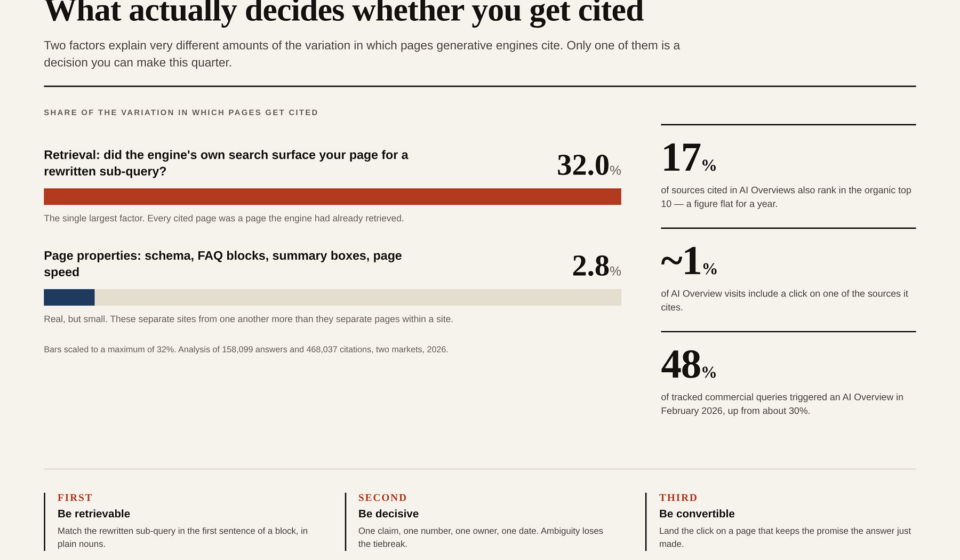
The proportions are the interesting part. A 2026 analysis of 158,099 answers and 468,037 citations across two markets found that retrieval — whether the engine’s own search surfaced the page at all — explains about 32% of the variation in citation, while page-level properties explain 2.8%. Every page ChatGPT cited was a page its search had already retrieved. Pages are cited because they were found; they are found because they matched a rewritten query in meaning.
That single finding reorganizes the job. You are not optimizing for the head term in your title. You are optimizing to be the best match for the four or five sentences a model invents while answering someone’s real question.
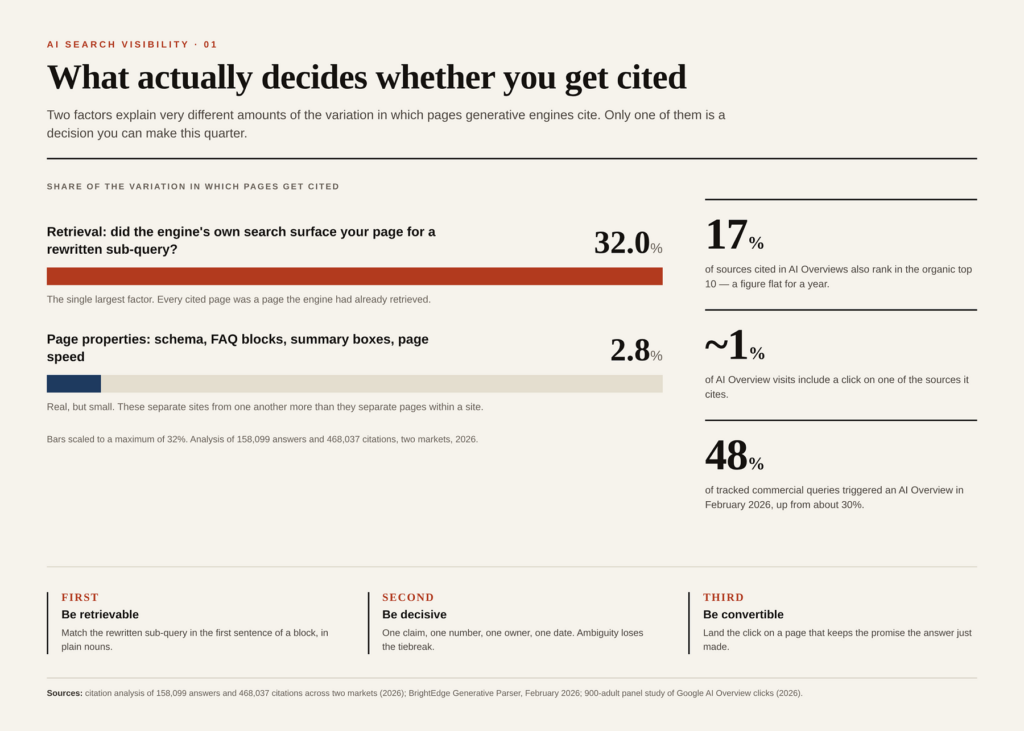
Two more numbers keep the picture honest. BrightEdge tracked citation overlap for a year: only about 17% of sources cited in AI Overviews also rank in the organic top ten, and that figure has barely moved. Ranking first does not buy you a citation, and ranking on page three does not exclude you. Separately, a 2026 panel study of 900 US adults found that people clicked a link inside an AI Overview in about 1% of visits. Citation and visit are different events with different economics.
The clicks that remain are also worth less than they used to be. Ahrefs compared 300,000 keywords before and after the feature rolled out and measured the damage at a 58% lower click-through rate for the position-one page when an AI Overview is present, up from 34.5% in its earlier pass. Position ten lost 19.4%. The feature does not just tax the winner; it taxes the whole first page.
Three numbers people quote wrongly
Zero-click gets repeated with three different values because it is measured three different ways. SparkToro’s 2026 analysis of Similarweb clickstream data put US Google zero-click at 68.01% for January through April of 2026, against 60.45% in 2024. Earlier figures of 58.5% are the 2024 dataset reported under a different definition. Quote the year and the market, or the number means nothing.
The prevalence figures are just as muddled. A crawl of trending queries produced 13.7%. A 21.9-million-search study produced 25%. BrightEdge’s tracked commercial keyword set produced 48%, up from about 30% a year earlier, which still leaves roughly half of queries with no AI Overview at all. All three can be true. They measured different query populations, and the commercial set is the one that matters for brands.
And the “AI traffic converts eleven times better” line has no primary source. Adobe’s trillion-visit dataset reports AI-referred retail traffic converting 42% better than non-AI traffic in March 2026, and 60% better by July. Those are strong numbers. Eleven times is a rumor wearing a statistic’s clothes.
3. Step 1 — Build the claim inventory
Before you touch a paragraph, list what the page asserts. Not the topics, the assertions. Each row gets four fields: who says it, when they said it, on what population, and what the claim excludes.
Classify as you go, because the categories fail differently. Definitions need a single canonical sentence. Quantities need a unit, a denominator, and a date. Mechanisms need a citation from someone who studied the mechanism rather than observed it. Comparisons need both sides measured the same way. Predictions need a named forecaster and a horizon, or they should be cut.
A long commercial page usually carries between forty and eighty assertions. That list is your edit queue now and your audit script later. Anything with an empty field gets deleted, not softened. “Studies show” is not a source. It is a hope.
4. Step 2 — Chunk the page, one claim per block
Here the official guidance and the academic evidence disagree, and pretending otherwise produces bad advice.
Google published consolidated guidance in May 2026 stating that site owners do not need to break content into small pieces for its AI features, because its systems can understand multiple topics on a page and surface the relevant part. Google also says that optimizing for generative AI search is, from its perspective, still SEO. Read that twice before you buy a chunking tool.
Then read the research. A structural analysis across six generative engines measured a 17.3% improvement in citation rate from structural changes alone. A controlled study running 252,000 trials through six models found topical relevance and list position dominating citation order. A recent timestamp and explicit pricing helped consistently. Formatting-only edits did almost nothing.
The resolution is unglamorous and useful: chunk for extraction and verification, not for markup. One block should carry one claim, its evidence, its scope, and its date — sixty to a hundred words, opening with the sentence that answers the question a person would actually type. If a paragraph contains three claims and two missing sources, no schema tag will save it.
A caution on FAQs, since every checklist recommends them. The same 158,099-answer study found that FAQ blocks, summary boxes, structured data, and page speed looked effective across websites but not within a website. Translation: FAQ-heavy templates tend to be a site-type signal, not a lever you pull on an individual URL. Write the FAQ because buyers want it. Do not expect the block itself to lift your citation rate.
5. Step 3 — Anchor the entity
Models do not only retrieve. They remember. That same study found ChatGPT writing brands it knows into its search queries, preferring sites it recognizes, and naming brands in answers with no supporting page at all — with controlled tests showing brand names reordering product rankings when the underlying facts were identical.
Which means a boring operational habit matters more than most “AI optimization”: one name, one definition, one category, everywhere. Your legal name and your trade name, resolved into a canonical form. A single-sentence definition that states what you do and who for, reused verbatim on the about page, the category pages, the byline, the press page, and the third-party profiles you control. A category descriptor that does not drift by quarter.
Rebrands are where this quietly breaks. So are product lines renamed for a campaign and translated badly for a second market. Each variant dilutes the entity, and the cost shows up months later as a model describing you as something you stopped being in 2024.
Test it the cheap way: ask three engines what your company does and how it differs from the nearest competitor. If the category comes back wrong, you have an entity problem, not a content problem.
6. Step 4 — Freshness and readability that survive the crawl
The recency finding from the controlled trials is narrow and therefore believable: a recent timestamp helps consistently. Not “new content wins” — a recent timestamp on a page whose claims are still accurate.
That distinction kills the laziest version of content refresh. Changing the modified date on a two-year-old page is a lie a parser can sometimes detect and a reader can always detect. Real freshness is a changed claim: a new figure, a retired number, an added boundary condition, a replaced source. If the substance did not move, leave the date alone.
Then check whether anything can read the page at all. Adobe measured machine readability across US retail sites and scored product pages at 66 out of 100. Roughly a third of the content on those pages is not machine-readable, usually because it is buried in JavaScript, images, or interaction. Homepages scored 75, category pages 74, help centers 79. You can write the best-structured claim on the internet and lose it to a rendering decision.
Access is the other half. BrightEdge reports that AI agent requests have reached 88% of human organic search activity, and that agents now account for roughly 15% of total website traffic, 95% of it driven by OpenAI. The same analysis found that only 19% of sites have specific directives for ChatGPT-related bots. Blocking agents is not blocking bots. It is blocking customers at the moment of decision.
And you cannot fix what you cannot see. Google added a native AI Assistant channel group to Analytics in May 2026, which helps but still cannot classify sessions that arrive with no referrer. A 446,405-visit analysis published by the analytics firm Loamly found 70.6% of AI-origin traffic arriving without referrer headers and defaulting to Direct. Judge this channel by last-click reports alone and you will conclude it does not exist.
7. Step 5 — Run a re-citation loop every month
One audit proves nothing. Engines change weekly; your baseline decays while you celebrate it.
The routine that works is small enough to survive a busy quarter. Pick twenty questions your buyers actually ask. Run them through three or four engines on the same day each month. For each, log whether you were cited, who was, and which passage of yours surfaced, if any. Then classify the failure, because the three failure modes have three different fixes.
Retrieved but not cited: your passage is close but not decisive. Tighten the claim, add the denominator, date the number.
Not retrieved: your page is not matching the rewritten sub-query. Rewrite the heading as the question, then answer it in the first sentence.
Cited, but the answer still describes you as the wrong thing: an entity problem. Go back to Step 3.
Run changes as experiments, not as opinions. One cluster of questions, one edit type, two to four weeks, then compare. If you change six things at once and citations rise, you have learned nothing you can repeat.
8. Schema is a ticket, not a strategy
Structured data does three real jobs: it disambiguates entities, it earns rich-result eligibility, and it keeps prices and availability current for shopping surfaces. Google’s May 2026 guidance is explicit that no special schema markup is required to appear in generative AI features, and that structured data should continue as part of ordinary SEO.
What schema does not do is earn citations. The evidence on that is the same as for FAQ blocks: effective across sites, negligible within a site. You are not being out-cited by a competitor’s JSON-LD. You are being out-cited by their better-matched passage.
Treat it like a ticket to the building. Necessary, cheap, unremarkable. Nobody gets the meeting because they had a ticket.
Same verdict for the newest ritual. Google’s John Mueller has said plainly that self-reported files like llms.txt cannot help a model decide which site to surface, since every site can write one. Google’s documentation tells site owners to skip the special files and get the HTML right.
9. The citation trap
Here is a failure mode that costs more than bad structure. It is citing sources you have not checked, because a weak source imports its volatility into your page.
Picture the eleven-times claim again. It spreads because it is flattering, and it spreads because nobody asks. When a verifying model encounters your page asserting eleven times and a competitor asserting 42%, it has no way to reconcile them, so it either drops both or picks the one with the clearer provenance. You lose the citation to the duller, better-documented number. That is the trap in one move.
The research backs the instinct but not the drama. Trust cues and completeness show up as smaller but consistent gains in the 252,000-trial study. They are a tiebreaker, not a multiplier. Which is exactly why they matter in competitive answers: when two passages are equally relevant, the tiebreak decides.
Two rules keep it clean. One tier-one source beats three aggregators quoting each other. And never publish a number you cannot reproduce from the original document, because someone, increasingly some model, will try.
10. The ninety-minute audit
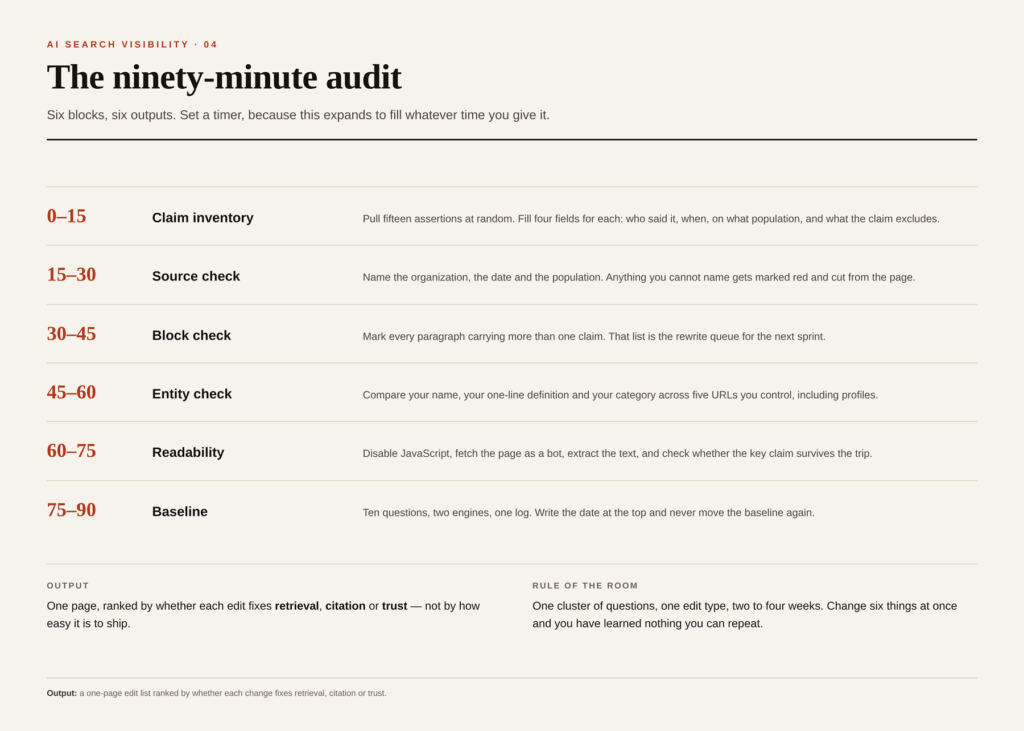
Six blocks. Set a timer, because this expands to fill whatever time you give it.
Fifteen minutes on claims: pull fifteen assertions at random from your highest-traffic page and try to fill all four fields.
Fifteen on sources: for each, name the organization, the date, and the population. If you cannot, mark it red.
Fifteen on blocks: mark every paragraph carrying more than one claim. That is your rewrite queue.
Fifteen on entities: check your name, definition, and category across five URLs you control.
Fifteen on readability: disable JavaScript, fetch the page as a bot, extract the text, and see whether your key claim survives the trip.
Fifteen on baseline: ten questions, two engines, one log spreadsheet.
The output should be one page, ranked by whether each edit fixes retrieval, citation, or trust, not by how easy it is to ship.
11. What to stop doing
Listicle inflation. Twenty items, no data, no boundaries. It matches queries and loses citations to anything with a number in it.
Keyword piling. Google’s guidance says its systems understand synonyms, so you do not need every variant. The original generative-engine benchmark found keyword stuffing among the weakest strategies.
FAQ stuffing. Useful for buyers, close to inert as a within-page citation lever, and the rich-result surface for it has long been narrow.
Writing in “AI tone.” Google’s guide devotes real space to the difference between commodity content and content with a point of view, and it is the clearest signal in the document about what actually travels. A summary of what everyone already says is the commodity in question.
llms.txt theater, AI-only microsites, and internal decks promising eleven-times conversion.
12. The scorecard
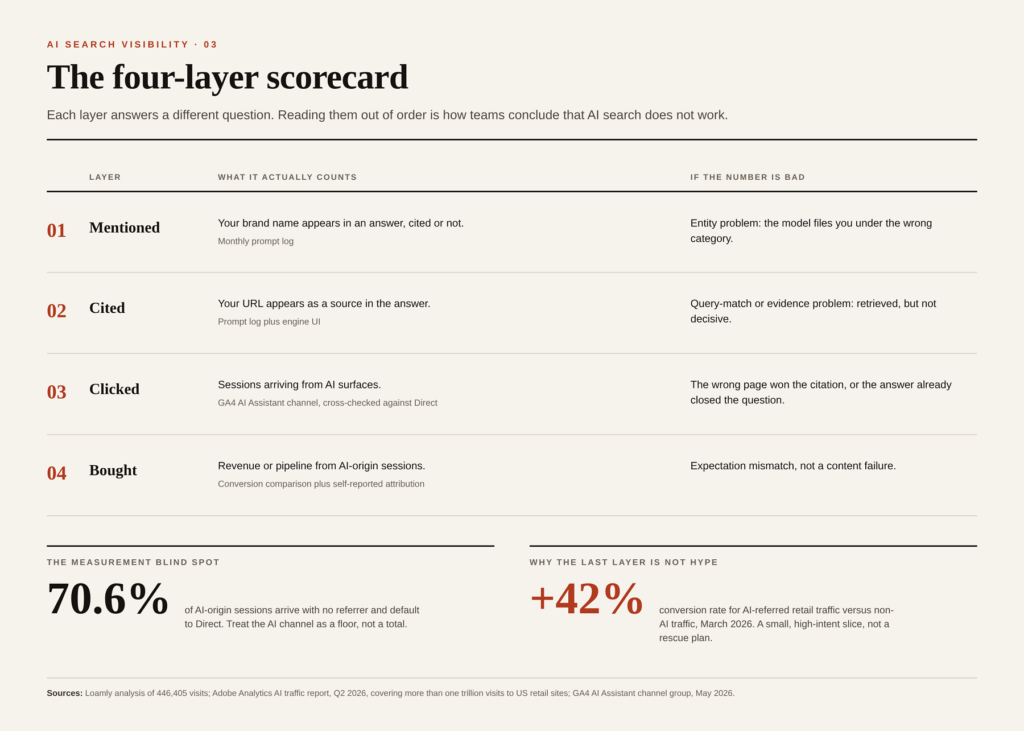
Measure four things, in this order, because each one explains the next.
| Layer | Definition | Source of truth | Cadence | Bad reading means |
|---|---|---|---|---|
| Mentioned | Brand name appears in an answer, cited or not | Monthly prompt log | Monthly | Entity problem — Step 3 |
| Cited | Your URL appears as a source | Prompt log plus engine UI | Monthly | Query-match or evidence problem — Steps 2 and 4 |
| Clicked | Sessions arriving from AI surfaces | GA4 AI Assistant channel, cross-checked against Direct | Weekly | Wrong page won the citation, or the answer already closed the question |
| Bought | Revenue or pipeline from AI-origin sessions | Conversion comparison plus self-reported attribution | Quarterly | Expectation mismatch, not a content failure |
Two honesty notes. First, the funnel is not linear: a mention can drive a branded search four days later, which no referrer will ever report. Second, AI-referred traffic converts well — 42% better than non-AI in Adobe’s March 2026 retail data, 60% better by July — but that is a conversion-rate effect on a small, partially invisible slice of sessions, not a rescue plan for a broken acquisition mix.
FAQ
Does ranking first on Google mean I will be cited in the AI Overview?
No, and the gap is wide. Only about 17% of sources cited in AI Overviews also rank in the organic top ten, a figure BrightEdge found flat across a year of tracking. Ranking and citation both draw from the index, but they select differently.
Should I add schema markup specifically for AI search?
Not as an AI-specific move. Google’s May 2026 guidance says no special markup is required for its generative features, and the citation research finds structured data effective across sites but negligible within one. Keep structured data for rich results and entity clarity; do not budget it as a citation strategy.
Is AI traffic worth measuring if most of it shows up as Direct?
It is worth measuring carefully rather than precisely. A 446,405-visit analysis found 70.6% of AI-origin sessions arriving with no referrer. Trend the AI Assistant channel alongside Direct, correct your baselines, and treat the number as a floor.
Do FAQ blocks help me get quoted?
Less than most checklists claim. The largest citation study to date found FAQ blocks effective across websites but not within a website, which suggests they signal page type rather than lift a specific URL. Write them for buyers, then put your evidence in the answer blocks.
How long before structural changes show up in citations?
Plan on weeks, not days, and test in clusters. Engines rewrite queries per answer and retrieval shifts constantly, so single-page edits produce noise. Change one variable across ten to twenty questions, wait two to four weeks, and compare citation share.