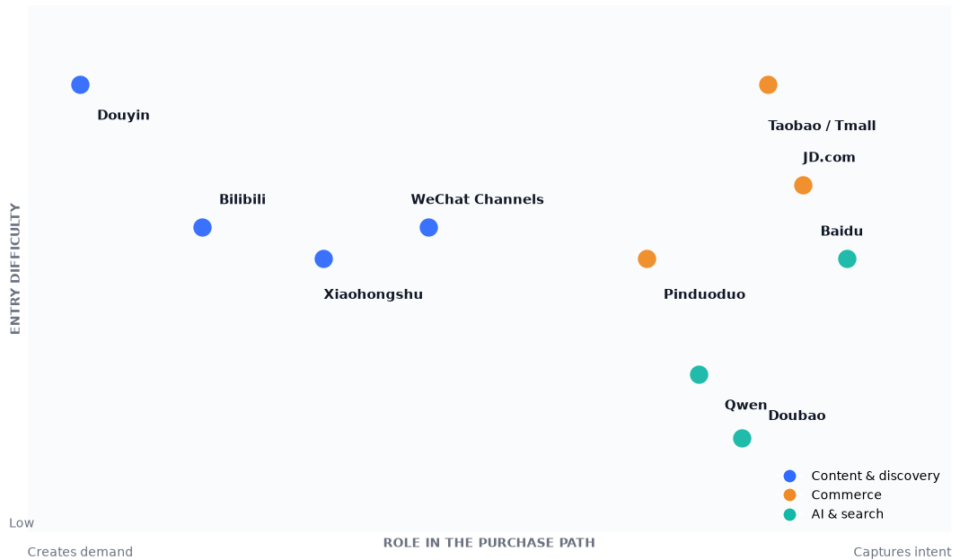
Top 10 Chinese Marketing Platforms Foreign Brands Should Know in 2026
A ranking built on marketing role, not on audience vanity metrics.
Every figure below comes from a regulatory release, a company filing, or a named research firm, with the as-of date attached. Where a platform doesn’t publish audited audience numbers, this article says so instead of repeating a figure nobody can source. Two things are worth knowing before you read the list. Chinese platforms publish reach data on their own terms, and third-party measurement firms count differently from platform ad systems. Treat any single number as a direction, not a ledger.
The short version
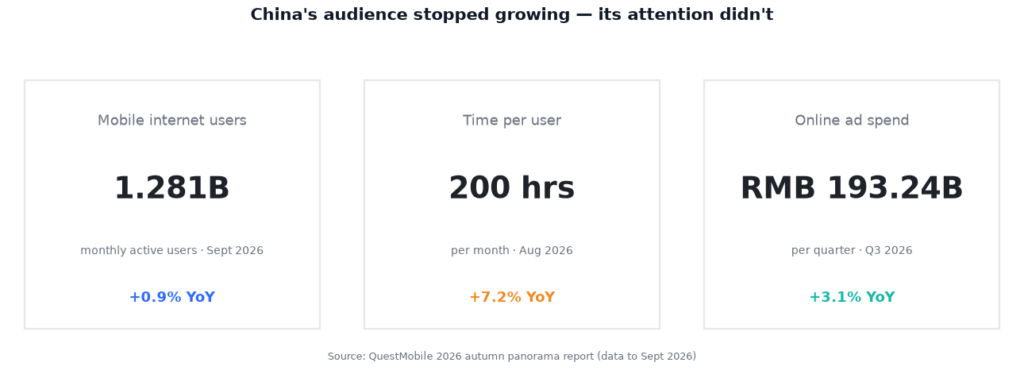
- Mobile audience growth is finished. China had 1.281 billion mobile internet users in September 2026, up 0.9% year on year.
- Attention is not finished. Average time per user passed 200 hours a month in August 2026, up 7.2%.
- Ad money is growing slower than attention. Online ad spend reached RMB 193.24 billion in the third quarter of 2026, up 3.1%.
- The front door moved. AI-native apps hit 546 million monthly users, while search apps lost 21.7% of per-user frequency.
- Build on two platforms, test one. Ten-platform plans die on operations long before they die on strategy.
1. Why this list looks different from the 2020 version
China’s internet used to be a growth story. It isn’t anymore, at least not in users. The audience is essentially fixed at 1.28 billion mobile users, and the year-on-year change rounds to nothing. What still moves is time: users now spend a little over 200 hours a month on their phones, which is roughly what most people spend asleep.
That single fact reorganizes everything a marketer does. You are no longer competing for a share of new users. You are competing for a share of an attention pool that grows about 6% a year, against platforms that are all chasing the same increment.
Three structural shifts follow from it.
Money is consolidating, not expanding. Internet advertising in China grew 3.1% in Q3 2026. That is roughly flat once you account for how fast inventory is being added. Growth now comes from taking budget away from someone else, which is why platform revenue lines look so wildly different from each other.
AI assistants became a front door. AI-native apps in China reached 546 million monthly active users in September 2026, up 82.1% year on year. In the same period, search apps lost 21.7% of per-user usage frequency and 17.2% of per-user time. People didn’t stop looking for answers. They started asking something that answers back.
Off-platform content now feeds on-platform buying. Online retail of goods and services grew 4.4% in the first nine months of 2026 while total retail sales grew 1.1%. Content platforms have spent five years building checkout into the scroll, and it worked. The interesting number is what happens inside them: Douyin’s mall tab grew 240% year on year in Q3 2026, which tells you where the shelf went.
2. How the ranking works
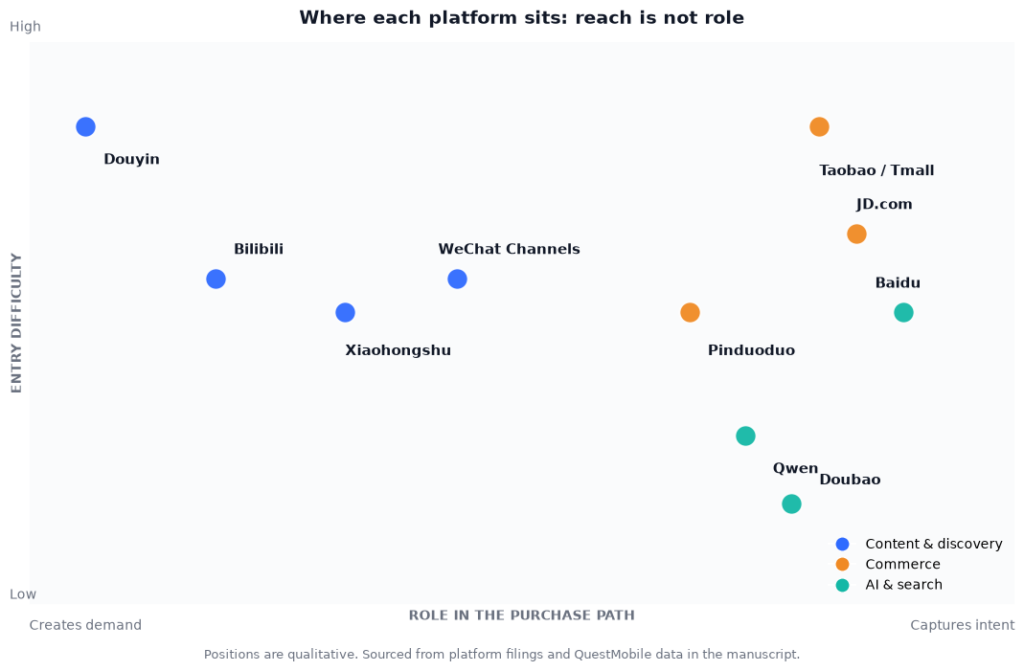
The order below follows marketing function, not size. A platform that reaches a billion people but cannot be measured or bought programmatically ranks lower than one that reaches 300 million with clean conversion tracking. Four criteria set the order: reach, marketing surface (paid, organic, and closed-loop), measurability, and the real cost of entry, which includes licenses, creative volume, and the operational headcount you’ll need in-country.
A note on data hygiene, because it matters more here than in most markets. Company filings are audited and reliable, so when Tencent, Baidu, Bilibili, Alibaba, JD, and Pinduoduo report numbers, those numbers are solid. Third-party measurement from QuestMobile and CNNIC is strong at the market level. Platform media kits are marketing documents and should be read as such. And when a major platform simply doesn’t disclose an audited audience figure, this article leaves the number out. That is the case for Xiaohongshu, and pretending otherwise would be the single easiest way to lose your credibility in a board meeting.
3. Group one: content and discovery
These four platforms decide what people want. They are where demand gets created, argued about, and pre-sold before anyone opens a shopping app.
3.1 Douyin: the demand-creation engine
ByteDance’s own advertising platform describes Douyin as a short-video platform with 600 million daily active users. The line carries no date, and no independent auditor signs off on it, so treat it as an order of magnitude rather than a precise figure. The national context is firmer: China had 1.074 billion short-video users as of December 2025, or 95.4% of everyone online.
What makes Douyin different from TikTok isn’t the format. It’s the fact that the store sits inside the feed. Live commerce, in-feed product cards, and the mall tab all share one recommendation system, which means a piece of content can move someone from “I didn’t know this existed” to “it arrives Thursday” without ever leaving the app. That mall tab grew 240% year on year in Q3 2026, which is the clearest signal in the whole market about where discovery is heading.
Use it for demand creation, new-category education, and live selling with real inventory behind it. Entry difficulty is high: a local entity or authorized agency, category-specific licenses for some products, and a creative output that most foreign teams underestimate by a factor of five.
3.2 Xiaohongshu: the decision-research layer
Xiaohongshu is where considered purchases get researched. Skincare, travel, home, education, anything with a research phase. Its content unit is the note, an image-and-text post that behaves more like a forum thread than a social update, and its search bar carries a lot of the traffic that used to go to general search engines.
Here is where this article has to be honest: Xiaohongshu does not publish audited monthly active user figures, and no research house has produced a number that survives scrutiny. Any figure you see quoted in a pitch deck should be treated as unverified. What is verifiable is its function, which is why it still ranks this high. If your category has a research phase and a review culture, Xiaohongshu sits in front of the purchase in a way that no feed-based platform does.
Entry is moderate. Content can be seeded through creators and brand accounts at a fraction of Douyin’s production cost. Measurement is the weak point: attribution leaks, and the platform’s own analytics won’t reconcile with your CRM.
3.3 WeChat Channels: distribution inside the relationship graph
Weixin, the app the world calls WeChat, reported 1.439 billion combined monthly active users as of June 30, 2026. Inside that, Channels is the short-video and livestream layer, and Tencent says total time spent on Channels grew more than 20% year on year in the second quarter of 2026. That combination is unusual anywhere in the world: a video feed that sits one tap from a messaging thread, a payment rail, and a mini-program that can complete a transaction.
The practical value isn’t reach. It’s the handoff. Content in Channels can push someone into an official account, a mini-program, or a group, which is how brands build the audience Chinese marketers call private domain. If your China plan involves repeat purchase or service, Channels is the connective tissue.
Entry difficulty is moderate, with one caveat. Organic reach here depends on an official account and often a mini-program, which means a development budget, not just a media budget.
3.4 Bilibili: long-form credibility with young adults
Bilibili reported 371 million monthly active users and 116.5 million daily active users in the second quarter of 2026, with daily users up 7% year on year and total time spent up more than 14%. A daily-to-monthly ratio near 31% is high for any platform, and it tells you something a reach number can’t: the people who show up actually stay.
The format rewards depth. Long video, commentary, tutorials, and a culture that punishes obvious advertising. That makes it slow and slightly uncomfortable for brands, and unusually effective for anything that needs explaining: hardware, software, education, financial products, anything where a five-minute explanation beats a fifteen-second hook.
Entry is moderate on cost and high on cultural risk. Content that reads as a paid placement gets buried, and the audience is quick to say so in the comments.
4. Group two: commerce
Three platforms here, and the interesting story in 2026 is that their economics have diverged sharply. That divergence is a better guide to where your budget should go than any GMV chart.
4.1 Taobao and Tmall: the shelf default
Alibaba’s China commerce business still owns the default shopping behavior for a huge share of the population. China had 937 million online shopping users as of December 2025. Alibaba reported approximately 64 million 88VIP members as of June 30, 2026, its highest-spending cohort, growing at a double-digit clip. That number matters more than raw traffic, because it describes people who buy often enough to pay for a membership.
The awkward data point: customer management revenue, which is mostly merchant advertising, fell 7% year on year in the June 2026 quarter, or grew 1% on a like-for-like basis once you strip out a contra-revenue program. Merchant ad budgets are shifting, and they’re shifting toward platforms where content and checkout share a single system.
Use Taobao and Tmall for search-driven conversion and for the credibility that a flagship store still confers. Entry difficulty is high: store setup, category qualifications, Alimama fluency, and a local operating partner.
4.2 JD.com: the trust channel
JD reported net revenues of RMB 346.4 billion in Q2 2026, down 2.9% year on year. The decline reflects a high base more than a collapse, but it says something useful: the platform built on first-party inventory and fast delivery is no longer growing on logistics alone.
What JD still owns is trust. For categories where authenticity and after-sales service carry real weight, JD converts better than platforms with looser supply chains. Its ad products are less sophisticated than Alibaba’s, which is a constraint and also an opportunity, since competition for keywords is thinner.
Entry is high. Margin structure, inventory terms, and the operational discipline JD demands tend to surprise Western brands in year one.
4.3 Pinduoduo: the price-elasticity channel
PDD Holdings reported total revenues of RMB 112.4 billion in Q2 2026, up 8%, with operating profit of RMB 27.8 billion, also up 8%. Profit growing in line with revenue at that scale is unusual, and it tells you the platform is no longer buying growth.
Pinduoduo is the channel for price-elastic demand, agricultural supply chains, and volume. Note what’s missing from its 2026 results: no active buyer count. Neither PDD nor JD publishes an annual active customer figure in these releases anymore, so any cross-platform comparison of “users” you see today is assembled from inconsistent definitions.
Entry cost is low; margin pressure is severe. If your product can’t survive a price comparison, this is the wrong door.
5. Group three: AI and search
This is the group that changed most since 2024, and the one most foreign teams still treat as a side experiment. In China, it’s now a distribution channel with its own audience numbers.
5.1 Doubao: the assistant that answers before search
Doubao reached 419 million monthly active users and 181 million daily active users in September 2026, according to QuestMobile. For scale: China’s entire AI-native app category was 546 million monthly users that month, so one assistant accounts for the majority of it. Users open it about 72 times a month and spend roughly 132 minutes there.
The marketing consequence is blunt. If your brand isn’t in the answer, you don’t exist at the moment of consideration. Doubao and its peers draw on indexed web content, structured pages, and the sources their retrieval layer trusts, which is why answer-level visibility has become a budget line of its own in China, separate from search ads.
Entry cost is low in cash and high in discipline. There’s no ad auction to buy your way into an answer. You earn it with crawlable, well-structured, factually specific content.
5.2 Baidu: the indexed web, now with a model in front of it
Baidu’s app still reached 644 million monthly active users in June 2026, which makes it the largest dedicated search surface in the country by a wide margin. Its AI-native marketing services brought in RMB 2.6 billion in Q2 2026, roughly flat year on year, while management described the broader online marketing business as under pressure.
Read those two facts together and you get the shape of the transition. The audience is intact, the ad model is being rebuilt around AI answers, and the revenue hasn’t caught up yet. For advertisers, that means Baidu remains the most familiar interface in China, with familiar campaign structures and familiar reporting, attached to an answer layer that behaves nothing like the ten blue links.
Entry is moderate and well-documented. The learning curve is mostly about what happens to your click-through rate when an answer appears above the result.
5.3 Qwen: the assistant inside the transaction
The Qwen app reached 158 million monthly active users and 29 million daily active users in September 2026. It matters less for its standalone scale than for where it sits: inside Alibaba’s ecosystem, next to Taobao, Amap, and the payment rail. Alibaba describes it as its flagship consumer AI application, and the strategic intent is visible in the product, which is built to complete tasks rather than to chat.
For brands, this is the quiet one. Assistant-led discovery inside a commerce ecosystem means the assistant may eventually pre-select, compare, and order. Getting your product data clean, structured, and machine-readable is the unglamorous work that determines whether you’re in that shortlist.
6. The ten platforms side by side
| Platform | Reach (latest verified) | Content unit | Best marketing job | Entry difficulty |
|---|---|---|---|---|
| Douyin | 600M DAU, per ByteDance’s ad platform (undated) | Short video, livestream | Demand creation, live selling | High |
| Xiaohongshu | Not disclosed; no audited MAU available | Image-and-text note | Research-stage influence | Moderate |
| WeChat Channels | Inside 1.439B Weixin MAU (June 2026) | Short video, livestream | Distribution plus private domain | Moderate |
| Bilibili | 371M MAU, 116.5M DAU (Q2 2026) | Long video | Credibility with young adults | Moderate |
| Taobao and Tmall | 64M 88VIP (June 2026); 937M online shoppers nationally | Product listing, livestream | Shelf conversion | High |
| JD.com | RMB 346.4B quarterly revenue (Q2 2026) | Product listing | Trust-led conversion | High |
| Pinduoduo | RMB 112.4B quarterly revenue (Q2 2026) | Price-led listing | Volume at low price | Moderate |
| Doubao | 419M MAU, 181M DAU (Sept 2026) | Conversation | Answer-level visibility | Low cost, high discipline |
| Baidu | 644M app MAU (June 2026) | Search result plus AI answer | Intent capture | Moderate |
| Qwen | 158M MAU, 29M DAU (Sept 2026) | Conversation plus task | Assistant-led discovery | Low cost, high discipline |
7. How to choose: three filters, then one rule
Filter one: does your category need explanation? If a five-minute video makes your product clearer, Bilibili and WeChat Channels earn their place. If a fifteen-second demonstration does the job, Douyin is cheaper per impression.
Filter two: how long is the purchase path? Fast, low-price, impulse-friendly products convert inside a content feed. Considered, high-ticket, service-heavy products need a research layer, which means Xiaohongshu and search, and they need a place to land, which means a mini-program or a flagship store.
Filter three: what measurement can your organization actually tolerate? Some platforms give you clean conversion data. Others give you directional evidence and a lot of anecdote. Choosing a platform your finance team can’t report on is how China budgets get cut in year two.
Then the rule: pick two platforms to build on and one to test. Two is enough to cover demand creation plus conversion. One test slot keeps you learning about AI answer visibility, which is where the audience is moving fastest.
8. What actually breaks foreign teams
The strategy is usually fine. The operations are what fail.
Licensing and entity structure. Advertising accounts on most major platforms need a mainland entity or an authorized agency, and some categories need additional approvals before a single impression runs.
Content volume. Chinese feeds reward frequency in a way most Western teams have never staffed for. A monthly content calendar doesn’t survive contact with a recommendation system.
Measurement fragmentation. There is no unified cross-platform attribution standard. Platform-reported conversions, your CRM, and third-party measurement will disagree, and reconciling them is a permanent job rather than a project.
Talent and language. Native-level copy, comment management, and creator negotiation can’t be machine-translated without visible damage.
Data flows. Cross-border data transfer rules affect how customer data leaves the country, and they affect your analytics architecture, not just your legal paperwork.
Price and promotion mechanics. Subsidy-driven pricing is a structural feature, not a seasonal tactic. Brands that can’t flex on price need a different angle.
Platform policy churn. Rules on content, categories, and ad formats change faster than global policy teams can track.
9. Where the budget is actually going
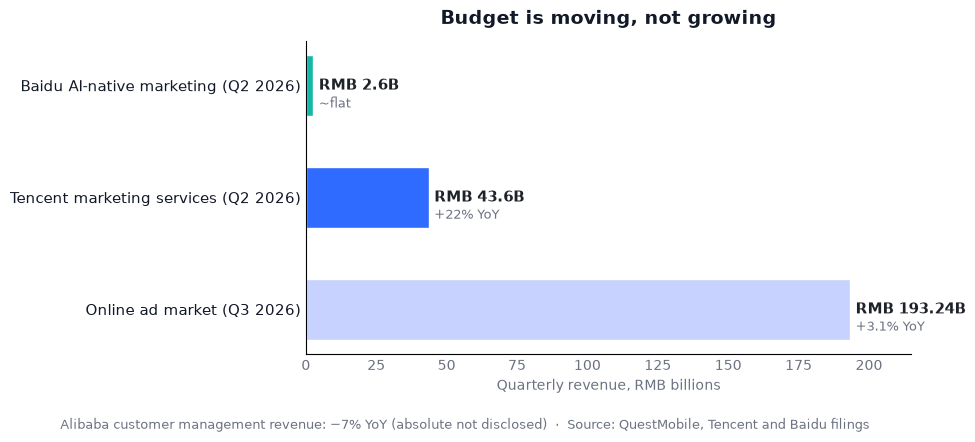
The market is growing slowly, and the money inside it is moving fast.
China’s online ad market was worth RMB 193.24 billion in Q3 2026, up 3.1%. Within that almost-flat total, three platform revenue lines tell the story of the redistribution. Tencent’s marketing services revenue rose 22% year on year to RMB 43.6 billion in Q2 2026. Baidu’s AI-native marketing services held flat at RMB 2.6 billion. Alibaba’s customer management revenue fell 7%.
The pattern is consistent with everything else in this article. Budget is moving toward inventory that sits next to a transaction, a relationship, or an answer. It is moving away from inventory that relies on a user clicking a link and starting a separate journey.
10. What to watch over the next twelve months
Assistant-first discovery becomes measurable. With 546 million monthly users in AI-native apps, the question stops being whether assistants matter and starts being how to report on them.
Micro-drama as an ad format. China had 664 million micro-drama users as of December 2025, 59% of the online population. It is the fastest-growing content format nobody outside China has costed properly.
Instant retail as a media channel. Quick-commerce infrastructure is turning proximity into an ad product, which changes what “local” means for a national campaign.
Agentic checkout. Once an assistant can compare and order, product data quality becomes a growth lever, not a hygiene task.
The squeeze on merchant ad budgets. If commerce platforms keep losing merchant ad revenue to content platforms, expect more bundled packages and more pressure on measured return.
One last thing
China’s platform market in 2026 rewards narrowness. The brands that struggle try to be everywhere and end up with five half-built operations. The ones that work pick a role in the purchase path, staff it properly, and let the platform’s own logic do the distribution. Ten platforms is a map, not a to-do list.
Frequently asked questions
Do we need a Chinese legal entity to advertise on these platforms?
For most paid media, yes, either directly or through an authorized agency. A mainland entity simplifies ad account setup, invoicing, and category approvals. WeChat is the partial exception: a verified official account can be opened by an overseas business, but mini-program development and payment integration usually require a local structure.
If we only have one year of budget, which platform comes first?
Pick the one that matches how your product gets decided, not the one with the biggest audience. Impulse products belong in a short-video feed with checkout attached. Considered purchases belong in a research layer plus a search surface. Either way, put a slice of budget into answer-level visibility from month one, because that channel compounds slowly before it compounds fast.
How is visibility inside an AI answer different from Baidu SEO?
Baidu SEO optimizes for a ranked list of links and a click. AI answers optimize for being quoted, which rewards specificity, clear entity naming, dated facts, and clean structure. Pages built to be summarized outperform pages built to be clicked. It is a different craft, on the same web.
Why do user numbers for the same platform differ so much between sources?
Because they’re measuring different things. Platform figures often count accounts rather than people, mobile-only rather than cross-device, and they may include mini-programs or group apps. Third-party firms deduplicate differently again. Choose one source per metric, state its as-of date, and don’t mix them in a single chart.
Is Xiaohongshu worth the investment if measurement is weak?
If your category has a research phase, yes, and plan to measure it like brand marketing rather than like performance marketing. Use search-volume movement, branded keyword growth, and creator content quality as leading indicators. If your product is bought on price and impulse, the platform’s influence is real but harder to justify, and your budget will work harder elsewhere.