Why the Most Important AI Address in China Is a County of One Million People
The most consequential thing at this year’s Wuzhen summit wasn’t a model. It was a county.
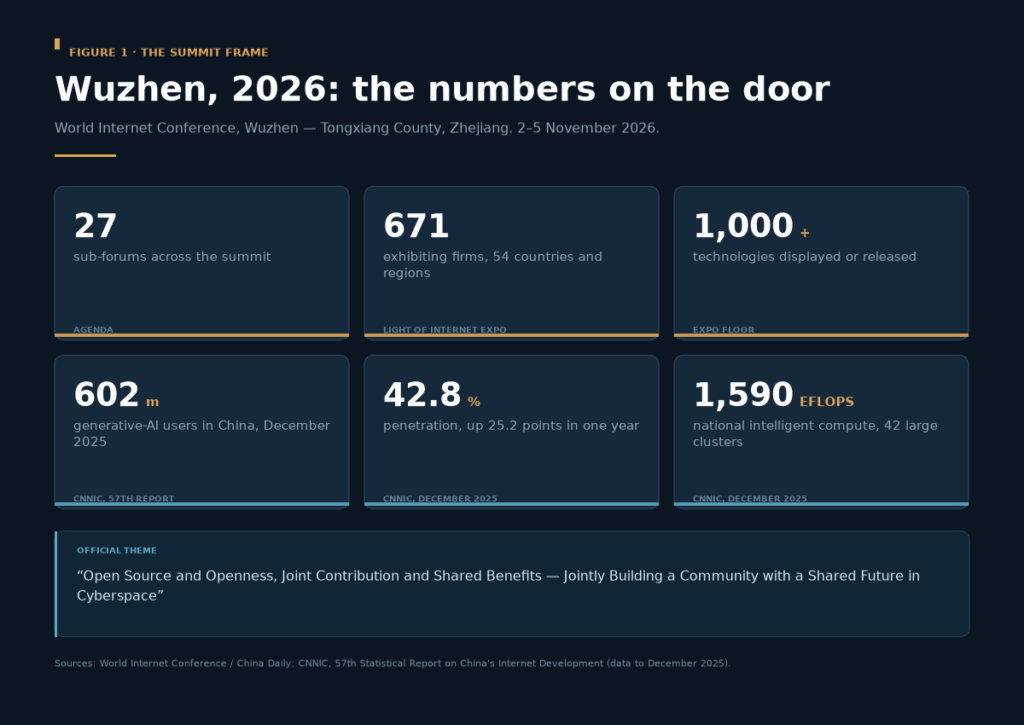
Wuzhen is a canal town of stone bridges and tour boats, folded into Tongxiang, a county-level city in Zhejiang. Every November it becomes the temporary capital of China’s internet industry; the rest of the year it is a place people visit on holiday. This year the World Internet Conference ran from 2 to 5 November, and its theme read less like a slogan than an instruction: “Open Source and Openness, Joint Contribution and Shared Benefits — Jointly Building a Community with a Shared Future in Cyberspace.”
You would expect the story to be about frontier models. It was about where models get put to work.
The expo floor points at the factory door
Walk the Light of Internet Expo and the emphasis is almost defiantly physical. More than 670 companies from 54 countries and regions, and more than 1,000 technologies displayed or released. Alibaba, Huawei, ZTE and Sugon brought computing systems, while Intel, Qualcomm, Microsoft, SAP and Kaspersky filled out the international aisle. The crowds, though, formed around production. Schneider Electric demonstrated inspection for semiconductor, battery and component manufacturing. A future-factory zone showed flexible garment sewing, precision assembly and workshop transport, with Aitu, a humanoid built for garment work, as the centrepiece. Security vendors sold agents that run penetration tests and code audits rather than dashboards that describe them.
That is a real shift in register. A few years ago, the expo was a capability parade. This year the question on the floor was narrower and harder: what does this thing do on a line, at a given defect rate, across a given shift?
Then the county answered
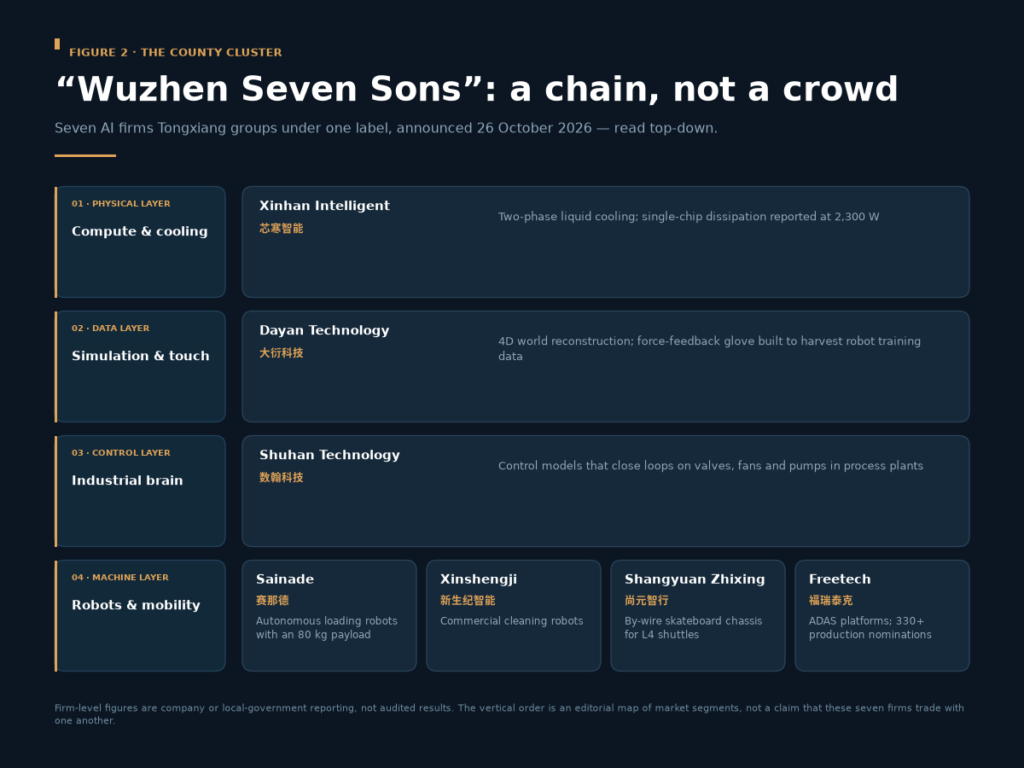
On 26 October, two weeks before the summit opened, Tongxiang put a name on seven of its AI companies: 乌镇七子, the Wuzhen Seven Sons. Hangzhou, an hour up the road, has spent two years coasting on the Six Little Dragons. Tongxiang answered with seven.
Coincidence or branding? Honestly, a bit of both — and the branding is doing real work. A label like that tells ministries, funds and reporters that a county has a portfolio rather than a poster child. But the substance is more interesting than the slogan.
Seven firms, one direction of travel
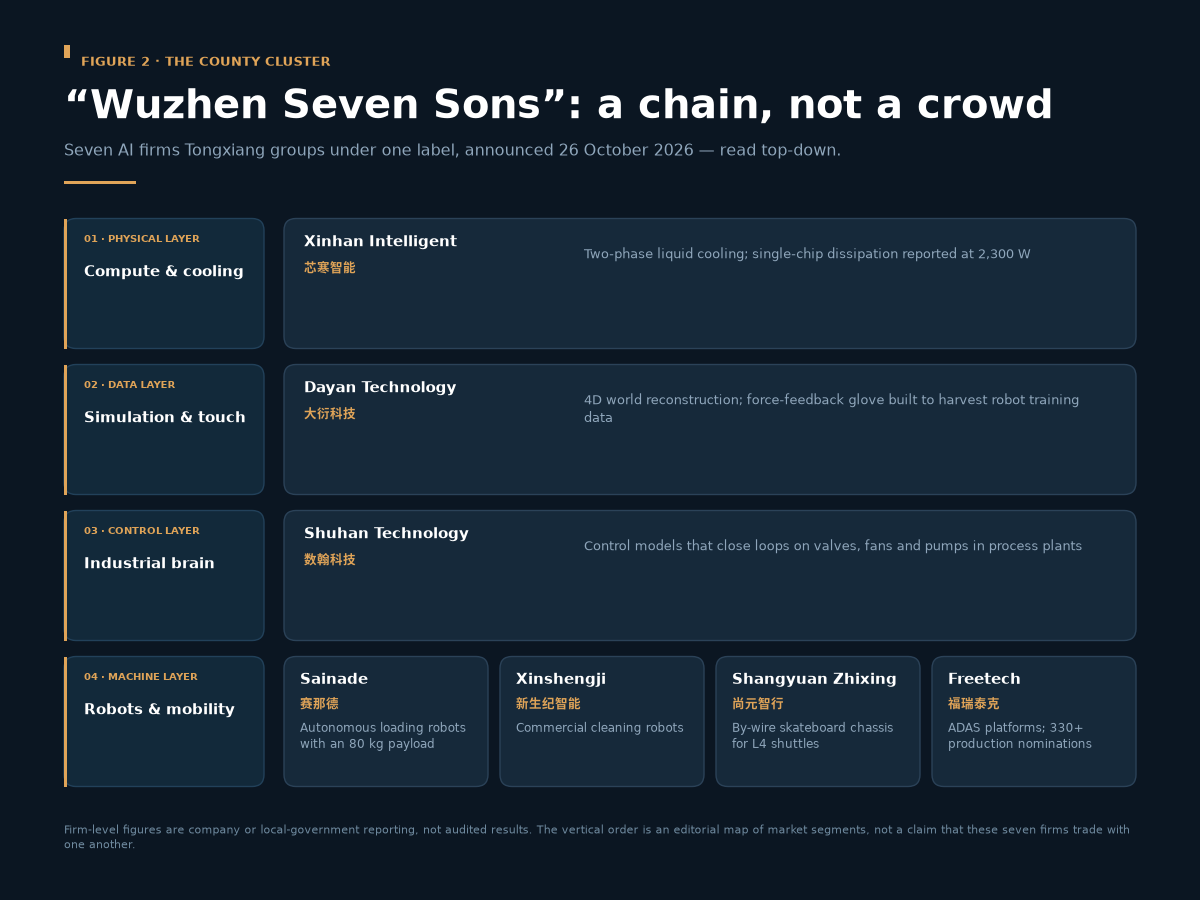
Read the seven as a stack of layers, which is how the county presents them. At the bottom sits Xinhan Intelligent, which does two-phase liquid cooling and is reported to pull 2,300 watts off a single chip. Above it, Dayan Technology builds simulation and touch — 4D world reconstruction plus a force-feedback glove used to harvest training data from physical work. Then Shuhan Technology, whose control models close loops on valves, fans and pumps in process plants rather than simply flagging anomalies. And at the top, machines and motion: Sainade’s autonomous loading robots with an 80-kilogram payload, Xinshengji’s commercial cleaning robots, Shangyuan Zhixing’s by-wire skateboard chassis for low-speed autonomous shuttles, and Freetech’s driver-assistance platforms, with more than 330 production nominations behind them.
Notice what is missing. No frontier lab. Nobody here is training a trillion-parameter general model. The chain runs from heat to data to control to motion, which is to say it runs through the things a manufacturing county already owns.
What a county cluster actually needs
Tongxiang did not stumble into this. Four inputs had to be present, and it is worth naming them, because most counties have two of the four and wonder why nothing happens.
A base you can instrument
Tongxiang’s old economy is summarised locally as 三丝一纺 — mulberry silk, chemical fibre, fibreglass, textiles and garments. Unglamorous. Also perfect: thousands of machines, measurable throughput, expensive downtime, and a manager who can tell you within a shift whether a change worked. AI needs places where the feedback loop is short and the cost of error is legible. A textile plant is exactly that.
Compute you don’t have to build
The 乌镇之光, or Light of Wuzhen, supercomputing centre is described locally as Zhejiang’s only national supercomputing centre. Reported figures put it at more than 1,000 deployed applications and over 100 mainstream large models, with utilisation above 80 percent. That last figure matters more than the first two do. Idle compute is a monument; busy compute is an input.
A corridor rather than a park
Tongxiang’s innovation axis is a 28-kilometre stretch of Wuzhen Avenue. Local reporting says it covers about 16 percent of the county’s land while holding more than 60 percent of its high-level talent and half its high-tech firms. Parks are real estate. Corridors create collisions, and collisions are where a chassis company meets an autonomy company.
Policy that pays the cost of trying
The county’s AI+ action plan bundles support across investment, model development, scenario demonstration and talent, including — per local reporting — compute and corpus vouchers aimed at the cost of experimentation. Subsidising the input is a different instrument from subsidising the product.
Thirteen years of foot traffic
There is a slower mechanism at work too, and it is easy to miss because it looks like tourism. The summit has been held here since 2014. Thirteen Novembers of investors, engineers and ministry delegations walking the same streets produce something a subsidy cannot: accidental meetings that turn into supply relationships. Freetech’s chairman first came to Wuzhen for the summit in 2016; the company later established a manufacturing and R&D base in the county and grew into one of the seven companies.
That is the part other counties cannot copy quickly. You can build a park in two years. You cannot build a decade of foot traffic.
Why open weights made this arithmetic work
Here is the part that rarely gets said plainly. A county cannot buy a frontier lab. It can buy time on someone else’s cluster, and it can offer factory floors that no lab has. Once capable model weights are openly downloadable, the licence fee for a decent base model collapses toward zero, and the binding constraints become compute, data and a place to test. Two of those three are local advantages.
That is why the summit’s theme is not decoration. Open weights are the mechanism by which a county can participate without owning a research institution. The United States is not short of counties; it is short of a policy stack that treats a county as a deployment unit.
The fork in the road
Which brings us to the commercial logic, and to the place where analogies to Silicon Valley start to break.
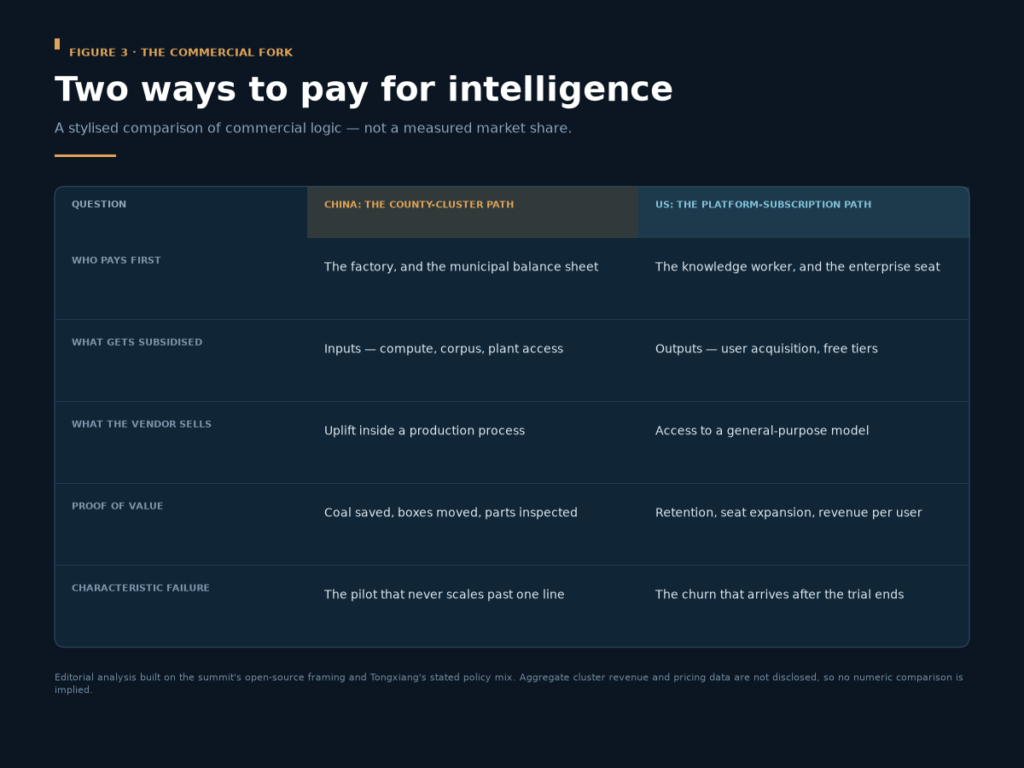
The dominant American pattern monetises access: a subscription, a seat, an API meter. Value is proved by retention and expansion. The pattern emerging here monetises uplift inside a process: a plant saves coal, a warehouse moves more boxes, an inspection step stops missing defects. Value is proved by an operational delta, and the buyer is often a factory manager with a budget line rather than a chief information officer with a platform strategy.
Neither model is superior. They fail differently. Subscription businesses die of churn after the trial; process businesses die in pilot purgatory, one line at a time, forever. If you are evaluating Chinese AI vendors, the failure mode to probe is not “will they survive the next funding round?” but “has this ever gone from one line to ten?”
If you sell into these clusters, change your questions
Most B2B playbooks assume a buyer who already believes in software. That buyer is rarer here than the headline user numbers suggest.
China had 602 million generative-AI users as of December 2025, up 141.7 percent year on year, with penetration at 42.8 percent — a jump of 25.2 percentage points in twelve months, according to CNNIC’s 57th report. National intelligent compute passed 1,590 EFLOPS across 42 large clusters. That is enormous adoption. It is also mostly consumer adoption of free tools, which tells you something important: familiarity is high, willingness to pay for software is not automatically high.
So the questions change. Not “what is your model’s benchmark score?” but “which plant, which line, which shift, and what did the number look like before?” Not “how accurate is it?” but “who owns the data it learns from, and what happens to my integration when your next model ships?” Not “can we start a pilot?” but “what did the last pilot cost to keep alive?”
Where this story breaks
Three honest caveats, because the genre of county-AI coverage is prone to inflation.
First, the label is promotional, not statutory. I found no evidence that the Wuzhen Seven Sons is a formal government designation with certification attached. It is how the county talks about a group of firms, and it should be read that way.
Second, the numbers are mostly self-reported. Firm-level figures in this piece come from company or local-government accounts and are unaudited. Where I could not corroborate a figure against an independent source, I left it out — which is why you will not find cluster revenue here, or valuation, or headcount. Nobody has published them.
Third, a chain on a slide is not a supply chain. The seven occupy adjacent segments; that does not mean they buy from one another. And the summit is in its thirteenth year, but this cluster is not. Announcements in Chinese local tech policy routinely run a year or two ahead of revenue. Treat the map as a statement of intent.
The setting changed
The interesting thing about Wuzhen 2026 is not that China has good models. Everyone knows that by now. It is that the country has started to treat AI as an industrial policy problem rather than a research race — and has picked the county, not the metropolis, as the unit that has to make it pay.
Six dragons in Hangzhou. Seven sons in a county an hour away. If you are still tracking this market by parameter counts, you are reading last year’s scoreboard.