Three Jobs, Not Three Channels: A Margin-Led Way to Choose Between Douyin, Xiaohongshu and WeChat Channels
Douyin vs Xiaohongshu vs WeChat Channels: Pick Two, Ignore the Third
They are not three versions of one thing. They are discovery, deliberation, and retention — and the channel you drop is decided by your gross margin, not by your category.
Every operator selling into China eventually faces the same shortlist: Douyin, Xiaohongshu, WeChat Channels. The reflexive answer is to run all three, split the budget, and let the market decide. That answer is expensive, and it is usually wrong.
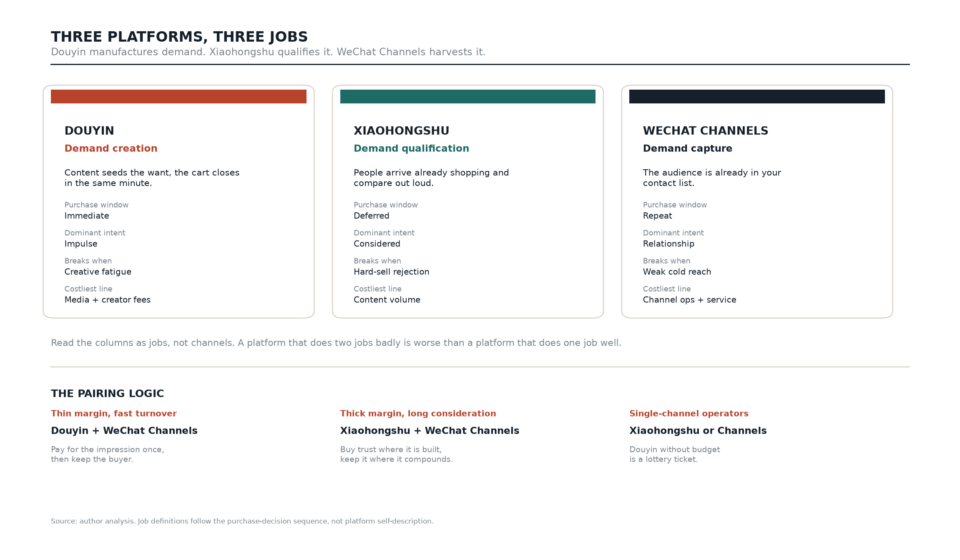
From the outside they look alike: full-screen video, creator-led selling, live rooms, and the same vocabulary of 种草 (planting desire) and 达人 (influencers). Underneath, they occupy three different positions in the purchase sequence, and each position has its own cost structure. One manufactures demand in front of people who were not shopping. One sits inside a search-and-compare habit. One distributes to an audience you already have a relationship with.
Once you see the three as jobs rather than channels, the allocation question changes. You are not choosing where to advertise. You are choosing which part of the buying decision you want to own, and how much you are willing to pay to own it.
A note on scope: this is written for operators with a real P&L — a contribution margin, a return rate, a repeat-purchase curve. If your budget is for brand awareness with no payback target, most of this will read as unnecessary discipline.
1. The false equivalence
The comparison persists because the interfaces have converged. Douyin, Xiaohongshu and Channels all ship a vertical feed, a live room, and a shop. A marketer who has only seen screenshots could be forgiven for thinking they are three doorways into the same room.
Three differences matter commercially.
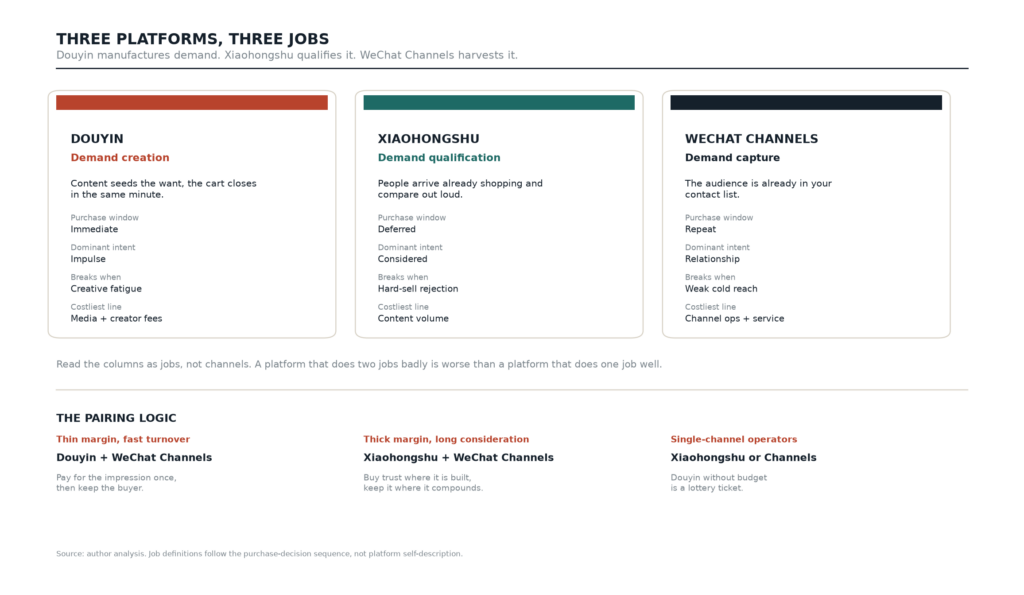
The intent at entry. Douyin opens on a recommendation. The user arrived to be entertained and ends up being sold to. Xiaohongshu opens on either a followed feed or a search box, and the search box is used the way people use a review site. Channels opens inside a messaging app, usually because someone sent a link or because a followed account posted.
The length of the purchase window. On Douyin the window is short by design: the offer, the price, and the checkout sit inside the same screen. On Xiaohongshu the window is days to weeks, and the purchase frequently happens somewhere else entirely. On Channels the window is the relationship, which can be months.
Who holds the buyer afterwards. This is the one most teams underweight. Douyin gives you an order and a weakly reachable follower. Xiaohongshu gives you a note that keeps working and a buyer you mostly cannot identify. Channels gives you a person inside a contact system you control.
A useful test: ask which sentence the platform owns. Douyin owns “I did not know I wanted this.” Xiaohongshu owns “I am deciding between three of these.” Channels owns “I bought this before and I trust them.”
2. Douyin: content manufactures intent, and the cart closes inside a minute
Douyin is a demand-creation machine with a checkout attached. Its feed does not wait for a search; it produces the want. That is why the platform can move categories that no one was looking for, and why it is brutal on categories that need explaining.
The scale is no longer in question. Douyin passed one billion monthly users, with average daily time in app above ninety minutes, and it has taken the top spot nationally on monthly time spent per user. Its commerce arm cleared RMB 3.42 trillion in GMV in the latest full year, and booked RMB 2.4 trillion in the first half of 2026 — a number that says growth is still real but no longer explosive. Across the whole market, livestream-enabled commerce is now a RMB 7 trillion business by the estimate in the annual industry report published in May 2026.
The economic consequence is simple and unforgiving. On Douyin you rent attention every single time. Nothing accumulates except a creative library and a follower base whose organic reach is thin. The cost of the next sale is roughly the cost of the last sale, plus whatever the auction has added since.
So Douyin rewards a specific kind of offer: a demonstrable product, a price that reads as a deal on screen, high turnover, low consideration, and a margin that can absorb paid distribution. It punishes anything that requires a paragraph of explanation, anything with a long evaluation cycle, and anything where the return rate quietly eats the contribution.
What it does better than anything else in the market is compress the distance between “that looks good” and “order placed.” That compression is the product. If your business needs that compression, Douyin is worth the rent. If it does not, you are paying for speed you cannot use.
3. Xiaohongshu: search-shaped, high-intent, allergic to hard sell
Xiaohongshu is the only one of the three that behaves like a library. Notes persist, get indexed, resurface in search, and keep producing impressions long after the creator has moved on. That changes the accounting: content here is capital expenditure, not media spend.
The platform is now at roughly 170 million daily users and is openly steering toward 200 million, with revenue in the region of RMB 42 billion. Those numbers matter less than the behavior behind them: people arrive with a question, not a mood. They compare, they read comments for the counter-argument, they look for the flaw. A note that admits a flaw converts better than a note that does not.
This is also why hard selling fails there. The community treats overt persuasion as a breach of the format, and the penalty is quiet: your reach collapses rather than your comments turning hostile. The platform’s own commercial direction reinforces the search logic — it has been building AI-assisted search into the commerce path, which tells you what it thinks its core asset is.
What Xiaohongshu rewards: specificity over polish, proof over adjectives, honest negatives, category authority, and a coherent visual world. What it punishes: discount-led positioning, generic brand claims, and the kind of content that could have been made for any platform.
The commercial catch is that conversion is often deferred and often off-platform. A buyer convinced in a note may complete the purchase in a marketplace search, a group chat, or a store. You will pay for the persuasion and book the revenue somewhere else, which is why Xiaohongshu punishes lazy attribution more than any other channel in this set.
4. WeChat Channels: distribution you already own
Channels is the odd one out because it is not a marketplace with a feed. It is a feed inside an app with 1.43 billion monthly users, wired into messaging, groups, subscriptions, and mini-programs. Distribution runs through the social graph: a like sends a video to someone’s contacts, a share lands in a group chat, a live room fills because it was forwarded rather than because it was auctioned.
Supply on the advertising side is still expanding. Video Accounts advertising grew about 20% in the first quarter of 2026 and about 22% across the first half, in a half-year when Tencent booked RMB 401.2 billion in revenue. Tencent has consistently framed ad load on Channels as below what it considers normal for a short-video feed — a polite way of saying inventory will keep being added.
That combination — rising inventory, social distribution, and a logged-in audience — produces the cheapest incremental reach available to a brand that already has customers. It produces almost nothing for a brand that has none.
Channels rewards service quality, repeat purchase, membership mechanics, and content made for people who already care. It punishes launch strategies that need strangers. The ceiling is your contactable base; the platform amplifies a relationship, it does not create one.
5. Three cost curves, not three prices
Comparing channels by CPM is the most common analytical error in this decision, because CPM describes a unit of inventory and says nothing about what happens after the impression.
Douyin is a variable-cost channel. Cost per acquired customer tracks the auction, rises as the category crowds, and does not fall with scale. There is no compounding asset on the media side. The curve is roughly flat and slightly upward.
Xiaohongshu is a fixed-cost channel with a long tail. The expensive part is producing enough notes to be credible across a category; the marginal distribution of the tenth note is close to zero, and that note keeps earning search impressions for months. The curve starts steep and flattens.
Channels is a low-marginal-cost channel with a hard ceiling. Reaching an existing contact is nearly free. Reaching a stranger is nearly impossible. The curve is flat and then vertical, where it hits the size of your list.
The practical implication: fixed-cost channels win above a content-volume threshold, variable-cost channels win below it. A team that can produce twenty credible notes a month has a different optimal answer from a team that can produce two.
The arithmetic that settles it is allowable CAC. Take contribution margin per order, multiply by the number of orders you expect from a cohort after accounting for decay, and you have the ceiling on acquisition cost. If contribution is RMB 60 and the cohort delivers 1.4 orders, the ceiling is about RMB 84 — and that ceiling, not the platform’s reported ROAS, decides whether a channel is viable.
6. Where each one breaks
Every channel has a failure mode that looks like success for the first six weeks.
Douyin breaks on thin economics. High return rates, price anchoring, and creative fatigue arrive together. The first month’s ROAS looks fine because the audience is fresh; by month three the same creative is bidding against itself, and the category’s CPM has moved. It also breaks structurally when the offer needs a salesperson rather than a demonstration.
Xiaohongshu breaks on throughput. The format demands volume and consistency, and a brand that posts twice a month is invisible inside a search index. It breaks sooner when the team treats it as an ad channel: paid amplification of content nobody would save is the most reliable way to spend money there and learn nothing. It also breaks on categories where price is the only variable, because the community will find the cheaper alternative and say so in the comments.
Channels breaks on cold reach. With no list, no service history, and no content for existing customers, the feed has nothing to amplify. Teams often misread this as a platform limitation. It is not; it is a relationship limitation.
In all three cases the false positive is identical: an early spike that is actually novelty, not efficiency.
7. A decision tree built on unit economics
Gross margin per order, after product cost, shipping, returns, and platform fees, sets the ceiling on what you can pay to acquire. Repeat rate sets the value of owning the buyer. Those two variables generate six sensible answers, and each one deliberately drops a platform.
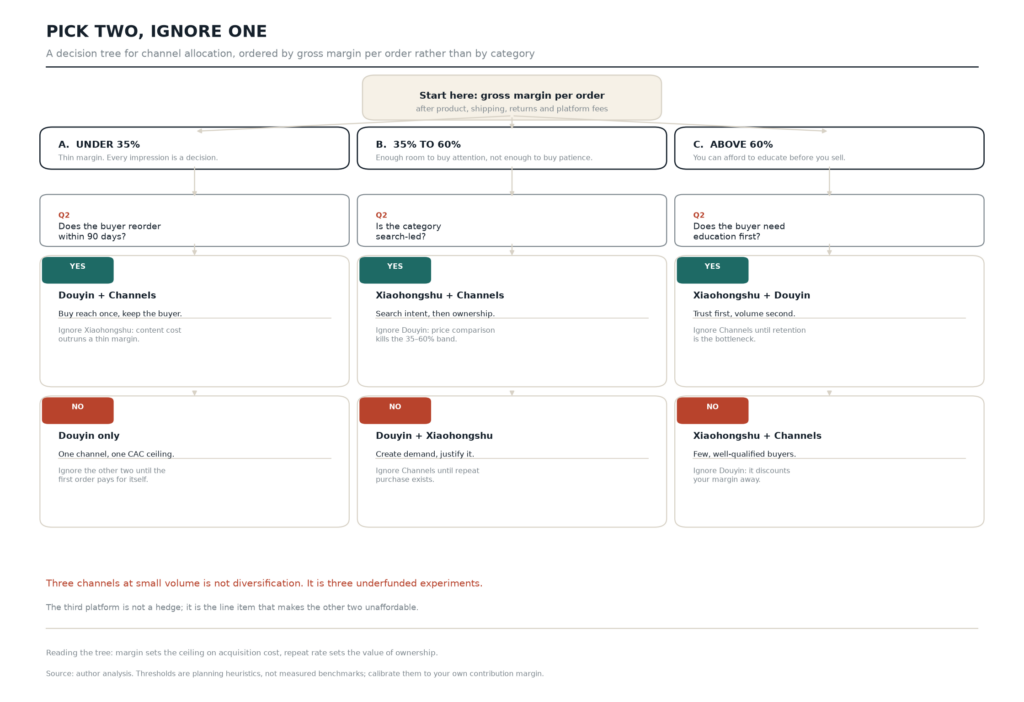
Under 35% margin, the only affordable model is cheap acquisition plus fast repeat. Douyin plus Channels, with Xiaohongshu set aside — not because it is worse, but because sustained content production is a fixed cost that a 35% margin cannot fund at the volume required to be credible. If the buyer does not reorder within ninety days, the answer collapses further, to Douyin alone with a hard CAC ceiling.
Between 35% and 60%, you can afford to buy attention but not to buy patience. If the category is search-led — considered, compared, and researched — Xiaohongshu plus Channels is the pairing, and Douyin is the one to drop, because price transparency on a mass feed will compress a mid-margin product into a low-margin one. If the category is not search-led, the pairing inverts: Douyin to create demand, Xiaohongshu to justify it, Channels deferred until repeat purchase exists.
Above 60%, education becomes affordable. Where buyers need to be convinced before they buy, Xiaohongshu plus Douyin is the strongest combination: trust built in the library, volume bought in the feed. Channels waits, because a high-margin business with no retention problem does not yet need a retention channel. Where education is unnecessary, Xiaohongshu plus Channels serves fewer, better-qualified buyers, and Douyin is the one that would discount the margin away.
The thresholds are planning heuristics, not measured benchmarks. The structure is the point: margin sets the ceiling, repeat rate sets the value of ownership, and the third platform is a deliberate omission rather than an oversight.
8. Why “all three” fails at small volume
Running three channels is not diversification. It is three underfunded experiments sharing one team.
Each platform has a minimum viable density below which you are buying noise rather than learning. Douyin needs enough creative volume to test offers weekly. Xiaohongshu needs enough notes to appear in search at all. Channels needs a list large enough that a broadcast produces a measurable response. Fund all three at a third of the required density and none of them will produce a signal you can trust.
The second cost is grammar. The creative grammar of a Douyin demonstration, a Xiaohongshu note, and a Channels broadcast does not translate from one to another. A team that tries to reuse assets across all three produces content that is mediocre on every platform, which is a slower and more expensive failure than picking one and doing it properly.
The third cost is attention. Channel operations are not passive; each one has a rhythm, a reporting cadence, and a set of platform-specific mechanics. At small scale the binding constraint is usually management bandwidth, not budget.
The 60/30/10 split is the most common version of this mistake. It guarantees that the 60 is under-resourced against its own competitors, the 30 is too small to compound, and the 10 exists only to satisfy a slide.
9. The handoff problem
None of these platforms is designed to hand you the buyer. That is not a bug; it is the business model.
Douyin reports conversions inside its own attribution window and counts them generously. Xiaohongshu’s influence is real but diffuse, and the purchase frequently lands in a different system. Channels is closed by design: the relationship lives inside WeChat, and what you can export is limited. Add overlapping exposures and you get the familiar result — three platforms each claiming the same order, and a blended CAC that no one can reconcile.
What actually works is instrumenting the handoff rather than the impression. Build unique offer architectures per channel, so the order carries its origin. Capture a first-party identifier at the earliest possible point. Build cohort tables on ninety-day windows instead of campaign windows. Run post-purchase surveys that ask where the decision started. And, where budget allows, use matched geo tests rather than platform-reported lift.
The organizations that get this right treat attribution as an operations problem, not a reporting problem. They accept a margin of error and design offers that make the error smaller.
10. The pairing order
If you accept the tree, the pairing decision becomes a ranking exercise with three criteria: cost of learning, speed to first signal, and whether the channel leaves you an asset.
Thin margin: Douyin plus Channels. Fastest route to a signal, and the only pairing where the acquisition channel pays for itself while the retention channel reduces the cost of the second order. Xiaohongshu is dropped, not deferred.
Mid margin: Xiaohongshu plus Channels. Slowest start, best compounding. The content library keeps earning, and the list captures the buyers the library produces.
High margin: Xiaohongshu plus Douyin. Education first, scale second. This is the only band where both demand creation and trust-building can be funded at the same time, and it is the band where Channels can wait without consequence.
One asymmetry deserves emphasis. Channels inventory is still being added, and the price of reaching an owned audience is still low relative to the alternatives. That window will not stay open indefinitely; ad load is a lever Tencent has explicitly said it intends to use.
11. The migration path
Ninety-day blocks, one metric per block, and a kill criterion written down before the block starts.
Days 0–90: one channel, one offer, one number. Pick the acquisition channel the tree assigns you. Run a single offer architecture. Measure contribution per acquired customer, not ROAS. The goal is not growth; it is a trustworthy number.
Days 91–180: add the retention channel. Build the list deliberately — every order should produce a contact, every contact should produce a reason to stay. This is the phase most teams skip, and it is the phase that determines whether the first channel’s economics ever improve.
Days 181–365: consider the third only if the ceiling allows. The test is narrow: does the first channel’s CAC ceiling still leave room for a second acquisition engine, and does the retention channel already cover the repeat business? If either answer is no, the third platform is a distraction with a media plan.
What to stop doing is easier to list than to enforce: stop buying reach to prove a channel works, stop reusing creative across formats, stop reporting platform ROAS as if it were profit.
12. The twelve-month view
Three supply-side shifts are already visible, and they change the arithmetic.
Channels is adding inventory while social distribution keeps its cost advantage. That makes owned-audience reach the cheapest line in the plan, and makes the list — not the follower count — the asset worth building.
Xiaohongshu is pushing commerce deeper into search, including AI-assisted search, which raises the value of a durable content library and lowers the value of a campaign burst. Content that answers a question will keep appreciating; content that announces a sale will not.
Douyin is maturing. Growth is normalizing, monetization is intensifying, and the platform is optimizing for merchant economics rather than for reach. Creative costs will keep rising, and the categories that survive there will be those with enough margin to keep buying the auction.
Put together, the direction is clear: distribution gets cheaper where you own the relationship, search gets more valuable where you own the answer, and paid reach gets more expensive everywhere. That is an argument for building two things — a content library that answers real questions, and a first-party list that survives platform changes — rather than for spreading a budget across three feeds.
The third platform is not a hedge. It is the line item that makes the other two unaffordable. Pick two, fund them properly, and revisit in twelve months, when the supply picture has changed again.
Summary
- Douyin, Xiaohongshu and Channels perform three different jobs: demand creation, demand qualification, and demand capture. Comparing them as channels is the root error.
- Cost structure differs more than CPM does: Douyin is variable and non-compounding, Xiaohongshu is fixed with a search tail, and Channels is low-marginal-cost with a reach ceiling.
- Gross margin per order sets the ceiling on acquisition cost; repeat rate sets the value of owning the buyer. Those two variables produce six defensible pairings, each with a named omission.
- Running all three at small volume fails on density, creative grammar, and management attention long before it fails on budget.
- The handoff, not the impression, is what must be instrumented. Platform-reported ROAS systematically overstates contribution.
FAQ
Can a small team run all three channels?
It can run three accounts. It cannot run three channels, because each requires a minimum density of content and a distinct creative grammar. At small volume, three channels produce three weak signals and one exhausted team.
Which two should a high-ticket, considered category choose?
Xiaohongshu and Douyin, in that order of investment. The library builds the argument; the feed buys the volume. Channels becomes relevant once repeat purchase or service becomes the constraint, which for many high-ticket categories is later than expected.
Is Douyin still viable with a thin margin?
Yes, but only with a hard CAC ceiling and a fast repeat cycle. Thin-margin operators should treat Douyin as a paid acquisition engine with an expiry date per creative, and pair it with a channel that lowers the cost of the second order.
Does Xiaohongshu need a dedicated team?
It needs a dedicated content function, which is not the same thing. The failure pattern is a performance team that treats notes as ad units. The work is closer to editorial than to media buying.
How do I measure performance when the platforms control the data?
Build the measurement around the handoff: channel-specific offer codes, first-party identifiers captured early, ninety-day cohort tables, and periodic matched geo tests. Accept imprecision and design offers that reduce it.