Discovery Happens Before Search: What Xiaohongshu Teaches Global Marketers
Xiaohongshu (RedNote) Marketing: Discovery Happens Before Search
You unlock your phone with nothing to buy. Somewhere between the third and the thirtieth post, a room appears: afternoon light, a lamp, a chair that looks genuinely comfortable. You save it. You keep scrolling. Two days later you type four words into a search bar, and the four words describe something you did not know you wanted on Tuesday.
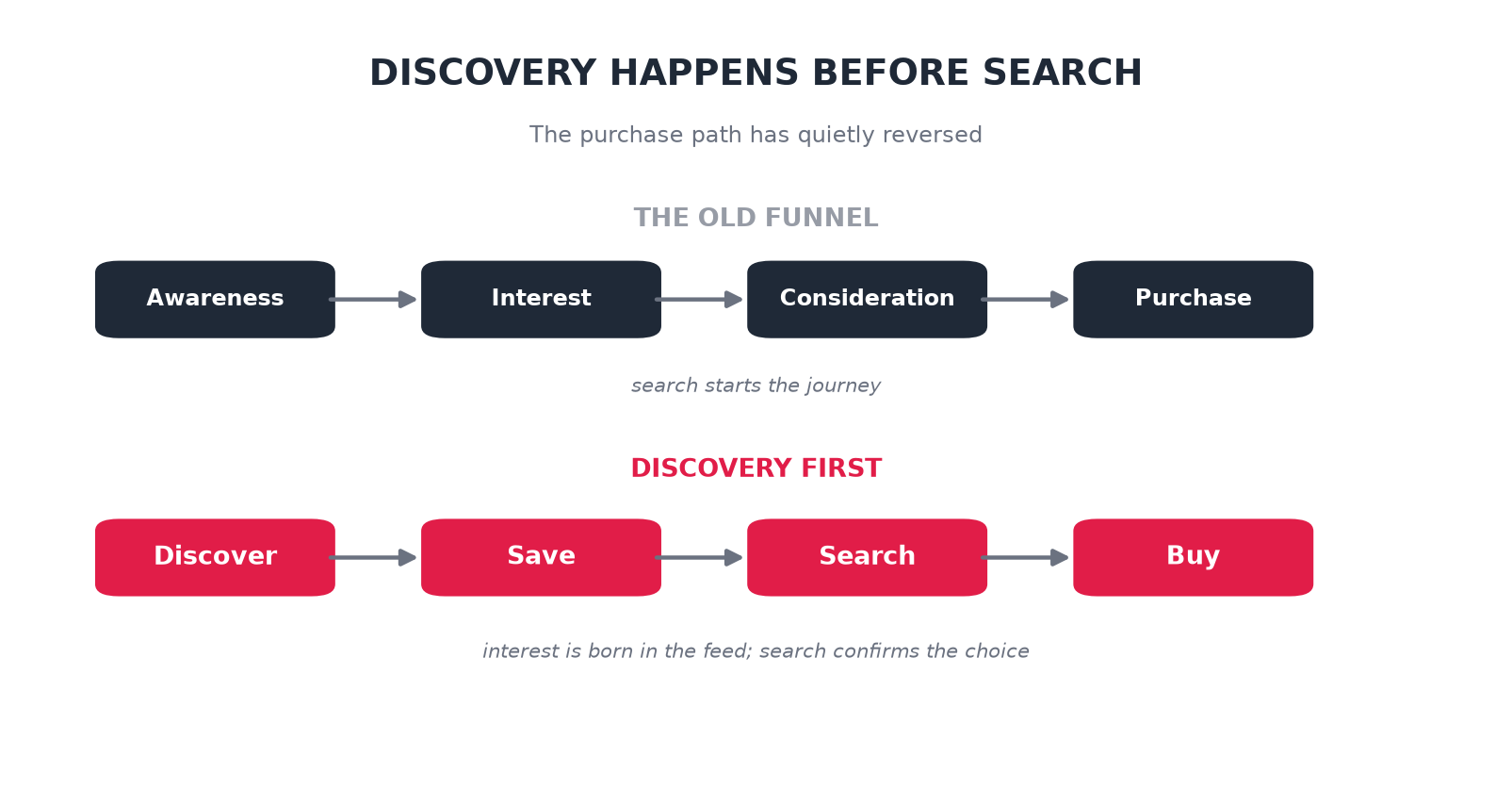
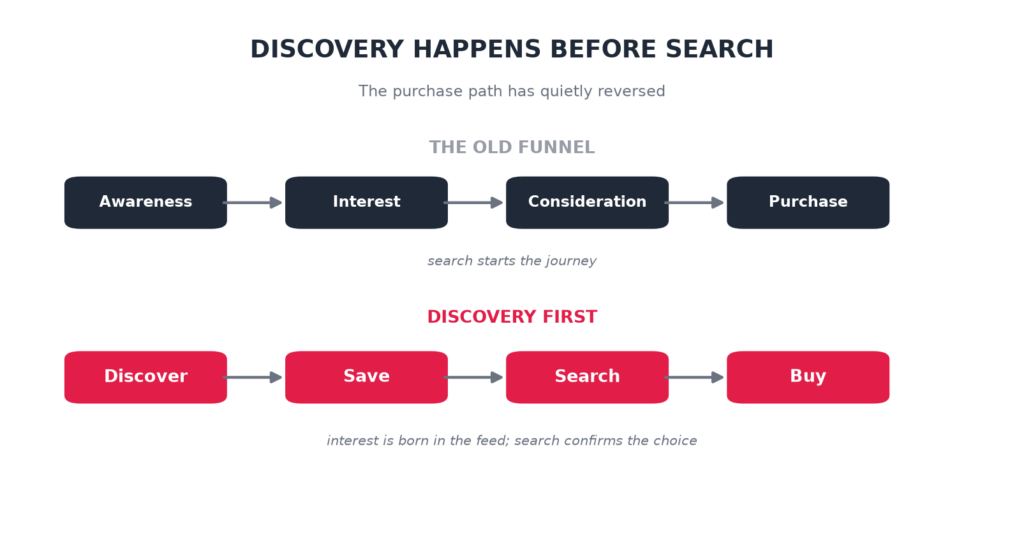
That sequence, repeated a few hundred million times a day, is the quiet structural change in marketing. The search did not create the interest. The feed did. Search collected the receipt.
Most brands still budget as if the order ran the other way, and that single assumption distorts everything downstream: the brief, the creator list, the measurement plan, and the reason the quarterly review concludes that social “does not convert.”
What “discovery before search” actually describes
Discovery before search is a behavior pattern in which interest forms inside a feed, before any keyword exists, and a query appears later as validation.
Three conditions have to hold at once, and each one breaks a habit marketing teams have spent twenty years building.
A person, not a placement. The trigger is a note, a photo, a forty-second clip. Something with a name behind it. The audience is not reading an ad and deciding whether to believe it. They are reading a stranger and deciding whether that stranger is like them.
The interest arrives before the language. You cannot keyword-target a need that has no words yet. This is the part budget models handle badly. If the need is created in the feed, the feed is where the media money belongs, not only the retargeting line that catches people afterward.
Relevance is not the same as an answer. A search engine is asked a question and returns a list. A discovery feed is asked nothing and returns a guess about who you are becoming. Different machines, different failure modes.
| Stage | Old assumption | Discovery-first reality |
|---|---|---|
| First contact | A paid impression interrupts a passive reader | A note is encountered while the reader is doing something else |
| Interest | Already present, waiting to be captured | Manufactured on the spot, often without words |
| Research | Search begins the journey | Search tests a decision already half made |
| Purchase | End of a linear path | One possible exit from a loop that keeps running |
The practical consequence is blunt. If your model assumes intent arrives pre-formed, you will keep buying the cheapest way to reach people who are already shopping, then wonder why acquisition costs creep up every year.
Why China is the cleanest place to watch this happen
China is the best laboratory for this behavior because a very large share of its users never had a desktop-search habit to unlearn. They went from feature phones straight into feeds, and the feed became their default interface for learning what exists.
The official numbers remove any doubt that this is mainstream. CNNIC counted 1.125 billion internet users in China at the end of 2025, with penetration at 80.1 percent, and reported 602 million users of generative AI tools, up 141.7 percent in twelve months. Independent measurement puts social platform reach at 98.6 percent of Chinese internet users, which means social is not a channel in China. It is the operating layer.
That is the context in which a platform built entirely around user-written notes could grow into a mass habit rather than a niche taste.
Inside Xiaohongshu: a platform built on the note
Xiaohongshu launched in 2013 as a place to write down purchases and trips and let other people read the notes. The unit of content has not really changed since. A note is a short piece of text with images or video, written by a person about something they actually used, ate, wore or visited.
Two design choices matter more than any feature list.
Distribution is earned per note. A new account can reach a large audience with one good note, because the system tests content on small cohorts and expands whatever holds attention. Follower count is a weak predictor of reach, which is why brands that buy a big account and expect guaranteed distribution keep getting surprised.
Saving is the signal that matters. On most platforms the valuable signals are likes and comments. Here the save sits closer to the top of the hierarchy, because saving means “I will need this later.” That is intent, recorded before purchase, in a place most attribution stacks never look.
What the user numbers can and cannot tell you. The company’s widely reported scale is roughly 300 million monthly active users, and independent estimates published during 2026 run higher, but Xiaohongshu does not publish audited user counts. Treat any single number as directional, and treat the direction as unambiguous. This is a mass-market platform whose center of gravity is young, urban and majority female, not a fashion micro-community.
The seeding mechanism: how desire gets planted
The Chinese word for this is seeding strategy, literally planting grass. In English the closest phrase is seeding, though seeding undersells what happens, because the goal is not coverage. The goal is to place a plausible desire in front of someone who was not shopping.
The mechanism runs in four moves.
- A creator with a small audience writes about a real experience, usually a specific one: the cream that fixed a patch of dry skin, the chair that survived two moves, the noodle shop worth a forty-minute queue. Specificity is what makes it readable, and readability is what makes it travel.
- The platform tests that note against a small group whose behavior suggests affinity. If saves and completion rates are healthy, distribution widens.
- A reader saves it. The save is the moment the note stops being content and becomes a small piece of private inventory.
- Later, the reader searches, often with the category in mind rather than the brand. What they search is the phrase the note taught them.
-
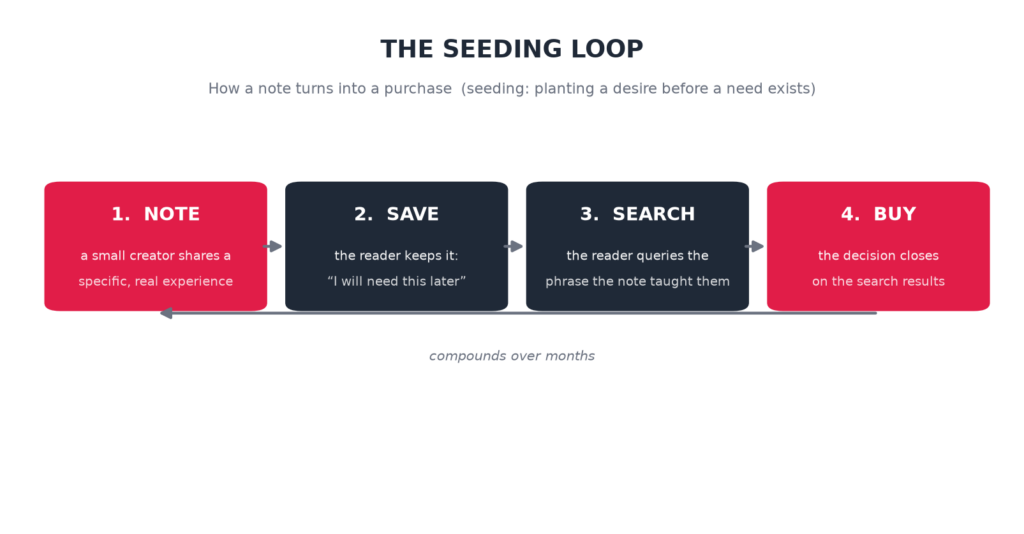
How a note turns into a purchase: note → save → search → buy, compounding over months. Notice what the brand controlled here: almost nothing beyond the truth of the claim and the clarity of the writing. That is uncomfortable for teams used to approving every pixel, and it is precisely why the mechanism works.
Why trust moves differently on a note
An ad announces its motive in the first frame. Everyone watching knows the purpose is to sell, and the brain discounts accordingly. A note hides nothing either, but the motive on display is different: this person is telling you something because they wanted to tell someone.
So the audience is not measuring production quality. They are measuring whether the writer had a reason to lie.
That is why a badly lit photo of a real kitchen can outperform a studio shoot, and why polishing a note too far destroys the thing that made it credible. Credibility is borrowed from the writer and repaid by the brand, one save at a time. It is slow, it compounds, and it does not appear in a last-click report.
Search inside the app runs on a different logic
The search layer inside a discovery platform is not a smaller version of a web search engine. It answers a different kind of question.
Web search receives open questions. What is this, how do I fix it, which one is cheaper. In-app search receives narrowed ones, because the person arriving has usually seen something already. Their queries look like category plus constraint, or brand name plus verdict: sensitive skin serum recommendation, is this pram worth it, honest review after six months.
Four implications follow, and this is where most of the incremental gain sits.
Titles are the ranking surface. A note titled around the phrase a buyer would type will keep collecting readers for months. A note titled as a mood will collect likes for a week and then stop.
The long tail is unusually long. Notes surface for narrow, specific queries that no paid campaign would ever target, because the volume is too small to bid on and perfectly matched to a purchase.
Brand terms need managing. People search a brand name with the word review attached. What the platform shows for that query is effectively your reputation, and it is written by other people. You can influence it by publishing honest, specific answers to the questions that phrase implies.
Depth beats polish. Because a note can answer a question, the useful ones read like answers: what it is, who it suits, what it costs, what went wrong after three months.
How a brand actually runs the loop
Strip away the vocabulary and a working Xiaohongshu program has four moving parts, run in order rather than all at once.
Content matrix. Notes do the discovery work, short video does the demonstration, live does the closing. Most brands over-invest in the last and under-invest in the first, because live is easier to count.
Creator mix. Small accounts with real usage carry the seeding load, because their recommendations still read as peer advice. Larger accounts amplify a claim already validated by smaller ones. Running the big names first usually wastes money, since their audience has no prior exposure to lean on.
Search capture. Every seeded theme needs a matching set of notes written for the query it will provoke. This is unglamorous copywriting: plain titles, plain answers, no slogans.
Community operations. Reply to questions in the comments, because a comment thread is a public FAQ that ranks. Keep the answers accurate even when they are inconvenient. Being caught exaggerating is the one failure mode that travels faster than the success.
Where live commerce fits
Live selling is usually described as the end of the funnel. On a discovery platform it works more like a pressure valve.
Someone has been seeded, has searched, has read four notes, and still has one unresolved question about size or shade. A live room answers it in ninety seconds and takes the order. That is a genuinely useful role, and a terrible one for first contact, because nobody who has never heard of you will sit through a live room to be persuaded.
What separates Xiaohongshu from Instagram, Reddit and Pinterest
The comparison is worth making precisely, because surface similarity misleads people into importing the wrong playbook.
Dimension Xiaohongshu Instagram Reddit Pinterest Primary user intent Decide what to buy or try Maintain a social presence Discuss and debate Plan and collect Content unit Practical note with proof Image or short video Thread and comment tree Pinned image Ranking signal Saves, completion, search match Engagement and recency Votes and moderation Saves and topical relevance Role of search A main entrance Secondary Strong, community-scoped Strong, planning-scoped Distance to transaction Short, often native Medium, usually external Long, usually external Medium, external What a brand buys Credibility inside a decision Reach and aesthetic fit Access to a conversation Placement in intent Instagram rewards a brand that already looks desirable. Reddit punishes a brand that sounds like a brand. Pinterest rewards planning content that keeps its shape for years. Xiaohongshu rewards evidence, in the specific form of a person describing what happened when they used the thing.
Get that wrong and you will produce beautiful content that nobody saves.
The global version of the same reflex
The behavior is not Chinese. The interfaces are.
In October 2026 there were 6.15 billion internet users worldwide, 73.9 percent of the population, and 5.81 billion active social media identities, 69.9 percent of everyone alive. Roughly 19 hours and 18 minutes a week go into social platforms per user, spread across an average of 6.66 platforms. When a channel absorbs that much attention, it stops being a channel and becomes the place where preferences are formed.
-
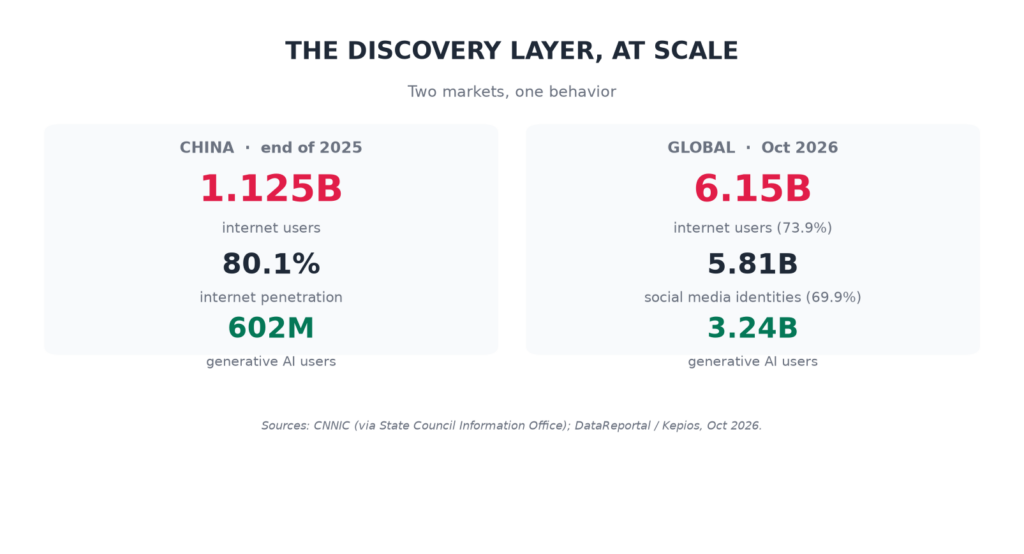
China (end of 2025, CNNIC) vs global (Oct 2026, DataReportal): internet users, social identities and generative AI users. Source note: CNNIC via the State Council Information Office; DataReportal / Kepios, October 2026. The mechanics rhyme across markets even when the products differ. A short video demonstrates a result. A photo carousel shows a room. A forum thread answers a doubt. In each case the decision starts somewhere that is not a search box, and the query arrives afterward, carrying a preference formed for free by someone you did not pay.
What AI changes about discovery
Two layers of machine intelligence now sit between the note and the reader, and from a marketer’s point of view they pull in opposite directions.
Recommendation decides who sees what. The ranking system learns taste from saves, watch time and search behavior, and it will keep rewarding content that produces a genuine reaction. That raises the floor. Vague, pleasant, interchangeable content gets filtered out faster than it did five years ago, because the model holds more evidence about what people actually keep.
Generative answers now sit on top. Worldwide, 3.24 billion people used generative AI platforms monthly as of October 2026, an increase of 57 percent in a year. In China, CNNIC counted 602 million generative AI users at the end of 2025. Both figures count users of tools rather than unique individuals, so read them as scale indicators. As answer engines summarize notes, reviews and product pages, the practical question shifts from “will this rank” to “is there a clean, quotable answer in here that a model can lift.”
That second shift has a concrete writing implication. A note or a page that states what the product is, who it suits, what it costs and what it does not do gives both a human and a model something to work with. A page built from slogans gives them nothing, and gets summarized into nothing.
Five mistakes that quietly waste the budget
Treating the platform as a billboard. Imported ad creative announces itself in the first second. In a discovery environment that reads as an interruption in a place people came to be helped.
Measuring impressions and paid clicks only. Those numbers move for reasons unrelated to intent, and they say nothing about whether a desire was planted. If saves and comment questions are flat, the campaign is not working, whatever the reach figure says.
Over-producing. Studio gloss removes the imperfection that made the note believable. Polish is not the constraint. Specificity is.
Skipping the search layer. Seeding without matching search content is a leaky bucket. Interest gets created, then handed to whoever ranked for the query.
Expecting a spike. Paid bursts spike and die. Discovery work starts slowly, holds its shape, and keeps returning readers for months. Judging it at week three guarantees the wrong conclusion.
A 90-day entry plan for a non-Chinese brand
This plan assumes a modest budget, a product that needs some explaining, and no existing Chinese-language presence. It is deliberately front-loaded with listening, because the most expensive mistake is writing for the wrong query.
Window Objective Main workstream Deliverable Signal to watch Days 1 to 30 Learn the language of the category Read 300 notes across the category and adjacent ones, log recurring questions verbatim A query map of 60 to 100 real phrases, grouped by decision stage Whether the phrases you planned to target appear at all Days 31 to 60 Seed honestly at small scale Brief 10 to 20 small creators with genuine product use, no script, one requirement: describe a specific outcome 10 to 20 published notes, titled against the query map Save rate and comment-question volume per note Days 61 to 90 Capture the demand you created Publish brand-side notes answering the top 20 questions, plus live sessions for unresolved doubts A search-facing answer set and a live calendar Share of target queries where your notes appear, and cost per saved note Two rules keep the plan alive on contact with reality. Do not brief creators on wording, because the phrasing that sounds native is the phrasing you would not have written. And do not scale spend until at least three notes show a save rate clearly above the category median, since scaling a flat note just buys more silence.
How to measure discovery without lying to yourself
The honest metrics are the ones that mark a decision forming.
-
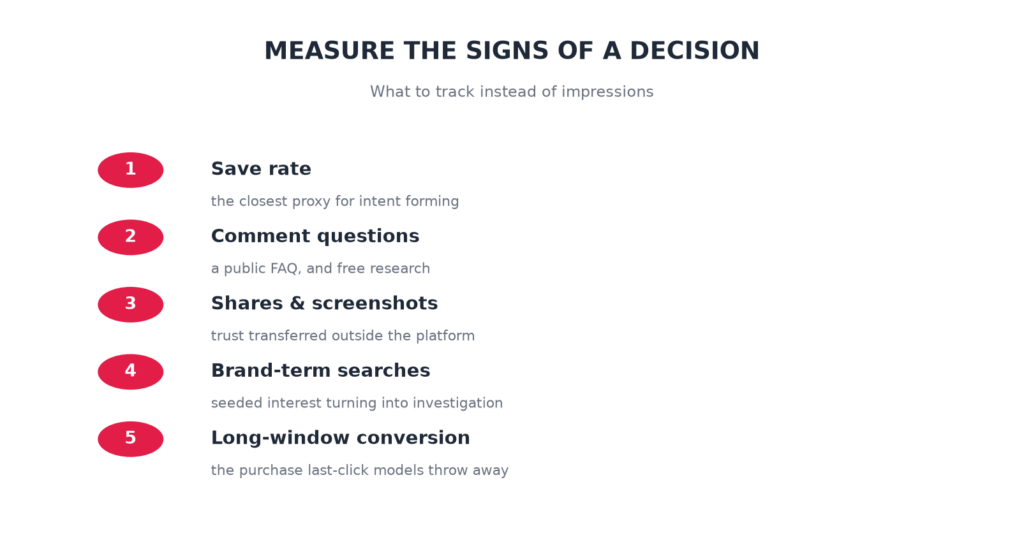
What to track instead of impressions: save rate, comment questions, shares, brand-term searches, long-window conversion. Signal What it means Why it matters Save rate The note is worth keeping Closest available proxy for intent formation Comment questions The reader is close but unresolved Free research, and a public FAQ Shares and screenshots Trust is being transferred outside the platform Growth you cannot buy Brand-term search volume Seeded interest is turning into investigation The bridge between discovery and search Assisted conversion, long window Purchase happened later than the click The number last-click models throw away Expect a lag. In discovery-led programs the gap between first contact and purchase usually runs in weeks, and any platform reporting on a one-day or seven-day window will systematically understate the effect. Set the window before the campaign starts, or the argument about attribution gets settled by whoever owns the dashboard.
The uncomfortable conclusion
If interest is manufactured inside feeds, the marketing job is not to intercept a decision. It is to be present, credibly, while the decision is being formed, and then to be findable when the person goes looking for confirmation.
That changes the org chart as much as the media plan. Content stops being a support function for paid and becomes the asset paid amplifies. Creators stop being a reach buy and become the evidence base. Search work stops being an SEO afterthought and becomes the closing mechanism.
China arrived at this configuration first, mostly by skipping a technology generation. Everyone else is arriving at the same behavior through different apps. The platform names will keep changing. The reflex will not.
Summary
Discovery before search describes a sequence in which interest forms inside a feed and a query arrives later to confirm it. Xiaohongshu is the most developed example: a note-first platform where distribution is earned per post, saves outrank likes, and an in-app search bar collects the demand the feed created. The surrounding scale is not in doubt. China had 1.125 billion internet users at the end of 2025, at 80.1 percent penetration, and 602 million generative AI users. Globally, 5.81 billion social media identities were active in October 2026, equal to 69.9 percent of the population. Trust moves through people rather than placements, which is why specific, imperfect notes outperform polished advertising at the point where intent is born. The operating model that follows is plain: seed honest usage, write for the query the seeding will provoke, answer questions in public, measure saves and search, and give the effect a window long enough to appear.
Frequently asked questions
What does discovery before search mean in one sentence?
It means a person encounters a product inside a feed, becomes interested there without searching for anything, and only later runs a query to confirm a choice that is already half made.Is Xiaohongshu a social network or a search engine?
Both descriptions are incomplete. It is a discovery platform with a serious search layer: the feed creates demand, and the search bar collects it. Treating it as only one of the two produces the wrong content.Why do ordinary notes outperform brand advertising there?
Because the audience judges motive rather than production value. A note reads as one person telling another something useful; an ad reads as a company asking for money. The first borrows credibility, the second has to buy it.How many users does Xiaohongshu actually have?
The widely reported figure is roughly 300 million monthly active users, and independent estimates published during 2026 are higher. The company does not publish audited counts, so use the number for scale, not for forecasting.Can a brand outside China apply any of this?
Yes, with one adjustment. The mechanism transfers, the platform does not. Wherever a feed is the front door, the work is the same: earn the save with specific evidence, then be the clearest answer when the confirmation search happens.