One Identity, One Payment, One Loop: How WeChat Rewired Chinese Marketing
WeChat Isn’t an App, It’s an Operating System
The label that misleads
Ask a Western marketer what WeChat is and you will usually hear some version of this: China’s WhatsApp, with payments bolted on. It is a convenient line for a slide. It is also too small to plan against.
Try a different comparison. Think about what an operating system does for the programs running on a phone. It hands every program the same known user. It settles the money. It decides which programs may reach each other and which stay locked out. Nobody thanks the operating system for any of that, because it works best when it disappears into the background.
WeChat launched in 2011 as a messenger. Since then, it has quietly taken on those three jobs for Chinese consumers, with the difference that it performs them inside one app rather than across a handset.
So the framing for anyone selling into China should be this. WeChat is not a channel you add to a media plan at the end. It is the environment your buyer already lives in, and your marketing either earns a place inside it or never happens at all.
What the wrong label costs you
The mistranslation is not a semantic quibble. It changes three decisions before anyone writes a brief.
It changes the budget. Call WeChat a social channel and the money lands in a social line item, which means the people approving it expect reach, frequency and follower growth. Call it an operating system and the money belongs with service, retention and product, where the payback is measured in repeat purchases.
It changes the team. A social team can run an account. It cannot build a mini program, staff a service desk, or maintain a customer record. Those are product and operations jobs, and they do not appear on a social org chart.
It changes the measurement. Reach is a number you rent. A reachable, identified customer is a number you own. Brands that treat WeChat as a channel tend to optimise the first one and wonder why the second one never arrives.
Three jobs, one app
An operating system is easier to recognise by what it guarantees than by what it contains. Three guarantees matter here.
Identity. Every user is one verified person with one account, not a cookie that expires when a browser closes.
Money. Payment is native to the identity, so a transaction is a small step rather than a redirect to a bank page and back.
Permission. The platform decides which services may talk to each other and which cannot. That control is what turns a pile of features into a system.
Picture a building where the shop, the till, the noticeboard, the service desk and the delivery dock all share one address, and the customer never has to step outside the lobby. Chinese consumers learned to shop in that building. Western consumers learned to shop across a high street. The habits formed by those two layouts are not interchangeable.
The five layers, in the order customers meet them
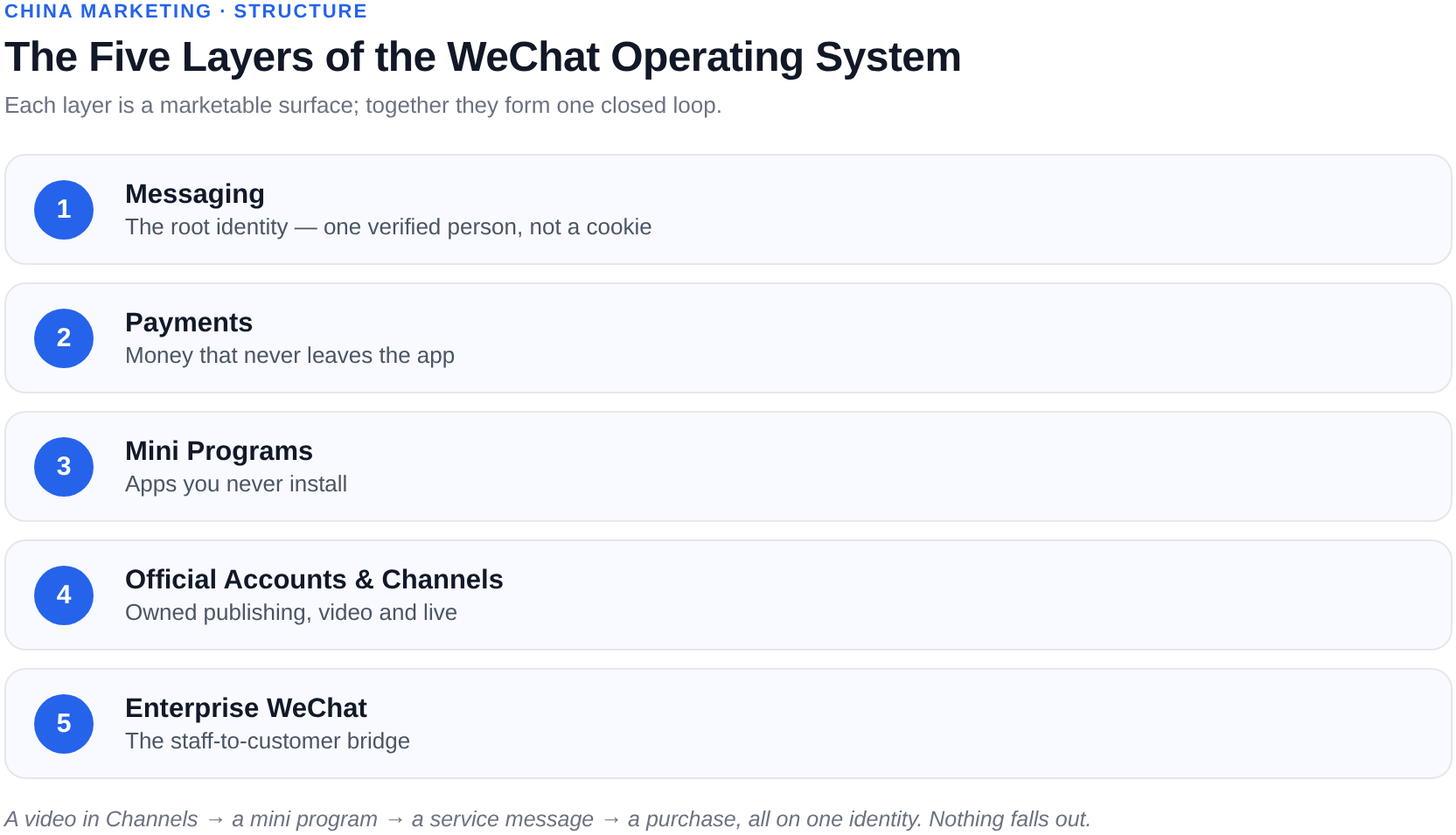
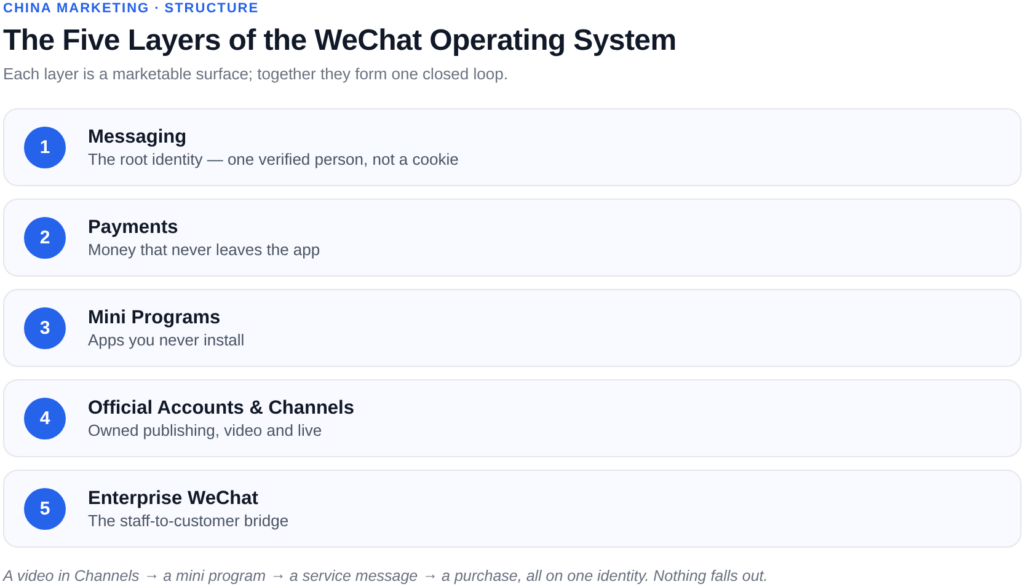
WeChat is not a flat product with a long feature list. It stacks, and each layer is a surface a brand can work on.
The messaging layer: an identity, not a cookie
This is the root. Chat is the reason people open the app, and the account behind the chat is the reason everything else is possible. When you reach someone here, you reach a person who has a payment history, a service record and a social graph attached to the same identifier.
The payment layer: money that never leaves the app
WeChat Pay sits inside that identity. The practical consequence for marketing is underrated: there is no handoff between persuasion and purchase. A recommendation, a coupon, an order and a receipt can all happen in the same thread, without a checkout page, a card form or a redirect that loses half the audience.
The mini program layer: an app you never install
Mini programs are lightweight applications that run inside WeChat, no download required. For a brand, that removes the single most expensive step in the Western funnel. You do not have to convince anyone to install anything. You have to convince them to open something.
The publishing layer: Official Accounts and Channels
Official Accounts carry articles, service notifications and menus. Channels is the in-app surface for short video and live streaming. Both are owned properties, which means the audience belongs to the brand’s account rather than to a feed ranked by an algorithm you cannot influence.
The enterprise layer: the bridge between staff and customers
Enterprise WeChat, Tencent’s workplace version of the app, connects employees to customers under a company-managed identity. A salesperson can hold a real conversation with a real contact, and the company keeps the relationship when that salesperson leaves. This is the part most foreign teams underestimate, because it is invisible from the outside.
How the layers lock together
The layers are not five parallel channels. They are one loop. A video in Channels points to a mini program. A mini program order triggers a service message in an Official Account. That message opens a conversation in Enterprise WeChat. That conversation produces the next purchase, which is measured against the same identifier as the first.
Nothing falls out of the funnel, because there is nowhere to fall.
Private domain: the concept the English word hides
Chinese marketers talk constantly about 私域 (sīyù), usually translated as private domain. The translation is accurate and slightly useless, because it sounds like a CRM feature. It is closer to a structural right.
Private domain means an audience you can reach again without paying a platform for the privilege, talk to directly, and track over time. Three properties, and most Western “owned” channels only deliver the first one properly. An email list can be reached, but it rarely transacts. A loyalty app can transact, but almost nobody installs it. A push token does neither well.
WeChat’s private-domain stack is unusually complete because the identity does all three jobs at once: reach, conversation, transaction. That is why the phrase carries so much weight in China. It is not a tactic. It is the only asset in the plan that does not get more expensive every quarter.
Why the funnel loses three steps
Run the two journeys side by side and count the handoffs.
The Western version: an impression, a click, a landing page, a form or an install, a retargeting cookie, a purchase, a support email. Six or seven surfaces, several logins, and at least two points where a meaningful share of the audience disappears and never returns.
The Chinese version collapses those steps because the identity already exists. There is no install, no separate login, no cookie handoff. The customer moves from a video to a service conversation to a purchase without changing address.
This has a direct consequence for creative and content work. In a fragmented market the landing page is the centre of gravity, so teams optimise pages. In a closed system the conversation is the centre of gravity, so teams optimise the first message, the service reply, and the offer inside the thread. Different craft, different metrics.
China’s digital base, with dates and sources
Numbers about China’s internet age badly, so here is the state of play, and which source each number comes from.
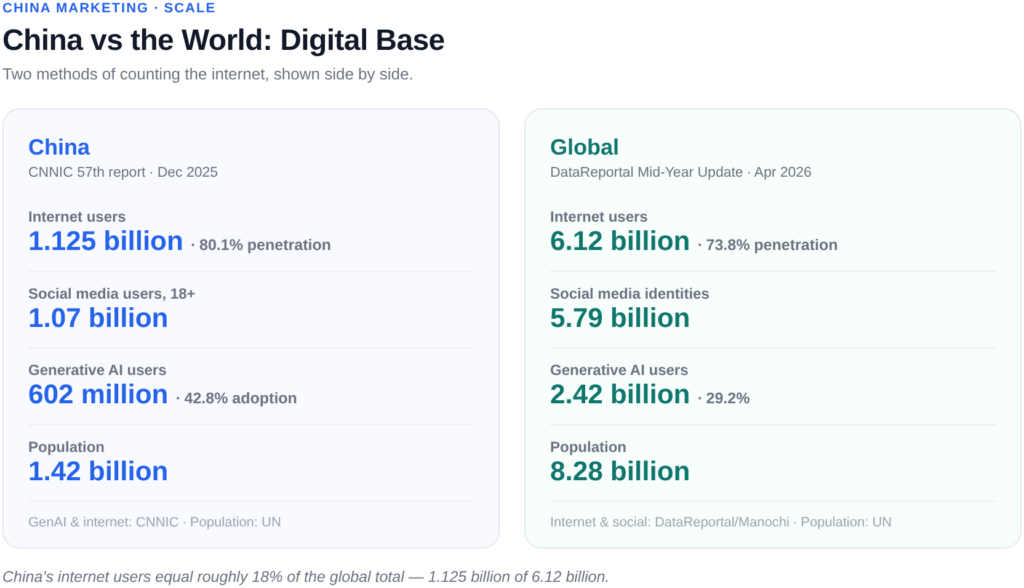
The authority in China is CNNIC, the state-run network information centre. Its 57th Statistical Report, released in February 2026 and covering data to December 2025, says:
- Internet users: 1.125 billion, equal to 80.1 percent of the population.
- Social media users aged 18 and above: 1.07 billion, or 93.8 percent of adults.
- Generative AI users: 602 million in December 2025, up 141.7 percent year on year, with adoption at 42.8 percent of internet users.
- Population: 1.42 billion, and shrinking. The United Nations puts the decline at 3.3 million, or 0.2 percent, during 2025.
One methodological note, because it matters for accuracy. Independent aggregators such as DataReportal, which work from the ITU’s broader definition of an internet user, estimate China’s base at 1.30 billion, or 91.6 percent penetration. The CNNIC figure is lower because it counts registered internet users on a narrower basis. Neither number is wrong; they answer different questions. When you read a China statistic, check which definition is behind it.
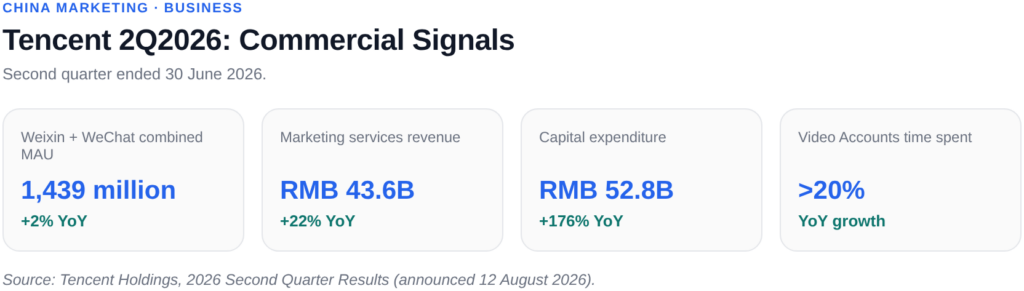
WeChat itself is the anchor point of that base. Tencent’s second-quarter 2026 results, for the quarter ended 30 June 2026, report combined monthly active users of Weixin and WeChat at 1,439 million, up 2 percent year on year from 1,411 million. Whatever else changes in Chinese marketing, that number is the floor that everything else stands on.
The rest of the planet, April 2026
Step outside China and the shape changes. DataReportal’s Digital 2026 Mid-Year Global Update, published in April 2026, gives the current global picture.
- Population: 8.28 billion people.
- Internet users: 6.12 billion, a penetration rate of 73.8 percent.
- Social media user identities: 5.79 billion, or 69.9 percent of the population.
- Still offline: roughly 2.2 billion people.
- Monthly users of generative AI platforms such as ChatGPT: 2.42 billion, equal to 29.2 percent of the population and up 141 percent year on year.
Put those two datasets next to each other and the size of China snaps into focus. Depending on the counting method, China is somewhere between one-sixth and one-fifth of the world’s internet users: CNNIC’s official count puts it at 1.125 billion, about 18 percent of the global 6.12 billion, while aggregators using broader definitions put it closer to 1.3 billion. Either way, this is not a niche market with interesting quirks. It is a very large fraction of the internet running on a different operating logic.
The West never consolidated. It kept the browser, the app store, the ad network and the payment processor as separate kingdoms, each competing for a slice of the same customer. That fragmentation is good for competition and brutal for attribution, because no single identity follows a buyer across all four.
Side by side
| Dimension | China | Global outside China |
| Entry point | One closed super-app identity | Browser plus a set of separate apps |
| Customer record | One verified ID across chat, pay and commerce | A separate login per platform |
| Where AI sits | Inside the operating system | Across ad platforms, data platforms and standalone tools |
| Scale reference | 1.125 billion internet users (CNNIC, Dec 2025); 1.44 billion Weixin and WeChat MAU | 6.12 billion internet users (April 2026); 5.79 billion social identities |
| AI adoption signal | 602 million GenAI users, 42.8 percent adoption (CNNIC); 86.4 percent of online adults monthly (GWI) | 81.2 percent of online adults monthly (GWI); 71.5 percent US, 62.8 percent UK |
| Ad revenue signal | Tencent marketing services RMB 43.6 billion in 2Q2026, up 22 percent year on year | Spread across many platforms, with no single closed loop |
Where AI marketing actually sits
This is the part of the story that changed most in the past year.
Outside China, AI marketing works like a toolkit. A model writes the copy, a platform scores the audience, a data warehouse stitches the identities, and a dashboard hopes the three agree. Each piece is genuinely good. The seams between them are where the money leaks, because none of them can see the whole buyer.
Inside China, AI shows up as a function of the operating system. Tencent’s second-quarter 2026 disclosure is unusually clear about how that works in practice. Marketing services revenue reached RMB 43.6 billion, up 22 percent year on year, credited to an upgraded AI-driven ad recommendation model, an automated campaign tool called AIM+ that now executes end to end for mini shop and mini drama advertisers, and closed-loop marketing inside the Weixin ecosystem. That loop lets services such as mini games and mini shops buy media more effectively on Tencent’s own properties. Video Accounts, the in-app video surface, grew total time spent by more than 20 percent year on year.
The forward-looking piece is smaller in scale and bigger in implication. Tencent has started a small-scale prototype test of Xiaowei, an agentic assistant inside Weixin, running on a customised model called WeLM built for user privacy, Weixin-specific tasks and inference efficiency. Hold that next to the layer map. An agent living inside the same identity as the chat, the payment and the storefront does not have to guess intent from a cookie. It can act on a conversation it is already part of.
Tencent is paying for this position. Capital expenditure hit RMB 52.8 billion in the quarter, up 176 percent year on year, most of it aimed at AI infrastructure. That is not a side project.
The adoption gap nobody priced in
Here is the finding that should reset a few assumptions. GWI’s Q4 2025 research wave — more than 240,000 respondents aged 16 and above across 54 of the world’s largest economies, covering over 80 percent of the global internet population — found that 81.2 percent of online adults had used at least one form of AI in the previous month. Scaled up, that implies about 4.02 billion adults using AI monthly, or 48.6 percent of the world’s total population. The definition is broad: it includes AI features inside office suites and design tools, not just standalone chatbots.
Now look at the country split. Among online adults, monthly AI use reaches 91.8 percent across South-East Asia, 86.4 percent in China, 71.5 percent in the United States, and 62.8 percent in the United Kingdom. Japan is the only market in the survey where fewer than half of respondents had used AI in the past month.
China’s own government data tells the same story from a second angle. CNNIC counts 602 million generative AI users at the end of 2025, with adoption at 42.8 percent of internet users and growth of more than 140 percent in a single year. That is a mass market for AI behaviours measured by the state, not a vendor’s press release.
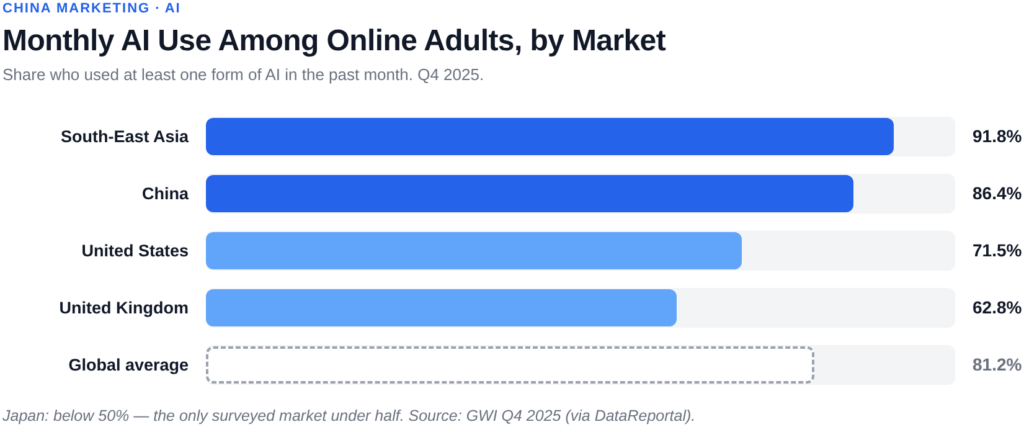
Treat the explanation as interpretation rather than measurement, because that is what it is. The likeliest reading is distribution, not enthusiasm. In China, AI mostly arrives inside the apps people already open every day, so using it asks for no new habit and no new download. In Western markets, AI usually arrives as something you have to go and choose, sign into, and remember to open. Adoption follows the path of least resistance, and the paths are built differently.
Five things foreign brands get wrong
Budgeting WeChat as a social channel. The money then buys followers instead of service capacity, and follower counts are the least valuable number in the ecosystem.
Treating the website as the centre of gravity. In a closed identity system the domain is not the destination. The account is.
Skipping mini programs and service. A brand with an Official Account and no service layer has a noticeboard and no shop. The conversion work happens in the layer most teams skip.
Borrowing AI as a campaign add-on. Generative copy is not the interesting part. The interesting part is an assistant that sits inside the transaction, and that requires a closed loop you probably do not have.
Underestimating content rules and licensing. Verified accounts, mini program registration and merchant payment access are tied to business credentials. Most foreign brands operate through a mainland entity or a licensed local partner, and that structure shapes what is legally possible before it shapes what is creatively possible.
A realistic first year
Start with three things and resist the rest.
Build a verified Official Account as the service and content base. Build one mini program that does a small number of jobs extremely well, such as product lookup, booking or member service. Staff a real service desk on Enterprise WeChat, because the private-domain asset is a conversation, and conversations need humans at the start.
Skip, for now, a full commerce build-out. Skip paid amplification at scale before retention works. Skip the impulse to run Channels like a global social account with a content calendar; run it like a shop window that points at the mini program.
Measure differently or you will misread everything. The useful numbers are repeat purchase rate among contacts, service first-response time, share of contacts still reachable after 90 days, and revenue per reachable contact. Click-through rate will tell you almost nothing about whether the loop is closing.
Set the timeline honestly. Two quarters to reach service readiness is a reasonable expectation. Two weeks is not, and teams that promise it usually end up with an account nobody answers.
Principles that survive translation
- Identity beats traffic. Whether it comes from one super-app ID or a unified customer data platform, the durable asset is the recognised customer.
- Closure creates continuity. Conversion improves when nothing falls out of the funnel, and the funnel only holds if the transaction happens inside it.
- Put AI under the transaction, not on the creative. The teams getting value in 2026 embed it in the decision and the checkout, not in the headline.
- Translate the strategy, never the tactic. If you operate in both worlds, the objective is the same and the architecture is not. Copying the tactic is how global teams end up with a beautiful account and no revenue.
- Scale is lopsided. Up to one in five internet users is Chinese and running on different mechanics. A global plan that skips that is a partial plan.
Summary
WeChat is not a messaging app with extra features. It is an operating system that fused identity, payment, mini programs, publishing and enterprise service into one closed loop, and it has behaved that way for more than a decade. China’s official internet base of 1.125 billion people, at 80.1 percent penetration according to CNNIC’s 57th report, sits inside that logic, anchored by 1.44 billion monthly users of Weixin and WeChat as of June 2026. The rest of the world, with 6.12 billion internet users and 5.79 billion social identities as of April 2026, stayed fragmented and browser-native. AI is deepening the split rather than closing it. Inside China it is becoming a function of the operating system, with Tencent’s marketing services up 22 percent year on year, 602 million generative AI users on the government’s count, and an agentic assistant in prototype. Globally it spreads across platforms and tools. Two real curves, two different playbooks, and one shared objective: own the customer relationship rather than rent access to it.
Frequently asked questions
Is WeChat really an operating system, or is that just a metaphor? Functionally, the metaphor holds. An operating system issues identity, moves money and controls which programs may talk to each other. WeChat does all three inside one app. The difference is packaging, not function.
Why did Western markets never produce an equivalent? In broad terms, because the commercial and regulatory incentives pointed the other way. Western markets kept the browser neutral, payments contested and app distribution open, and competition scrutiny made deep bundling expensive. Fragmentation survived because it was defended, not because it served marketers better.
Can a foreign brand sell inside WeChat without a local entity? Most cannot do it cleanly. Verified status, mini program registration and merchant payment access are tied to business credentials, so foreign brands typically operate through a mainland entity or a licensed partner. That is a structural constraint rather than a marketing preference, and it is better settled before the creative work starts.
How does AI marketing differ between China and the global market? In China, AI increasingly works inside a closed system that already holds the identity, the payment and the conversation, so it can act rather than merely predict. Globally, AI is distributed across ad platforms, customer data platforms and standalone tools, which makes it powerful per task and blind at the seams.
What single figure best captures China’s weight in global marketing? Its scale relative to the rest of the internet. China’s 1.125 billion internet users, by CNNIC’s count, are roughly 18 percent of the world’s 6.12 billion, while broader definitions put the figure nearer one in five. Ignoring China means ignoring a large share of the internet and a working preview of integrated AI commerce.