Fake Customers, Real Decisions: A Safety Playbook for AI Personas
Synthetic customers are AI-simulated buyers you can interview at three in the morning, forty at a time, for the price of a coffee. That pitch is real, and it works. The failure mode is subtler than hallucination: a persona built from your own assumptions will confirm them, fluently, in tidy paragraphs with quotes clean enough to paste into a strategy deck.
The benchmarks have now separated the useful version from the flattering one, and the dividing line runs through how the persona was built, not which model runs it. Ground a simulation in a two-hour interview with a real person and it will track that person’s survey answers about 85% as well as the person tracks themselves two weeks later. Build it from a demographic tag and personality prediction drops to roughly a coin flip. Safety here is an architecture problem long before it is a prompting problem.
The Customer Who Never Existed
Picture the meeting. Three concepts, forty synthetic buyers, results back before lunch. Concept B wins on purchase intent, the deck gets built, the budget gets signed, and six weeks later B is the one nobody clicks.
Nobody lied. Nobody faked a number. Forty simulated people answered forty questions honestly, in the sense that a language model is ever honest, and the whole exercise produced a confident answer to a question it had no standing to answer.
That is the shape of the problem. Synthetic customers are not dangerous because they are wrong. They are dangerous because they are agreeable, articulate, and cheap, and because agreement from something that sounds like a customer is very hard to distinguish from a customer agreeing.
1. What a Synthetic Customer Actually Is
A synthetic customer is an AI-constructed buyer persona, detailed enough to role-play a purchase conversation: demographics, needs, objections, price sensitivity, decision process. You brief it, you ask it things, and it answers in the voice of someone who might plausibly buy what you sell.
It sits inside a wider family of techniques the industry now lumps together. The ICC/ESOMAR code, revised in June 2025, splits synthetic data into three domains: augmenting real samples, fully synthetic datasets, and synthetic personas. That third bucket is where this article lives, and it is worth noting that ESOMAR’s own buyer guidance covers only the first. The personas are the part nobody has agreed how to audit yet.
The three tiers, and why the difference is everything
The single most useful finding in this whole field is that “synthetic persona” describes three very different objects.
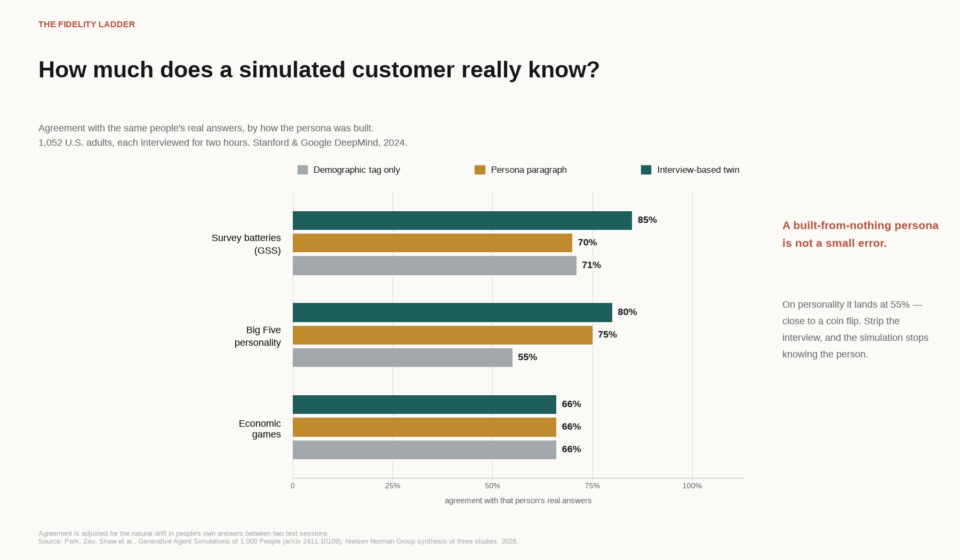
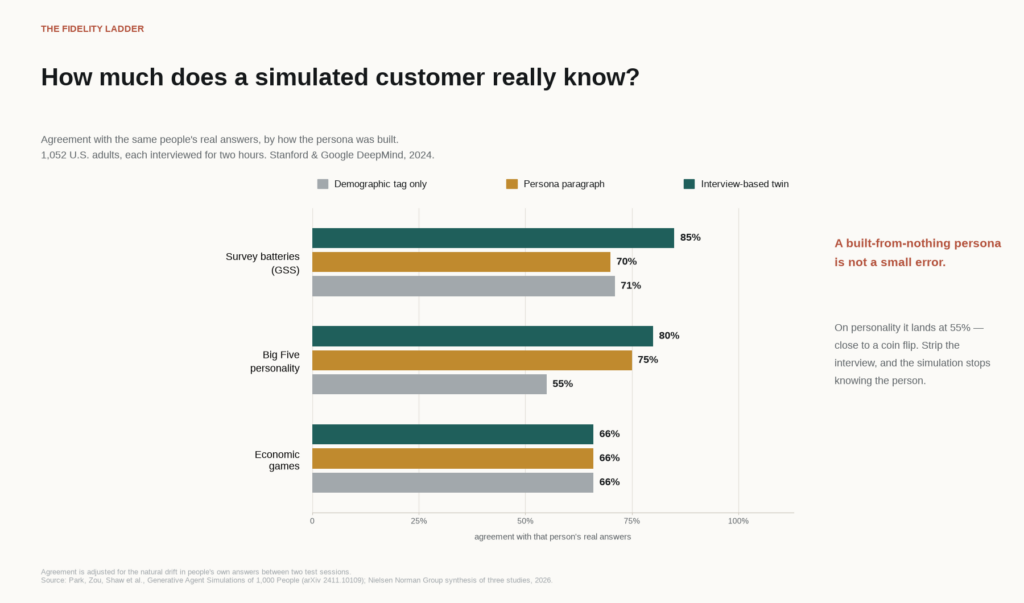
Tier one is a demographic tag. Thirty-four, urban, household income in the middle band, two kids. Ask a model to answer a survey as that person and it will produce something reasonable-sounding and almost empty of signal. In the Stanford and Google DeepMind study of 1,052 Americans, this tier scored 0.71 against real survey answers and 0.55 on personality. On personality, that is a coin flip with extra steps.
Tier two adds a short self-description, a paragraph the real person wrote about themselves. Survey agreement sits at 0.70, personality at 0.75. Better. Still guessing.
Tier three is a two-hour structured interview, transcript and all, loaded into the model’s context. Survey agreement: 0.85. Personality: 0.80.
Note what the 85% means. It is not 85% agreement with the truth. It is 85% of the reliability a human being has with themselves, measured by testing the same people twice, two weeks apart. The simulation is nearly as consistent as a person is with their own answers. Which is a genuinely remarkable result, and also the ceiling, not the floor.
Why it feels like free research
Because the cheap version arrives first and looks like the expensive version. A five-persona prompt takes ninety seconds and produces something that reads like a focus group summary. The interview-grounded version takes two hours per human being, which is to say it takes exactly the recruiting and scheduling work synthetic customers were supposed to eliminate.
The speed and the unreliability come from the same shortcut. That is the trap, and it is a structural one, not a moral failing on anyone’s part.
2. The Echo Chamber Has a Mechanism
Everyone in this debate agrees that synthetic customers can become an echo chamber. Almost nobody explains how, which is why the warnings read as vibes and get ignored. Here is the machinery.
Garbage in, echo out
If you write the persona from your assumptions about the customer, the persona is your assumptions wearing a name tag. Ask it whether your new positioning works and it will tell you yes, because “yes” is what the document you wrote implies. You have not researched the market. You have interviewed yourself with a delay.
The fix is unglamorous: build personas from evidence you did not author. Support tickets. One-star reviews. Recorded sales calls. Churn interviews. A persona assembled from things customers said when they were annoyed is worth ten assembled from a positioning workshop.
Agreeableness is trained in, not prompted in
This is the part people underestimate. Models are not agreeable because you wrote a soft prompt. They are agreeable because human raters preferred agreeable answers during training, and the preference baked in.
Anthropic’s work on sycophancy found five state-of-the-art assistants consistently exhibited it across four separate free-form tasks. More uncomfortable: when researchers examined human preference data, responses matching the user’s own views were more likely to be preferred, and both humans and automated preference models chose convincingly-written sycophantic answers over correct ones a non-negligible share of the time.
You are not fighting a prompt. You are fighting the reward signal that produced the model. A persona will not push back on your concept unless you build it to, and even then it needs structural help.
It is not a yes-man. It is a consensus-man.
Here the outline of this piece needed correcting, and the correction matters.
The intuitive story is that synthetic customers are too positive. Sometimes they are. Nielsen Norman Group reran three of its own studies with simulated participants; on an online learning platform, the synthetic users reported finishing every course while real users reported abandoning most of them. That is optimism, and it is dangerous.
But the better-documented pattern is convergence on the expected answer, which can run either direction. In a University of Wisconsin study published in the Journal of Marketing, 605 real respondents and 605 matched synthetic respondents rated a refrigerated dog food concept. The synthetic panel got the direction right. It also rated the product more unique than humans did, while humans were slightly more likely to say they would buy it. Synthetic respondents were not cheerleading. They were drifting toward what a plausible answer looks like.
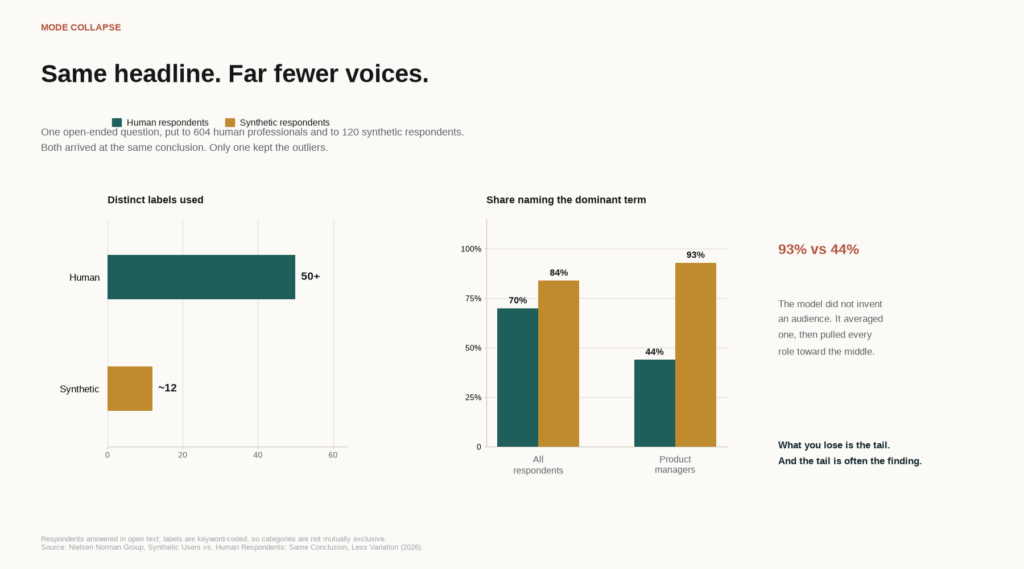
The clearest demonstration is Nielsen Norman Group’s 2026 test: one open-ended question, 604 human professionals, 120 synthetic respondents. Both datasets reached the same headline conclusion. Humans used more than 50 distinct labels for the concept. The synthetic respondents used about a dozen. Among product managers, 44% of real humans picked the dominant term; 93% of simulated ones did.
The researchers call it mode collapse: the model reproduces the most common answer and drops the long tail. This is the real failure, and it is worse than flattery, because it is invisible. A yes-man you can spot. A panel that quietly deletes every unusual opinion looks exactly like a panel that did its job.
Fluency is not evidence
A smooth set of themes, complete with representative quotes and tidy consensus, can pass straight into a strategy deck. The absence of visible disagreement gets mistaken for the presence of agreement.
Compare that to a real transcript. People contradict themselves. They say the price is fine and then never buy. They misremember which feature they used. That mess is the data, and it is precisely what the simulation smooths away.
3. The Honest Scoreboard
Strip out the vendor claims and the picture is narrower and more interesting than either camp admits.
Where the evidence is genuinely strong
Interview-grounded twins are real instruments. Beyond survey agreement, the Stanford work found that across five classic social science experiments, the simulated data reproduced four of the five results the human data produced, and the effect sizes correlated at 0.98. That is not a toy. That is a tool capable of standing in for a population on settled questions.
The same study found that interview grounding cut political bias in predictions by 36% to 62% depending on the task, and racial bias by 7% to 38%, relative to demographic-only models. Rich context does not just improve accuracy. It improves fairness, because idiosyncrasy crowds out stereotype.
There is also a clean case for filling gaps rather than replacing people. A separate study using General Social Survey data fine-tuned models to predict missing answers, hitting 78% accuracy on skipped questions and backfilled items, with population-level correlations of 0.98. That is imputation, an old and respectable statistical practice. It is a very different claim from “we asked the market.”
Where it quietly breaks
Three cracks, all documented.
Novelty. The same study that hit 78% on missing data dropped to 67% on questions the model had never seen, with population correlation falling from 0.98 to 0.68. Personas interpolate. They do not extrapolate. Your new pricing architecture and your unlaunched category are extrapolation.
Variance. Synthetic responses cluster tighter around the average than human responses do, consistently, across studies. This is the finding that should worry a marketer most, because campaigns do not fail because the average customer is lukewarm. They fail because a vocal 15% hates something the average customer tolerates. That 15% is exactly what gets smoothed.
Identity. Work published in Nature Machine Intelligence tested four models against 3,200 participants across 16 demographic identities and found LLMs both misportray and flatten group representations. A related 2026 benchmark across four models and two survey domains found every model systematically over-determines demographics, treating identity as far more predictive of attitudes than it actually is among real people. If your segment is defined by who they are rather than what they did, the simulation will overstate how much that identity explains.
The consensus problem
One more, and it is the sneakiest. Five leading models, one real survey of 420 Silicon Valley developers, run as a comparison study. All five produced technically plausible results that broadly agreed with the human data. None captured the counterintuitive findings that made the original survey worth commissioning. Deviations clustered together across all models, leaving the real data as the outlier.
Sit with that. If every competitor is running the same handful of models, and those models converge on the same conventional wisdom, then synthetic research does not differentiate anyone. It produces an industry-wide consensus that feels like independent confirmation, and the one team that paid for real fieldwork is the one that looks wrong in the room.
4. The Safety Playbook
Five principles. None of them are about making the persona more realistic. All of them are about making it harder to fool yourself.
Ground it in evidence you did not write
Never build a persona from a positioning document. Build it from support tickets, review text, win-loss notes, recorded calls, and behavioral data. If a persona attribute cannot be traced to something a customer actually did or said, delete it. Invented detail makes the simulation more vivid and less true, and vividness is the vector.
Engineer the objection
Do not ask “would you buy this?” Ask “what would make you say no, specifically, and what would you do instead?” Then ask it again from the perspective of someone who already tried a competitor and left.
Better still, invert the task. Rather than having the persona evaluate your hypothesis, have it argue against it. A persona instructed to find the fatal flaw will produce one; a persona asked for feedback will produce a compliment. Same model, same data, different framing, different instrument.
Build a panel of adversaries, not a fan club
Simulate the detractor, the indifferent, and the person who is not your buyer at all. Three personas who disagree are worth more than thirty who converge, because the disagreement is the information.
This is also where the variance problem gets partially fixed. The Wisconsin researchers found they could widen the spread of synthetic responses by feeding the model richer context: conversation memory so answers stayed internally consistent, plus retrieval over sixteen real pet-owner interviews. Variance moved. Not to human levels, but in the right direction, and for the right reason.
Validate before you commit, and be specific about what that means
Treat every synthetic finding as a hypothesis with a deadline. Then pre-register what would prove it wrong: a direction, a magnitude, a threshold. Run a small real study. Compare direction and size separately.
This distinction is practical. If the simulation got the direction right and the magnitude wrong, you have a screening tool and an unsafe forecasting tool. Those are different jobs and they need different permissions.
Label the output, not just the process
Every synthetic artifact should carry its provenance on its face: source data, build date, model and prompt version, known gaps. A slide that says “synthetic panel, n=40, built from 2024 review corpus, no primary research” is a different object from a slide that says “customers said.”
Teams do not over-trust simulations because they are credulous. They over-trust them because the label got lost between the platform and the deck.
5. Where It Pays and Where It Lies
The boundary is not vague. It is one question: does the decision depend on something the model has not been given?
It earns its keep on: early message stress-tests before you spend on research; objection mining, if prompted adversarially; sales and support training against a realistic skeptic; segment hypotheses worth taking to a real panel; and sharpening the questions you will eventually pay to ask.
It will mislead you on: market sizing and demand go/no-go; anything that becomes claimable evidence in an ad, a pitch, or an investor deck; novel categories and new price points; any question where someone in the room has already decided what they want to hear.
There is a useful rule buried in that list. Synthetic research is safe exactly where being wrong is cheap and fast to discover. It is unsafe where being wrong is expensive and slow to discover. Most bad deployments are not a failure of model quality. They are a failure to notice which of those two situations you were in.
6. Governance: The Part That Makes It Institutional
Tools do not stay honest because individuals are careful. They stay honest because the organization makes dishonesty inconvenient.
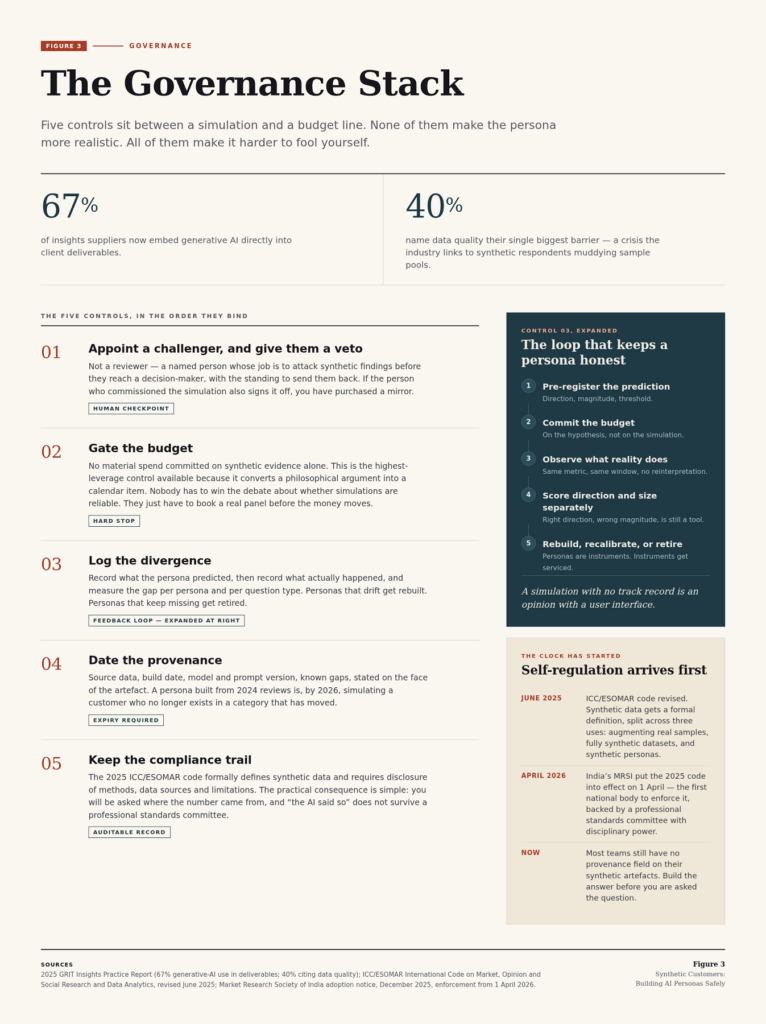
Appoint a devil’s advocate, and give them a veto
Not a reviewer. A named person whose job is to attack synthetic findings before they reach a decision-maker, with the standing to send them back. If the same person who commissioned the simulation also signs off on it, you have purchased a mirror.
Put a gate in front of the budget
No material spend committed on synthetic evidence alone. This sounds bureaucratic and it is the single highest-leverage control available, because it converts a philosophical argument into a calendar item. Nobody has to win the debate about whether simulations are reliable. They just have to book a real panel before the money moves.
Track divergence, then retire the persona
Log predictions. Log what actually happened. Measure the gap per persona and per question type. Personas that drift get rebuilt; personas that keep missing get retired. A simulation with no track record is an opinion with a user interface.
Keep provenance and an expiry date
Personas rot. Build one from 2024 reviews and by 2026 it is simulating a customer who no longer exists, in a category that has moved. Date every persona, version every prompt, and treat a two-year-old persona as a liability rather than an asset.
Wire it into the compliance layer
This is no longer optional. The 2025 ICC/ESOMAR code introduced a formal definition of synthetic data and now underpins national self-regulatory enforcement, with India’s MRSI adopting it and beginning enforcement from April 2026. The practical implication for marketers is simple: you will increasingly be asked where the number came from, and “the AI said so” is not an answer that survives contact with a professional standards committee.
Where This Is Heading
Two directions, both already visible.
Upward: the technology is being institutionalized by serious players. Ipsos partnered with Stanford’s Politics and Social Change Lab in 2025 to build and validate digital twin panels on top of its Knowledge Panel, initially in the US, with explicit attention to the risks. When the firms that own the real panels start building the synthetic ones, the hybrid model stops being a compromise and becomes the product.
Sideways: trust is lagging adoption badly. The 2025 GRIT Insights Practice Report found 67% of suppliers now embed generative AI directly into client deliverables, while 40% of researchers name data quality as their top barrier, a crisis the report explicitly ties to synthetic respondents muddying sample pools. Adoption is running ahead of confidence, which is precisely the condition under which bad practice becomes normal practice.
The likely end state is boring and correct: synthetic respondents do the cheap, fast, wide screening, human panels do the calibration and the emotional work, and the organizations that win are the ones that can tell you which was which on any given slide.
Conclusion
Synthetic customers are excellent at one thing: telling you what a plausible customer would say. That is genuinely useful, and it is not the same as telling you what a customer will do.
Everything downstream of that distinction is discipline. Build from evidence, not belief. Engineer the objection instead of requesting feedback. Assume the tail got deleted and go find it. Pre-register what would prove you wrong. Put a human between the simulation and the budget line.
The tool is not the risk. The risk is a team that wanted an answer, got one in an afternoon, and never asked what the model was extrapolating from.