Why Voice Agents Lose Trust They Technically Earned
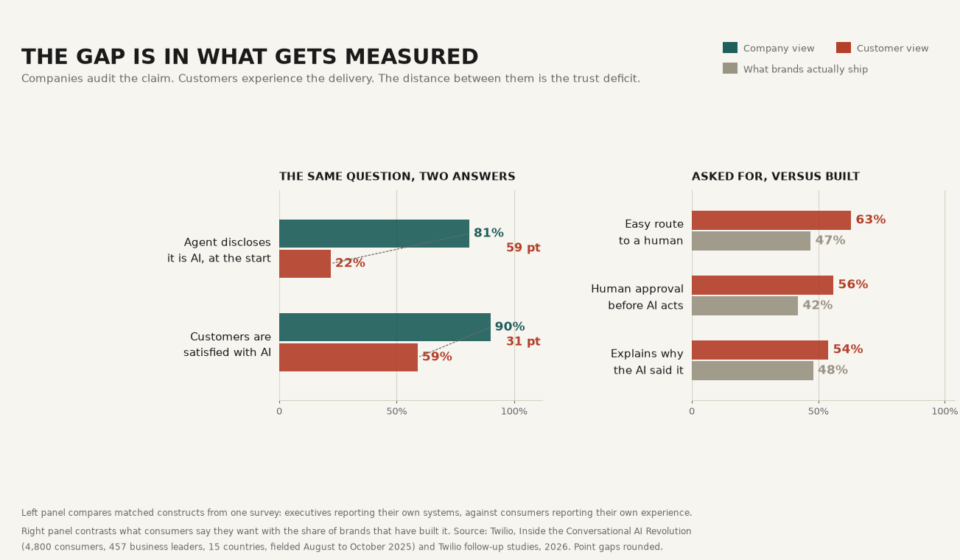
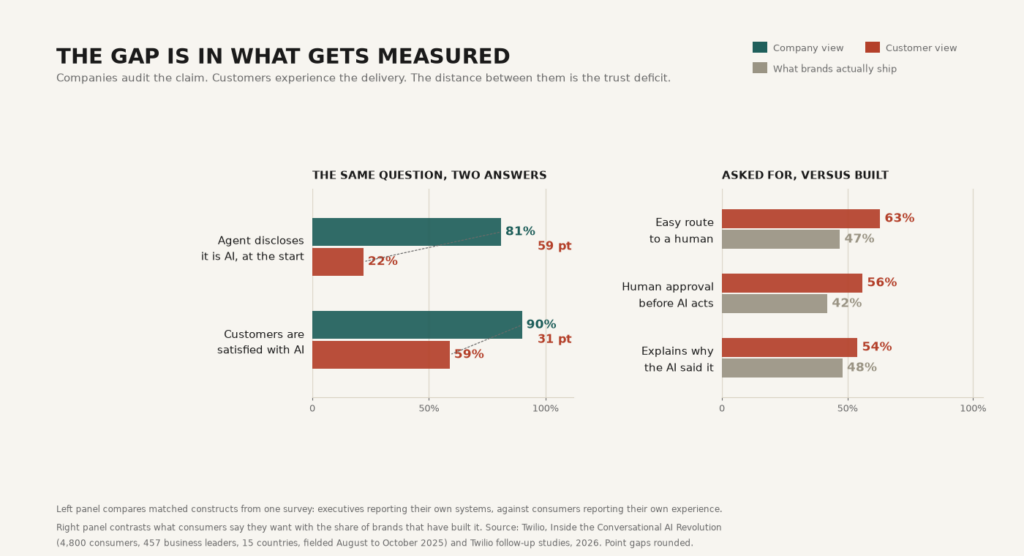
Here is a pair of numbers from the same global survey that should stop you cold. Asked whether their AI agents identify themselves as AI at the start of a conversation, 81% of brands said yes. Consumers, asked about the same conversations, put it at 22%.
That is not a rounding difference. It is a fifty-nine point disagreement about whether a specific, verifiable event occurred.
Now the second pair. Ninety percent of business leaders believe their customers are satisfied with conversational AI. Fifty-nine percent of customers are. A thirty-one point gap, and a familiar shape.
Neither gap is a model problem. That is the part most teams get wrong.
The pattern sits at two moments
Both gaps cluster at the same two points in a call: disclosure and handoff.
Disclosure is measurable from the inside. Your system emits the line, the log records it, the compliance box is ticked. Whether the customer heard it is a different question entirely, and it is the one that determines trust. A disclosure that satisfies a legal checklist and a disclosure a person actually registers are separate events, and only one of them is in your dashboard.
Handoff has the same structure, with worse numbers. Seventy-eight percent of consumers have tried to bypass an AI agent to reach a human. Sixty-three percent want an easy route to one; 47% of brands provide it. Seventy-six percent say the human they finally reach has little or no context about their problem. And when an agent can’t resolve something, it burns about eighty-one seconds of failed attempts before escalating.
Every one of those figures describes the same mechanism: the company audits what the system emits, the customer experiences what the system does under pressure.
Why this persists
Because self-reported metrics are cheap and experience metrics are not.
It costs nothing to log that a disclosure played. It costs real work to sample transcripts and ask whether the disclosure landed, whether the accent sounded synthetic, whether the customer’s second sentence shifted from question to complaint. The first number is available in a dashboard by lunchtime. The second requires someone to read.
So the org reports the first number, and the first number looks excellent.
This is why I have stopped believing containment rate as a standalone metric. An agent can close a conversation without resolving anything, and the dashboard cannot tell the difference between a solved problem and a customer who gave up. The tell is the repeat-contact rate thirty days later, and almost nobody connects the two reports.
What the finding actually demands
Three things, in ascending order of difficulty.
Instrument the customer’s side, not just the system’s. Disclose, then verify comprehension in the next turn. If the customer keeps talking as though they are speaking to a person, the disclosure did not land, whatever the log says.
Treat the handoff as the product. A warm transfer with a three-line summary and no repeated questions outperforms a better-sounding agent every time. Sixty-three percent of people are asking for an exit; almost half of brands still haven’t built a door.
Stop measuring resolution in isolation. Pair it with post-containment satisfaction and repeat contact. The first is a leading indicator of a system that works; the second is a lagging indicator of one that doesn’t.
The reframe
The uncomfortable conclusion is that AI voice is not primarily a trust problem. It is an instrumentation problem wearing a trust problem’s clothes.
Companies are not failing because their models are dishonest. They are failing because they measured the version of events their own software could report, and assumed that was the version their customers lived.
That assumption is cheap to keep and expensive to hold.