Why ChatGPT Cites You and Gemini Names You
Two engines read the same web and came back with opposite conclusions about what a source is for.
Semrush and Kevin Indig ran 115 prompts across four engines, logging 3,981 domain appearances in 14 countries. The aggregate finding went viral: 61.7% of citations never name the brand. Useful number, wrong unit of analysis. Split it by engine and the behaviour inverts.
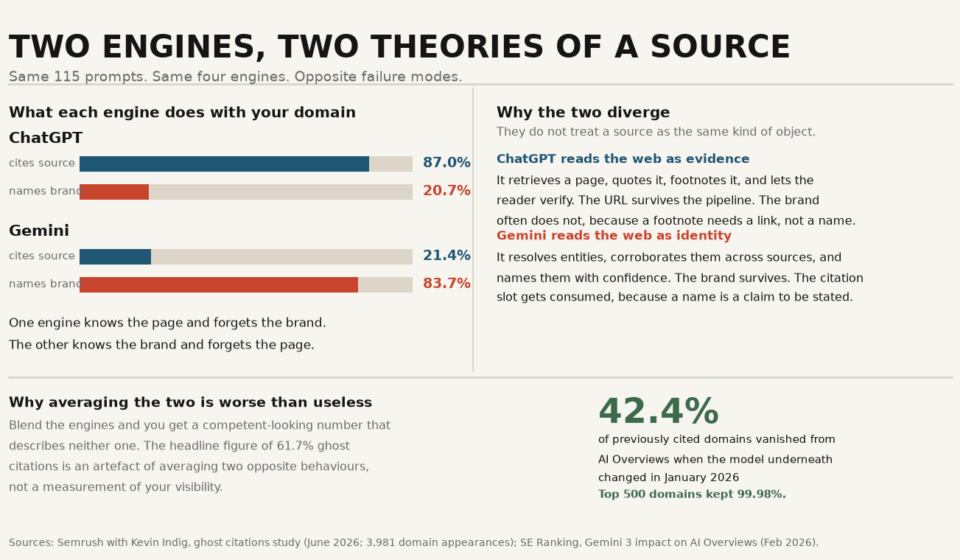
ChatGPT cited a source in 87% of cases but named the brand only 20.7% of the time. Gemini named the brand 83.7% of the time and cited a source in 21.4%.
That is not a quality gap. It is a philosophical one, and it tells you what each engine believes a citation is.
ChatGPT treats the web as evidence. Its retrieval layer hands the model passages, the model quotes them, and the footnote exists so a reader can check the claim. A footnote needs a link. It does not need a name. The URL survives the pipeline intact; the brand attached to it is incidental metadata, and often it does not survive at all. You were used. You just were not introduced.
Gemini treats the web as identity. It resolves entities, corroborates them across multiple sources, and states them with confidence. Saying “according to Ahrefs” is how a resolved entity gets expressed. But naming a thing is itself a citation — it consumes the slot. The brand survives, the link does not.
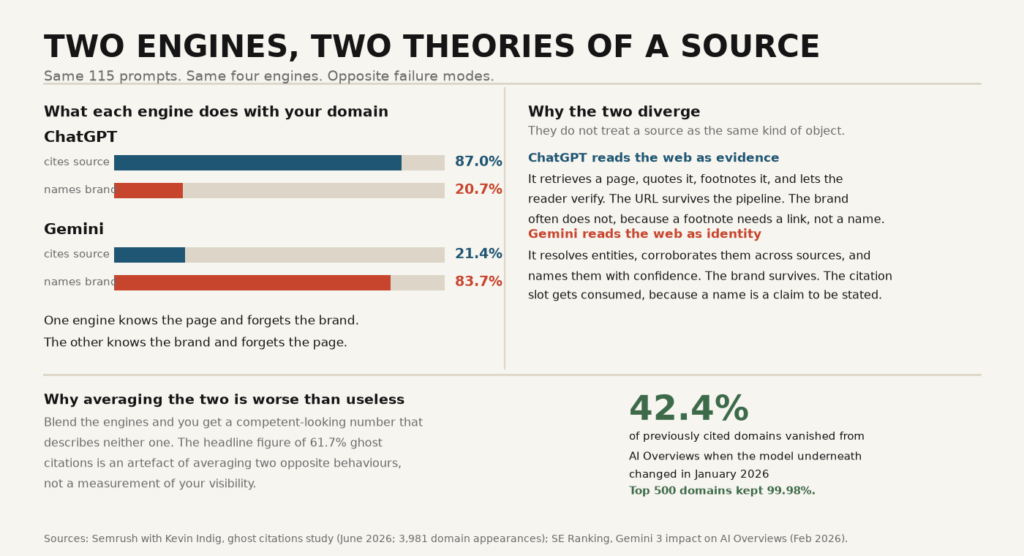
Here is why this matters more than the headline number. Average the four engines and you get a competent-looking figure that describes none of them. A dashboard reporting 61.7% ghost citations is not measuring your visibility. It is measuring the arithmetic mean of two incompatible theories, and it will tell you to fix the wrong thing.
The divergence also predicts who survives a model change. When Google made Gemini 3 the default behind AI Overviews on 27 January 2026, SE Ranking measured what happened next: 42.4% of previously cited domains disappeared. Almost all of them were long-tail. The top 500 most-cited domains held 99.98% of their citations.
Read that against the entity logic. The domains that vanished were the ones that had been retrieved as evidence — links doing a job that a different retrieval stack could do. The ones that survived were the ones already resolved as entities, because an identity does not depend on any single pipeline finding it.
Which reframes the strategic question. Optimising for citation is optimising to be useful evidence, and evidence is substitutable. Optimising for entity resolution is optimising to be a thing the model knows, and known things are not substitutable.
Most GEO advice sells the first and calls it the second. The data says only one of them survives the next model release.