Why 5% of Your Ads Do All the Work — and How to Buy More Tickets
A field guide to the arithmetic that decides whether your creative volume is a strategy or an expensive habit
Two variants. Two weeks. One winner. That protocol survived twenty years not because it was good science but because making an ad was expensive. One photo shoot, one edit, a handful of headlines, and a media buyer who waited for the confidence interval to close. The test was never a methodology. It was a budget constraint wearing a lab coat.
The constraint is gone. What replaced it is not more testing — it is a different question. Not “which of these two is better,” but “which combination, among the ones we can afford to read, moves the number.” Those two questions have different arithmetic, different failure modes, and different owners. Treating them as the same question is where most creative budgets quietly evaporate.
The two-variant test was never comparing much
An A/B test holds everything constant except one variable. That is its virtue and its blind spot. It can tell you that headline A beats headline B with reasonable confidence. It cannot tell you that headline A, paired with a testimonial photograph, a vertical crop and a price-led offer, would have beaten both by a margin that makes the original result look like rounding error.
The design space is combinatorial. Five headlines, four images, three offers, three formats, two openings: 360 cells before you consider audience. A two-cell test samples 0.6% of that, then reports the winner as though the other 358 were empty.
There is a statistical problem layered on top. Most creative testing is underpowered by design, because significance is expensive. The largest published dataset here comes from CXL, which analysed 28,304 experiments on its platform: about one in 7.5 produced a statistically significant lift above 10%, and 47.2% of respondents admitted they had no standard stopping point for a test. Nearly half the industry was calling winners the moment the dashboard turned green — the single most reliable way to manufacture a result that will not replicate next quarter.
What actually changed is that creative became the targeting
For a decade the lever was audience. You built interest stacks, layered lookalikes, excluded converters, and creative was downstream of that decision: a message aimed at a bucket you had already defined.
That inversion is over.
The retrieval gate
When Meta published the design of Andromeda in December 2024, it described a retrieval system that narrows tens of millions of eligible ads to a few thousand candidates per person before any auction runs. The system reported a 10,000-fold increase in model capacity, a 6% improvement in retrieval recall, and an 8% improvement in ads quality on selected segments. Read those together and the implication is structural: the first filter is not your audience settings. It is whether your ad is distinct enough to survive retrieval at all.
Meta rebuilt the system again in October 2026. The new version scores more than a billion ads per second in production on a single GPU server, roughly 100× the 2024 throughput, with about 300× fewer inference operations, and Meta credits it with a 2.4% increase in Facebook conversions since 2025. The stated trigger for the rebuild is the sentence worth reading twice: generative AI creative tools had helped advertisers “rapidly create hundreds of millions of new ads,” which grew the candidate pool the system has to score. When a platform rebuilds its infrastructure to absorb your output, your output has become the input to everyone’s strategy.
Iteration is not diversification
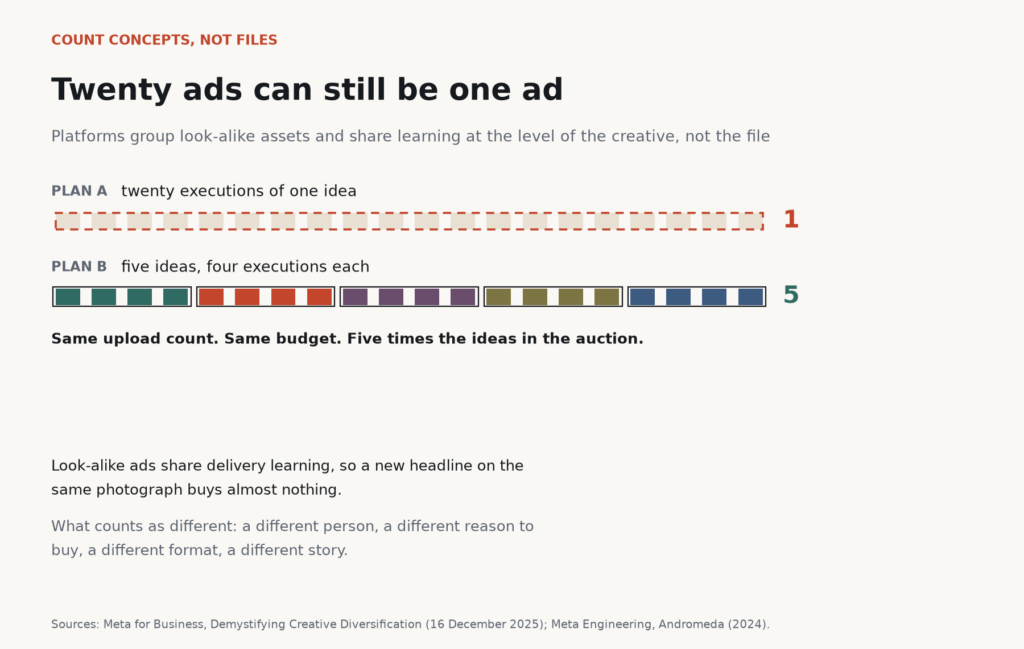
Meta said the quiet part out loud in December 2025, in guidance titled Demystifying Creative Diversification. Its ads system, the post explains, groups ads that share key visual and thematic attributes and treats them as variations of a single creative — sharing learning and delivery optimisation at the creative level, not the ad level. The post then draws a line that most teams blur:
- Iteration sharpens an idea. Two ads, identical visuals, different calls to action.
- Diversification expands the territory. Distinct assets built for different personas or use cases.
Iteration is not worthless. It is just not growth. A new headline on the same photograph tells the system almost nothing it did not already know — and increasingly it tells the system that you have one idea.
The arithmetic nobody runs
Generating a thousand variants is a solved problem. Reading a thousand variants is not, and the gap between those two facts is the entire discipline.
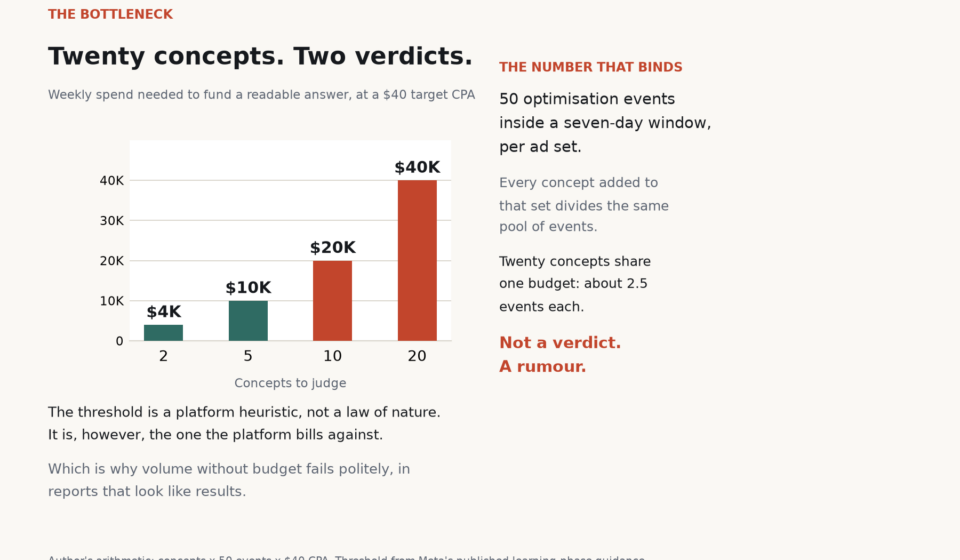
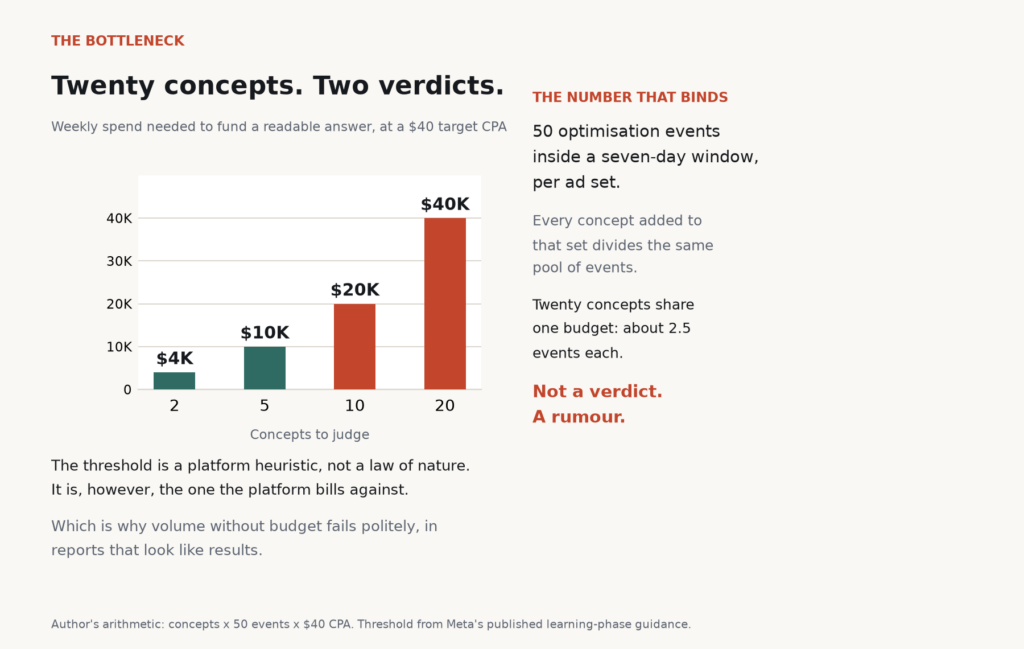
Meta’s documented learning threshold gives us the maths. An ad set typically needs around 50 optimisation events inside a seven-day window to exit the learning phase. Those events are whatever you told the ad set to optimise for, counted per ad set, in a rolling week — and every concept competing inside that set divides the same pool.
What fifty events actually buys
Take a realistic account: a $40 target cost per acquisition, 50 events required per concept. One concept needs about $2,000 a week to earn a verdict. Five need $10,000. Ten need $20,000. Twenty need $40,000 — every week, just to reach the point where a comparison means anything.
The polite failure
Twenty creatives against that same 50-event threshold leaves each one two or three events of signal. A pattern that thin is not a test result. It is a rumour with a dashboard, and it fails politely: no error message, just a report that looks like a result and a decision that will not hold.
Which is the correct reading of the volume argument, and the opposite of how it usually gets sold. Volume is not a strategy. Volume is how you buy lottery tickets. The strategy is deciding which tickets your budget can actually cash.
Counting concepts, not files
The most expensive mistake in high-volume testing is counting files. Twenty hook variations on one video is one idea with twenty executions. Meta’s grouping behaviour means those twenty compete for the same retrieval slot as a single creative, while your reporting shows twenty rows and your team feels productive.
The practical version, drawn from Meta’s own Advantage+ guidance: maintain at least 20 diversified ads per campaign, reserve 20–30% of budget for testing new ones, and note that a single campaign supports up to 150 creative combinations. What that guidance is not is “20 files.” It is 20 genuinely different propositions, and the platform’s definition of different is stricter than most briefing templates allow.
The five keys, and the inversion in your head
There is a measurement story that explains why this shift landed when it did, and it has nothing to do with AI.
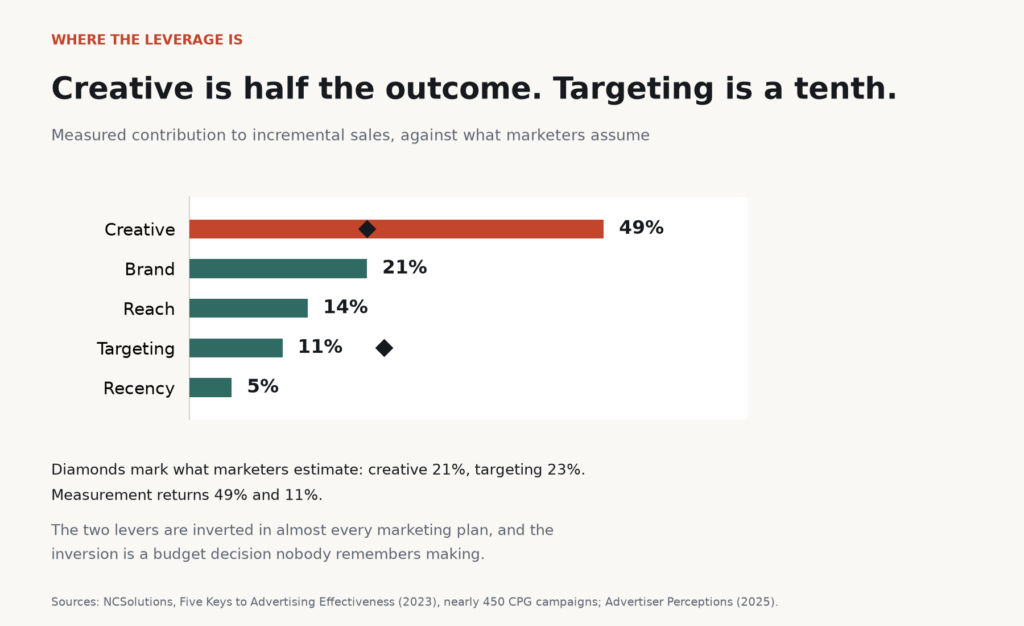
NCSolutions, in its 2023 update to Five Keys to Advertising Effectiveness, modelled nearly 450 CPG campaigns and attributed incremental sales as follows: creative 49%, brand 21%, reach 14%, targeting 11%, recency 5%. Creative’s weight was unchanged from the original 2017 study; targeting’s had crept from 9% to 11%.
Now compare perception. When Advertiser Perceptions asked brands and agencies in 2025 to estimate the same split, they put creative at roughly 21% and targeting at roughly 23%. The two levers are inverted in almost every marketing plan — the factor worth half the outcome gets the last budget line and the first deadline, while the factor worth a tenth gets the strategy deck.
Google cites the same research in its own creative guidance, which is a useful independence check: two competing platforms quoting 49% from one source is not collusion, it is a shared measurement base. And the direction of travel fits the mechanics. If targeting is worth a tenth, creative is worth half, and targeting has been automated into a broad-audience default, then creative is the only lever left that a human still holds.
What survives at volume
Three findings hold up across sources, and each one undercuts a piece of received wisdom.
The winner is rarely the one you would have picked
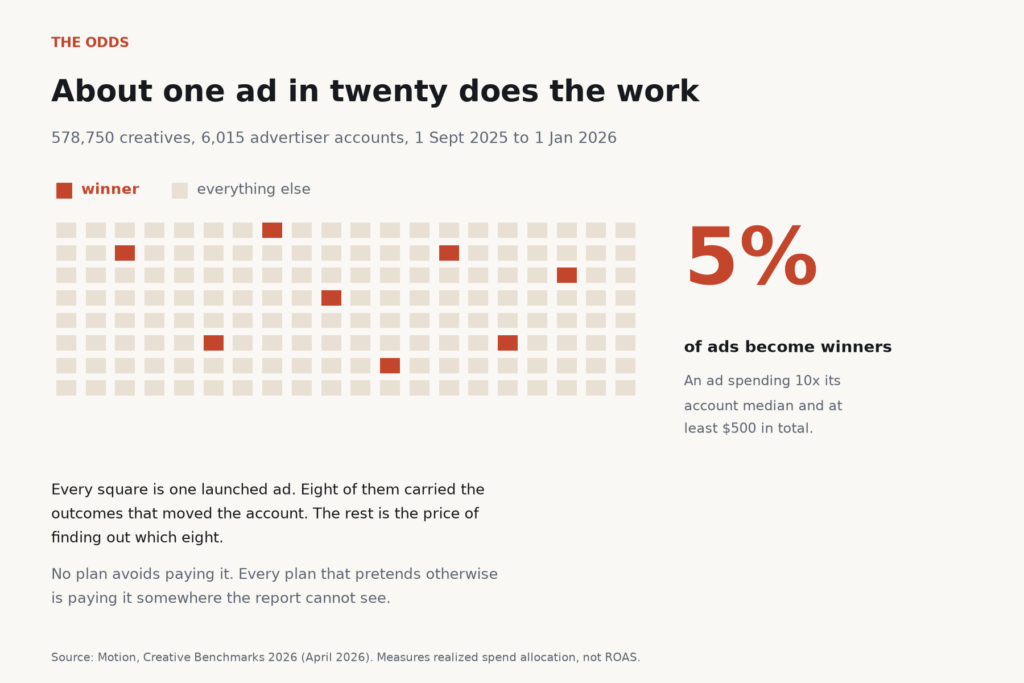
Motion’s Creative Benchmarks 2026 analysed $1.29 billion in realised Meta spend across 578,750 creatives from 6,015 advertiser accounts, spanning September 2025 to January 2026. It defined a winner as an ad spending at least 10× its account’s median and at least $500 in total. About 5% of creatives qualified. That threshold sits somewhere in the top decile of spend inside an account, which means the pool is thin by construction, not by accident.
The report is explicit that it measures where spend goes, not ROAS — the right level of humility, and the reason I trust it more than most vendor studies. It also implies an uncomfortable conclusion: if 5% of ads carry the account, and you cannot predict which 5%, then volume is not a growth tactic. It is a sampling method.
Format still buys efficiency
Meta’s Cyber 5 2025 analysis found ad sets containing at least one image, one video and one 9:16 vertical video with audio delivered 7.3% lower cost per action than sets missing any of the three. On Reels specifically, vertical video runs about 34.5% below static image CPA. And broader format and messaging mixes have been credited with up to a 32% CPA improvement and a 9% lift in incremental reach.
None of this is creative genius. It is giving the system more placements to choose from — which is precisely the argument for diversification over iteration, made in cost-per-action rather than in taste.
Content attributes are measurable, and they are narrow
An Ekimetrics study conducted with Meta modelled 3 billion impressions across almost 23,000 individual creatives over three and a half years, using 124 models that combined econometrics with computer-vision object and text detection. Four features drove significant ROI uplifts across brands: brand cue, logo, product, and person.
Not aesthetics. Not cleverness. Presence — of the thing you sell, and of the human using it. Sobering for anyone who believes craft is unmeasurable, and equally sobering for anyone who believes it is the whole story.
The playbook that survives the arithmetic
Four moves, in the order they matter.
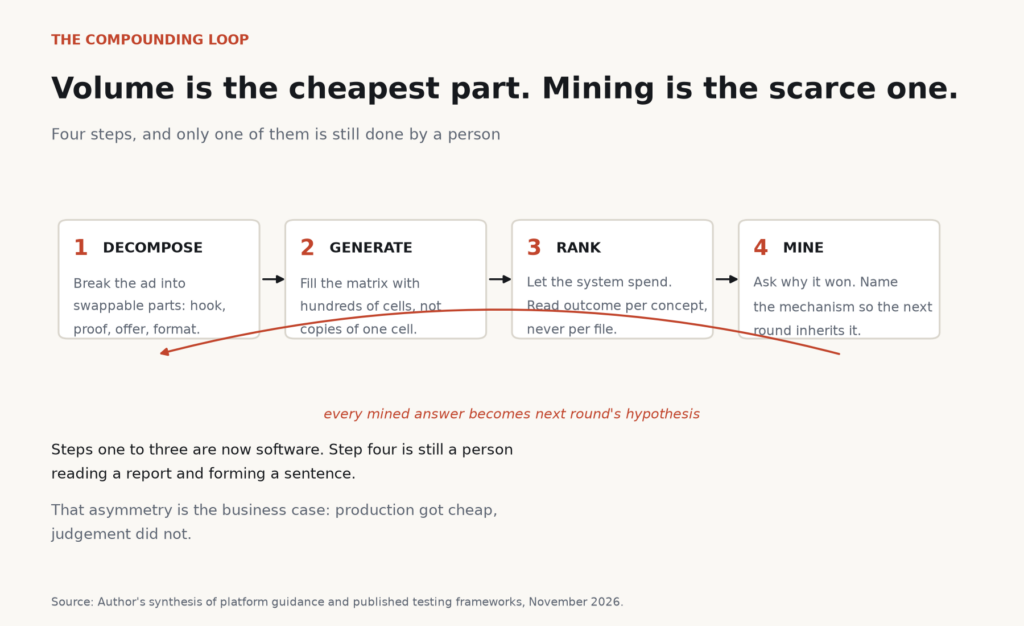
Decompose before you generate. Break the ad into swappable elements: the opening claim, the proof, the offer, the format, the face, the setting. This is not a creative exercise, it is an indexing exercise. You are deciding in advance which variable you will be able to attribute a result to. A brief that bundles a new hook, a new offer and a new format into one asset can win, and teach you nothing.
Count concepts, not files. Build the matrix so each cell is a different reason to buy, aimed at a different person, in a different format. Four hooks inside one concept are four executions and one test. Two concepts with four executions each are two tests. That distinction separates a report reading “concept B won” from one reading “ad 14 won, we think.”
Let the system allocate, and read spend as the verdict. Under an explore-exploit regime, spend is the signal, not the scoreboard. An ad with a spectacular ROAS on $60 has not been validated; it has been flattered. Motion’s 10× median plus $500 floor is a reasonable minimum bar for calling something a winner rather than an outlier.
Mine the winner, and write down the mechanism. This is the step almost everyone skips and the only one that compounds. Why did it win? Which element carried it — the objection it answered, the persona it recognised, the format it fit? If the answer is “it just performed better,” you bought a result rather than a learning, and next month you start from zero.
Three ways this goes wrong
Insight dilution. A thousand variants without a structured analysis layer produces noise and a very confident slide. The failure mode is not a shortage of winners; it is the inability to explain any of them. If your programme cannot answer “what did we learn about our buyer this quarter,” you are running an auction, not an experiment.
The local maximum. Optimisation finds the best version of the idea you already had. It will not find the idea you did not have. A system trained on your last 500 ads will keep proposing riffs on your last 500 ads — which is why human intervention belongs at the level of the concept matrix, not the headline.
Overfitting to the click. Creative that wins on CTR and loses on retention is a real and expensive pattern, invisible if your only readout is platform-reported ROAS. The platforms have an interest in the shorter metric. Balance performance reads with whatever downstream signal you can defend to a CFO, because the cost of a thousand efficient clicks is sometimes a brand nobody remembers.
The flattening problem
Now the part the volume advocates skip.
IAB and Sonata Insights, in The AI Ad Gap Widens, found that 83% of ad executives say their company has deployed AI in the creative process, up from 60% two years earlier. They also found that 82% of those executives believe Gen Z and Millennial consumers feel positive about AI-generated ads, while 45% of those consumers actually do. The gap has widened from 32 points to 37. Among Gen Z alone, 39% report negative sentiment, nearly double the rate among Millennials, and 30% describe brands that use AI for advertising as inauthentic.
Read that alongside IAB’s July 2026 video report — nearly two-thirds of video buyers now use generative AI for creative, with a third of ad assets including it this year and 43% projected for 2027 — and a specific risk emerges. If everyone generates from the same handful of models, with the same default lighting and the same pleasant synthetic faces, the combinatorial space collapses from the supply side. The research literature already has a name for the underlying dynamic: models trained on their own outputs lose diversity over successive generations. Advertising does not need to train on its own output to inherit the problem. It only needs everyone to prompt the same way.
Meta’s own framing is unusually blunt here. Generative variations of one winning ad are iteration, not diversification. The new concept — a new buyer, a new problem, a new story — still has to come from a person who has talked to a customer.
What happens next
The bottleneck is migrating from production to judgement. Generation is now a commodity line item; extraction is not, and it does not scale with compute. The organisations that compound an advantage over the next two years will not be the ones shipping the most variants. They will be the ones whose creative and media teams share a single learning log, and who can explain last quarter’s winner in one sentence.
The takeaway
A/B testing asked a question that fit the cost of production. That cost has collapsed, so the question has to change — but not into “how many can we make.” The right question is narrower and harder: how many variants can we afford to read, and what are we doing with what we learn?
The brands that win at creative volume will not be the ones with the biggest variant count. They will be the ones who treat testing as a portfolio with a budget, count concepts instead of files, refuse to crown a winner that never got a fair contest, and mine every result for a mechanism they can reuse. That is a slower sentence than “a thousand variants.” It is also the only version that survives contact with a P&L.
Frequently asked questions
Is A/B testing dead, or is that just a headline?
Not dead — demoted. A controlled two-cell test remains the cleanest way to answer a single causal question, especially on offers and landing pages. What died is A/B testing as the primary creative strategy. It samples a vanishingly small slice of a combinatorial space, and at current production costs that sampling rate is no longer rational.
How many variants should we actually run?
Work backwards from budget, not forwards from ambition. Divide weekly spend by your target cost per action, then divide by 50 — the event count a set needs to exit learning. A $3,500 weekly budget at a $35 target yields roughly two concepts with real signal behind them. Twenty concepts on that budget does not buy twenty tests; it buys twenty rumours. Raise the count only when the spend can pay for the read.
Why does the platform treat my twenty ads as one creative?
Because they are one idea. Meta groups ads that share key visual and thematic attributes and shares delivery learning at the creative level. A new headline or caption on the same footage does not create a new proposition — it creates a new file. The practical test of distinctness: could a stranger tell two of your ads apart with the sound off, at thumbnail size?
Does AI-generated creative converge, and does it matter?
It can, and it does. When teams generate from the same models with similar prompts, outputs drift toward a shared visual dialect — and consumers are already responding. Only 45% of Gen Z and Millennial consumers feel positive about AI-generated ads, against 82% of executives who assume they do. The countermeasure is not avoiding AI. It is keeping human-sourced concepts, real customers and real settings inside the matrix so the space stays wide.
What is the single highest-leverage change a mid-sized team can make this quarter?
Separate the learning log from the ad account. Most teams store results inside the platform, where they are summarised into a dashboard and then forgotten at the next campaign reset. A plain document that records, per test, the hypothesis, the concepts compared, the spend per concept, and the mechanism behind the winner will outperform any additional creative volume you can buy this quarter.