Why Duplicating a Winning Ad Makes It Look Mediocre
INSIGHT — The economics behind a number that keeps getting misread
You have a winner. So you do the sensible thing: you duplicate it. New ad set, new audience, same creative, because why would you change a working asset? Three weeks later, every copy is reporting a fraction of the original’s performance. The original is still your hero. The clones are dead weight. Someone in the room says the word fatigue, and the meeting moves on.
Fatigue is not what happened. A tax was levied, and nobody sent the invoice.
The pool does not grow when you add ads
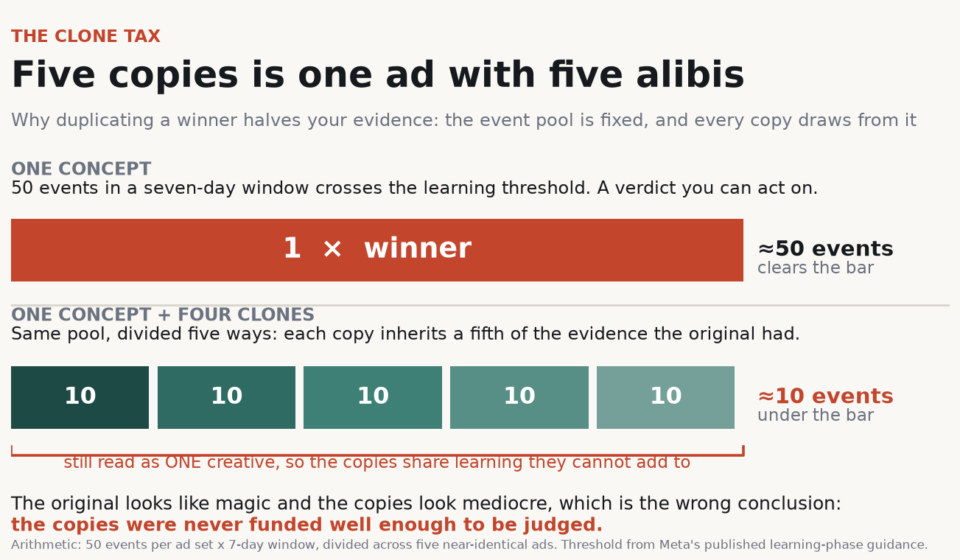
Start with the constraint that governs everything downstream. Meta’s documented learning threshold asks an ad set for roughly 50 optimisation events inside a seven-day window before it exits learning. Those events are not generated by your creative. They are generated by your budget, divided by your cost per action.
Fifty events at a $40 target cost is about $2,000 a week. That is the price of one readable answer in one ad set. Duplicate your winner into four more sets and you have not created four more answers; you have created four more mouths asking for the same $2,000 each. If the budget didn’t grow, each copy now receives a fifth of the evidence its parent had. Ten events. Below the threshold. Unreadable.
The copy didn’t get worse. It got quieter.
Grouping makes the arithmetic worse
The second half of the mechanism is newer and less understood. Meta’s Demystifying Creative Diversification guidance, published in December 2025, describes a system that groups ads sharing key visual and thematic attributes and treats them as variations of a single creative, sharing delivery learning at the creative level.
That grouping is efficient for delivery and brutal for measurement. Copies of a winner compete for the same retrieval slot and cannot accumulate independent evidence, because the system is already treating them as one thing. You have spent four extra budgets to learn nothing new about a creative you already understood. The platform isn’t withholding a result; there is no result to withhold.
Why it looks exactly like fatigue
Here is the part that makes the illusion convincing. Both phenomena produce the same dashboard shape: a strong early number, then a slope down, then flatness.
Genuine fatigue is a response to repeated exposure — the audience has seen it too often. The clone tax is a response to divided measurement — the audience is fine, your instrument isn’t. One is a creative problem with a creative solution. The other is a budgeting problem that no amount of new hooks will fix, which is why teams respond to it by producing more variations of the same idea and watching the number fall further.
The uncomfortable part
If this is right, then part of what made your winner a winner was that it stood alone. It received undivided events. It was measured properly.
That means your historical best-performing asset is not a pure reading of creative quality. It is creative quality plus the accident of having been adequately funded. Archive it as evidence of what the concept can do — not as a promise that the concept will do it again under a quarter of the budget.
What the arithmetic actually asks of you
Count concepts, and fund each one to the threshold or don’t launch it. Two concepts with real budgets teach you more than ten with a fifth of the evidence each. And when something wins, the right move is rarely to clone it — it is to spend the next round on a different concept, because the winner has already told you what you needed to know.
Duplication feels like risk reduction. It is evidence reduction wearing the same costume.