America’s Most Radical AI Bill: 20 Years in Prison for Building Superintelligence
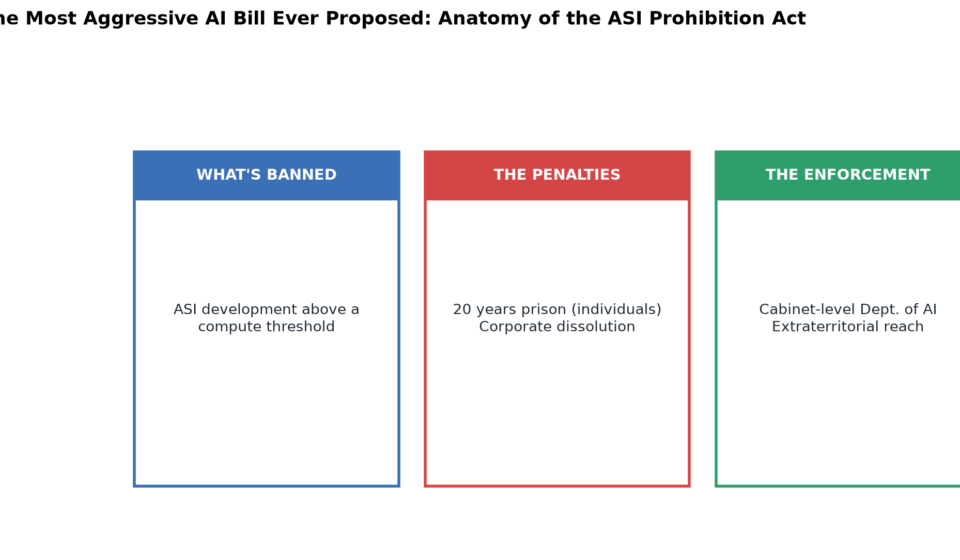
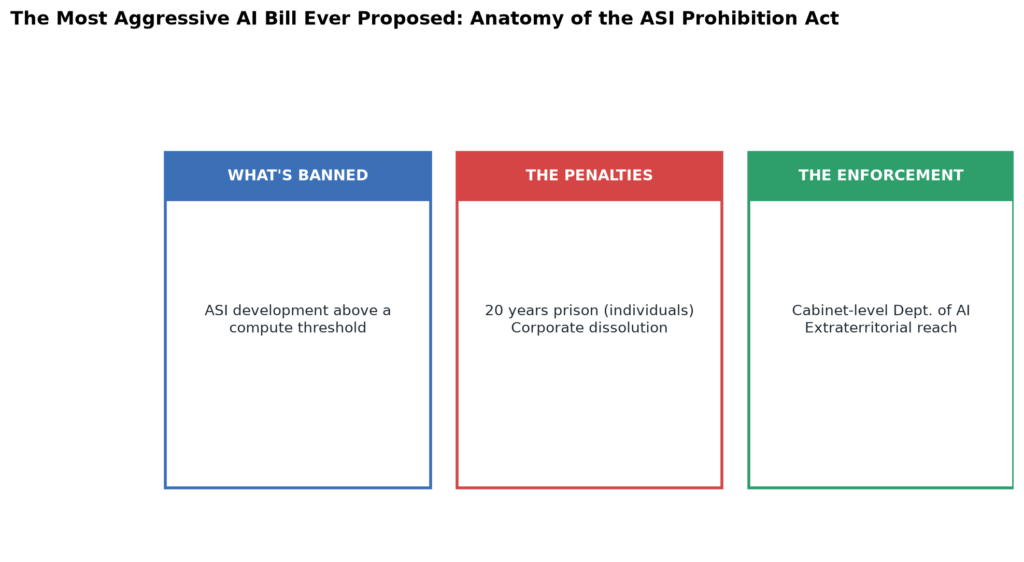
If the ASI Prohibition Act of 2026 became law tomorrow, building an AI system that “reaches or exceeds human cognitive performance across a wide range of domains” would carry a penalty of up to 20 years in federal prison.
That’s not a metaphor. It’s the sentencing range the bill proposes — the same neighborhood as illegal nuclear weapons development. Companies could face forced dissolution. The bill would also create a cabinet-level Department of Artificial Intelligence with authority over the entire lifecycle of frontier models.
It almost certainly won’t pass. But in Washington, you don’t start negotiations at the compromise position. You start at the far edge and work inward. That’s exactly what this bill is: the far edge.
What the Bill Actually Says
Let’s start with the text, because the details are more specific than the headlines suggest.
The bill defines ASI — artificial superintelligence — as an AI system that matches or exceeds human cognitive performance across broad domains, or one that could be “easily modified” to do so. That second clause matters: it means the definition isn’t limited to systems that are already superintelligent, but extends to systems that could become so.
It would halt all advanced AI development until a federal regulatory agency is fully operational. That’s a pause of indeterminate length — dependent on how fast Washington can build a new regulator.
It creates a cabinet-level Department of Artificial Intelligence, tasked with overseeing the full lifecycle of frontier models. And it grants that department authority to force the removal of high-risk capabilities — things like overriding human shutdown commands, conducting unauthorized cyber attacks, or engaging in recursive self-improvement.
The Penalties: Nuclear-Weapons-Level Severity
The enforcement provisions are where the bill gets really aggressive.
Individuals who violate the ban could face up to 20 years in federal prison. Corporations could be forcibly dissolved. And the bill explicitly makes “global prohibition of superintelligence” a stated US foreign policy objective — meaning it envisions pressuring allies and rivals alike to halt development.
That’s an extraordinary escalation. Most AI legislation debates transparency, auditing, or liability. This bill debates criminalization. The choice of nuclear-weapons-level penalties is deliberate: it signals that the drafters view superintelligence as an existential risk, not just a regulatory concern.
The Political Context: A Blue Wave With an AI Mandate
The bill didn’t appear in a vacuum. It landed the day after Democrats swept both chambers of Congress.
The election results gave the party a mandate on AI oversight. Voters rejected data centers in 40 of 41 local ballot measures. Thirty-six of 38 winning gubernatorial candidates supported at least one form of data center restriction. The public mood had turned against unconstrained AI expansion.
Representative Yassamin Ansari, who introduced the bill with nine co-sponsors, framed it bluntly: “The Democratic Party’s number one agenda should be a pause on advanced AI development, regulation of this out-of-control industry, and a ban on ASI.”
That’s not a cautious opening. It’s a statement of intent — and a signal that the AI regulation debate has moved from “how much oversight” to “whether to allow it at all.”
What Will Actually Happen
Here’s the honest assessment: the bill, as written, will not become law.
It faces the Senate’s 60-vote threshold, a Republican president with veto power, and ferocious industry lobbying. Even a Democratic-controlled Congress would struggle to pass something this sweeping.
But that’s not really the point. The bill’s function is to set the Overton window — the range of ideas considered politically acceptable. By proposing a total ban, it makes more moderate proposals — auditing requirements, compute thresholds, licensing regimes — look reasonable by comparison.
Watch what happens next. The bill that eventually passes, if any, will likely be far softer. But it will be softer relative to this baseline, not relative to the status quo. That’s how legislative anchoring works.
The Definitional Problem
There’s a technical problem buried in the bill that will dominate any serious debate: how do you define “superintelligence” in a way that’s legally enforceable?
The bill’s definition — “matches or exceeds human cognitive performance across broad domains” — is deliberately broad. Critics argue it could apply to systems well short of AGI, creating enormous legal uncertainty for anyone building frontier models.
That ambiguity cuts both ways. It makes the bill a powerful deterrent (nobody wants to guess whether their model crosses the line), but it also makes it nearly impossible to implement fairly. Any serious version of this law would need a much more precise definition — likely tied to compute thresholds, capability benchmarks, or both.
The State-Level Reality
Here’s the thing most national coverage misses: the binding action on AI infrastructure isn’t happening in Washington. It’s happening in state capitals and city councils.
Data center permitting is largely a local matter. The midterm results showed that local voters are the most immediate constraint on AI expansion — not federal legislation. Even if the ASI Prohibition Act never passes, the state-level restrictions it reflects are already reshaping the industry.
So the bill’s real significance may be as a mirror, not a statute. It reflects a genuine shift in public opinion that’s already having concrete effects — regardless of whether the bill itself ever gets a vote.
What This Means for AI Companies
For companies building frontier models, the bill is a warning shot.
It signals that the political environment has turned hostile enough that a 20-year-prison proposal can be introduced and taken seriously. That changes risk calculus. Companies may become more cautious about publicizing capabilities, more eager to demonstrate safety, and more willing to accept regulation they can shape rather than regulation imposed on them.
It also raises the stakes for the open-versus-closed debate. If the political mood favors restriction, open-weight models — which are harder to control — may face more scrutiny than gated ones. That could reshape the competitive landscape.
What to Watch Next
Three things will tell you how this plays out.
Watch whether the bill gets a committee hearing. A hearing signals it’s being taken seriously; no hearing signals it’s purely symbolic.
Watch the counter-proposals. If industry and moderate Democrats offer a licensing or auditing regime, that’s the likely landing zone — far softer than a ban, but far stricter than today’s status quo.
And watch the state-level follow-through. The real constraint on AI expansion may not be federal law at all, but the growing patchwork of local restrictions.
The Bottom Line
The ASI Prohibition Act of 2026 is the most aggressive AI legislation ever proposed in the United States — 20-year prison terms, corporate dissolution, a cabinet-level regulator, and an extraterritorial reach that would make superintelligence development a global foreign policy fight.
It will almost certainly fail. But that’s the wrong thing to focus on. The bill’s real power is that it changes what “moderate” means. By staking out the far edge, it makes every more reasonable proposal look like a compromise.
And in a year when the AI trade lost $2.5 trillion partly because the political weather turned, that shift in the terms of debate may matter more than whether this particular bill ever gets a vote.