Apple Just Borrowed $7.5 Billion — With $137 Billion in the Bank
On the same day the Nasdaq lost 5.52% and the semiconductor index crumbled 12.25%, Apple quietly raised $7.5 billion in the bond market — and investors placed $31 billion in orders, more than four times the offering.
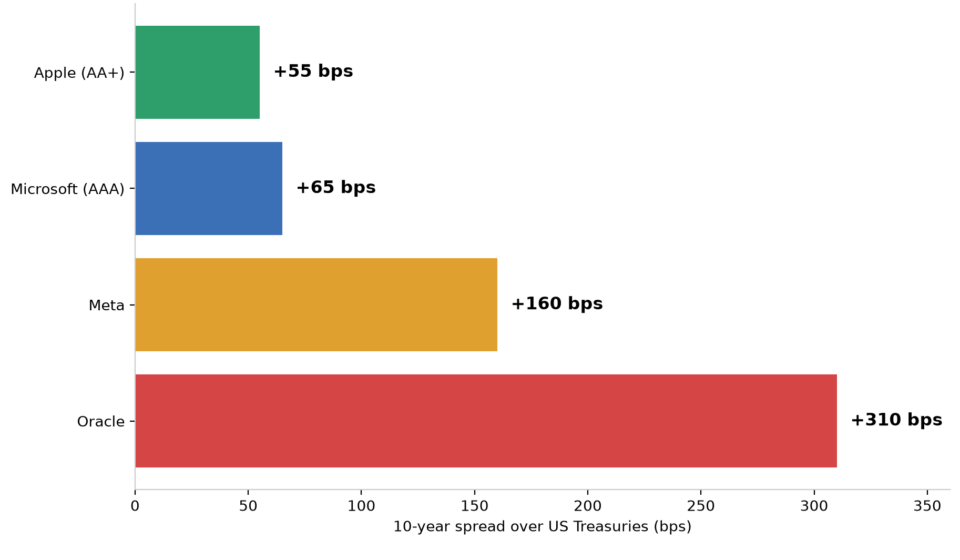
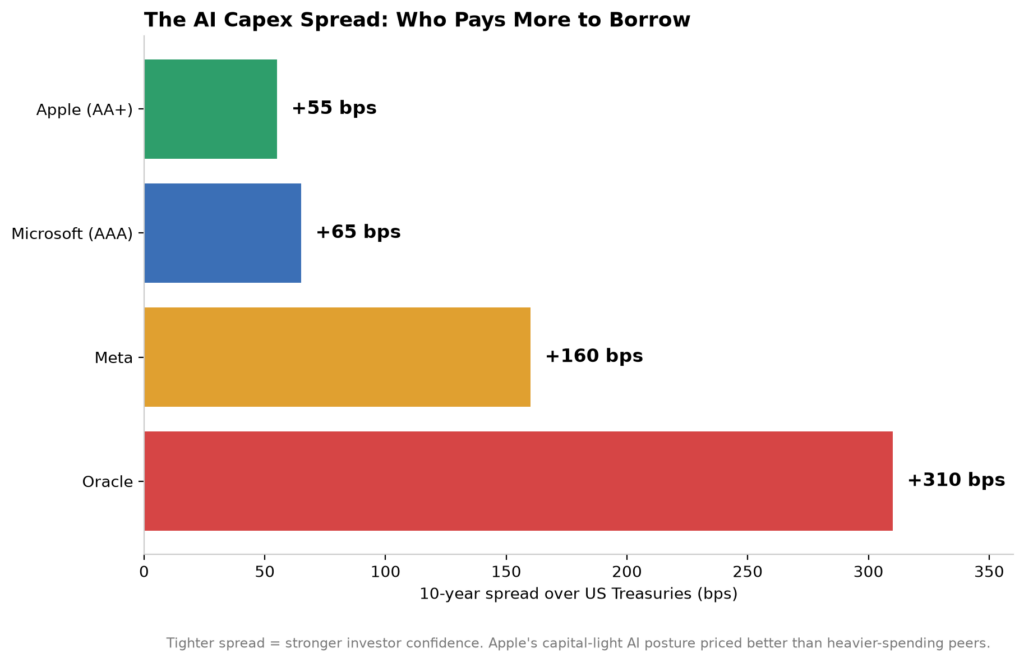
The 10-year tranche priced at just 55 basis points over US Treasuries. Microsoft paid 65. Meta paid 160. Oracle paid 310.
Apple has $136.9 billion in cash and equivalents. It did not need to borrow.
But the bond market needed somewhere safe to go — and Apple, by not betting its balance sheet on AI infrastructure, became the safest port in the storm.
The Deal: Terms and Structure
Let’s get the specifics straight, because the numbers tell the story.
Apple’s final issuance was $7.5 billion, upsized from an initial target of about $7 billion as demand poured in. The deal was split across seven tranches with maturities ranging from two to ten years.
The 2036 tranche — the longest-dated piece — totaled $2 billion at a 5.35% annual coupon, priced at 55 basis points over comparable Treasuries. That initial spread guidance was 80 basis points; strong demand compressed it by a quarter of a percentage point.
The bookrunners were Bank of America, Deutsche Bank, Goldman Sachs, and JPMorgan. Orders peaked at roughly $31 billion, an oversubscription of more than four times.
For context: Apple’s last bond sale, in May 2025, raised $4.5 billion and drew about $10 billion in orders — roughly 2.2x. This time, both the size and the demand multiple were larger.
Why Apple Borrows With $137 Billion in the Bank
The obvious question: if you have $136.9 billion in cash and marketable securities, why issue debt?
The answer is part tax strategy, part capital management. Much of Apple’s cash sits overseas; repatriating it can trigger significant tax consequences. Issuing US-dollar bonds lets the company fund domestic needs — including its massive share buyback program — without touching that overseas cash.
In the fourth quarter of its 2026 fiscal year, Apple generated $28 billion in operating cash flow and returned $28 billion to shareholders. That’s the machine the bond market is financing: not factories or data centers, but buybacks and dividends.
Bloomberg Intelligence analyst Robert Schiffman put it plainly: Apple’s return to the bond market “looks opportunistic rather than need-driven,” with proceeds available for buybacks and dividends.
The AI Credit Spread: Apple vs. Everyone Else
Here’s where the story gets interesting for anyone watching the AI trade.
Look at the spreads. Apple, rated AA+ by S&P, priced its 10-year debt at +55 basis points. Microsoft, rated AAA, paid +65. Meta paid +160. Oracle paid +310.
Those numbers aren’t random. They’re the bond market’s verdict on each company’s AI exposure.
Apple spends relatively little on AI data center infrastructure. Its AI strategy — Apple Intelligence — is largely on-device and consumer-facing, a capital-light approach. Microsoft is spending heavily on AI but has a diversified, cash-generating business. Meta is pouring tens of billions into infrastructure with uncertain returns. Oracle is making an aggressive cloud buildout with leverage.
The tighter your AI capex and the stronger your cash flow, the less you pay to borrow. In November 2026, “not spending on AI” became a credit advantage.
The Big Tech Bond Wave
Apple wasn’t alone in tapping the market. Over the preceding days, Big Tech companies issued roughly $50 billion in US corporate bonds.
Meta, Microsoft, Oracle, and Apple all came to market — but for different reasons. Most were funding AI infrastructure. Apple was funding shareholder returns.
That distinction is now visible in pricing. The market is separating “AI borrower” from “general corporate borrower” within Big Tech, and it’s charging the AI borrowers more.
This is a significant shift. For years, the assumption was that AI investment was a growth signal — the more you spent, the more bullish investors were. The bond market is now saying something different: heavy AI spending carries risk, and that risk has a price.
The Shareholder-Return Contrast
Apple’s capital allocation has always prioritized shareholder returns over infrastructure spending. It buys back hundreds of billions in stock, pays a growing dividend, and invests in products rather than data centers.
That strategy has been criticized at times — the knock being that Apple is “behind” on AI. But in a week when AI capex anxiety hammered the market, that same restraint looked like discipline.
Apple’s stock fell about 1.5% on the day — a bad day, but far better than its AI-heavy peers. When you’re not spending on the thing the market is worried about, you don’t fall as far when the worry hits.
What This Means for the Bond Market
The Apple deal is a useful signal for anyone watching corporate credit.
First, high-quality issuers can still raise enormous sums even in a selloff, as long as their story is “we don’t need the money for risky bets.” Apple’s four-times oversubscription proves it.
Second, the AI capex premium is real. Companies funding infrastructure are paying more to borrow than companies funding buybacks. That gap will shape how CFOs think about financing their AI ambitions.
Third, the bond market may be ahead of the equity market in pricing AI risk. Equities have been volatile on AI sentiment; credit spreads have been quietly telling a more consistent story.
What to Watch Next
Three things will show how this plays out.
Watch whether other cash-rich, capital-light companies follow Apple to market. If they do, it confirms that “not spending on AI” is now a financing advantage.
Watch the AI borrowers’ spreads. If Meta, Oracle, and others have to pay more to raise debt, the cost of AI infrastructure rises — and some projects may get shelved.
And watch Apple’s next capital allocation decision. If it keeps prioritizing buybacks over AI infrastructure, the credit market will keep rewarding it. If it pivots to heavy AI spending, the spread advantage may narrow.
The Bottom Line
Apple raised $7.5 billion it didn’t need, at a price better than any of its AI-spending peers, on the worst day for tech stocks in over a year.
That’s not a contradiction. It’s the bond market’s clearest statement yet about the AI trade: in a world where the cost of building data centers is rising and the political permission to build them is shrinking, the companies that aren’t spending heavily on AI are looking less like laggards and more like safe havens.
Apple didn’t need the money. It just needed to prove a point — and the market handed it $31 billion in orders to make it.