Claude Gets Your Bank Account — and the Trust Question Changes Forever
Claude can now see your bank account. Not metaphorically — literally.
On November 5, Anthropic launched a “Personal Finance” beta for US Pro, Max, and Ultra subscribers, connecting Claude to users’ bank accounts and credit cards through Plaid’s read-only API. It can answer questions like “How much did I spend on dining last month?” It can detect duplicate charges. It can flag a subscription that quietly crept up by five dollars a month.
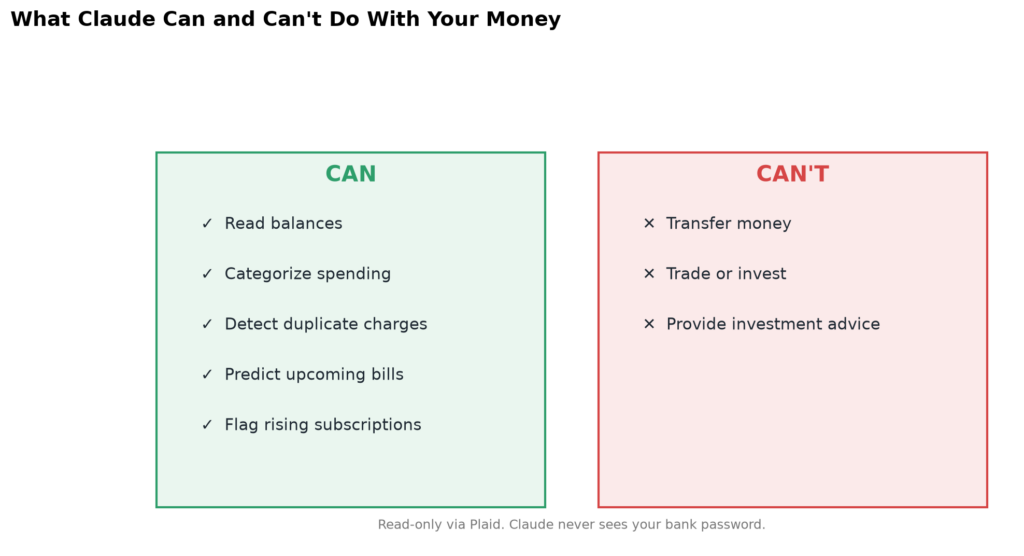
It cannot transfer money. It cannot invest it. And Anthropic says it won’t recommend financial products.
But the boundary — assistant versus advisor — is now thinner than ever. And that’s the real story here: not the feature itself, but the precedent it sets.
What Claude Can Actually Do
Let’s start with the mechanics, because they matter for understanding the trust model.
Users connect their bank accounts and credit cards through Plaid, the financial-data network that powers countless budgeting apps. The key word is read-only: Claude can see balances, credit limits, account information, and up to two years of transaction history. It never asks for or sees your banking password.
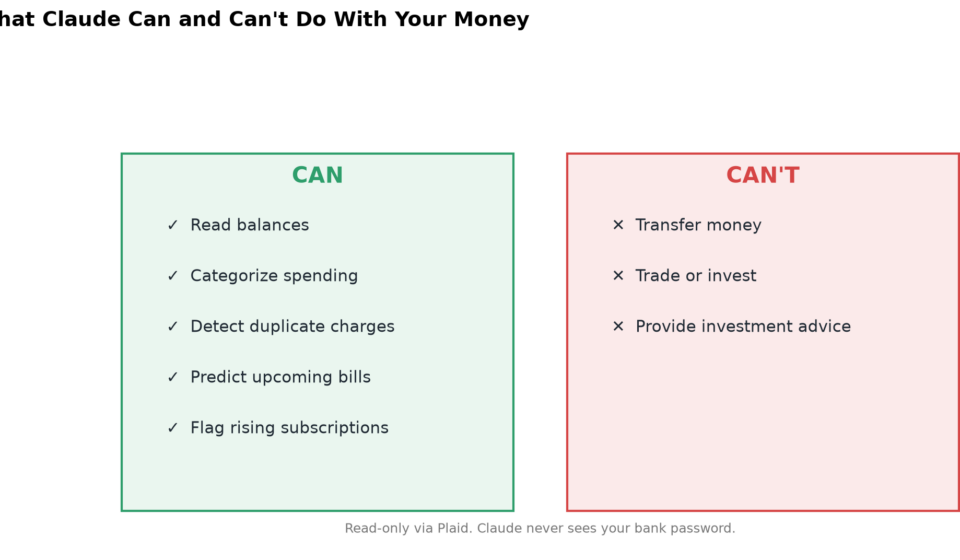
From there, the functionality is analytical, not operational. It can categorize your spending, answer balance and transaction questions, estimate upcoming bills based on visible recurring charges, and surface the kinds of problems people miss — duplicate charges, unexpected fees, and bills that rise gradually month over month.
That’s genuinely useful. Budgeting apps have done pieces of this for years, but they’ve never been conversational, and they’ve never been able to follow up. Claude can.
What It Deliberately Can’t Do
Here’s where Anthropic is being careful — and where the product design reveals the strategy.
Claude cannot transfer money. It cannot execute trades. It is explicitly not designed to provide investment advice. The company describes the feature as read-only, and that’s not a technical limitation so much as a deliberate boundary.
That boundary is smart. Moving money and giving investment advice are the two functions that trigger the heaviest financial regulation. By staying strictly on the analysis side, Anthropic avoids stepping into territory that would invite regulator scrutiny — at least for now.
But boundaries have a way of moving. Once users are comfortable with an AI reading their transactions, the next question — “can you just pay this bill for me?” — becomes a product decision rather than a technical one.
The Privacy Commitments — and Their Limits
Anthropic has made specific privacy promises, and they’re worth reading precisely.
Conversations within the Personal Finance hub are not used to train models. That’s a meaningful commitment — financial data is among the most sensitive personal information there is.
There are no ads and no sponsored recommendations. Anthropic says it doesn’t offer its own credit cards, loans, or savings accounts through the feature.
But note the precision. The training promise applies specifically to conversations within the Personal Finance hub — not to all Claude conversations. And Anthropic hasn’t promised Claude will never make a financial product suggestion in some other context. The commitments are real but scoped.
The “Read-Only Beachhead” Strategy
If you want to understand why Anthropic chose read-only access, think about how trust actually gets built.
Read-only is the lowest-friction entry point into financial data. It’s useful enough to try, low-risk enough to allow. Once a user has tried it and found it helpful, the mental barrier to deeper integration drops.
This is a classic “beachhead” strategy. Land on the least-threatening shore, establish a foothold, then expand. Anthropic isn’t the first company to think this way, but it’s the first major AI assistant to execute it at the account level.
The competitive context matters too. OpenAI hasn’t launched an equivalent. Apple and Google have transaction data through Apple Pay and Google Pay, but haven’t integrated it into their AI assistants at this depth. Anthropic is first — and first-mover status in a trust-sensitive category is valuable.
Why This Matters Beyond Personal Finance
Step back, and the implications run wider than budgeting.
If AI assistants become the interface for personal finance, consumers may stop visiting bank websites and personal finance blogs directly. The “best credit card 2026” search that once started with Google could start with Claude.
That’s a structural change in how financial content gets discovered. Financial institutions may have to negotiate Plaid-level data access with AI platforms — or risk being disintermediated. Marketing strategies built on search-engine visibility may need to adapt to an AI-mediated discovery model.
And there’s a deeper question: if an AI can see your spending patterns and answer questions about them, at what point does “assistant” become “advisor”? Anthropic says it’s not there. But the line is getting blurrier with every feature update.
The Trust Threshold
Here’s the honest uncertainty. We don’t yet know whether “read-only” feels safe enough to become a habit — or just safe enough to try once.
Consumer comfort with AI and money likely varies sharply by task. “Tell me my balance” feels different from “move my money,” which feels different from “recommend investments.” Anthropic is betting that by starting at the safest end, it can earn enough trust to move toward the middle.
Whether that bet pays off depends on something no one can fully predict: how quickly people get comfortable with an AI knowing how they spend.
What to Watch Next
Three signals will show how this evolves.
Watch whether Anthropic expands beyond read-only. A move toward bill payment or budgeting automation would signal confidence — and invite regulatory attention.
Watch the competitive response. If OpenAI or Google launches a similar feature, the “AI financial assistant” category becomes real, and the race for trust accelerates.
And watch the regulatory posture. Financial regulators will eventually weigh in on what an AI assistant can and can’t do with consumer financial data. That guidance will shape how far this feature can go.
The Bottom Line
Anthropic’s Personal Finance feature is a small product with a large implication. It’s the first time a major AI assistant has been systematically connected to users’ bank accounts — and it’s designed, deliberately, to be as unthreatening as possible.
But the unthreatening version is just the opening move. The real question isn’t whether Claude can see your bank account today. It’s whether, a year or two from now, you’ll trust it to do something with that information.
The trust experiment has begun. And like all trust experiments, its outcome won’t be decided by the launch — but by what happens next.