Google’s $17 Billion Bet: The AI Data Center That Comes With Its Own Power Plant
Two days after American voters rejected data centers in 40 of 41 local ballot measures, Google announced its first-ever data center in Wyoming — a $17 billion, multi-decade commitment in Laramie County, near Cheyenne.
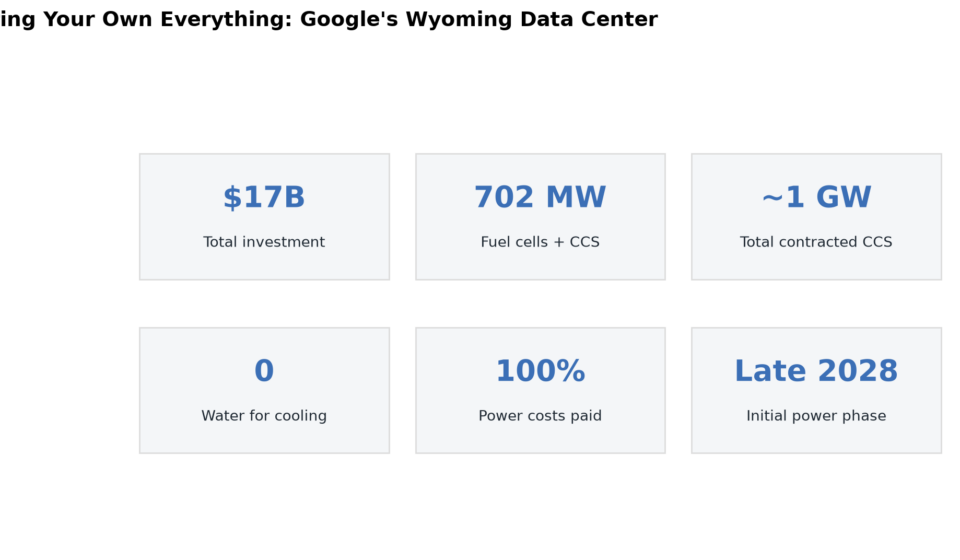
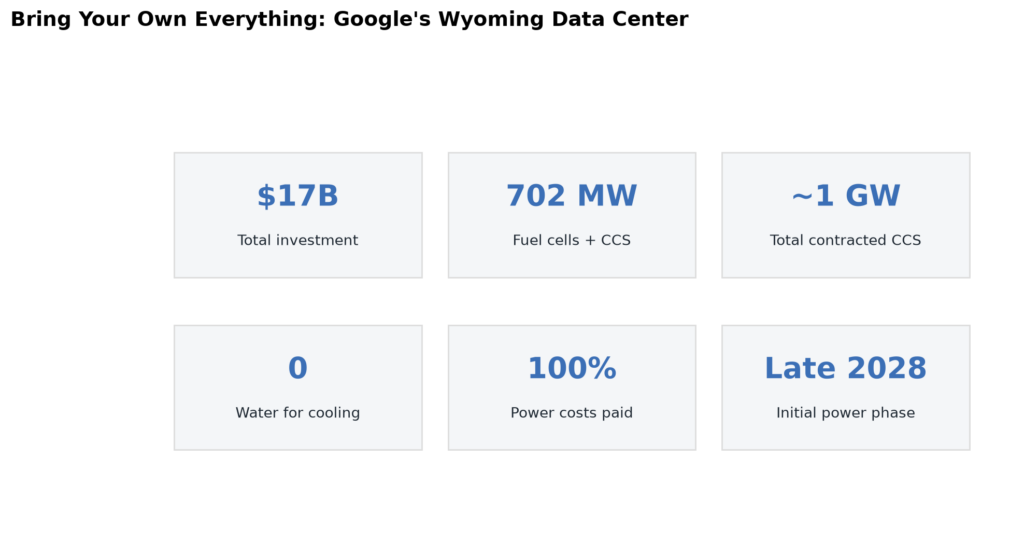
It will be powered primarily by a 702-megawatt fuel cell installation — the largest planned commercial fuel-cell project for any data center — with carbon capture and permanent sequestration handling what Google calls “a large majority” of emissions. It will be air-cooled, meaning zero strain on local water supplies. And Google will pay for every watt it uses plus the grid upgrades its growth requires.
The message is unmistakable. If you want to build AI infrastructure in post-midterm America, you’d better bring your own everything: power, carbon solution, and a community plan.
The Project: What Google Is Actually Building
The basics first. Google is building its first data center in Wyoming, in Laramie County near Cheyenne. It’s a long-term, $17 billion investment.
The partners are a roster of energy and infrastructure names: Tallgrass Energy, Black Hills Energy, American Electric Power (AEP), Related Digital, and Bloom Energy. AEP is investing roughly $4 billion in the fuel cell generation facility itself, according to reporting from Bloomberg and others.
The scale is genuine, but the more interesting story is how the power gets made.
Power: 702 Megawatts of Fuel Cells and Carbon Capture
The headline generation asset is a 702-megawatt solid-oxide fuel cell installation, manufactured in the US by Bloom Energy, operated by AEP.
Fuel cells work differently from gas turbines. Instead of burning natural gas, they convert it to electricity through an electrochemical reaction. That’s more efficient, and — critically for carbon capture — it produces a concentrated stream of CO2 that’s easier to capture than the diluted exhaust from combustion.
The captured carbon is piped to Tallgrass Energy’s Eastern Wyoming Sequestration Hub for permanent geological storage. Google says this will remove “a large majority” of the plant’s emissions, though it hasn’t published a specific capture rate. The deal brings Google’s total contracted carbon capture capacity in the US to nearly one gigawatt, building on its first such project announced in fall 2025.
Google is also sourcing power from gas generators run by Tallgrass and Black Hills Energy, and is studying whether carbon capture can be retrofitted onto Tallgrass’s combined-cycle turbines.
Water: Air Cooling by Design
Here’s a detail that deserves more attention than it gets: the Wyoming facility will be air-cooled.
Data centers typically consume enormous amounts of water for cooling. Air cooling eliminates that demand entirely, at the cost of roughly 10% more electricity use. Google has made the trade deliberately, given Wyoming’s water constraints.
The context matters. In July 2026, Cheyenne halted some data center water discharges after a Meta contractor released a rare bacterium into the city’s wastewater reuse system. Water is a sore point in the region, and Google’s air-cooling choice is a direct response to that sensitivity.
It’s also a signal. In water-stressed regions, air cooling may become table stakes for hyperscalers that want permission to build.
Community: The “Pay Your Own Way” Social Contract
Google’s announcement is carefully constructed to answer the questions that sank other projects.
It commits to paying 100% of its power consumption and covering the infrastructure costs driven by its growth — the “you don’t get to socialize your costs” promise that politicians have been demanding from Big Tech.
It projects hundreds of millions of dollars in property tax revenue for Laramie County and School District 1. It held a community meeting in downtown Cheyenne that drew more than 200 residents, and it’s standing up a multi-stakeholder Community Council with its partners — Google, AEP, Black Hills, Tallgrass, Related Digital, and Bloom Energy — to address growth concerns.
That’s not altruism. It’s the price of admission in a political environment where 40 of 41 ballot measures went against data centers. Google is effectively saying: we heard you, and here’s how we’ll be a net positive.
The Irony: Bloom Energy’s Stock Fell the Same Day
There’s a bitter irony buried in the announcement.
On the same day Google announced it would use Bloom Energy’s fuel cells, Bloom Energy’s shares fell more than 14%. Why? Because the broader market was pricing in data center restrictions that would reduce demand for exactly the kind of generation equipment Bloom makes.
So you had a situation where the single biggest fuel-cell order for a data center was announced, and the fuel-cell maker’s stock dropped — because investors were more focused on the political headwinds than the specific deal. That’s a vivid illustration of how the market is now pricing AI infrastructure: on sentiment and politics, not just orders.
The New AI Infrastructure Playbook
Step back, and Google’s Wyoming project reads like a manual for the next phase of AI infrastructure.
The old playbook: find cheap land, connect to the grid, build, hope the permits hold. The new playbook: own your generation, pair it with carbon capture, air-cool to protect water, form a community council, and pay 100% of your costs.
Google’s approach isn’t the only way to do it — Amazon is pursuing a nuclear-powered model in Texas (see our A8 coverage) — but it’s the most complete articulation of the new rules. The companies that can replicate this self-contained model will build. The ones that can’t will sit on the sidelines while the political weather clears.
Why Wyoming, Why Now
The choice of Wyoming is itself instructive. It’s a low-population, energy-rich, Republican-leaning state with existing natural gas infrastructure and a sequestration hub nearby. It’s about as far from the “data center backlash” belt as you can get in the US.
Google isn’t just building a data center. It’s building a proof point: that data centers can be a net positive for a community, that they can be powered and cooled responsibly, and that they can get built even in a year when voters turned against them.
If the Wyoming model works, it becomes a template. If it doesn’t, the backlash gets worse.
What to Watch Next
Three signals will determine whether Wyoming becomes a blueprint or a cautionary tale.
Watch the carbon capture performance. Google says “a large majority” of emissions will be captured, but hasn’t given a number. Actual capture rates will be scrutinized closely.
Watch the community relationship. If the Community Council produces genuine local buy-in, other hyperscalers will copy the model. If it becomes a rubber stamp, the backlash will return.
And watch whether other states adopt similar “bring your own power” requirements. If Wyoming-style deals become the norm, the cost of AI infrastructure goes up — but the political risk goes down.
The Bottom Line
Google’s $17 billion Wyoming data center is the clearest statement yet that the AI infrastructure era has entered a new phase. It’s not about who can build the biggest campus fastest anymore. It’s about who can build one that a community will accept, a grid can support, and a carbon target can survive.
The old playbook assumed permission was free. The new playbook — Google’s playbook — prices it in. And in a year when the market lost $2.5 trillion partly because permission stopped being free, that’s the most important shift of all.
The AI buildout isn’t stopping. It’s just getting a lot more expensive to do right.