The Quiet Cost of AI Content — and How to Stop Paying It
The argument about AI content has been stuck between two equally lazy positions for three years. One camp insists a machine can’t write. The other behaves as if it should write everything. Neither position survives ten minutes of contact with a real editorial calendar.
The pendulum swung twice
In early 2023, the smart take was that generative models produced bland, faintly uncanny prose, and that publishing it at scale would get a brand ignored by readers and punished by search engines. By 2025 the smart take had flipped. Every brief came with a note about speeding things up, every deck had a slide about content velocity, and every job description quietly folded three roles into one.
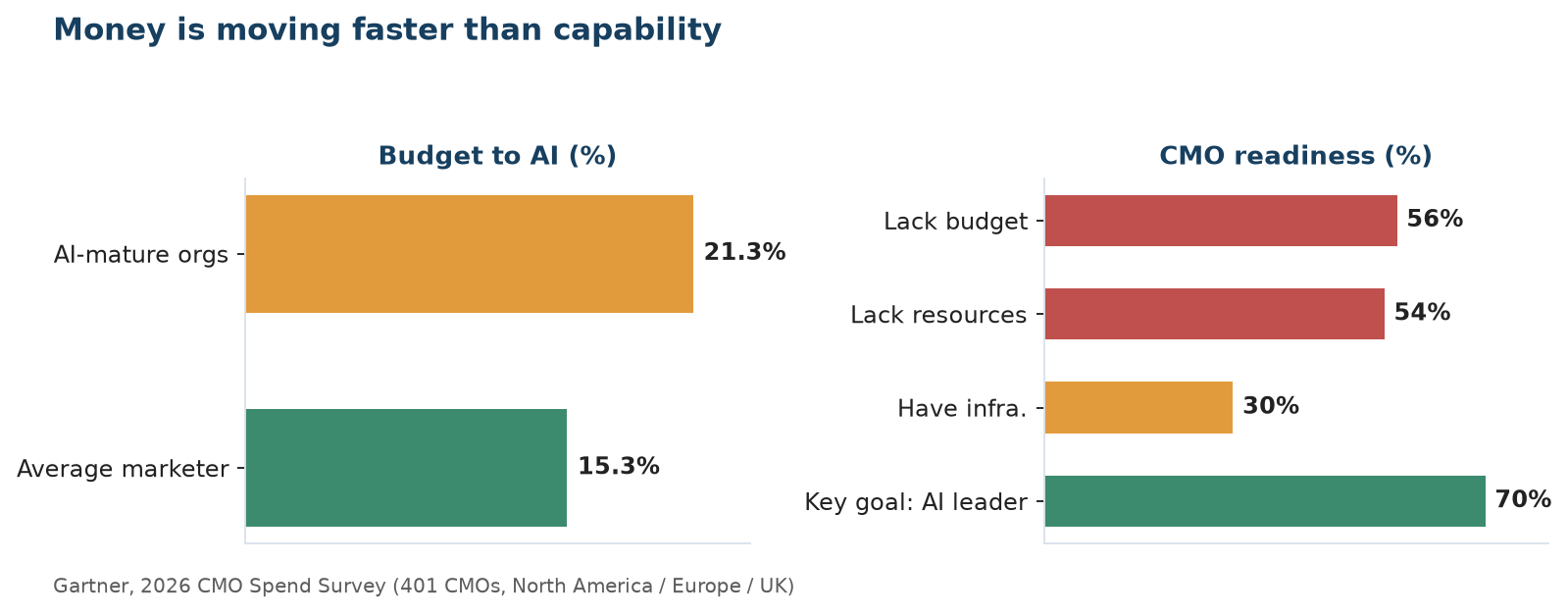
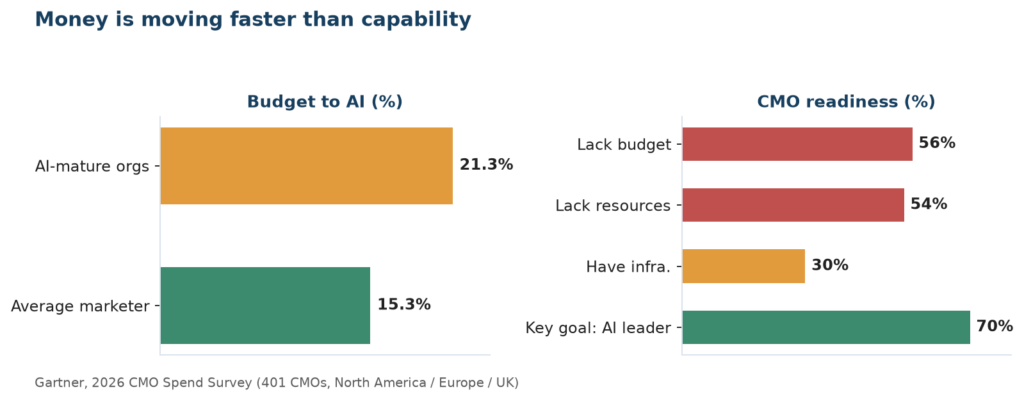
You can see the flip in the money. Gartner’s 2026 CMO Spend Survey found marketing leaders steering an average of 15.3% of their budgets into AI initiatives, with 70% naming AI leadership as a key goal for the year. Organizations that are already equipped to scale the technology push that share closer to 21.3%. And yet only 30% believe their organizations have the infrastructure to scale those investments at all. Fifty-six percent said they lack the budget to execute their 2026 strategy.
That gap is most of the story. The tooling arrived years before the operating model. As Gartner’s Ewan McIntyre put it, the risk is that CMOs “invest in AI tools faster than they build the data foundations, processes, governance and talent required to scale them.”
So the real question was never whether AI writes. It already does, in drafts nobody credits, in summaries nobody reads closely, in translations nobody proofreads. The question is which sentences deserve a human name attached, and what that name is still worth.
Where AI genuinely earns the seat
Steelman the case first, because pretending the machine is useless wastes real money.
Drafting, repurposing, localization
The economics here are boring in the best way. A serviceable first draft used to cost a writer half a day. Now it costs minutes plus a sharp brief. Repurposing is the least controversial win: one long piece becomes a newsletter, a script, six social posts and a slide. Localization sits close behind, with one caveat. Models translate meaning well and flatten idiom badly, so a native editor still has to walk the last mile.
None of this is about creativity. It is about deleting the blank page.
Summaries and structured output
Hand a model your own documents, then ask for a summary, a comparison table, a product feed, alt text, meta descriptions, or ten FAQ variants. These outputs have a checkable ground truth. That makes them cheap to verify and easy to improve on a second pass.
Checkable versus unverifiable is the most useful line in this entire debate. Draw it once and half the argument dissolves.
Where it quietly falls apart
Four failure modes, ordered by how expensive they are to discover late.
Failure one: sameness
A 2024 experiment by Anil R. Doshi and Oliver P. Hauser, published in Science Advances, gave some writers story ideas from a language model while a control group wrote unaided. The AI-assisted stories were rated more creative, better written and more enjoyable, most noticeably among the less creative participants. Sounds like a clean win.
Then the twist. The AI-assisted stories were also more similar to one another than the stories written by humans alone. Individual quality up, collective variety down. The authors describe it as a social dilemma: each writer ends up better off while the pool of novel ideas narrows.
For a newsroom, that is a curiosity. For a brand, it is an identity drain. Every competitor prompting the same three models toward the same “engaging, conversational, human-centric” register ends up sounding like the same company with different logos.
Failure two: the hallucination floor
Hallucination did not disappear; it got smaller and better hidden. On Vectara’s running leaderboard, which tests grounded document summarization, the strongest model listed as of October 2026 lands near 1.8%. Most widely deployed models sit between 3% and 5%.
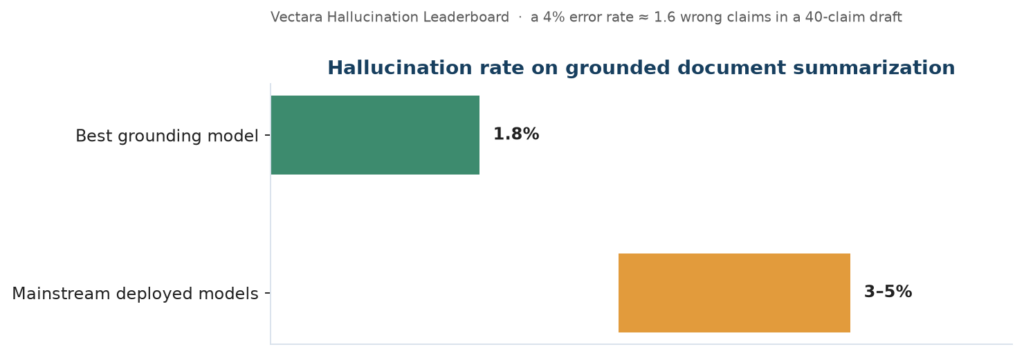
Run that math on real work. A 900-word explainer carrying 40 verifiable claims, drafted at a 4% error rate, ships with roughly one or two wrong claims. That is not a rounding error. That is a correction notice with your name on it.
The uncomfortable part: models sound most confident exactly where readers are least equipped to check.
Failure three: voice, judgment, and the things you can’t prompt
Brand voice is not an adjective list. It lives in refusals, in uneven emphasis, in the sentence a founder would never allow. Models optimize for plausibility, and plausibility is average-shaped by construction.
Judgment is worse. Judgment is knowing what not to publish, when a number is too fresh to cite, when a claim needs legal review, when a topic is a trap this week. No prompt fixes that, because the training data contains no record of your company’s specific downside.
The audience noticed before the analysts did
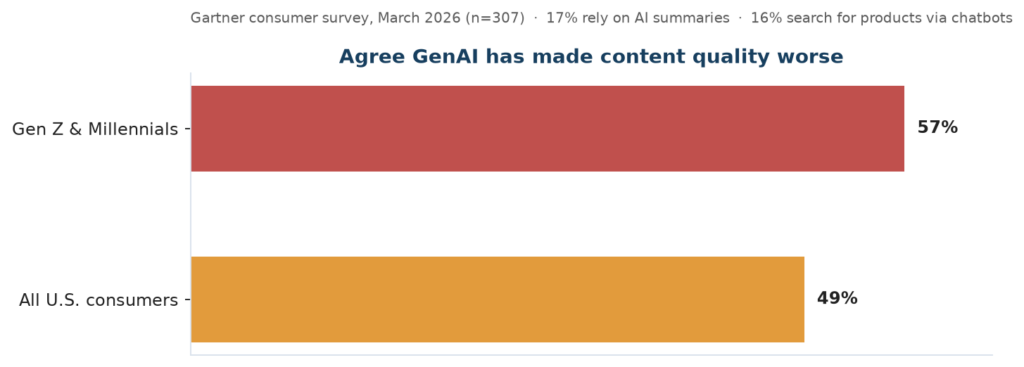
Gartner surveyed 307 U.S. consumers in March 2026. Forty-nine percent agreed that generative AI has made the quality of content available to them worse. Among Gen Z and millennials, that number rises to 57%.
“AI-generated content is increasing the volume of media that consumers encounter, but not necessarily the value,” said Kate Muhl, a VP analyst in Gartner’s marketing practice.
A related Gartner survey of 328 consumers, conducted in February 2026, found something else worth circling: about 17% of consumers now rely on AI summaries to get information about products and services, and 16% use chatbots to search for what to buy. Your first reader may be a model. Your second reader already suspects the text was generated.
What Google actually rewards
Google’s long-standing position is more boring than both camps want. In its guidance on AI-generated content, the company says its ranking systems will reward original, high-quality content demonstrating expertise, experience, authoritativeness and trustworthiness, and that the focus is “the quality of content, rather than how content is produced.” Google frames E-E-A-T as the qualities its systems aim to reward, not a single ranking factor. Appropriate use of AI is not against its guidelines. Mass-producing pages mainly to game rankings is.
The spam policy spells this out under scaled content abuse: many pages generated primarily to manipulate search rankings rather than help users, “no matter how it’s created.” Using generative tools to churn pages without added value is named as an example.
Google’s documentation for AI Overviews and AI Mode, updated in December 2025, goes further. It states that no special optimization is required to appear in AI features, that normal SEO fundamentals still apply, and that clicks arriving from AI Overview pages tend to be higher quality, with users more likely to spend time on the site.
Which quietly demolishes most of the GEO folklore. There is no secret file to upload, no magic schema to bolt on. There is distinctiveness, clean structure, and being checkably right about something specific.
The rules changed on both sides of the Pacific
Europe’s AI Act puts transparency obligations into effect in August 2026. Providers of generative systems must ensure AI-generated content is identifiable, and certain outputs, including deepfakes and text published to inform the public on matters of public interest, must carry clear, visible labels.
China moved earlier. Content-labeling rules took effect on September 1, 2025, requiring AI-generated text, images, audio and video to carry visible or embedded identifiers. Enforcement followed: by September 2026, cyberspace authorities reported removing more than 5.61 million pieces of unlawful or rule-violating content, acting against over 49,000 accounts and dealing with more than 2,400 websites and apps.
Disclosure is no longer a brand-safety talking point. It is plumbing.
Why China sharpens the question
China’s generative AI user base passed 700 million in the first half of 2026, up from 602 million at the end of 2025, when penetration stood at 42.8%. By mid-2026, penetration had crossed half the population. Three-quarters of users, 76.0%, say they have generative AI answer questions, the single most common application. Usage counts for AI assistants and office-productivity apps each grew more than 100% year over year.
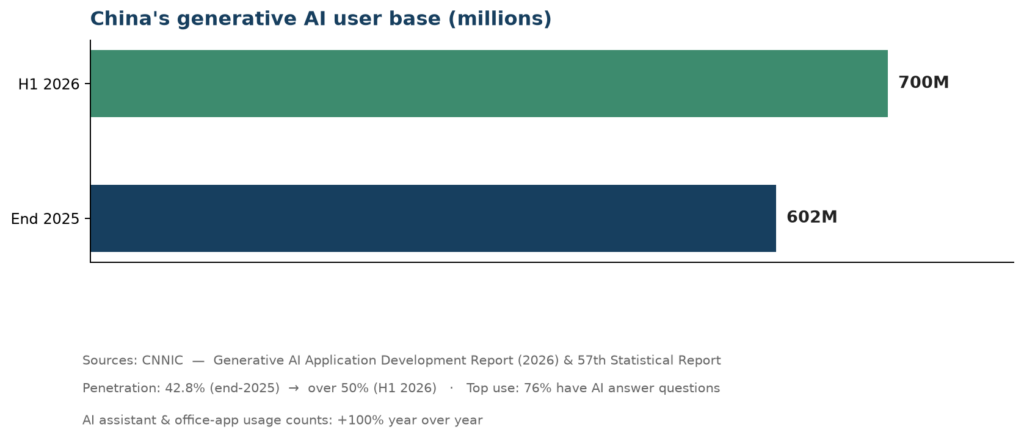
Two consequences follow for content teams. First, a growing share of reading happens through an intermediary that paraphrases before a human ever sees the page. Machine legibility stops being an SEO side quest and becomes basic distribution. Second, Chinese platforms are tightening rules on automated accounts and inauthentic AI content, which means content that pretends a human wrote it is now a platform risk as well as a reputation risk.
Those two pressures pull in opposite directions. Legibility rewards structure. Authenticity rewards a person. Holding both at once is the actual job.
For teams outside China reading this as a market signal, the sequencing matters. Answer-first behavior and a labeling regime arrived in the same eighteen months, so the market is stress-testing machine legibility and disclosure enforcement at once rather than one after the other. Treat that as a preview, not an exception.
A framework with four buckets
Judge every content type on two axes. Does its value come from being distinctive? And how expensive is a wrong claim? The answers sort your calendar into four buckets.
| Bucket | Typical work | Who leads |
|---|---|---|
| Commodity, low risk | Meta descriptions, alt text, product attributes, approved-copy translation, subject-line variants | AI, with spot checks |
| Commodity, high risk | Pricing pages, spec sheets, compliance summaries, data recaps | AI drafts, human verifies every claim |
| Distinctive, low risk | POV essays, newsletter commentary, category arguments | AI as sparring partner, human writes |
| Distinctive, high risk | Crisis statements, regulatory positions, executive positioning, interpretation of original research | Human leads, AI only for hygiene |
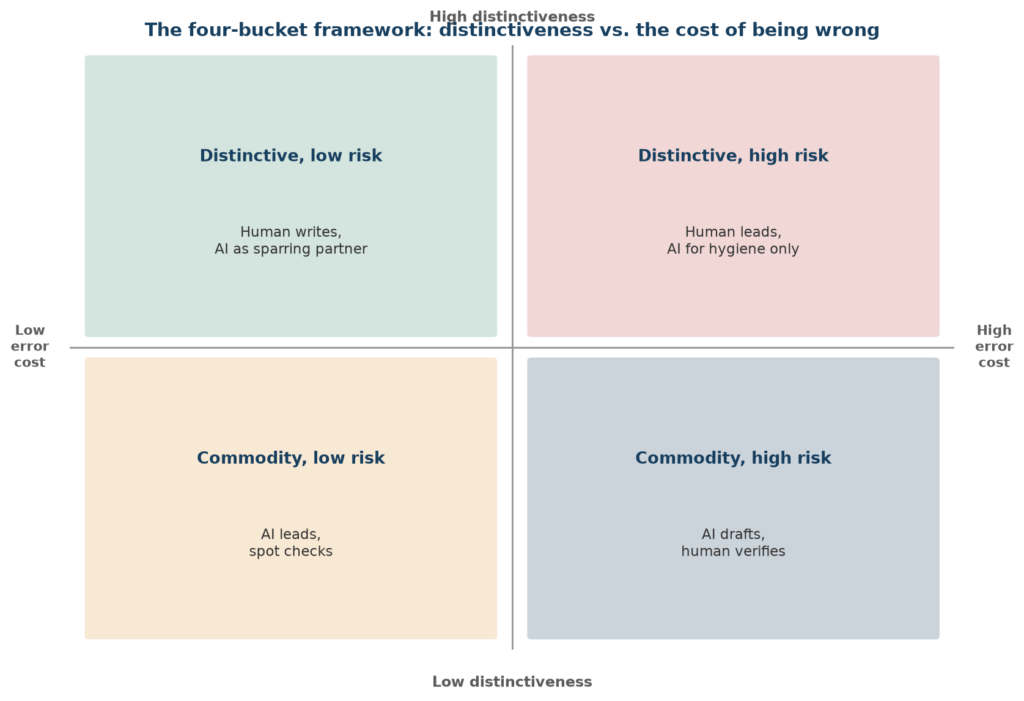
The heuristic is simple enough to tape to a monitor: the further down and right a task sits, the fewer machine fingers belong on the keyboard.
The ownership ladder
Most teams stop at the first two rungs and call it a workflow. The ladder is longer.
Generate. Select. Edit. Verify. Sign.
The final rung is where the argument actually ends. Signing means a named person is accountable, in the byline, on the record. If nobody signs, nobody owns, and errors become orphans that everybody assumes someone else caught.
A brief that survives generation
Most complaints about bad AI output trace back to a bad brief, not a bad model. Four things belong in every brief before anyone types a prompt.
- The audience, and the one question the piece has to answer.
- The sources the model may use, attached rather than recalled.
- The claims that need a citation, listed in advance.
- The sentences the brand would never publish, written out as prohibitions.
Everything else is decoration. A model given sources and prohibitions produces work a human can actually edit. A model given a topic and a tone produces something that reads fine and means nothing.
Guardrails that survive an audit
- Build a source pack for every brief. Retrieval from your own documents beats model memory every time.
- Keep a claim ledger. Every statistic gets a primary source and a date before it reaches a draft.
- Ban straight publication of generated text. If it was not substantively rewritten, it does not ship.
- Write the voice guide as a list of prohibitions, not adjectives.
- Set disclosure language by content type, and make it consistent.
- Register AI-assisted assets so you can answer a regulator’s question without a scavenger hunt.
- Route regulated claims to review automatically, not optionally.
- Kill the wrap-up reflex. Model-shaped endings and tidy three-part summaries are a tell.
What to measure
Track process, not vibes. Rework rate tells you whether editing is real. Post-publish error counts per thousand words tell you whether verification is real. Performance differences between assisted and human-only work in the same format tell you whether the tool is helping or just faster. The swap test tells you whether the piece is yours: replace your logo with a competitor’s and see if it still reads true. If it does, it was never really yours.
One more number, since more buying decisions now start inside a chat window: sample a fixed set of prompts every month and record how often your brand shows up in AI-generated answers versus the three competitors you worry about most. It is a crude metric, and it beats guessing.
The uncomfortable conclusion
AI raises the floor of acceptable content and lowers the ceiling of average content. The commodity layer gets cheaper by the quarter, which means the premium layer has to get more expensive. If a model can produce it from a two-line prompt, it was never your advantage.
That is not an argument against the tools. It is an argument about allocation. Let the machine own the scaffolding, and spend the saved hours on the sentences only your company can defend in a room with your name on the door.
Summary
The debate has moved past whether AI can write. It writes, constantly, and mostly at the commodity layer. What remains contested is accountability. Google rewards quality regardless of authorship but treats scaled, unoriginal output as spam. Audiences are skeptical, with nearly half of U.S. consumers saying generative AI has made content worse. Regulators in Europe and China now require machine-made content to be identifiable. The practical answer is unglamorous: let AI draft, repurpose, translate and summarize checkable material, keep humans on voice, verification and judgment, and make sure every published piece has a person willing to sign it.