China’s First AI Feature Film Cost RMB 10 Million. It Earned RMB 1.5 Million in Eight Days.
China’s First AI Feature Film Cost RMB 10 Million. It Earned RMB 1.5 Million in Eight Days.
A fully generated cast, 10,000 opening screenings and a state release permit were not enough. Eight days into its run, Bona Film Group’s experiment is heading for a lifetime gross of about RMB 3 million.
31 October 2026 — Shanghai
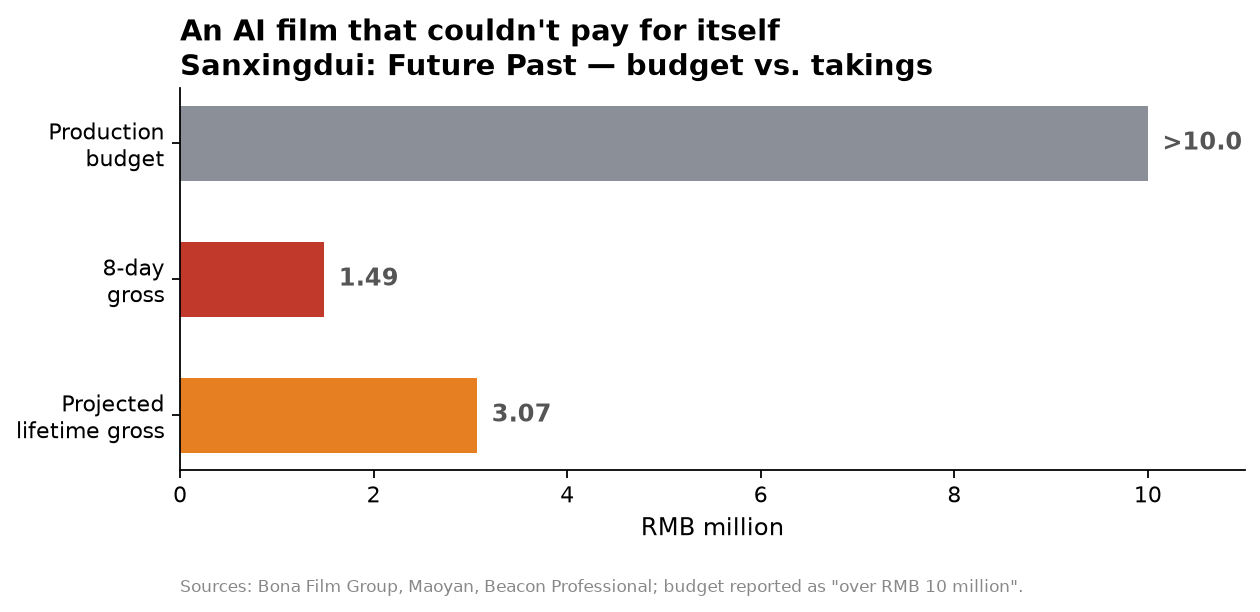
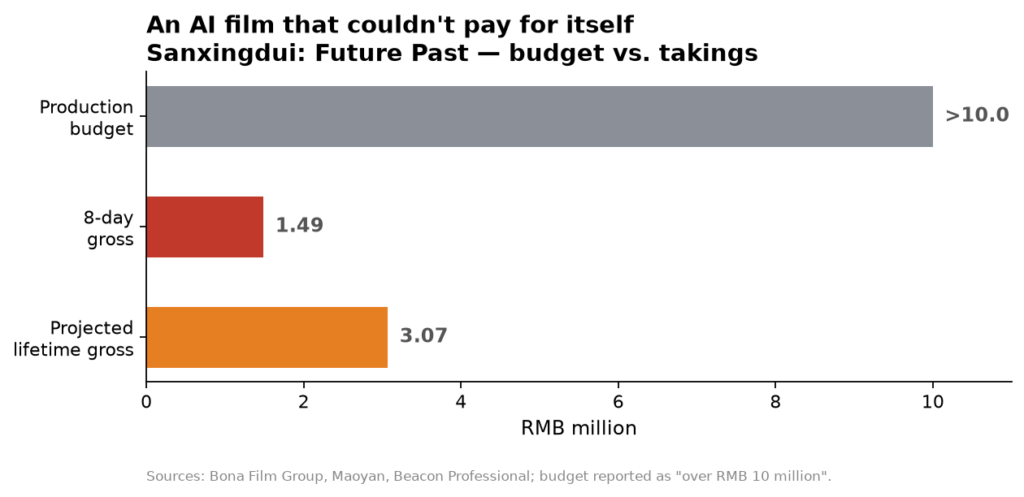
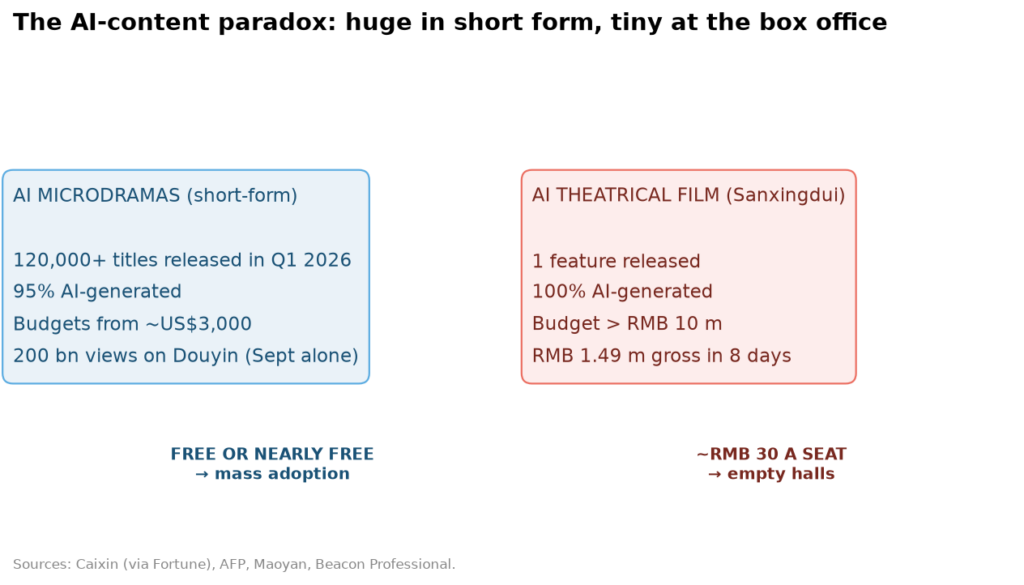
Sanxingdui: Future Past arrived in Chinese cinemas on 23 October with more than 10,000 screenings booked for its opening day and a claim no other film could make: it was the first fully AI-generated feature to hold a Chinese theatrical release permit, the green notice known locally as the “dragon mark.” Eight days later, ticketing-data provider Beacon put its cumulative gross at roughly RMB 1.49 million—about US$200,000—against a production budget of more than RMB 10 million (about $1.5 million).
The film runs 100 minutes and builds its story around the Sanxingdui site in Sichuan, a Bronze Age culture whose bronze masks, standing figures and sacred tree have puzzled archaeologists for a century. On screen, a future civilisation has surrendered control to algorithms, and an archaeologist must reassemble relics to decode a warning from space. Every character, voice and backdrop was generated. There were no actors to cast, no locations to scout and no sets to build.
Bona says the work took more than two years, occupied nearly 100 people across 17 specialised roles and produced more than 1.2 million source images. The team rebuilt the film end to end at least five times. None of that showed up in the sales pattern. Presales on the morning of release stood at RMB 80,000, and by 29 October audience occupancy had fallen to roughly 0.2 percent, according to Maoyan. Beacon’s model projects a lifetime gross of RMB 3.07 million.
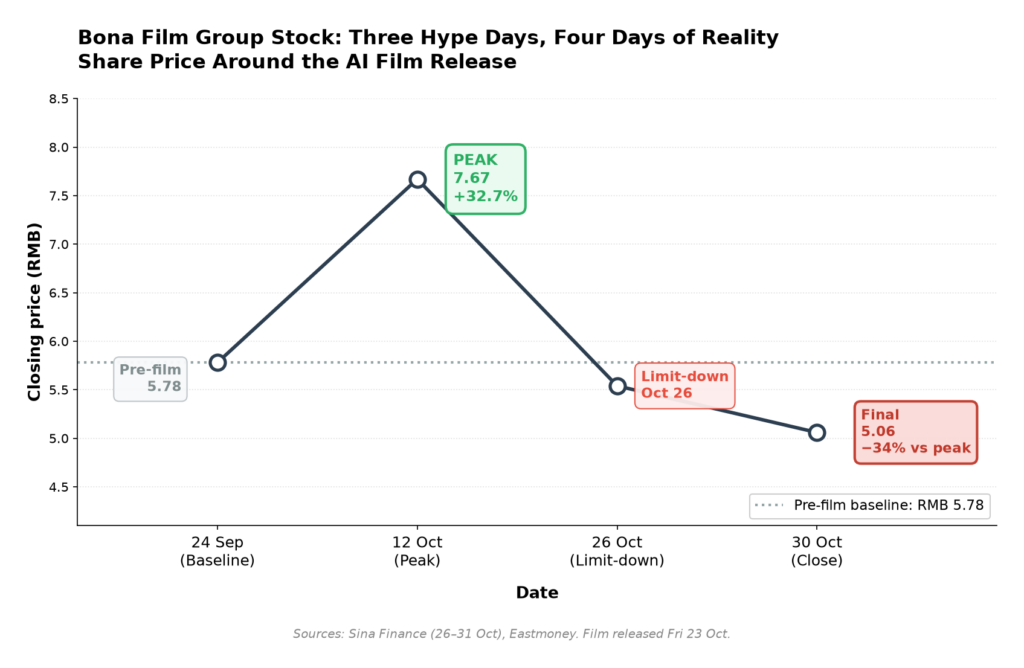
Equity markets had already voted differently. Bona’s shares rose by the daily limit on 28 September, 9 October and 12 October, gaining 32.7 percent from RMB 5.78 to RMB 7.67 in about eighteen days on the strength of the release date alone. They fell by the limit on 26 October, the fourth day of the run, and closed at RMB 5.06 on 30 October: 34 percent below the peak and below the level they held before the film was dated.
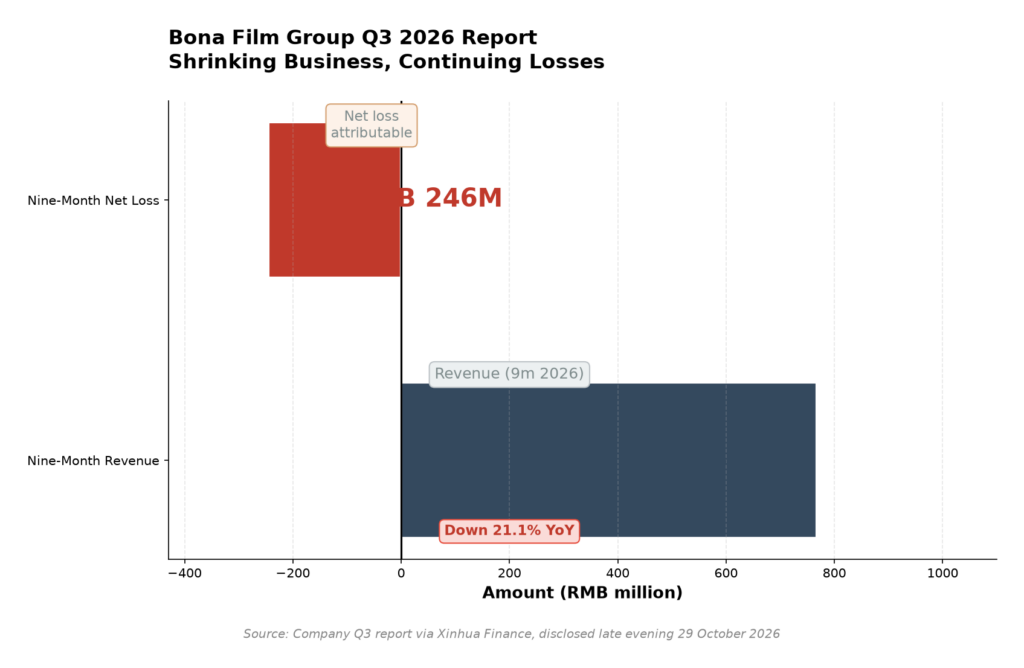
The company’s third-quarter report, disclosed on the evening of 29 October, supplied the context. Revenue for the first nine months came to RMB 767 million, down 21 percent year on year, with an attributable net loss of RMB 246 million. Its AI film and television business booked RMB 1.93 million of revenue in the first half of 2026—a rounding error against group revenue in the hundreds of millions.
Audience complaints were not about a single bad frame. They were about continuity. Characters age and rejuvenate between shots, dialogue drifts out of sync with lip movement, and a snowstorm leaves coats, hair and complexions untouched. The producer, Qu Jixiaojiang, has said the team never expected the film to make money, and Bona’s president, Jiang Defu, framed the release as a first attempt rather than a commercial proposition: “We are the first to try it, the first to get a theatrical release permit and the first to be tested by the audience. I think that is not easy at all.”
What makes the result awkward is that Chinese audiences have already accepted AI video at enormous scale, just not at RMB 30 a seat. More than 120,000 microdramas were released in the first quarter of 2026, and over 95 percent of them were AI-generated, with production budgets sometimes as low as US$3,000. AI short dramas on Douyin drew 200 billion views in September alone. Free at the point of use, generated video is a product. Behind a ticket window it becomes a claim that has to be defended—and the film had no stars, no familiar franchise and a title that meant most to people already interested in archaeology.
The wider market is not the problem. The 2026 worldwide box office is projected to approach US$36 billion, which would make it the best year since 2019 and the strongest post-pandemic year to date. AI features have taken limited runs in India, Malaysia and the United States, but none at this scale, and in most Hollywood production the technology still sits behind the camera rather than in front of it.
Bona is not waiting for the verdict to settle. A second AI feature—reported under the Chinese title 《计划外:广寒行动》, with no confirmed official English title—is already in production, and the company is negotiating releases in Russia and France after opening Sanxingdui in Malaysia on the same day as China.
What to watch
- Whether the second film changes method rather than ambition: a shorter cycle, a tighter script, a smaller cast of generated characters.
- Whether exhibitors keep allocating screens to AI features in a season with no shortage of conventional hits.
- Whether the “first AI film” label still carries any pricing power in the stock market, now that the first one has been priced.