The Same Question, Two Different Answers: How AI Search Rewrote the Buying Journey in China and the West
How AI Search Is Changing Buying Decisions — in China and the West
The same question, two different answers
Ask an assistant in Chicago and an assistant in Shanghai the same question — a laptop for video editing, under twelve hundred dollars, needed by Friday — and you get two answers that are both sensible, both confident, and quietly incompatible with each other.
That gap is not a quirk of the models. It is a map of two retail systems.
One assistant is reasoning over an open web it crawled minutes ago. The other is reasoning over a catalogue its parent company already owns, inside an app where the payment button sits two taps from the answer. Same question. Different plumbing. Different economics. And, as a result, a different job for the marketer standing behind the product.
This is the part most cross-market commentary gets wrong. People compare the chatbots and conclude that China is “ahead” or that the West is “more mature.” Neither is quite true. What actually differs is where each system puts the transaction, and therefore what an AI answer is allowed to do.
What actually changed — and what did not
The shorthand version of the last two years goes like this: search is dying, chat is eating it, and buying now starts with a prompt.
The measured version is stranger and more useful.
A July 2026 study linked panelists’ assistant prompts and responses to the same people’s observed searches and pageviews, then reconstructed their sessions across surfaces. The finding inverted the standard story. Content and search more often come first, and the assistant sits deeper in the journey, not at its mouth. Within the same person, the direction asymmetry ran +20.6 percentage points. And 34.1 percent of assistant-containing sessions contained no observed visit to the open web at all, against 19.5 percent for those same users’ search-centred sessions — a within-user gap of 13 points.
Read that again, because it reframes everything downstream. The assistant is not usually the front door. It is a room in the middle of the house. A lot of deciding now happens in that room, and the room has no windows.
That is why the practical question has shifted. It is no longer only “do I rank?” It is “when the machine composes an answer in a room I cannot see, does my product survive the composition?”
The scale, in numbers both markets can agree on
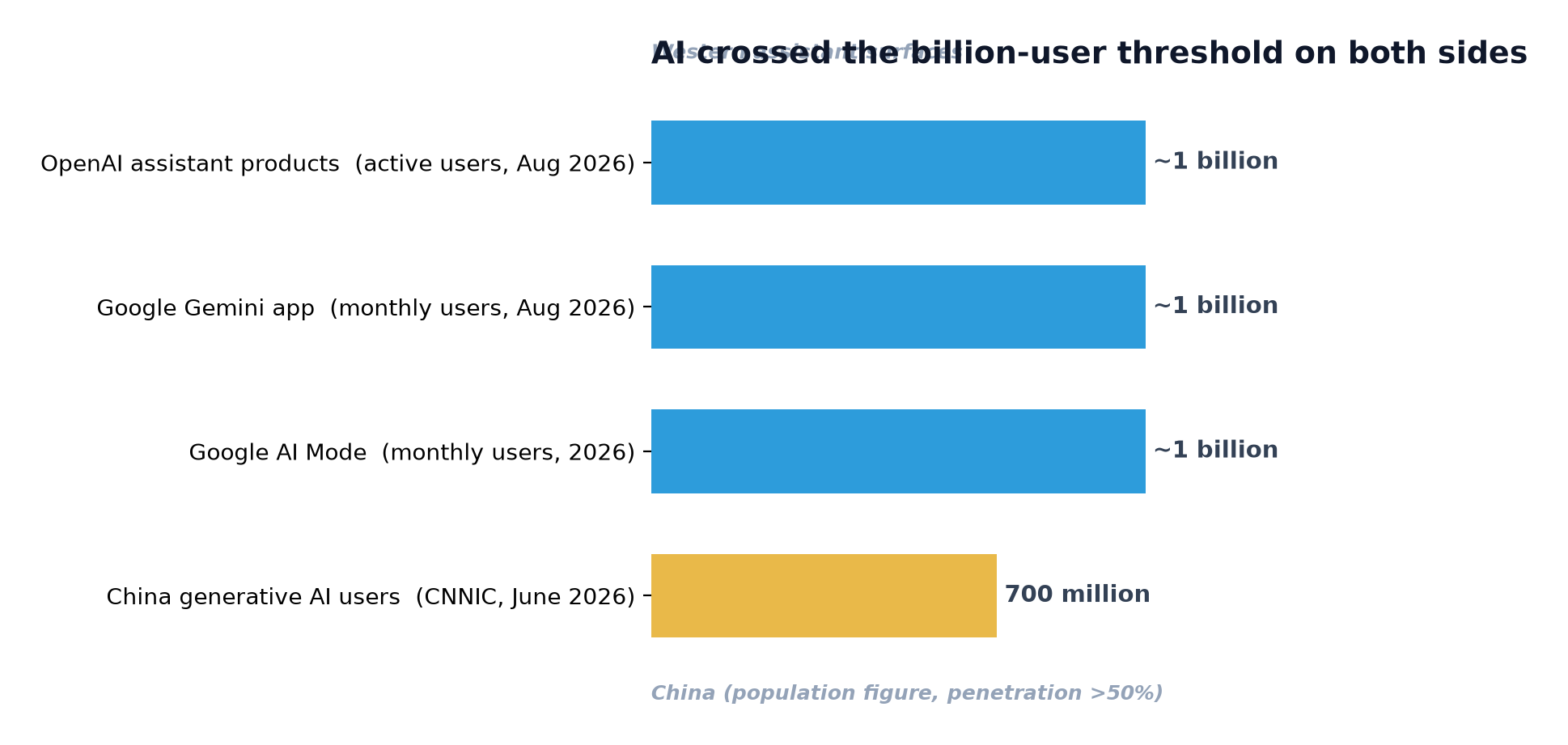
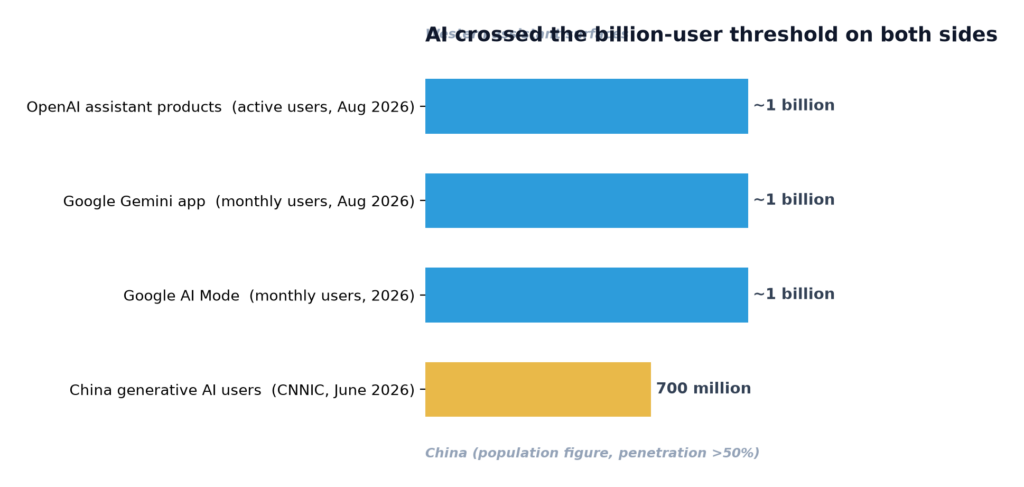
Three Western assistant surfaces each crossed a billion users inside twelve months, and China reached a comparable milestone as a population rather than a product.
OpenAI said in August 2026 that its models reach more than a billion active users and more than two million businesses. Google’s Gemini app passed a billion monthly active users the same month, which the company called its fastest-growing product ever. Google’s separate AI Mode surface also reports more than a billion monthly users globally, with queries about three times longer than classic searches and query volume more than doubling every quarter since launch.
China’s number is a population statistic, which makes it more telling. The China Internet Network Information Centre’s Generative AI Application Development Report 2026, released in September, put the country’s generative AI user base above 700 million as of June 2026, up from 602 million at the end of 2025, with penetration past half the population. Answering questions remains the dominant use at 76 percent of users. AI search and life assistance accounts for 32.5 percent. And the three most-used product categories are AI general assistants, AI search engines and AI life assistants — three flavours of the same behaviour.
So roughly a billion people on each side are now asking a machine what to buy. The interesting divergence is not in that number. It is in what happens ninety seconds later.
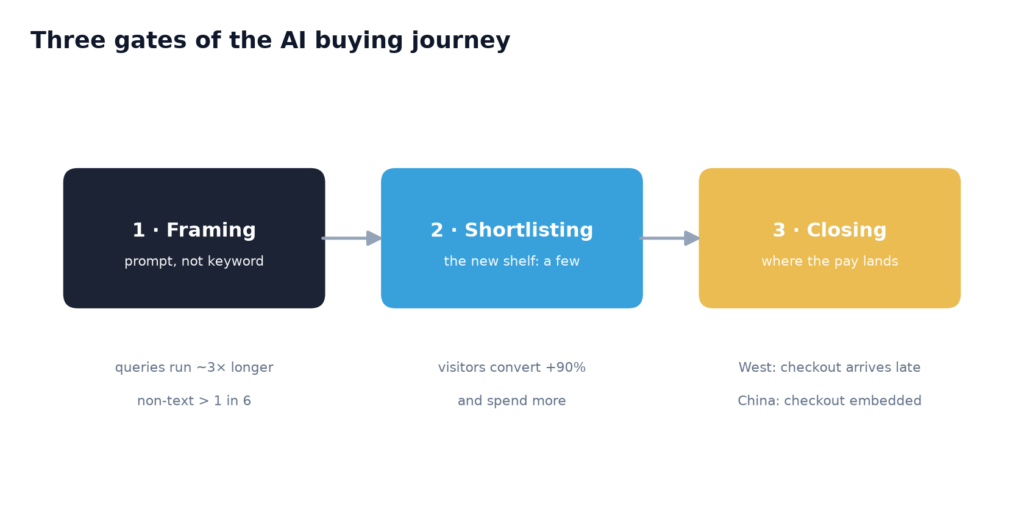
The decision journey now has three gates
Strip away the platform branding and the same three bottlenecks appear in both markets. Each one has a different owner, and each one asks something different of a brand.
Gate one: framing
The query was a keyword. The prompt is a paragraph. Google reports that AI Mode queries run about three times longer than traditional searches, and that follow-up questions grow more than 40 percent month over month in the United States as people refine mid-conversation. More than one in six AI Mode searches now arrives in a non-text format.
This is the least discussed and most consequential change. When someone typed “best running shoes,” you knew the category. When someone says “I pronate, I run on wet pavement, I have a bad knee, and I want to spend under a hundred,” the constraint set is now the real target. Your product either satisfies the constraints or it does not. There is no ranking trick that fixes a mismatch.
Marketers lose control of the question here. What remains in your control is whether your product data answers the sub-questions a model will inevitably ask: material, fit, use case, delivery window, compatibility, warranty.
Gate two: shortlisting
Inside the answer, the shelf shrinks. A model typically surfaces a handful of options, not a page of them. That shortlist is the new shelf space, and it is smaller than anything a search results page ever was.
Here the economics get loud. Adobe’s latest US data, reported at the end of October 2026, shows the advantage widening month by month. In September, visitors who arrived through an AI platform converted 90 percent better than visitors from other channels — email, paid search, social — and generated 83 percent more revenue per visit, the largest difference Adobe has recorded this year. They spent 73 percent more time on site, viewed 25 percent more pages, and added items to their carts at a 53 percent higher rate. The turnaround is stark: as recently as August 2025, AI-referred traffic converted nine percent worse than other sources. AI traffic to US retail sites grew 71 percent year on year in September, extending nearly two years of uninterrupted monthly growth.
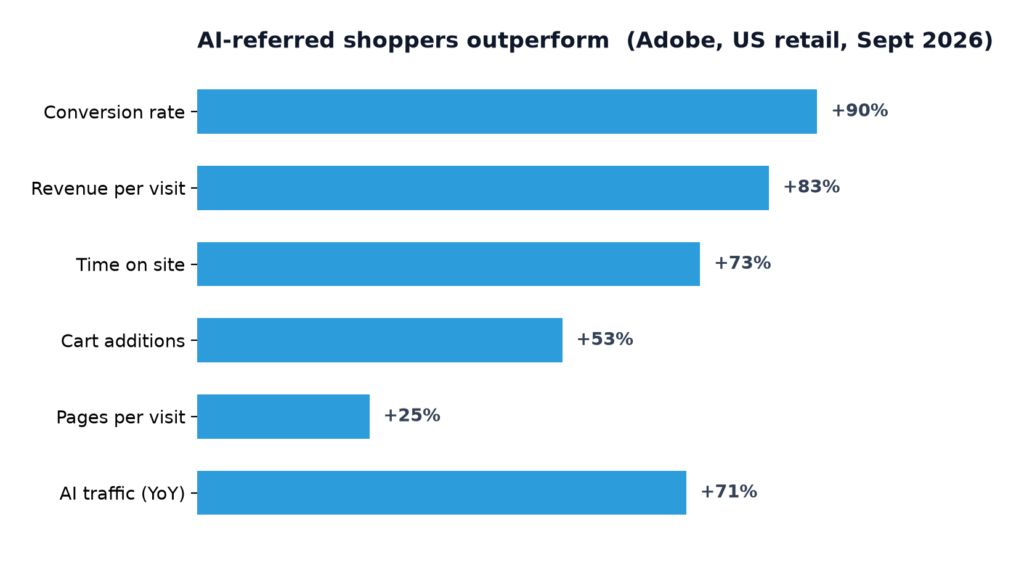
Two explanations compete for those numbers, and both are probably partly right. The first is selection: the assistant already filtered, so the person who arrives is pre-qualified. The second is information quality: the assistant answered the doubts that usually kill a cart.
One detail supports the second. In Adobe’s August 2026 survey of five thousand US consumers, 69 percent of respondents who had used AI for shopping said they were less likely to return an item bought with AI assistance, and 77 percent said the assistant made them more confident. If that holds, AI’s most valuable contribution to retail may be fewer returns rather than more clicks.
Gate three: closing
This is where the two markets split cleanly, and where the strategy diverges.
In the West, the transaction is arriving late and arriving loudly. OpenAI shipped Instant Checkout in September 2025, rolling out first to U.S. buyers on Etsy with Shopify merchants to follow, and has since pushed shopping features outward, including a virtual try-on for apparel in October 2026. TikTok announced a Shopping Assistant and an in-app checkout called Buy Direct in early October. Google began putting ads inside AI Overviews and AI Mode, then scaled AI Mode ads to ten more countries on 28 October 2026, with Brazil, Mexico and the UK queued for the fourth quarter.
In China, the transaction never left. It was already there. Which is the subject of the next two sections.
The West: an information layer learning to sell
For most of the last two years, Western AI search was an information product with a commerce problem. It could tell you what to buy. It could not take your money without an awkward handoff.
That is changing, and the change is being paid for by advertising.
OpenAI began serving ads in ChatGPT in February 2026. By the end of August, the ad business had reached a one-billion-dollar annualised run rate in roughly two hundred days — a pace the incumbent ad platforms took years to reach, and a trajectory reported widely across trade and financial media. Google’s move is structurally gentler and commercially bigger: existing Search, Shopping and Performance Max campaigns are automatically eligible to appear inside AI answers, with no new campaign type and no separate budget. Ads get labelled as sponsored, and Gemini-written explainers can appear alongside them without advertiser approval.
Sit with that for a second. The neutral-advisor phase of Western AI search lasted about three years. It is now over, and the rules of the new shelf are being written by auction mechanics that most brands have not yet modelled.
The traffic story is more modest than the revenue story. AI referrals are growing fast from a small base, and most sessions still end without a merchant visit. Being cited is not the same as being clicked, and being clicked is not the same as being bought. Western marketers now have to manage three separate scores where they used to manage one.
China: a commerce layer that learned to talk
China did not bolt a checkout onto a chatbot. It bolted a chatbot onto a mall.
By the 2026 Double 11 shopping festival, AI shopping guides had become standard equipment across the major platforms. JD’s app shipped a native shopping agent in its 16.0 release in September 2026, handling text and voice search, video look-up of the same item, 3D placement previews and after-sales entry points. Alibaba had already wired its Qwen assistant into Taobao in May, so that product selection, ordering and payment run inside one conversation, drawing on a catalogue of roughly four billion products and more than twenty years of shopping-scenario data. ByteDance put an “ask before you buy” entry on the first level of Doubao’s navigation, routing intent straight into Douyin’s storefront. Pinduoduo opened AI search in May. Meituan pushed its assistant into local-life bookings. Kuaishou let people add to cart without leaving the dialogue.
The scale, where disclosed, is large. JD said nearly 80 million users had used its AI shopping guide in the first quarter of 2026, more than double the prior year, as reported by Beijing News. During a six-day subsidised Lunar New Year promotion, Qwen completed more than 120 million orders — a campaign figure, heavily discounted, but a useful upper bound on what happens when an AI assistant is handed both intent and a payment rail.
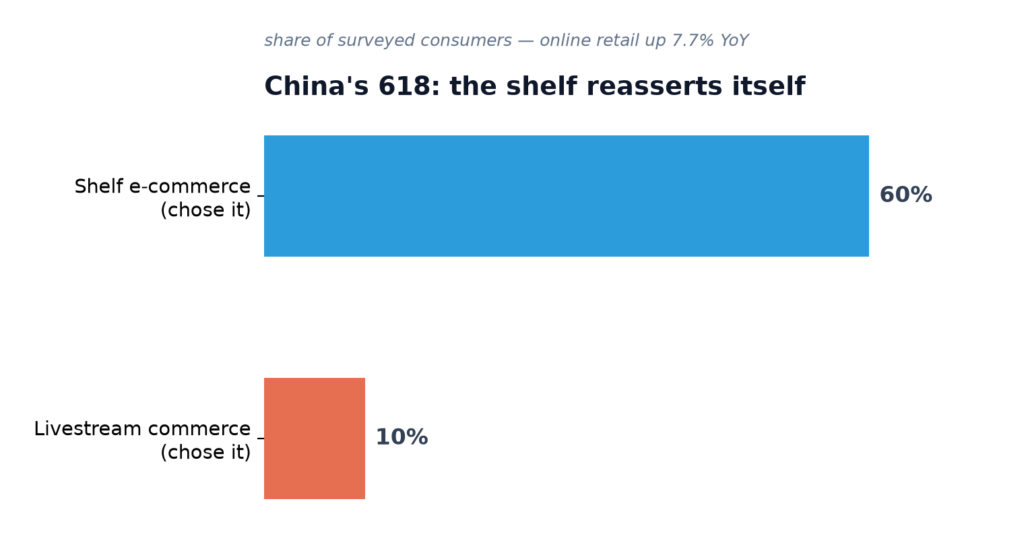
The 2026 618 mid-year festival is the cleaner read on structure. A joint consumer-insight report released during the festival by a research institute, a national advertising academy and a data analytics firm found online retail sales up 7.7 percent year on year across the monitored window — and, more telling, that 60 percent of surveyed consumers chose shelf-style e-commerce, while 10 percent chose livestream commerce. AI, in other words, is strengthening the catalogue model rather than dissolving it. The same report described AI as having moved from a marketing gimmick to core festival infrastructure, running through recommendation, customer service, livestreaming and logistics.
And the agent layer is still expanding. Alibaba is preparing Qwen Go, an assistant that handles refunds, delay-compensation claims, bookings and service appointments on the user’s behalf, with actions visible on screen and interruptible. ByteDance is testing a standalone personal assistant tied to Doubao. Neither is a shopping product exactly. Both reduce the number of decisions a person has to make manually, which is the same thing as reducing the number of times a brand gets to intervene.
The structural contrast, in one table
| Global and Western markets | China | |
|---|---|---|
| Where discovery happens | AI Overviews and AI Mode, ChatGPT, Gemini, Perplexity, plus social apps | AI guides inside Taobao/Tmall, JD, Pinduoduo, Douyin; Doubao and Qwen as front doors |
| What the answer is built from | Model plus a crawled open web | Model plus an owned catalogue, platform reviews and purchase history |
| Where the transaction lands | Increasingly inside the assistant; still mostly the merchant’s own checkout | Inside the same app, same session, same payment method |
| What the marketer optimises | Citation, structured product data, third-party mentions, feed accuracy | Attribute completeness, dialogue fit, platform-native AI tooling, price clarity |
| Monetisation state | Ads live inside AI answers on both Google and OpenAI | AI guides deliberately unmonetised so far, with no ad slots and no merchant fees |
| Dominant risk | Being cited wrongly, or not at all, while traffic quietly decays | Being absent from a shortlist that ends in a checkout in the same breath |
Why the two systems diverged
Four structural differences explain almost all of it.
Payments first. A Western assistant that wants to transact has to negotiate with card networks, wallets, merchants and platforms, one integration at a time. A Chinese assistant inherits a payment method the user already trusts inside an app they already open daily. The friction is not comparable, so the product shape is not comparable.
Catalogue second. Western models compose answers from an open web they do not own, which makes consistency and accuracy a constant negotiation. Chinese assistants increasingly query a catalogue their parent company operates, which makes the data authoritative by construction and the recommendation auditable by the platform.
Discovery habits third. Western shopping grew up around a search-and-compare reflex. Chinese shopping grew up around feeds, and then swung back toward shelves as consumers tired of livestream volatility and high return rates — the 60-to-10 split in the 618 report is that swing, measured.
And the fourth is the quiet one. In the West, the brand is the unit of trust. In China, the platform often is. That inverts where a recommendation has to prove itself, and it changes which signal an AI assistant is willing to rely on.
What breaks first: the ranking-click-revenue chain
Every performance marketing model of the last twenty years assumed a chain: a query, a ranked list, a human scan, a click, a session, a purchase. Budgets, attribution windows, agency fee structures and content calendars were all built on that chain being intact.
Three links are now weak.
Ranking no longer guarantees visibility, because the answer can be composed above the list. Clicks no longer guarantee a session, because a third of assistant sessions never reach the open web. And sessions no longer guarantee attribution, because the referrer is often stripped, mislabelled, or simply absent from the analytics view.
The consequence is a measurement gap that most organisations have not closed. Ask a marketing team what share of qualified demand originated in an AI conversation and you will usually get a number derived from a channel bucket that was designed for something else. That gap is not cosmetic. It systematically under-reports the channel that converts best, which is precisely how a company talks itself into under-investing in the thing that is working.
There is a second, subtler break. When ads enter the answer, the answer stops being a neutral referee. Google’s own framing is careful — paid placement does not influence the organic response — but the shelf now has two kinds of occupant. Brands that plan for only one will misread their results.
What this means for brands
Legibility beats presence
Generative engine optimisation (GEO) is the practice of making content legible to an answer engine rather than to a ranked list. In peer-reviewed work presented at ACM KDD 2024, adding source-attached statistics, direct quotations and explicit citations lifted visibility inside AI-generated answers by up to 40 percent across a benchmark of ten thousand queries.
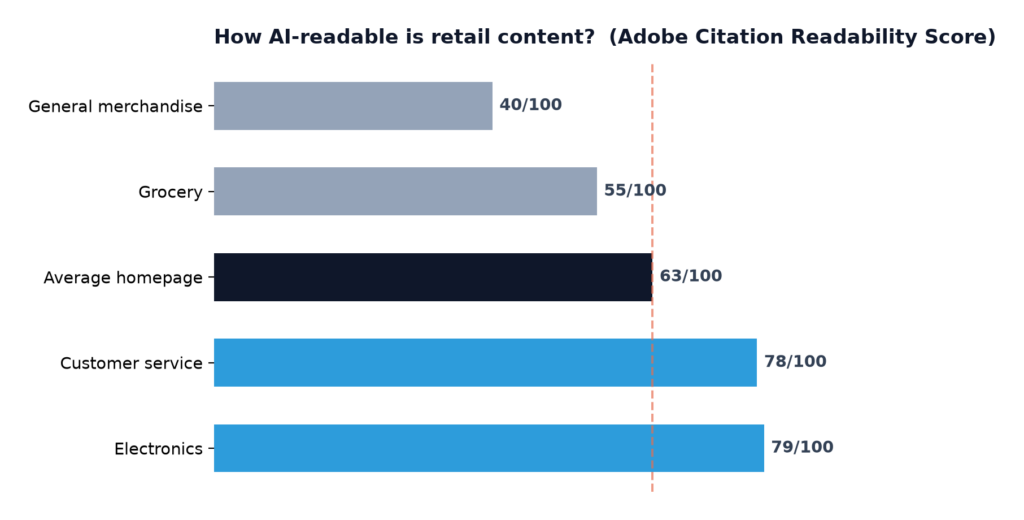
That laboratory finding now has a live, commercial mirror. Adobe’s Citation Readability Score — a measure of how effectively AI systems can understand and cite a website’s content — put the average US retail homepage at just 63 out of 100 in September 2026. Electronics retailers scored highest at 79, helped by specification-rich category and support pages. Grocery scored 55, and general merchandise homepages scored 40, dragged down by navigation-heavy, promotional layouts. Read that last number again: the average general-merchandise homepage is failing machine readability by more than half.
The brands winning AI referrals are not the ones shouting loudest. They are the ones whose product facts survive being copied into someone else’s sentence.
The unit of competition is the answer, not the page
A page competes with other pages. An answer competes with other answers, and it is assembled from fragments: your specification table, a review platform’s rating, a forum thread, a shipping promise. You no longer control the whole artefact. You control your contribution to it, and whether that contribution is consistent everywhere it appears.
This is why the practical work looks boring. Complete attribute schemas. One canonical price. Stock and delivery stated in machine-readable form. Reviews that mention the use case, not just the star rating. Adobe’s own list of what helps — product details, buying guides, FAQs and return policies — maps cleanly onto the kind of content most teams already have and have never fully structured.
Consistency is a cross-market problem, not a translation problem
A global brand cannot translate an English product page into Chinese and expect the same answer quality. The corpora differ, the trust surfaces differ, and the questions differ. The Chinese shopper’s prompt carries different constraints — bundle pricing, subsidy timing, delivery to a pickup locker — and the assistant answers from a different database. The presence work is a separate programme in each market, not a localisation pass on one.
A two-market checklist
- Instrument AI referrals as their own channel. Separate AI-originated sessions from organic and paid, and report them weekly. If the bucket does not exist, the channel is invisible by default.
- Audit what the answer says about you. Run a fixed prompt set in every market and language you sell into, monthly, and record whether you appear, whether you are described correctly, and which competitors appear instead. Frequency over time matters; a single screenshot is noise.
- Complete the attribute layer. Specifications, variants, compatibility, materials, dimensions, warranty, stock, delivery windows. Every AI comparison is a database query, and a missing field is a lost comparison.
- State price and promotion unambiguously. A price that needs inference is a price the model will guess at, and it will guess from a competitor’s page.
- Write for extraction, not for scrolling. Put the answer in the heading. Repeat it in the first two hundred words. Use definitional sentences — “X is Y” — in the passages you want quoted.
- Attach every number to a source and a date. This is the highest-leverage content change available, and it is the one most teams skip because it feels like housekeeping.
- Build separate presence programmes for each corpus. Western visibility leans on review platforms, forums and comparison pages. Chinese visibility leans on platform review ecosystems, short-video review content and community Q&A. Same principle, different venues, no shortcuts between them.
- Decide your agent posture deliberately. Partner with the platforms, build on your own property, or restrict third-party agent access. There is no neutral option, because the default is decided for you.
What to watch next
Three things will determine whether 2027 looks like a refinement or a rupture.
Recommendation consistency is the first. Early comparative testing in China found two leading assistants returning almost non-overlapping brand sets for the same constrained request, with the shopper still expected to confirm. If that variability persists, “AI visibility” becomes a probability rather than a position, and brands will need frequency-based measurement rather than snapshots.
Monetisation is the second. Chinese AI shopping guides are, for now, unmonetised — no ad slots, no merchant fees. That is a strategic choice, not a permanent condition. The moment a platform sells placement inside a recommendation, the entire optimisation logic shifts, exactly as it did in the West this year.
Regulation and liability are the third. An assistant that recommends a product and then handles the refund is performing a consumer-facing function, and the rules for that are being written in both jurisdictions at once.
Summary
The same question now produces structurally different answers, and the difference is not the model. It is where the transaction lives.
In the West, AI search spent two years as an information layer and is now learning to sell, funded by advertising that arrived inside the answer itself. In China, AI was grafted onto a commerce layer that already owned discovery, payment and logistics, so the assistant was transactional from the start. Both systems now run on roughly a billion users. Both reward the same underlying asset: product truth that a machine can read, quote and trust — which Adobe is now beginning to score directly.
The mistake to avoid is treating this as a search marketing problem. Ranking still matters, but it is no longer the mechanism that decides what a customer sees. Composition does. And composition is won upstream, in fields and schema and sourced numbers, long before anyone types a question.
Frequently asked questions
Does AI search replace Google, or sit on top of it?
Mostly it sits inside and after it. A 2026 panel study found that search and content more often precede assistant use, and that assistants occupy a deeper position in the journey. A third of assistant sessions never reach the open web at all, which means AI both depends on the web and hides it.
Why do AI-referred visitors convert so much better?
Two reasons compound. The assistant has already filtered, so the arrival is pre-qualified. And the assistant has already answered the doubts that normally stall a purchase. Adobe’s 2026 data shows a widening conversion premium, and its consumer survey links AI assistance to a lower stated likelihood of returns.
Is China’s AI shopping boom just subsidy-driven?
Partly, and the subsidised campaign numbers should be read as ceilings rather than baselines. But the structural signals are not promotional: AI guides are standard across the major platforms, merchants are rewriting product data for machine legibility, and shelf commerce is gaining share against livestream. Those are durable shifts.
What is the single highest-return change a brand can make this year?
Complete, consistent, machine-readable product data with sourced numbers. It improves citation, improves recommendation accuracy and appears to reduce returns. It is also the cheapest of the available options, which is why it is usually deferred.
Can a global brand run one AI visibility strategy across both markets?
Not one strategy — one source of truth. The facts should be identical everywhere. The surfaces, the corpora and the prompts are not, so the presence work has to be built twice, in parallel, against different platforms and different languages.