GEO, Explained: How Brands Get Quoted by ChatGPT, Perplexity and Gemini
Your buyer used to type four words into Google and scroll. Now they type a full sentence into an assistant and read one paragraph back. That paragraph either mentions you, or it doesn’t. Everything below is about the second case.
The one-sentence answer
Generative engine optimization, or GEO, is the work of making your brand’s information easy for an AI assistant to find, understand, and quote accurately.
That’s the whole thing. No funnel diagram required.
The term has a traceable origin, which is rarer than you’d think in marketing. A preprint posted in November 2023 and later published at the ACM KDD conference in 2024 tested nine content-level tactics against a benchmark of generative-engine queries and reported visibility gains of up to 40 percent. That number traveled further than the paper’s caveats ever did. Read the caveats anyway; they’re the useful part.
One warning before we go further. “GEO” currently covers three different outcomes, and people mix them up constantly:
- Discoverability. Does the engine retrieve your page at all?
- Citation. Does it name you, or link to you?
- Absorption. Does your definition, your number, your framing survive into the final answer?
Only the third one changes what a buyer believes. A fourth outcome, referral traffic, is a separate business problem with a separate budget. Blur all four and you’ll end up reporting a feeling.
A gut check before the theory
Ask yourself a blunt question. When someone in your category asks an assistant “which of these is worth paying for,” does an answer come back with citations at all?
Sometimes it doesn’t. Plenty of responses are generated straight from a model’s training memory, with no retrieval, no index, and no slot for you to win. A July 2026 study that linked people’s prompts to their observed browsing found that 34.1 percent of assistant sessions included no external web step whatsoever. For a growing share of questions, the answer is the destination.
So the first diagnostic is not “how do I rank.” It’s “which questions in my market trigger a search at all.” Almost nobody measures this, and it’s cheap to test. Run the prompts. Log whether citations appear.
SEO and GEO, side by side
| SEO | GEO | |
|---|---|---|
| What you compete for | A position in a list | A sentence inside an answer |
| What the reader does | Scans results, picks one | Reads one answer, maybe clicks a name |
| Unit of success | Ranking, click, session | Citation share, absorption, referral |
| Main levers | Relevance, links, freshness, crawlability | Structure, extractable evidence, entity clarity, corroboration |
| What quietly fails | Thin pages, slow pages, duplicate intent | Keyword stuffing, persuasive fluff, chunks that answer nothing |
| Timeline | Weeks to months | A quarter to learn, two to compound |
| Classic mistake | Chasing position one | Chasing a screenshot |
The overlap is real. Crawlability, relevance and clean structure feed both. But the outputs differ, and so does the failure mode. A page can rank third and never get quoted. A page can be invisible in the ten blue links and become the source a model leans on. Different game, different evidence.
Why this is a 2026 problem and not a 2028 one
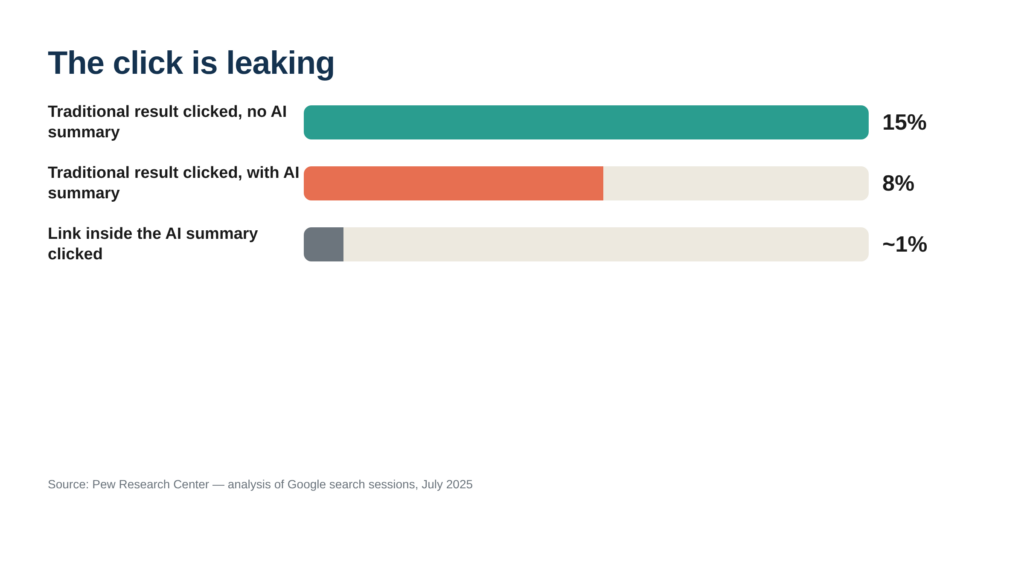
The click is leaking. Pew Research Center analyzed real Google search sessions and published the results in July 2025. When an AI summary appeared, users clicked a traditional result in about 8 percent of visits. Without one, that figure was about 15 percent. Clicks on the links cited inside the summary itself were roughly 1 percent of visits.
The downstream effect is already measurable. An Ahrefs-based analysis of December 2025 data found that ranking number one on Google now delivers 58 percent fewer clicks than it used to. The top spot still matters, but the tap is running slower.
The traffic is compounding. Adobe Analytics forecast a 520 percent surge in AI-driven traffic to US retail sites for the 2025 holiday season. The follow-up landed hard: in the first quarter of 2026, AI traffic to US retailers was up 393 percent year over year. The base is still small — industry estimates put AI referrals near or below one percent of typical site traffic — but the growth curve is steep.
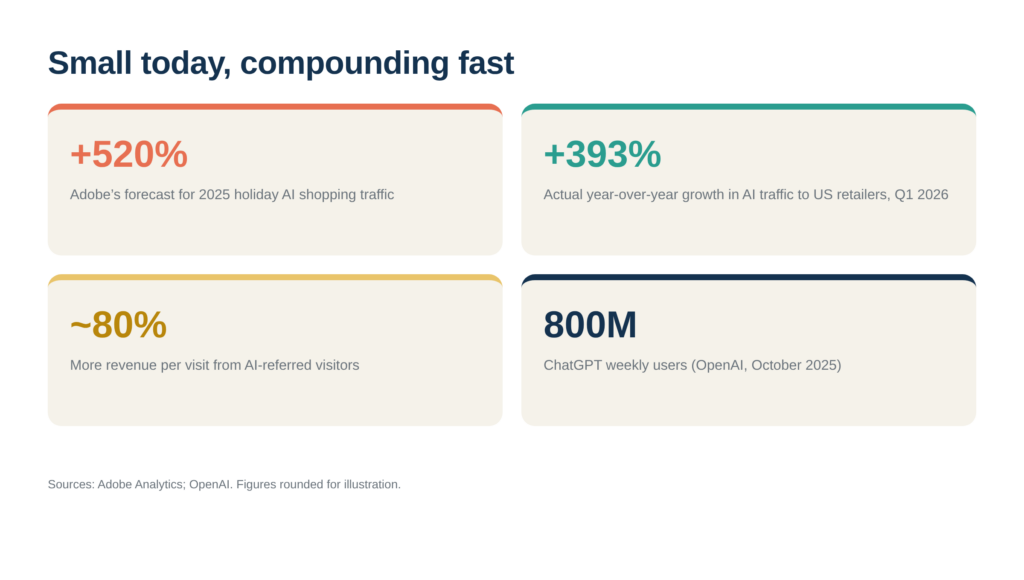
The quality is better, not just bigger. Here’s the part most of the hype misses. Adobe’s retail data shows that AI-referred visitors generate roughly 80 percent more revenue per visit than visitors from other referral sources. And the platforms themselves have scale that didn’t exist a year ago: OpenAI reported more than 800 million weekly ChatGPT users in October 2025.
Small, high-intent, compounding. That’s the honest description of this channel, and it’s a better reason to start measuring than any projection on a slide.
How an AI answer actually gets built
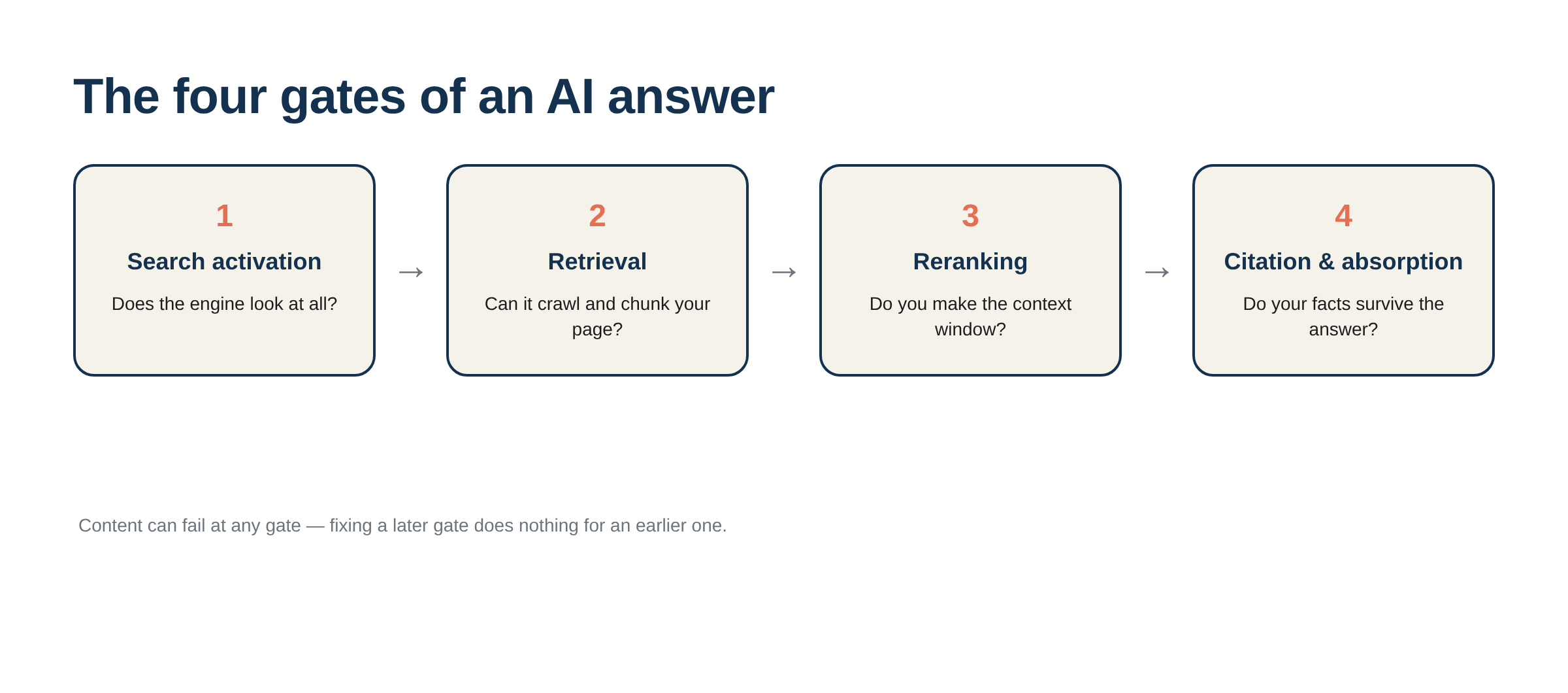
An AI answer isn’t a search result with a summary bolted on top. Think of it as four gates, each with its own way of killing your content.
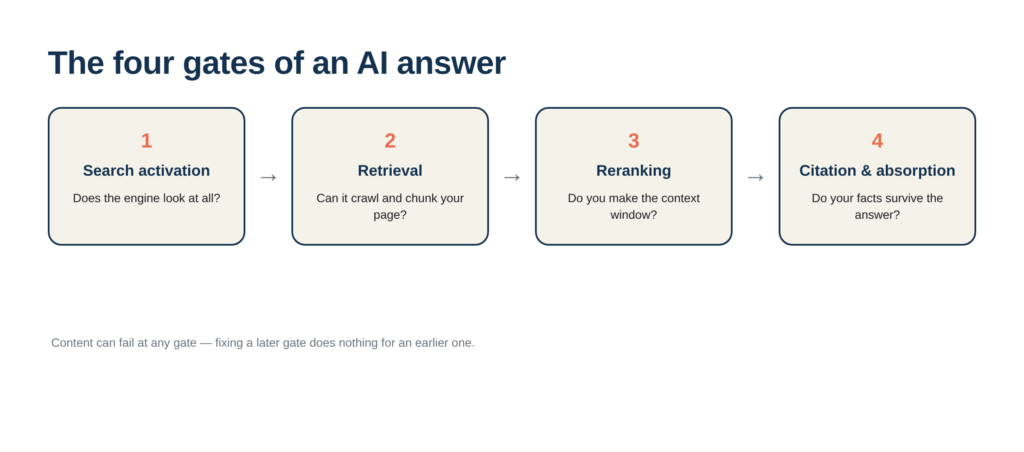
Gate one: search activation. The engine decides whether to look at the web at all. If it answers from memory, there is nothing to optimize.
Gate two: retrieval. Crawling, chunking, matching. If the crawler can’t reach the page, or the page dissolves into chunks that answer nothing in particular, everything downstream is decoration.
Gate three: reranking. Dozens of passages get pulled; a handful get placed in the context window. This is the stage with the most confident online advice and the least public evidence behind it.
Gate four: citation, then absorption. A 2026 measurement study ran 602 controlled prompts across ChatGPT, Google AI Overviews, Gemini and Perplexity, collecting thousands of search-layer citations. Its clearest finding: citation breadth and citation depth diverge. Google and Perplexity cite more sources per answer. ChatGPT cites fewer, but the pages it picks carry far more weight on the wording that follows.
And high-influence pages share a profile. Longer. Better structured. Semantically aligned with the question. Dense with extractable evidence — definitions, numerical facts, comparisons, numbered steps.
That last line is the most actionable sentence in the entire literature. Not “write better.” Write things that can be lifted out and reused without you in the room.
The three layers of GEO
Most guides collapse GEO into “write quotable content.” That’s one layer of three, and the weakest one on its own.
Layer one: the content layer
Structure and quotability. A direct answer near the top, before the wind-up. One idea per block, so a chunk means something after the blender. Tables where the underlying question is a comparison. Numbers with units, dates and ranges attached, because a statistic without a date is a rumor.
The KDD work is blunt about one thing here: keyword stuffing, the oldest SEO reflex, produced little to no gain in generative answers. Persuasive, authoritative-sounding prose didn’t move the needle either. What moved it was evidence — added statistics, added quotations, added citations to credible sources. Fluent, easy-to-read writing helped as well, which tells you these systems reward clarity, not swagger.
Layer two: the technical layer
Schema and machine readability. Organization, Product, FAQ and Article markup, consistent entity naming across your site, a sitemap that doesn’t require archaeology, and pages that render without JavaScript gymnastics. None of this is glamorous. All of it decides whether gate two is passable.
Worth saying plainly: structured data doesn’t get you quoted. It removes reasons for you not to be.
Layer three: the ecosystem layer
What other people say about you. This is where GEO departs furthest from link building.
A 2025 comparative study of AI search behavior found a systematic bias toward earned media — third-party, authoritative sources — over brand-owned pages and social content, a sharp contrast with the more balanced mix in traditional search. Translation: your own website is necessary, but it isn’t sufficient. A model assembling an answer looks for consensus, and it cannot invent one.
What the research actually supports
One: the founding result holds inside its harness. The KDD benchmark showed a source already sitting in a fixed context can improve its own visibility by up to 40 percent, with quotation and statistics additions doing most of the work, and up to 37 percent on the deployed Perplexity engine. Note the scope. That’s visibility inside a context that already contains you. It says nothing about whether an engine would ever find you.
Two: structure is measurable. A 2026 preprint that engineered document architecture, information chunking and visual emphasis reported a 17.3 percent relative lift in citation rate and 18.5 percent in judged content quality across six engines. One team, not yet replicated. Treat it as a hypothesis with a decimal point, not a target.
Three: brand size sets the ceiling. A large-scale 2026 tracking study of more than 100,000 prompt responses found global household brands appearing in 73 percent of relevant AI answers on a first run, established mid-market brands at 44 percent, and niche or small brands at just 11 percent. Roughly thirty points per rung.
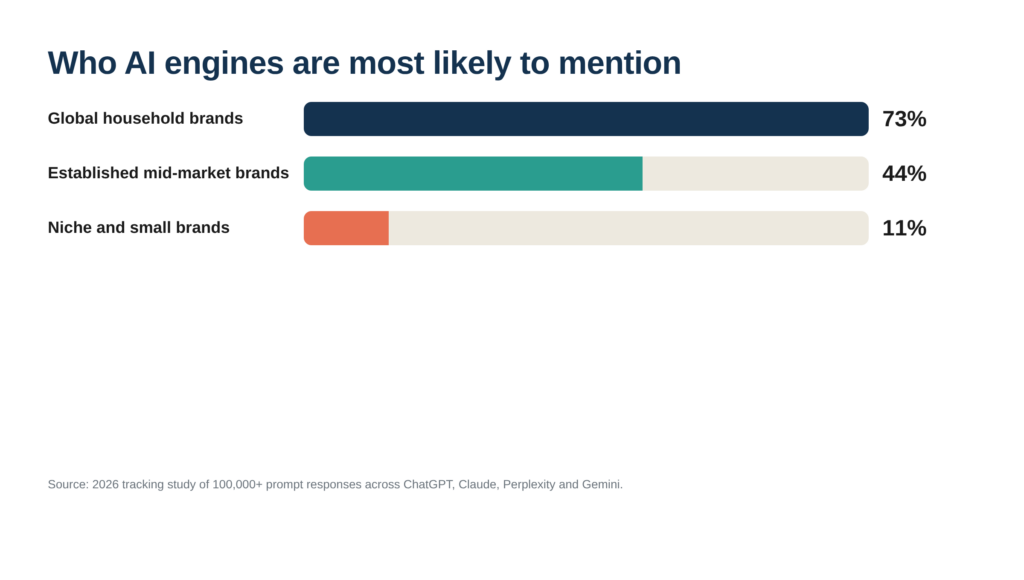
If you’re on the bottom rung, GEO isn’t a shortcut past the ladder. It’s how you stop being invisible while you climb.
Four: the assistant increasingly contains the whole journey. Back to that 34.1 percent figure. For a growing share of questions, someone asks, the engine answers, and the session ends. No click to anyone.
The China half of the story
If your audience includes anyone selling into China, the global playbook transfers at the level of mechanics and breaks at the level of KPIs.
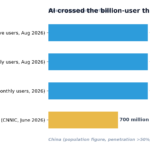
China’s official statistics reset the frame. The China Internet Network Information Center, or CNNIC, put generative AI users at roughly 602 million as of December 2025 — more than double the 249 million counted a year earlier — and reported the figure surpassing 700 million in the first half of 2026, pushing national penetration past 50 percent.
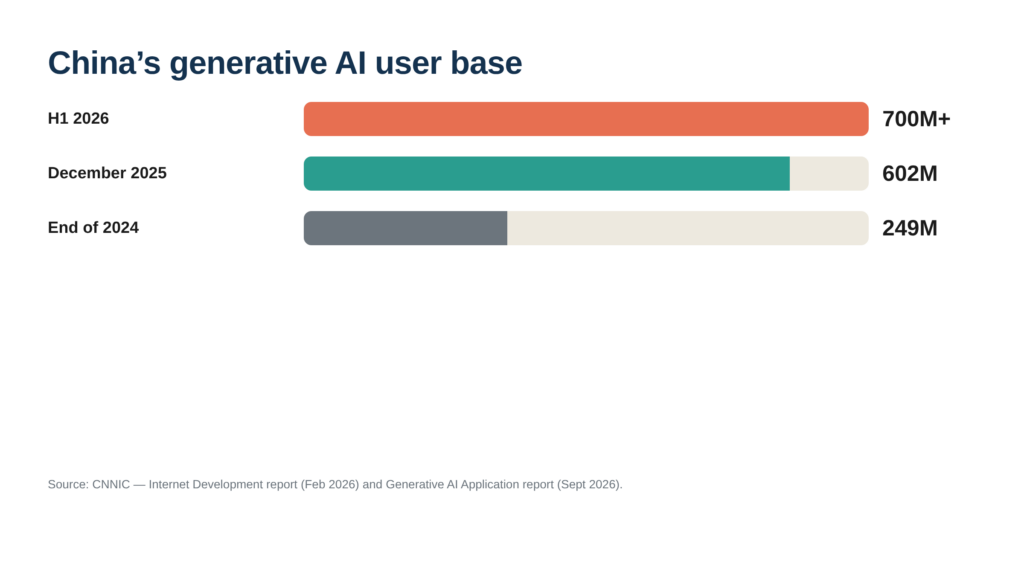
Fifty percent is the threshold where a technology stops being early and starts being normal. That changes the brief. The assistant is no longer a side door; for a large share of product research it’s the front door.
The structural difference matters more than the headline number. China’s assistants — Doubao, Qwen, Yuanbao, Quark and DeepSeek — live inside apps people already open every day, and the answer is often the endpoint rather than a signpost. Browse, compare, order, pay, all without a click.
So what travels, and what doesn’t? Citation mechanics travel: clear entities, structured pages, evidence you can lift. The KPI doesn’t. Where retrieval ends inside the assistant, share of answer replaces share of traffic, and consistency across sources does more work than cleverness, because there are fewer independent sources for a model to cross-check against.
What GEO is not
It isn’t a ranking system. There’s no page one, no position three, no climb to screenshot.
It isn’t a content trick. Invisible text, doorway pages, synthetic reviews — all of it fails at gate two, and some of it fails at the trust layer before a model ever sees it.
It isn’t a one-time fix. The window resets. Models update. A citation you earned in March is a memory by June.
It isn’t SEO with a new vocabulary. SEO competes for a slot a human scans. GEO competes for a sentence a human reads and stops at.
And it isn’t a promise. Anyone quoting a guaranteed citation rate is describing their own test harness, not your market.
What to do first: three steps, thirty days
Step one: make your data legible. One canonical brand name, used identically everywhere. One set of facts repeated without variation across site, profiles, directories, partner pages. A wrong number travels faster than a missing one and poisons the entity.
Step two: publish pages built for extraction. Take your ten highest-intent pages and rebuild each around a direct definition at the top, numbers with dates attached, and a comparison table where the question is a comparison. Add a real FAQ block to each, answered in two or three sentences.
Step three: watch the answers. Build a fixed set of 50 to 100 questions your buyers actually ask, at decision stage. Run them twice a month. Record the date, the platform, whether the answer cited anything, who it cited, and whether your fact survived. Use paraphrases of the same question, because a single phrasing measures one string, not a topic.
Expect the traffic line to stay flat for a while. Expect citation share to move first. That sequence is normal, and fighting it wastes the budget you’ll want later.
How to tell whether it’s working
Four numbers, four different questions.
- Search activation rate. How often does an engine retrieve anything at all for your category’s prompts?
- Citation share. How often are you named, relative to the competitive set?
- Absorption share. How often does your specific fact or framing survive into the final wording?
- Referral traffic and conversion. The commercial outcome, tracked separately for a full quarter.
One method rule keeps you honest: never compare raw citation counts across platforms. Breadth differs by engine. Compare your share within each platform, over time.
The honest bottom line
GEO is not a channel you buy. It’s a set of conditions you make true — a clear entity, pages that survive chunking, evidence someone else can lift, facts that don’t contradict themselves, and enough independent corroboration that a model has something to agree with.
The measurable upside in 2026 is modest and real: about one percent of visits on average, growing at triple-digit rates, converting better than everything else, and concentrating in categories where an answer has to hand the reader off to a website.
The downside of ignoring it is quieter. A share of the answer goes to whoever wrote the paragraph the model preferred, and you find out a year later, from a sales call recording.
So treat it as insurance with a growth curve attached. Build the conditions now, measure share of answer rather than clicks, and stop waiting for a dashboard that will never be precise. Nobody can see inside the pipeline. Everyone can count what comes out of it.
Next: the deeper piece, GEO in 2026, covers the four gates in detail, the measurement methodology, and the China-specific playbook.
Five questions people actually ask
Is GEO just SEO with a new name?
No, though they share plumbing. SEO competes for a position in a list a person scans. GEO competes for inclusion and framing inside an answer a person reads once. Same inputs in places — different outputs, different failure modes.
Does this mean rewriting my whole site?
No. Start with ten pages. A definition at the top, dates attached to numbers, one comparison table, one honest FAQ block.
Why does the same brand get cited in ChatGPT and vanish in Perplexity?
Because the engines retrieve differently and cite at different depths. Compare share within an engine, never across.
How long before citation share moves?
Usually within a quarter, if you’re publishing extractable content and your entity is clean. Referral volume lags behind, sometimes by two quarters.
Does GEO work the same way in China?
The mechanics do; the scoreboard doesn’t. Share of answer matters more than referral traffic, and consistency across sources matters more than volume of content.