The Dinner Is Over: How Chinese B2B Marketing Moved to Content
For two decades the deal began with a dinner. Now it begins with a search box — and increasingly, a model doing the reading.
1. The dinner nobody schedules anymore
Ask a sales director in Suzhou or Foshan what changed and you rarely get an answer about culture. You get an answer about paperwork.
A few years ago the quarterly entertainment budget was a line item nobody argued with. Twelve dinners, a few cases of baijiu, a private room booked for the client’s procurement manager and his team. Expensive, inefficient, and it worked — because when public information about suppliers was thin, a shared meal was the cheapest due-diligence instrument available. You learned whether the man across the table would still answer his phone in a crisis. That is worth more than any brochure.
Then the reimbursement form got harder to sign.
Finance wanted an itemized guest list. Audit wanted to know why a technical visit required a banquet. The regional manager did the arithmetic on a per-head basis and discovered that the same money bought four months of a content retainer.
2. Guanxi was never really about the food
This is worth saying plainly, because Western commentary usually gets it wrong in both directions. Guanxi (关系) is not bribery in a dinner jacket, and it is not friendship either. It is a trust infrastructure that grew where institutions were slow: when contracts were hard to enforce and credit histories were thin, personal accountability stood in for institutional accountability. If I vouch for you and you fail, I lose standing. That is a real mechanism, and it scaled for exactly as long as the information problem lasted.
Two forces erode it. The first is information: when a buyer can check your delivery record, your certifications and your competitors’ prices in ten minutes on a phone, your personal guarantee is worth less. The second is enforcement: when bribery carries a documented legal cost, vouching gets expensive.
Both arrived at roughly the same time.
3. What actually killed the banquet
Not a change of heart. Two pieces of paper.
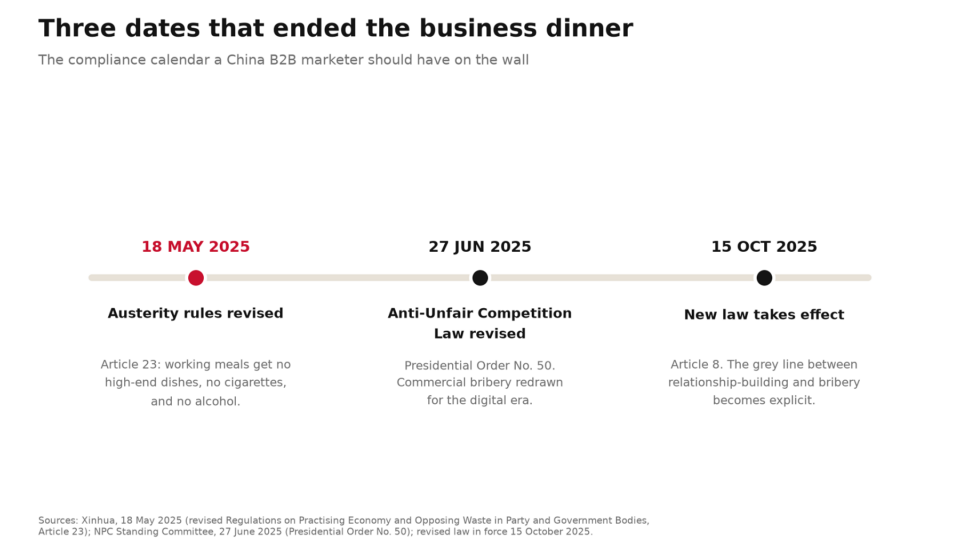
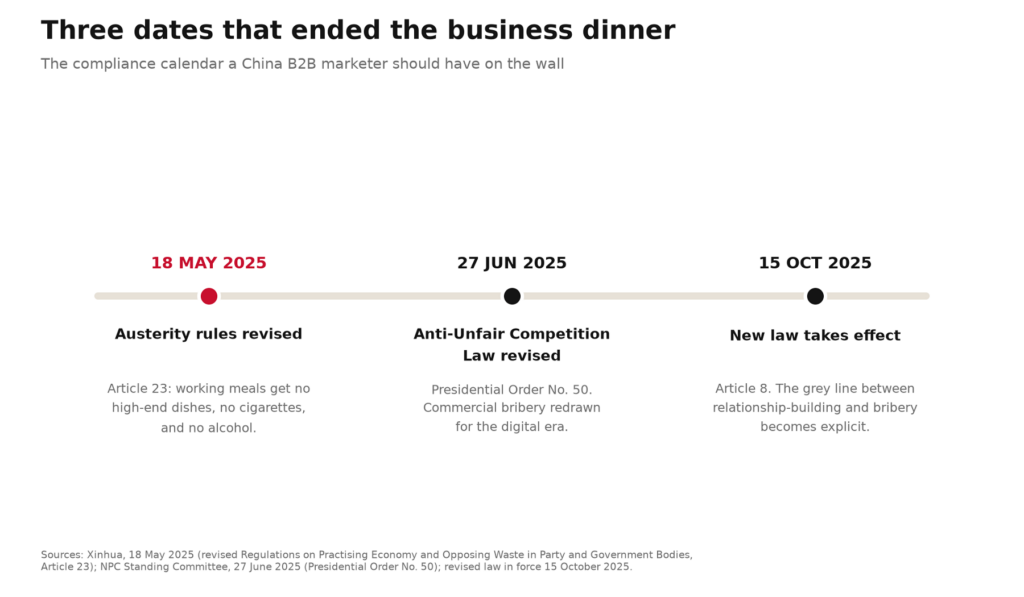
On 18 May 2025 the Communist Party of China’s Central Committee and the State Council issued a revised version of the Regulations on Practising Economy and Opposing Waste in Party and Government Bodies . Article 23 tightened the rules on official receptions: total spending caps, itemized accounting, no shifting reception costs into meeting or training budgets, and a working meal with no high-end dishes, no cigarettes and no alcohol.
That regulation binds party and government bodies. Its practical reach is wider. Anyone selling to a state-owned enterprise, a public hospital, a university or a local government project is now selling into an audit culture that treats the banquet as a finding, not a courtesy.
Then, on 27 June 2025, the Standing Committee of the National People’s Congress adopted the revised Anti-Unfair Competition Law, in force since 15 October 2025. Article 8 extends the definition of commercial bribery to three categories of recipient: employees of the counterparty, entities and individuals entrusted by the counterparty, and anyone who can influence a transaction through position or influence.
That third category is the one that ends a business model. The consultant who knows the deputy director, the former colleague who makes introductions, the industry association that arranges a meeting — all of them now sit inside the definition rather than beside it.
4. A market of 57 million companies, not five hundred
Here is where most global B2B decks go wrong. The China buyer they describe — a state grid, a national carmaker, a tier-one battery supplier — is real, but statistically it is a rounding error.
By the end of March 2025 China had more than 57 million registered private enterprises, equal to 92.3% of all enterprises in the country, according to the State Administration for Market Regulation. Another 9.5 million new enterprises were registered during 2025 alone.
Most of those companies have no procurement department and run no RFP with a scoring matrix. Picture the owner’s son: he studied mechanical engineering, uses three AI tools before lunch, and decides which supplier gets the call. He decides the way a consumer decides: on a phone, at eleven at night, by comparing what he can see.
5. The research habit is now an AI habit
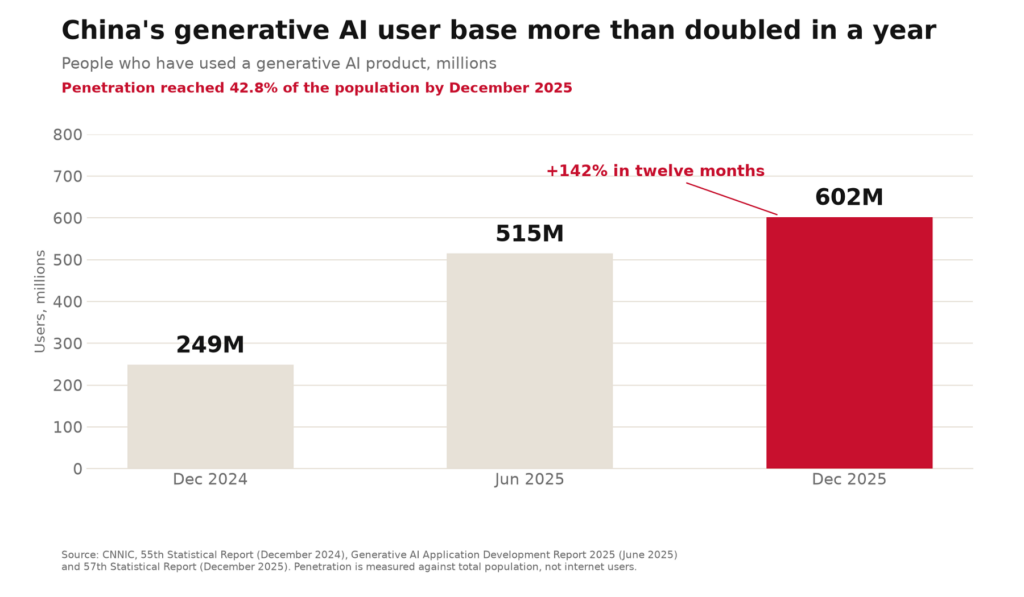
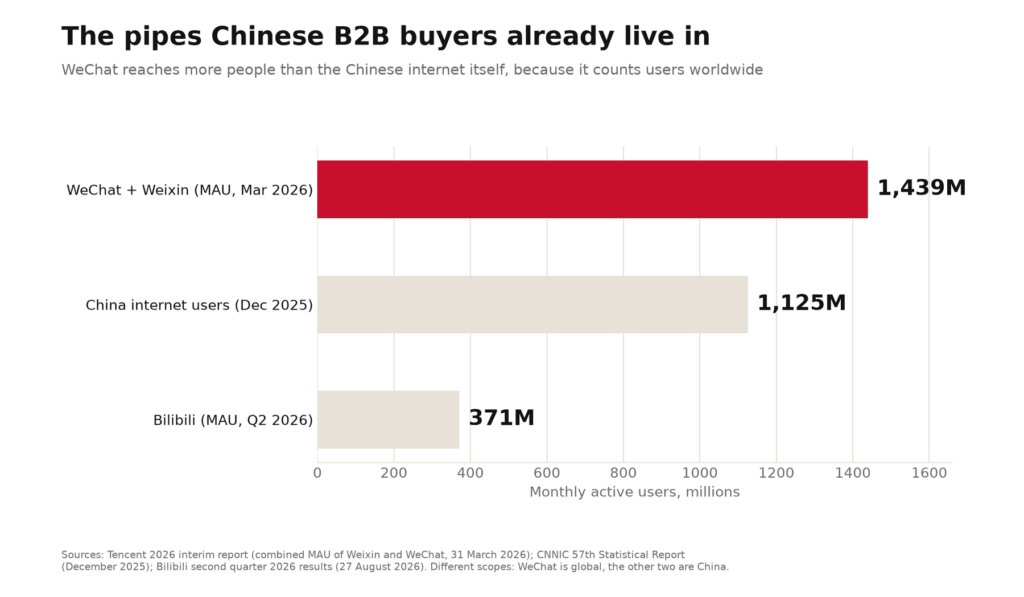
The macro numbers are hard to argue with. China had 1.125 billion internet users at the end of 2025, or 80.1% of the population, per CNNIC’s 57th Statistical Report. By the same point, 602 million people had used a generative AI product — 42.8% of the population, up from 249 million a year earlier.
A word of caution, because this is where a lot of B2B content quietly cheats. CNNIC counts people who have used a generative AI product. It does not tell you what share of B2B purchase decisions now happens without a sales rep. Nobody publishes a defensible figure for that. The statistics that circulate in agency decks, with a consultancy’s name attached and no traceable report behind them, are best treated as folklore. What is documented is the substrate: more than half the country, and nearly everyone under 45 in a purchasing role, has a model one thumb-tap away, and uses it for the unglamorous work of comparison.
6. Where the research actually happens
WeChat first, and not because of reach. Combined monthly active users of Weixin and WeChat reached 1.439 billion as of 31 March 2026, up 2% year on year, according to Tencent’s interim report. The number that matters for B2B is not 1.4 billion. It is that the Official Account is at once a publishing platform, an inbox, a CRM record and a payment rail. A buyer can read your teardown of a competitor’s servo motor, forward it to a colleague, add you to a group and receive a quotation, without leaving the app.
One warning: Tencent does not publish a count of Official Accounts. The figures in agency decks are estimates dressed as data. Do not build a plan on a number nobody will defend in a meeting.
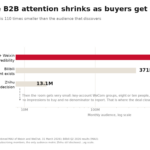
Bilibili is the surprise: 371 million monthly active users and 116.5 million daily actives in the second quarter of 2026, and 113 minutes of average daily time in the app. For consumer brands that is a media buy. For industrial marketers it is a discovery engine: a twenty-minute factory tour, a teardown of a hydraulic valve, a welding line running at speed. The viewer is not browsing for entertainment. They are checking whether your plant is real.
Zhihu is the opposite trade. The platform stopped disclosing monthly actives; its second-quarter 2026 results disclose 13.1 million average monthly subscribing members instead. Smaller, more deliberate, and — because the audience pays — unusually well qualified. A single answer comparing three suppliers on tolerance and lead time will outlive a year of WeChat posts.
7. The stack, rebuilt for how procurement actually reads
| Surface | The job it does | Publish this | Stop doing this |
|---|---|---|---|
| WeChat Official Account | The place a buyer checks whether you are serious | Teardowns, test data, lead times, policy explainers | Corporate news, award announcements, chairman speeches |
| WeChat Channels and Bilibili | Proof that the factory exists | Line tours, QC process, installation walkthroughs | Brand films with orchestral music |
| Zhihu | The comparison a buyer reads at midnight | How-to-evaluate frameworks, honest trade-off tables | Reposted press releases |
| Baidu and AI answer engines | Where the shortlist forms | Structured spec pages, FAQ, comparison pages a model can quote | Keyword-stuffed landing pages |
| WeChat private domain | Where the relationship now lives | Group onboarding, sample tracking, service SLAs | Broadcast blasts to a dead list |
| Live and webinar | Compressing a technical evaluation | Engineer-led demos, Q&A with the people who build it | Sales decks read aloud |
8. Flattery versus evidence
Nobody mourns the old content, but it is worth naming what it was: flattery. Strong technical capability. Leading position in the industry. Customers across the globe. Adjectives that survive translation and convey nothing.
The replacement is evidence, and evidence has a shape. A tolerance table. A mean-time-between-failures figure with the test method attached. A lead time that distinguishes stock items from configured items. A total-cost-of-ownership calculator that lets the buyer change the electricity price. A page that names the certifications you hold, the ones you do not hold, and how long the missing ones will take.
The sentence a Chinese B2B buyer responds to is no longer trust me because we have a relationship. It is: here is the number your engineer asked for, published, dated and signed by the lab.
9. Where AI content earns its keep — and where it loses the deal
AI is good at the boring eighty percent of B2B content, and the boring eighty percent is where the hours go. The technical section of a tender document runs to two hundred pages of structured repetition. Product specs exist in four languages and change quarterly. Every factory visit holds forty pieces of content no one has had time to cut. A sales team asks the same twelve questions about torque curves.
Models handle all of that, under supervision.
Then there is the twenty percent that decides the deal, and models are worse than useless there, because they are fluent. The number nobody else has. The named customer’s real failure mode, told with permission. The photograph of the second shift on a Tuesday. The admission that your lead time is eight weeks, not four, and why that is still the right choice.
There is also a compliance trap most global teams have not thought about. In China, certificates are legal documents. If a model invents a CE mark, a 3C certificate number or a test report reference — and it will, confidently, because those strings look like every other string — you have not produced bad copy. You have produced a misrepresentation a competitor can screenshot.
10. Guanxi is not dead. It moved.
Any honest account has to say this: the shift is uneven. In government procurement, in heavy industry, in provincial infrastructure, relationships still decide outcomes, and a foreign supplier with no local partner will usually lose to one with twenty years of history.
What changed is the medium. The relationship now runs through a WeCom group (企业微信), a forwarded article, a sample shipped on approval, a service engineer who answers at eleven at night. Private domain is guanxi with a dashboard — same currency, better memory. A dinner bought attention for two hours. A group chat holds it for two years, and leaves a record that satisfies audit.
11. Five things global teams still get wrong
They localize instead of answering. Translating a global whitepaper produces grammatically correct Chinese that answers questions no Chinese buyer asked. The tell is in the first paragraph: the framing is wrong before the first fact.
They treat WeChat as a newsletter. An Official Account with a service-account backend, a mini-program for sample requests and a group structure for key accounts is a product. An account that pushes monthly press releases is a noticeboard.
They hire a person instead of building a system. One bilingual content manager cannot manufacture local proof points. Proof points come from the service team, the installation engineers and the QA lab — people who never talk to marketing.
They import a funnel that assumes a rep-led journey. If your model has the buyer meeting sales at stage three, the content plan is already wrong. In China the meeting is often the last step, and its job is to confirm what the buyer has already read.
They ignore the compliance calendar. A case study that names a client without written permission, a testimonial from a government official, a success story built on a state-owned buyer — after October 2025 these are not merely gauche. They are a liability.
12. What to measure when the funnel is dark
B2B cycles run long — often the better part of a year. WeChat attribution leaks. Private-domain traffic is invisible to web analytics. Anyone showing you a clean multi-touch dashboard for a Chinese B2B pipeline is showing you a model, not a measurement.
Measure proxies instead. Branded search volume on Baidu, by product line. Read-through rate on Official Account articles — WeChat reports it, and it separates content people finish from content people scroll. The share of first meetings where the buyer arrives with your document already open. Cycle length for inbound versus outbound. The win rate on technical bids where your engineers were quoted back to you.
None of that is elegant. All of it is defensible.
13. A ninety-day sequence that fits a real budget
Weeks one and two: mine the questions. Sales call notes, customer service logs, the twelve questions your technical team answers every week. This is the only research that matters, and it costs nothing.
Weeks three to six: build five evidence assets, not fifty. A comparison table with honest trade-offs. A total-cost calculator. A test-report explainer that translates lab language into procurement language. A lead-time page with real numbers. A how-to-evaluate framework that names your competitors fairly.
Weeks seven to ten: publish each on the surface it belongs to. WeChat for the buyer who already knows you. Bilibili for the engineer checking whether you exist. Zhihu for the comparison that happens at midnight. Baidu and structured pages for the model reading on the buyer’s behalf.
Weeks eleven to thirteen: close the loop. Route readers into a private-domain group, measure first-meeting conversion, and retire the two assets that produced nothing.
The takeaway
The banquet was a tax on relationships: paid in evenings, in baijiu, in favors owed. Content is a tax on expertise, and it has one advantage — it compounds. A dinner is consumed the night it is served. A specification table, a teardown, a lead-time page keep working, in a language the buyer’s engineer trusts, and now in a form a model can quote.
For global B2B companies selling into China, the opportunity is not to out-dinner the locals. It is to out-document them. The buyers are already reading. The question is whether they are reading you.