Why Chinese Banks Put AI Everywhere Except the Advice
Here is what a composite of Chinese retail-bank deployments looks like in 2026. A model drafts the explainer, answers a fee question at eleven at night, ranks three funds by risk, and flags a misleading phrase before the compliance team sees it. Then, at the moment the customer decides to buy, the model stops. A human relationship manager signs off.
That stopping point is not caution, and it is not a technological limit. It is a price.
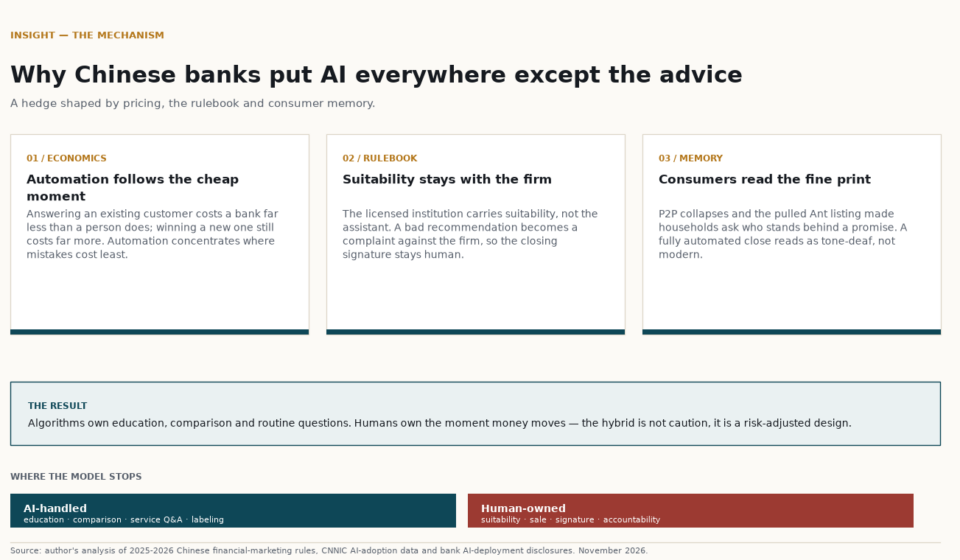
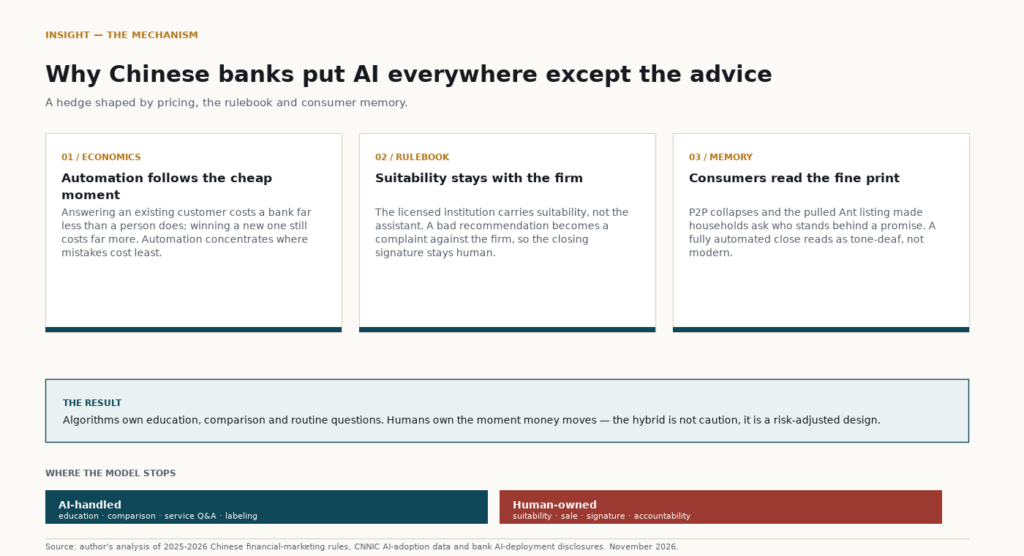
Start with the unit economics. Handling an existing customer’s routine question costs a bank far less with a model than with a person, while winning a new financial customer remains expensive. So the return on automation is highest exactly where a wrong answer is cheapest: education, comparison, and routine servicing. The closer a model moves toward the sale, the more an error costs and the less the automation saves. Marketers read that gradient and keep the machine at the shallow end of the funnel.
Then there is the rulebook. China’s suitability obligations sit with the licensed institution, not with an assistant. If a tool tells a retiree that a high-risk fund is appropriate, the firm absorbs the complaint and the remediation. A signature assigns that responsibility in advance. Greater model accuracy does not change who is accountable, which is why AI stacks in Chinese banking commonly still hand the closing step to a person.
The third force is memory, and it is the one Western observers most often miss. Chinese households did not simply read about fintech risk; many lived through peer-to-peer platforms collapsing between 2015 and 2019 and through Ant Group’s listing being pulled in 2020. The result is not distrust of technology. It is a habit of reading the fine print and asking who stands behind the promise. Meeting that consumer with a fully automated close reads as tone-deaf rather than modern.
Put the three gradients together and the hybrid model stops looking like a compromise. It is an optimization. AI owns the moments that are frequent, cheap, and reversible. Humans own the moments that are rare, expensive, and irreversible.
There is a marketing consequence worth naming. When the sale itself stays human, a brand cannot win on how intelligent its model sounds. It competes on how legible its accountability is: named advisers, published fees, clear exclusions, and a number to call when markets fall. That is why so much Chinese financial creative looks deliberately plain. It is not selling intelligence. It is selling the fact that someone can be held responsible.
One last finding: the constraint on scaling AI content is rarely the model. Once generation is close to free, the scarce resource is review capacity — the person who can say no before a claim reaches a customer. The teams that rebuilt their content operations around that bottleneck are the ones shipping the most AI, not the ones with the biggest models.