Where Did My Ad Budget Go? A Marketer’s Guide to Attribution
The budget you cut last quarter — was it really dead weight, or did it simply refuse to raise its hand in the report?
The Feeling Everyone Shares
Every marketing leader knows the feeling. You sit in a review meeting, look at the numbers, and a quiet voice asks the question nobody wants to say out loud: where did the other half of that money actually go?
It is not that the spend disappeared. It is that the measurement cannot see where it went. A channel drove awareness, shaped preference, nudged someone over the line three weeks later — and none of that shows up as a conversion in your dashboard. So the line item looks empty, and empty looks like waste.
That is the trap at the heart of marketing attribution. What feels like wasted budget is very often budget doing invisible work. The problem is rarely the spend. The problem is the lens.
Why Dashboards Lie a Little
A dashboard does not lie on purpose. It reports what it can count, and it can count the things that are easy to count: clicks, impressions, sessions, last-touch conversions. Those numbers are clean, precise, and mostly useless for telling you what actually moved revenue.
Clean is not the same as true. When we optimize for what the dashboard rewards, we quietly optimize for what is easiest to measure — not what matters most to growth.
There is a newer wrinkle making this worse. Marketers now have access to more signals, dashboards, and measurement tools than at any point in history, yet confidence in making sense of it all keeps drifting the wrong way. More data has not produced more certainty; it has produced more noise. The paradox of modern measurement is that the more we can see, the less we seem to know.
Think of attribution as a story we tell the dashboard. The story is internally consistent, it has a clear hero — the last click — and it makes everyone in the room feel like the numbers add up. The only problem is that the story is incomplete, and the parts it leaves out are usually the most valuable ones.
Last-Click Is the Default Trap, Not the Truth
Last-click attribution became the default for a simple reason: it was the easiest model to build. Track the final touch before the sale, give it 100% of the credit, done.
But convenience is not accuracy. Last-click crowns whichever channel happened to be standing closest to the finish line and quietly executes everyone who ran the earlier legs of the race. The search ad that closed the deal gets the glory. The video, the newsletter, the in-store experience, the word-of-mouth — all of it becomes invisible.
The result is a systematic bias toward bottom-of-funnel, always-on, cheap-to-credit channels. It is not a conspiracy. It is just a model that was never designed to tell the truth, only to be simple.
The Missing Top-of-Funnel Signal
Here is where the damage compounds. When the model only credits the last touch, top-of-funnel investment starts to look like a pure cost. Brand campaigns, upper-funnel video, organic content, PR — none of them convert directly, so none of them get credit.
And so the cycle begins. You cut the top of the funnel because it does not convert. Then conversions slowly decline, because there is no longer anything feeding the funnel. You measure the decline, blame the remaining channels, and cut a little more.
It is like deciding an engine is useless because you can only see the exhaust. The engine was never supposed to convert. It was supposed to make the conversion possible.
China’s Closed-Loop Advantage
If you want to understand why attribution is hard in most of the world, it helps to look first at where it is comparatively easier.
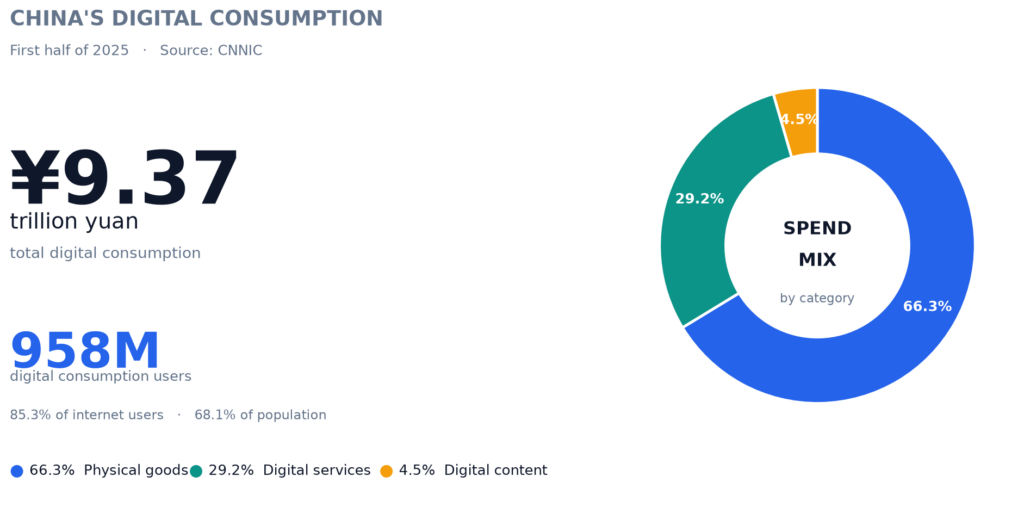
China’s digital economy runs on a scale that makes the stakes enormous. In the first half of 2025 alone, total digital consumption reached 9.37 trillion yuan — roughly 1.3 trillion US dollars — driven by 958 million digital consumption users. That is 85.3% of all internet users and 68.1% of the entire population. Physical goods make up 66.3% of that spend, digital services 29.2%, and digital content 4.5%.
The structural advantage is the closed loop. China’s super apps — WeChat, Alipay, and others — keep the user inside one container for discovery, consideration, transaction, and even the mini-program that fulfils the order. When more of the journey happens in one place, more of it can be seen and attributed without stitching together a dozen platforms.
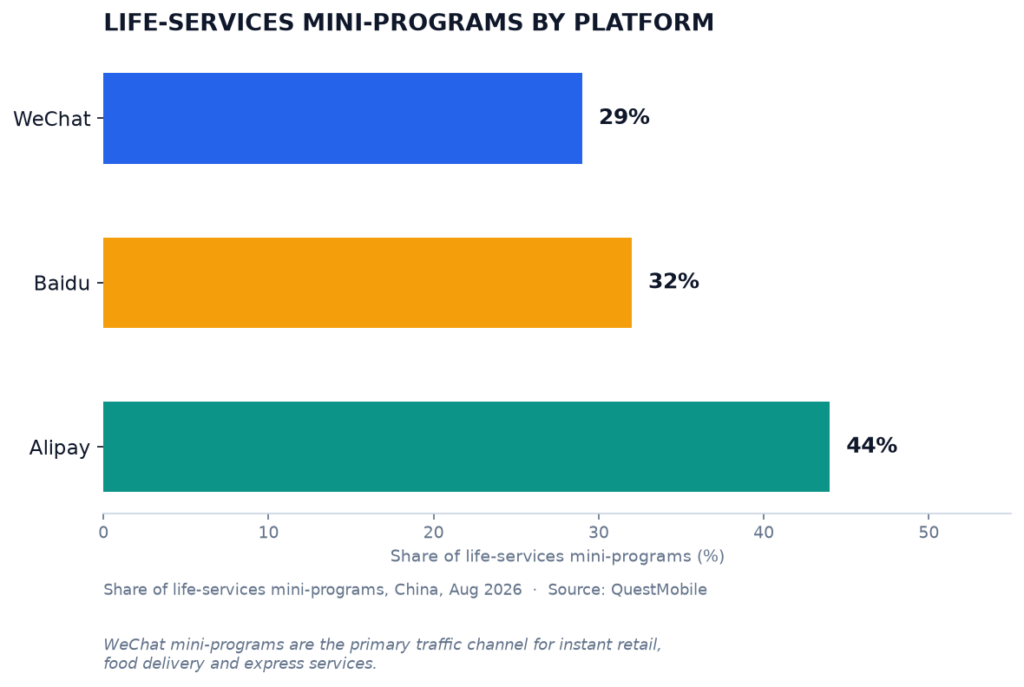
The numbers bear this out. China’s mobile internet reached 1.278 billion monthly active users by August 2026, and life services now run on an app-plus-mini-program model. Life-services mini-programs account for 29% of WeChat mini-programs, and WeChat’s mini-program has become the primary traffic channel for instant retail, food delivery, and express services.
That does not mean China has solved attribution. It means the friction is lower, and the container does more of the heavy lifting.
The West’s Fragmentation Tax
Most Western marketers pay a tax that their Chinese counterparts largely avoid: fragmentation.
The journey that in China might live inside one or two super apps is, in the West, scattered across search engines, social networks, streaming services, retail media networks, connected TV, and a browser that keeps erasing its own memory. Each walled garden reports on its own terms, in its own currency, with its own definition of a conversion. Stitching all of it together is a data-engineering project, not a marketing task.
On top of that, the foundation under user-level tracking has cracked. Privacy regulation and platform changes have made individual-level tracking far harder, which directly erodes the reliability of the attribution models that depended on it. The result is a measurement system that was already biased toward the last click, now also working with less signal than before.
Fragmentation is not a bug you fix once. It is a structural condition you measure around.
A New Blind Spot: The AI Layer
There is a fresh variable making attribution harder in both markets at once, and it deserves its own warning.
AI assistants and AI search are becoming a major front door to purchase decisions. In China, AI general assistants alone passed 1.16 billion monthly active users by September 2026, growing 44% year over year. A shopper now asks an assistant a question, gets a synthesized answer, and clicks through — or does not click through at all.
That is the dangerous part. When a buyer’s decision is shaped inside an AI answer that your analytics never sees, the influence happens off your dashboard entirely. The channel that quietly steered the choice gets zero credit, because there is no click trail to follow. AI is compressing the funnel at the exact moment it is also hiding more of it.
Attribution was already biased. The AI layer adds a blind spot on top of the bias.
MMM: The Old Tool That’s Back
When last-click stops working, an older idea returns: marketing mix modeling, or MMM.
MMM does not try to follow every user. It works at an aggregated level, correlating total marketing activity — across channels — with business outcomes over time. It asks a different question than attribution does. Attribution asks who touched the customer last. MMM asks what actually moved the revenue.
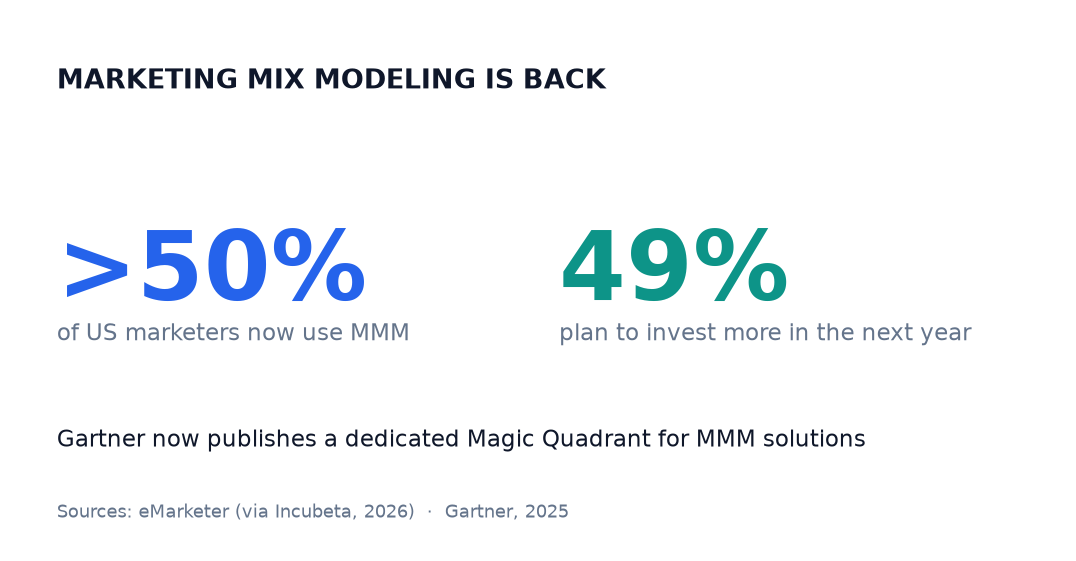
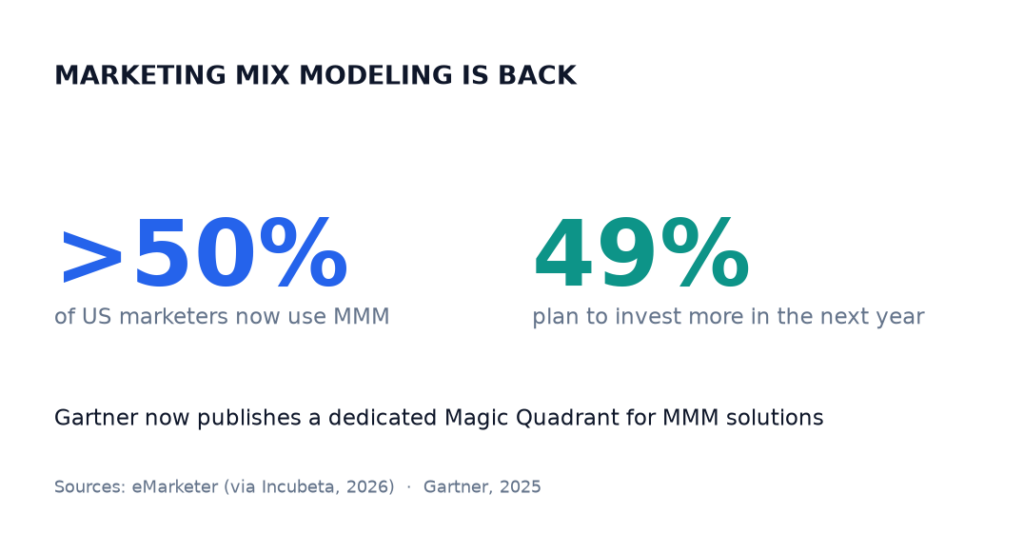
The industry has noticed. Gartner now publishes a dedicated Magic Quadrant for marketing mix modeling solutions, a category that simply did not exist as a formal market a few years ago. The tooling has matured enough that vendors now compete on speed to value, self-service, and cross-functional adoption rather than on whether the approach works at all.
Adoption tells the same story. More than half of US marketers now use MMM, and 49% plan to increase their investment in it over the coming year, according to eMarketer data. The reason is straightforward: as tracking gets harder and the media mix gets more complex, the tools that could see everything become less trustworthy, and the tools that can see the whole picture become more valuable.
Set realistic expectations, though. A proper MMM build typically takes one to three months, and unlocking its full potential often runs six months to a year. It is a strategic compass, not a real-time steering wheel.
Incrementality Over Attribution
If MMM is the wide-angle lens, incrementality is the truth test.
Incrementality asks a deceptively simple question: would this sale have happened anyway? It measures the lift that a campaign actually creates, rather than the activity it merely touches. You run geo-experiments, holdout groups, or matched-market tests, and you compare the exposed group against the control.
The shift in mindset is everything. Attribution tells you what people did. Incrementality tells you what your marketing changed. Those are not the same thing, and confusing them is where most wasted spend actually hides — not in the spend itself, but in the confusion between correlation and causation.
Incrementality is slower and more expensive to run. It will not replace your dashboard. But it should be the thing that keeps your dashboard honest.
A Pragmatic Stack for 2026
The practical answer is not to pick one measurement system and swear loyalty to it. It is to run several, each for a different job.
Last-touch attribution still has a role — it is fast, cheap, and useful for tactical, same-week decisions. MMM is your strategic compass, telling you how channels work together and where the long-term return actually sits. Incrementality is your occasional audit, the reality check that keeps the other two from drifting into fantasy.
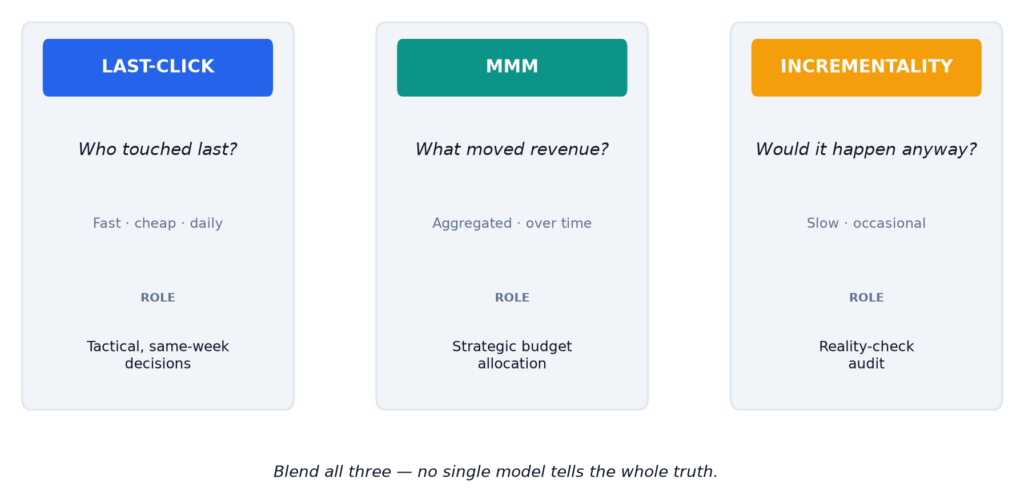
The mistake most teams make is treating one of these as the whole answer. Last-touch alone will starve your brand. MMM alone will move too slowly for weekly trading. Incrementality alone is too expensive to run on everything. Blended, each one covers for the others’ blind spots.
What to Stop Measuring
Some of the most liberating work you can do is deciding what not to trust.
Stop treating last-click ROAS as the scoreboard for the whole business. It is a tactical metric with a built-in bias, not a verdict on channel value. Stop killing channels because they do not attribute cleanly — that is punishing the channel for the model’s blindness. And stop mistaking dashboard cleanliness for measurement accuracy.
The goal is not to measure everything. It is to measure the few things that actually change your decisions, and to be honest about the uncertainty baked into the rest.
How to Defend the Brand Budget
This is where the whole conversation usually lands: how do you protect brand spend when the CFO is holding a last-click report?
The answer is to change the evidence, not the argument. Brand investment builds the pool that performance marketing then drains. If you only measure the drain, brand always looks like a cost. If you measure the pool — with MMM and incrementality — brand starts to look like the reason the drain keeps working.
Defend the brand budget with its own numbers: the lift a brand campaign creates, the conversion-rate improvement it delivers to the channels that follow, the share of demand that would not exist without it. You cannot win that fight with last-click data. You win it by bringing better measurement to the table.
The Honest Conclusion
So is half your budget actually wasted? Almost certainly not. But half of it may be invisible to the tools you are currently using.
The budget that feels wasted is usually the budget doing the quiet work of making everything else convert. The fix is not to cut it. The fix is to build a measurement system that can finally see it.
Attribution will always be a story we tell the dashboard. The difference between a good marketer and a great one is whether that story is honest.