More AI Search Activity, Less Monetization: Google Faces a New Ad Test
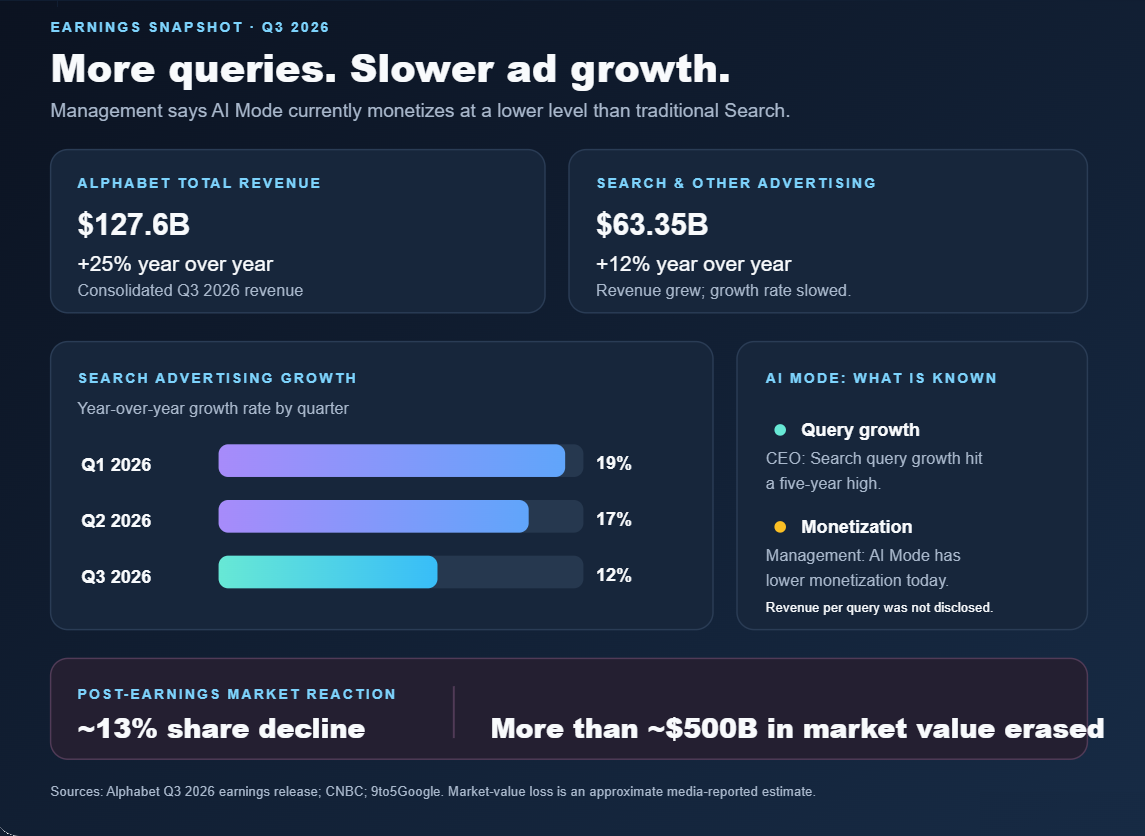
Alphabet’s third-quarter results put a growing tension in Google Search into sharper focus: search queries are rising, but Search advertising growth is slowing. Alphabet reported revenue of $127.6 billion for Q3 2026, up 25% year over year. Google Search and other advertising revenue grew 12% to $63.35 billion, down from growth of 17% in Q2 and 19% in Q1.
Alphabet shares fell about 13% on October 29, according to CNBC, in a post-earnings sell-off that 9to5Google reported erased more than $500 billion in market value. The reaction followed an earnings miss and concerns including negative free cash flow; it should not be attributed to AI Mode alone.
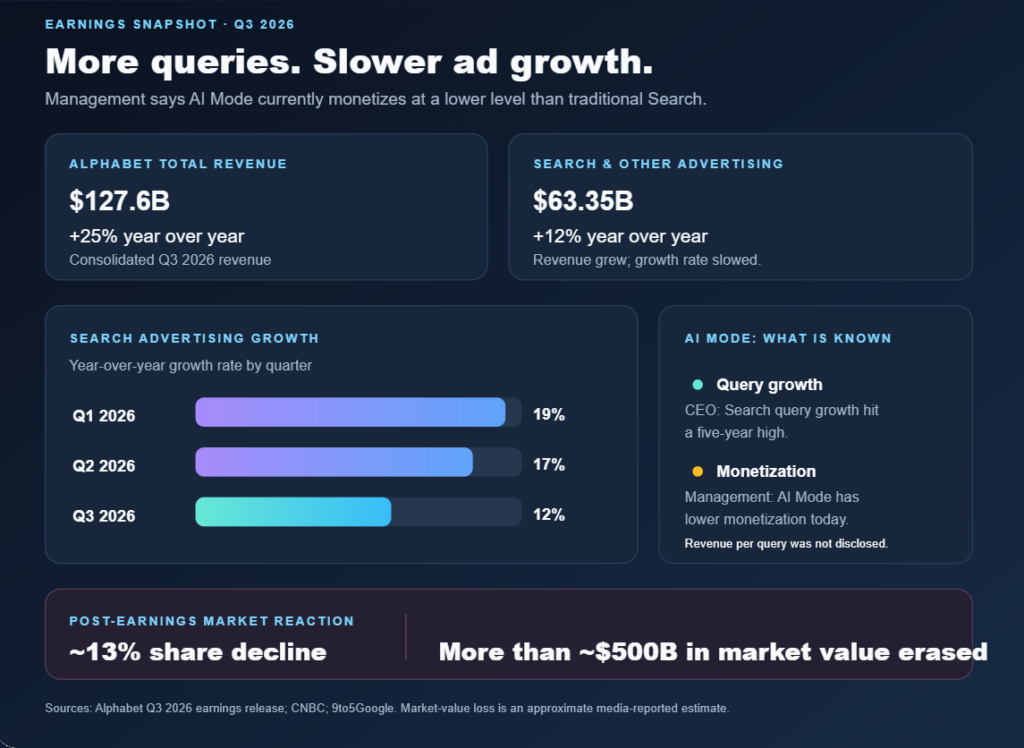
The infographic compares Alphabet’s revenue growth with Google Search and other advertising growth, charts the year-over-year Search advertising growth rate across Q1–Q3 2026, and summarizes management’s comments on query growth and AI Mode monetization.
More queries, slower Search advertising growth
Alphabet CEO Sundar Pichai said Google’s year-over-year Search query growth reached its highest rate in five years. At the same time, Search and other advertising revenue growth slowed from 19% in Q1 to 17% in Q2 and 12% in Q3.
The distinction is important: Google’s Search advertising revenue did not decline. It increased to $63.35 billion. What slowed was the rate of growth. Alphabet also said foreign exchange was the biggest factor behind the deceleration relative to the prior quarter, so the change cannot be assigned to AI alone.
What Alphabet said about AI Mode
On the earnings call, Google Chief Business Officer Philipp Schindler said strong growth in AI Mode queries had an impact because the product had lower monetization than traditional Search.
That is a meaningful admission about the economics of the new format. But it is not a quantified comparison of revenue per query: Alphabet did not disclose how much an AI Mode query earns, or the precise gap between AI Mode and a conventional search.
Why the format matters to advertising
Traditional Search presents a ranked set of links, with advertising placed around commercial intent. AI Mode delivers a synthesized response and supports follow-up questions. That changes the setting in which ads appear and the route a user may take from a query to a click.
The business-model question is whether Google can build advertising formats that work in conversational search while keeping answers useful and trusted. Google has announced an expansion of ads in AI Mode, but that rollout is an experiment in monetization—not evidence that the new format already matches the economics of traditional Search.
A signal to watch, not a verdict
Alphabet’s Q3 results do not show that AI has already made Search advertising revenue fall. The segment grew 12% year over year. Nor do they establish that AI Mode caused the slowdown: management cited foreign-exchange effects, and the company has not quantified the specific contribution of AI Mode.
What the quarter does show is a widening gap between two indicators investors have reason to watch: Search query growth and Search advertising growth. The first reached a five-year high, according to Pichai; the second slowed for a third consecutive quarter.
For the wider advertising industry, the question is not simply whether AI search attracts more engagement. It is whether that engagement can generate relevant, measurable advertising revenue at scale. Alphabet has acknowledged that AI Mode currently monetizes at a lower level than traditional Search. The size—and durability—of that gap remains undisclosed.