OpenAI’s ChatGPT Ad Network Adds 26 Countries and Surpasses 100,000 Advertisers
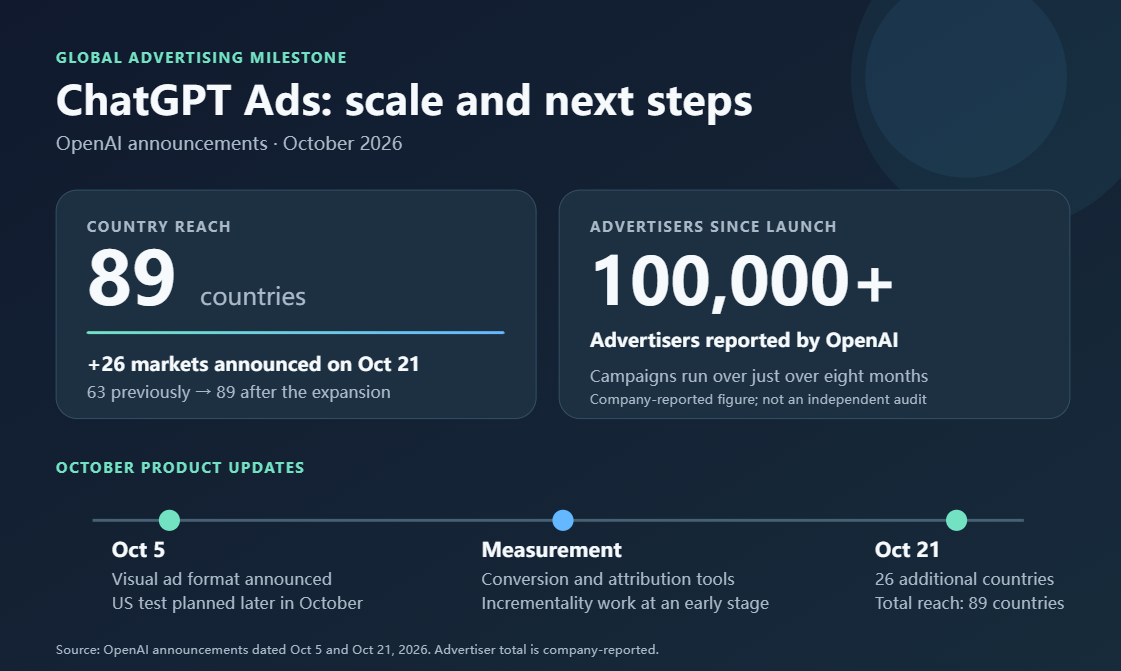
OpenAI says ChatGPT Ads now reach 89 countries, following an expansion into 26 additional markets announced on October 21, 2026. The company also reports that more than 100,000 advertisers have run campaigns on the platform since its US test began in February—just over eight months ago.
The announcement marks a rapid expansion for a new advertising channel built around conversational AI. Earlier in October, OpenAI announced a visual ad format and broader measurement tools, addressing two practical questions for marketers: how to communicate beyond text and how to assess campaign impact.
ChatGPT Ads add 26 countries
The October expansion brings ChatGPT Ads’ reported availability to 89 countries, up from 63 before the latest rollout. The newly added markets span Latin America, Europe, the Middle East, Africa and Asia. OpenAI said 14 of the additions are in Latin America, following earlier launches in Mexico and Brazil.
The 100,000-plus figure counts advertisers that have run campaigns since launch, according to OpenAI. It should not be read as the number of currently active advertisers: the company has not publicly provided a breakdown of active accounts, spend or campaign performance alongside the milestone.
Visual ads and measurement tools
On October 5, OpenAI announced a visual ad format designed to show products and services through images. The company said it planned to begin testing the format later that month in the United States with an initial group of advertisers. The test is for users on the Free and Go plans, with ads labeled and kept separate from the image being generated.
OpenAI also announced expanded measurement capabilities and partner integrations. These include tools for sharing conversion data, attribution partnerships across web and app campaigns, and early-stage work on geo-based incrementality experiments. It also described brand-suitability pilots with DoubleVerify and Integral Ad Science.
The announcements are notable, but they do not amount to a complete public measurement standard. Incrementality work was described as early-stage, and advertisers will still need to assess how well the available tools answer their own questions about reach, attribution and business outcomes.
Ads remain limited to Free and Go plans
As of its October 21 announcement, OpenAI said ads would appear only on ChatGPT’s Free and Go plans. Plus, Pro and Enterprise subscriptions would remain ad-free.
OpenAI’s stated advertising principles say ads should be clearly labeled and separate from ChatGPT’s answers, and that advertising should not influence those answers. The company also says it does not sell users’ conversations to advertisers. These are OpenAI’s published policies and commitments; they are not independent evidence that users will always perceive the distinction as clear.
The open question: can ads coexist with answer trust?
The core challenge is not simply where to place an ad. It is whether people will continue to trust an answer when a commercial message appears in the same conversational experience.
OpenAI says ads do not affect ChatGPT’s answers. But the distinction between a helpful response and a relevant sponsored placement will have to remain legible to users in practice—not just in policy language. Clear labeling, separation from answers, privacy safeguards and credible measurement will all matter as the platform grows.
For advertisers, ChatGPT represents a relatively new paid channel without a long-established playbook for conversational discovery. That creates room for early experimentation, but it does not guarantee visibility or performance. Brands will need to learn which contexts are suitable, how users respond and whether campaigns produce outcomes that can be measured reliably.
The 89-country milestone shows that ChatGPT Ads is expanding quickly. Whether that scale becomes a durable advertising business will depend on more than advertiser sign-ups: OpenAI must demonstrate that ads can be useful to marketers without weakening users’ confidence in the answers they came for.
Structured FAQ
1. How many countries does ChatGPT Ads reach?
OpenAI said on October 21, 2026, that ChatGPT Ads had expanded to 89 countries after adding 26 markets.
2. How many advertisers have used ChatGPT Ads?
OpenAI reported that more than 100,000 advertisers had run campaigns since the ads test began just over eight months earlier. The figure is company-reported and does not specify how many advertisers are currently active.
3. When did ChatGPT Ads launch?
OpenAI began testing ads in the United States on February 9, 2026. The initial test was for logged-in adults using the Free and Go plans.
4. What new ChatGPT ad format did OpenAI announce in October 2026?
On October 5, OpenAI announced a visual ad format to be tested during image generation in ChatGPT. The company said the test would begin later that month in the United States with an initial group of advertisers.
5. Do ChatGPT ads influence the answers?
OpenAI’s stated policy is that ads do not influence ChatGPT’s answers and are clearly labeled and separated from them. This is the company’s policy commitment, not an independently audited finding.