AI Agents Are Becoming a New Audience for the Web
Meta Muse, OpenAI Dots, and Anthropic Claude Duet point to a web where AI can read, browse, and act for users. For publishers, the next challenge is making information accessible, clear, and credible to both people and machines.
In 2026, Meta, OpenAI, and Anthropic each introduced or previewed a personal AI agent designed to do more than answer a prompt. These systems can work in the background, use connected applications, and, in some cases, browse websites or prepare actions for a user.
The shift matters to marketers, but the headline should be measured: these launches do not prove that search rankings, clicks, or traditional SEO have stopped mattering. They do suggest that users may increasingly rely on agents to find information and complete tasks without browsing a conventional results page themselves.
That creates a new question for publishers: when an agent reads a page on someone’s behalf, can it identify what the page says, judge whether it is trustworthy, and use it appropriately?
Three products, three different operating models
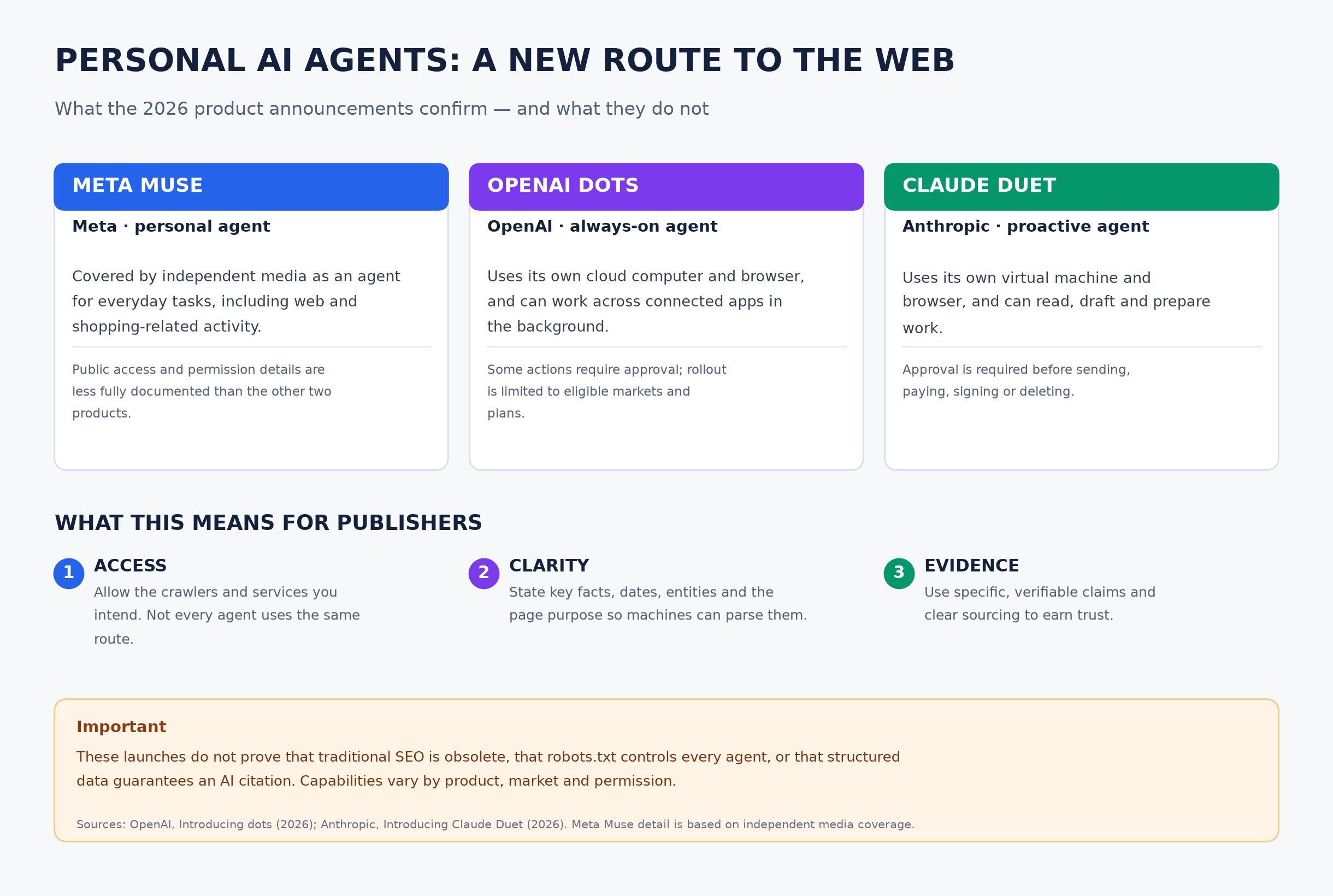
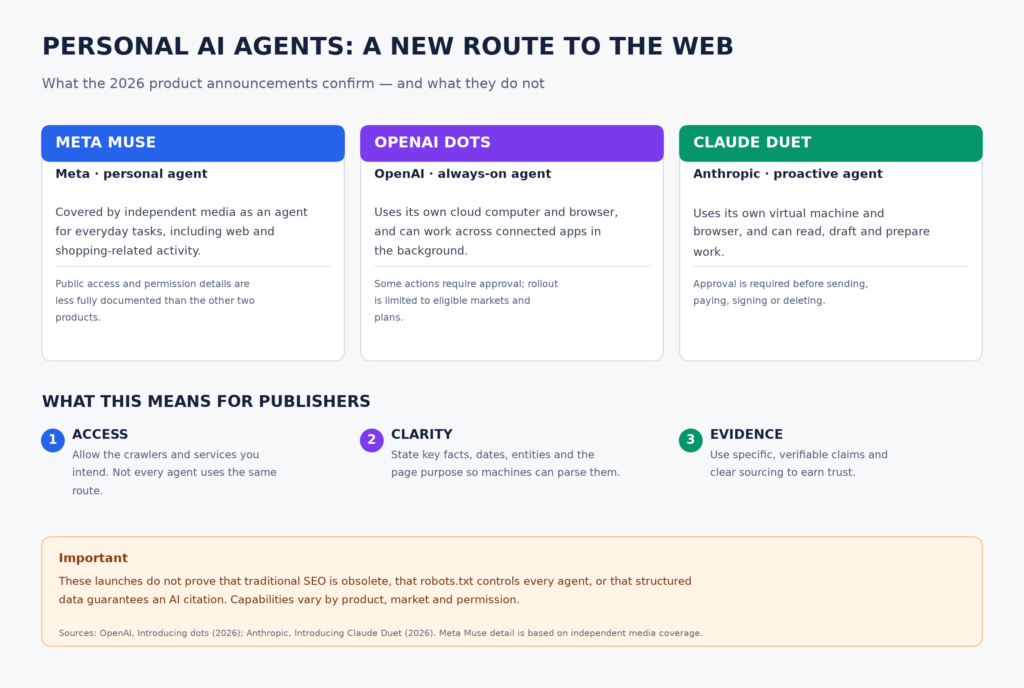
Meta Muse is Meta’s personal-agent offering. Muse has been covered by independent media as an agent for everyday tasks, including web and shopping-related activity. Publicly available information about its exact technical design and permissions is less complete than the official product documentation available for OpenAI Dots and Claude Duet. Its capabilities should therefore be described cautiously rather than treated as a template for all agents.
OpenAI Dots is described by OpenAI as an always-on agent that can work toward user goals through its own cloud computer and browser. It can connect to apps and continue tasks in the background. OpenAI also says users can set boundaries and that some actions require approval. Its rollout is limited to eligible markets and plans; it is not a universal consumer feature available everywhere.
Anthropic Claude Duet is a proactive agent offered as a research preview. Anthropic says Duet can work in the background using its own virtual machine and browser, and can read, draft, and prepare work. It requires user approval before actions such as sending a message, making a payment, signing a document, or deleting information. The initial preview was limited to US Pro and Max subscribers through a waitlist.
These distinctions matter. “Can browse,” “can prepare an action,” and “can complete a transaction” are not interchangeable claims. The products have different permissions, availability, and approval requirements.
Why agents may change content discovery
Traditional search typically gives users a list of pages to inspect. An agent can take a different route: it may retrieve information, compare sources, summarize findings, and present a recommendation inside a conversation or workflow.
That could reduce the number of moments when a user sees a search-results page. It does not, by itself, establish that search rankings or organic clicks are declining. Nor does it mean that every agent accesses the web in the same way. Some may use a search index, a connected service, a browser, or another retrieval method.
For publishers, the practical implication is narrower and more useful: the route to a reader may vary, so important information should be easy to access and interpret across more than one discovery interface.
Robots.txt: a crawler signal, not a universal agent switch
Robots.txt remains relevant when a website wants to communicate crawling preferences to compatible crawlers. But it is not an access-control or security mechanism, and it should not be treated as a single switch governing every personal agent.
An agent might retrieve a page through a search engine, a browser, an application connector, or another service. The applicable access behavior depends on the system involved. Site owners should review their crawler policies, but they should not assume that one robots.txt rule defines how every agent can or will access content.
The strategic question is not simply whether to block or allow AI. It is to decide which content should be discoverable, which services may access it, and whether the site’s policies reflect those choices.
Structured data helps explain a page — but cannot guarantee a citation
Structured data can make entities and page attributes more explicit to software. Clear headings, descriptive page titles, dates, authorship, and well-maintained schema can also reduce ambiguity.
That is a sound publishing practice, but it is not a promise of inclusion in an AI-generated answer. There is no verified evidence that a particular schema type guarantees that a personal agent will recommend or cite a page. Search engines and personal agents may also use different systems and selection criteria.
Treat structured data as part of sound site architecture, not as a shortcut to AI visibility.
GEO: an emerging discipline, not a guaranteed growth lever
Generative Engine Optimization, or GEO, focuses on improving the chance that content is understood and surfaced by generative search systems. The term has academic grounding: a 2024 ACM SIGKDD paper introduced a framework for studying visibility in generative-engine responses and reported that certain methods improved visibility by up to 40% in its experiments.
That result is not a forecast of traffic, citation frequency, or sales for personal agents in 2026. The paper also found that the effectiveness of its strategies varied by domain. Its value is as evidence that content visibility in generative systems can be studied—not as proof that one optimization formula works everywhere.
What publishers should prioritize now
1. Make key information easy to reach
Check that important pages load reliably and that intended crawlers and services are not blocked by accident. Review robots.txt and relevant access policies, but remember that different products may use different retrieval paths.
2. State the answer clearly
Put the page’s main point near the top. Use headings that describe the information below them. Identify products, organizations, dates, and technical terms explicitly rather than relying on context that may be obvious only to a human reader.
3. Make claims verifiable
Use precise, current information and identify its source. Keep claims close to supporting evidence. Clear attribution and transparent updates make content easier for both readers and systems to evaluate.
4. Keep technical markup accurate
Use structured data where it accurately represents the page. Keep it consistent with visible content, and fix outdated or contradictory markup. The aim is to reduce ambiguity—not to imply that markup can force an agent to select a page.
5. Measure agent discovery separately
Track referral traffic and citations where the platforms make them visible. Test important user questions across relevant AI products and record whether the brand is mentioned, whether a source link appears, and whether the answer represents the page accurately.
Do not combine all agent visibility into one metric. Product access, market availability, and citation behavior differ, and some systems may not expose enough data for reliable attribution.
The measured conclusion
Meta Muse, OpenAI Dots, and Claude Duet show that major AI companies are building assistants that can work across apps and, in some cases, browse the web or prepare real-world actions. They point to a possible new path between a user’s question and the content that informs the answer.
That path is still developing. The evidence does not justify declaring SEO obsolete, treating all agents as web crawlers, or promising that structured data will secure AI citations.
For now, publishers have a more defensible goal: make important information accessible, easy to understand, and supported by evidence. That will not guarantee a recommendation from an agent. It will, however, make the content more useful to the people—and systems—that encounter it.