The Four Chinese AI Platforms Marketers Keep Confusing (And How to Tell Them Apart)
Doubao vs Kimi vs DeepSeek vs Qwen: A 2026 Comparison for Marketers
You’ve got four Chinese AI apps on your phone, and if you’re honest, they all feel like the same chat box wearing a different logo. Ask any of them to write a caption and they’ll each hand you something usable. So does the choice actually matter?
Yes — and the reason is the part most guides skip. These four are not the same tool with different skins. They’re four different kinds of colleagues, each wired for a different job. Pick the wrong one and you’ll burn an afternoon wrestling with a tool that was never built for what you’re trying to do.
This guide is for marketers deciding where to spend their own time — and, increasingly, where their customers are spending theirs. Let’s start with numbers so we’re grounded in reality, not hype.
Why this guide exists
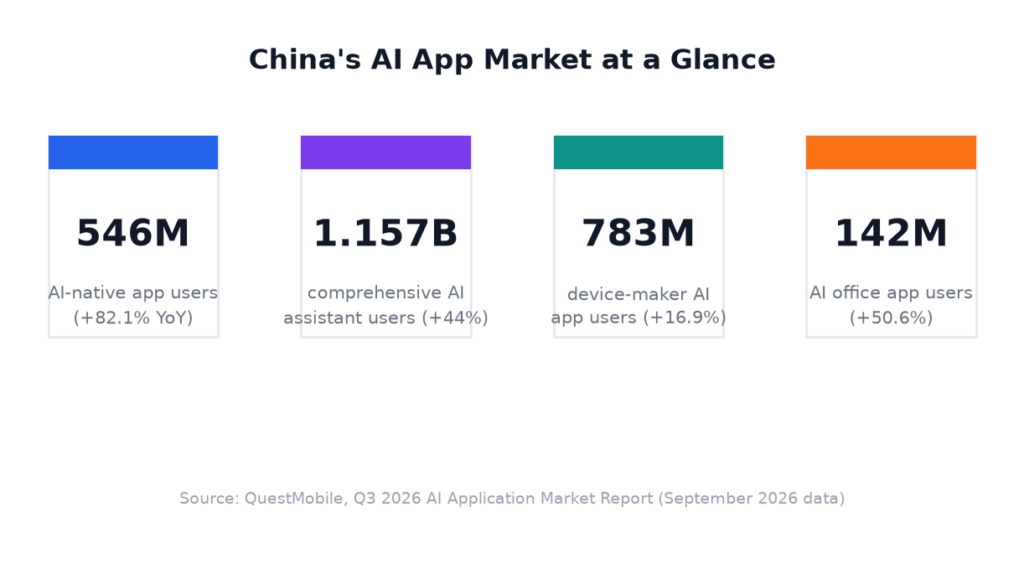
China’s market for standalone AI apps reached 546 million monthly active users in September 2026, up 82.1% year over year, according to QuestMobile’s Q3 2026 report on the AI application market. That’s just the “AI-native” apps — the downloadable assistants like the four we’re about to map. Step back and the picture widens: device-makers’ built-in AI reached 783 million users, and the broader category of comprehensive AI assistants topped 1.157 billion. AI office apps added another 142 million, up 50.6% year over year.
The scale is the point. AI has stopped being a novelty in China and become the default way hundreds of millions of people search, write, and get work done. For a marketer, that means the platforms below are no longer optional side channels. They’re where attention is actively migrating.
And here’s the part worth sitting with: Chinese search apps are shrinking — usage frequency down 21.7% and time spent down 17.2% year over year. The traffic isn’t evaporating. It’s moving to these AI-native apps, which have quietly become the new search box. That single shift is why this guide matters.
The four platforms at a glance
Before we talk personality, here’s the raw sizing from QuestMobile’s September 2026 data:
- Doubao (ByteDance): 419 million MAU, up 143.6% year over year
- Qwen (Alibaba): 158 million MAU, up 5,076% year over year — explosive growth off a near-zero base a year earlier
- DeepSeek: 123 million MAU
- Kimi (Moonshot AI): not in the top ten by monthly actives
-
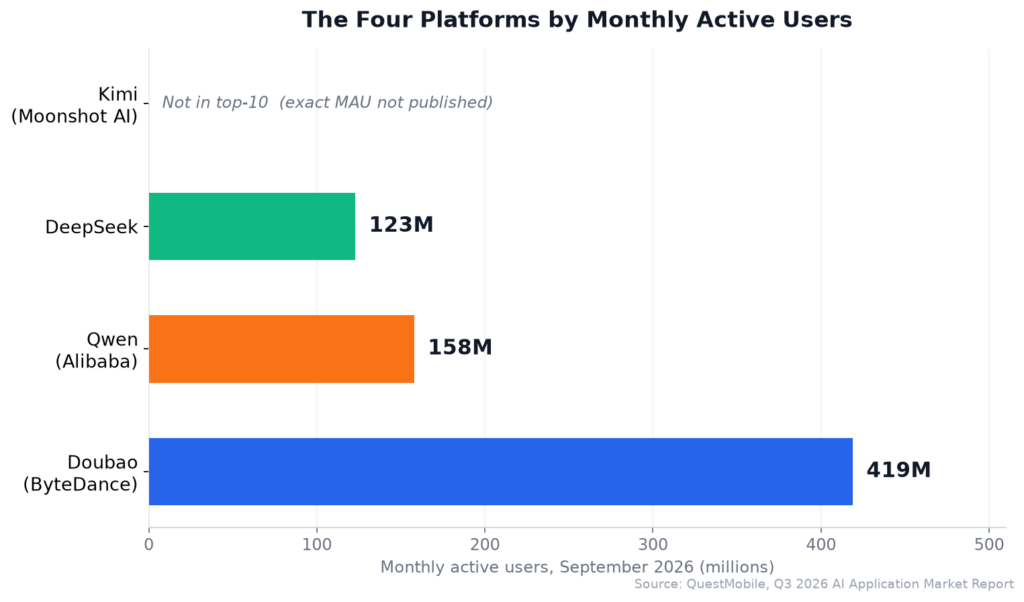
The Four Platforms by Monthly Active Users That last line is the first thing to pause on, because it’s the single most useful insight in this guide. Kimi is, internationally, one of the most talked-about Chinese AI products — its creator Moonshot AI was reportedly valued near $50 billion. And yet, by raw monthly active users inside China, it doesn’t crack the top ten. Fame and scale are pointing in opposite directions, and understanding why tells you exactly when to reach for it.
Doubao: the ecosystem-native assistant
Doubao is the most-used AI app in China by a wide margin — 419 million monthly actives and 181 million daily actives as of late September 2026. It’s more than 2.6 times the size of its nearest rival.
Doubao suits you when you live inside ByteDance’s ecosystem. It’s built into Douyin (the Chinese TikTok), Feishu (ByteDance’s workplace tool, known abroad as Lark), and a family of creator products. If your marketing runs on short video, e-commerce, or livestream commerce, Doubao is the assistant that already speaks your platform’s native language.
What it’s for: fast, high-volume production. Caption writing, script drafts, product descriptions, quick research — Doubao is tuned to get you from prompt to usable output with as little friction as possible. QuestMobile describes its citation approach as a “subtraction” play: fewer sources, tighter answers, faster turnaround. That’s a deliberate design choice favoring speed over depth.
The engagement data backs this up. Doubao users open it 72 times a month on average and spend 132.5 minutes in it. It’s the frequency leader — a utility you reach for repeatedly, not a deep-work tool you settle into.
It suits you most when your bottleneck is volume and you need a tool that already lives where your audience does.
Kimi: the long-context deep reader
Kimi is the outlier, and it’s the key to this whole guide.
Moonshot AI, founded in Beijing in 2023 by former Google Brain researcher Yang Zhilin, built its name on one thing: extremely long context. While most assistants struggled past a few thousand tokens, Kimi was reading entire documents, reports, and book-length material. Its K3 model, released in July 2026, carries 2.8 trillion total parameters, activates roughly 104 billion per token, and handles a one-million-token context window. Moonshot’s K2 line had already gone open-weight under a Modified MIT license; K3 follows with public weights under a custom license aimed at keeping commercial API resellers in check.
That capability made Kimi internationally famous — the Chinese AI name Western observers recognize first. Bloomberg reported Moonshot’s final private round near a $50 billion valuation and an annualized revenue run-rate of roughly $1 billion, a stunning climb from a $4.3 billion valuation less than a year earlier. Alibaba holds around 36% as a financial investor, alongside Tencent and others, and the company has confidentially filed for a Hong Kong listing.
And yet, inside China, Kimi sits outside the top ten AI apps by monthly users. Its reputation vastly outruns its reach.
What it’s for: deep, source-heavy work. If you need to digest a 200-page industry report, compare dozens of competitor pages, or produce research with careful attribution, Kimi is built for exactly that. QuestMobile classifies Kimi’s citation style as “deep coverage” — the direct opposite of Doubao’s subtraction. It cites broadly and thoroughly, which is precisely what you want when the writing has to hold up under scrutiny.
It suits you when depth matters more than speed — when you’d rather read one well-sourced answer than three fast ones.
DeepSeek: the open reasoning engine
DeepSeek is the reasoning specialist, and — critically for many marketers and their engineering teams — the open-source one.
It shot to global attention in early 2025 when its reasoning model rattled Western markets by matching frontier performance at a fraction of the cost, and it has held to an open-weight approach ever since. That openness matters in concrete ways: you can self-host it, fine-tune it, and tap a large developer community building around it. For a marketer, that usually shows up indirectly — your data or engineering team may already be running DeepSeek somewhere in the stack.
What it’s for: hard thinking. DeepSeek’s edge is step-by-step reasoning on complex problems — strategy breakdowns, data interpretation, logic-heavy analysis. The usage pattern tells the story: DeepSeek users spend 136.7 minutes a month in it, the highest time commitment of the major assistants, even though they open it less often (65.9 times) than Doubao. Fewer sessions, longer ones — the signature of a deep-work tool.
QuestMobile groups DeepSeek’s citation approach with Tencent’s Yuanbao under “steady iteration” — meaning it refines how it handles sources rather than making dramatic shifts.
It suits you when the task is “think this through with me,” not “generate this fast.”
Qwen: the office-closed loop
Qwen (also sold as Tongyi Qianwen) is Alibaba’s model family — and it’s the growth story of 2026, up a staggering 5,076% year over year to 158 million monthly actives, with 29 million daily actives.
The engine behind that surge is a closed loop built around DingTalk, Alibaba’s workplace platform. Qwen isn’t just a chat window; it’s woven into where office work actually happens — meetings, documents, approvals, collaboration. QuestMobile frames it as the office-native play: a meeting discussion becomes a tracked action item, documents self-archive, and business tasks flow from conversation to completion.
What it’s for: operational, workflow-embedded assistance. If your marketing team runs on DingTalk, or your business touches Alibaba’s commerce ecosystem, Qwen is the assistant that meets you inside the tools you already use rather than asking you to come to it.
Like Doubao, Qwen’s citation logic is a “subtraction” play — efficiency first, fewer sources, faster answers.
It suits you when the goal is to close the loop between a conversation and an actual deliverable inside your work system.
How marketers actually use each
Here’s the practical translation, task by task.
- High-volume short content: Doubao. Captions, product blurbs, ad copy at scale.
- Long-form research and competitor deep dives: Kimi. The context window is the differentiator.
- Strategy, logic, and data reasoning: DeepSeek. When the problem is hard and the answer isn’t obvious.
- Workflow-embedded production: Qwen. When output needs to land directly in your team’s tools.
The mistake most people make is using one tool for everything, then concluding that “AI isn’t that good.” Usually what’s actually happened is that they asked a fast tool to think deeply, or a deep tool to produce volume. Match the tool to the task and most of the frustration disappears.
Strengths and hard limits
Every one of these has a ceiling, and knowing the ceiling matters as much as knowing the strength.
Doubao’s strength is reach and speed. Its limit is depth — the subtraction-style citations mean fewer sources and lighter verification by default, so it’s weaker when your content has to be defensible.
Kimi’s strength is context and attribution. Its limit is scale and friction — the K3 tier sits behind a paid membership, and demand has at times outrun capacity.
DeepSeek’s strength is reasoning and openness. Its limit is polish — it’s a thinking engine first and a slick content generator second.
Qwen’s strength is workflow integration. Its limit is that much of the magic lives inside Alibaba’s ecosystem. Step outside DingTalk and a meaningful chunk of the advantage fades.
Open vs closed: why it matters
DeepSeek and Qwen both maintain significant open-source or open-weight offerings. Kimi occupies a middle ground — K2 and K3 publish open weights, but under licenses that constrain large commercial API resellers. Doubao leans most closed, tuned tightly to ByteDance’s ecosystem.
Why should a marketer care about what looks like a developer’s question? Because openness changes three things you’ll eventually feel:
- Control — you can host and tune open models yourself, keeping data in-house.
- Cost — self-hosted open models can run far cheaper at scale than per-token API fees.
- Ecosystem — open models get embedded in third-party tools you already use, meaning your content may end up shaped by them whether or not you adopt them directly.
If any of those three touch your work — data privacy, budget, or tooling — the open-versus-closed question stops being academic.
Picking by task, not by hype
The framework is simple: name the job first, then pick the tool.
- “I need 50 product descriptions by Thursday” → Doubao.
- “I need to understand a 150-page industry report” → Kimi.
- “I need to figure out why our funnel broke” → DeepSeek.
- “I need my team’s meeting to become a real deliverable” → Qwen.
Notice what none of these starts with: “which AI is best?” They all start with a verb. That’s the whole trick, and once you internalize it, the tool selection takes about thirty seconds.
A five-minute selection matrix
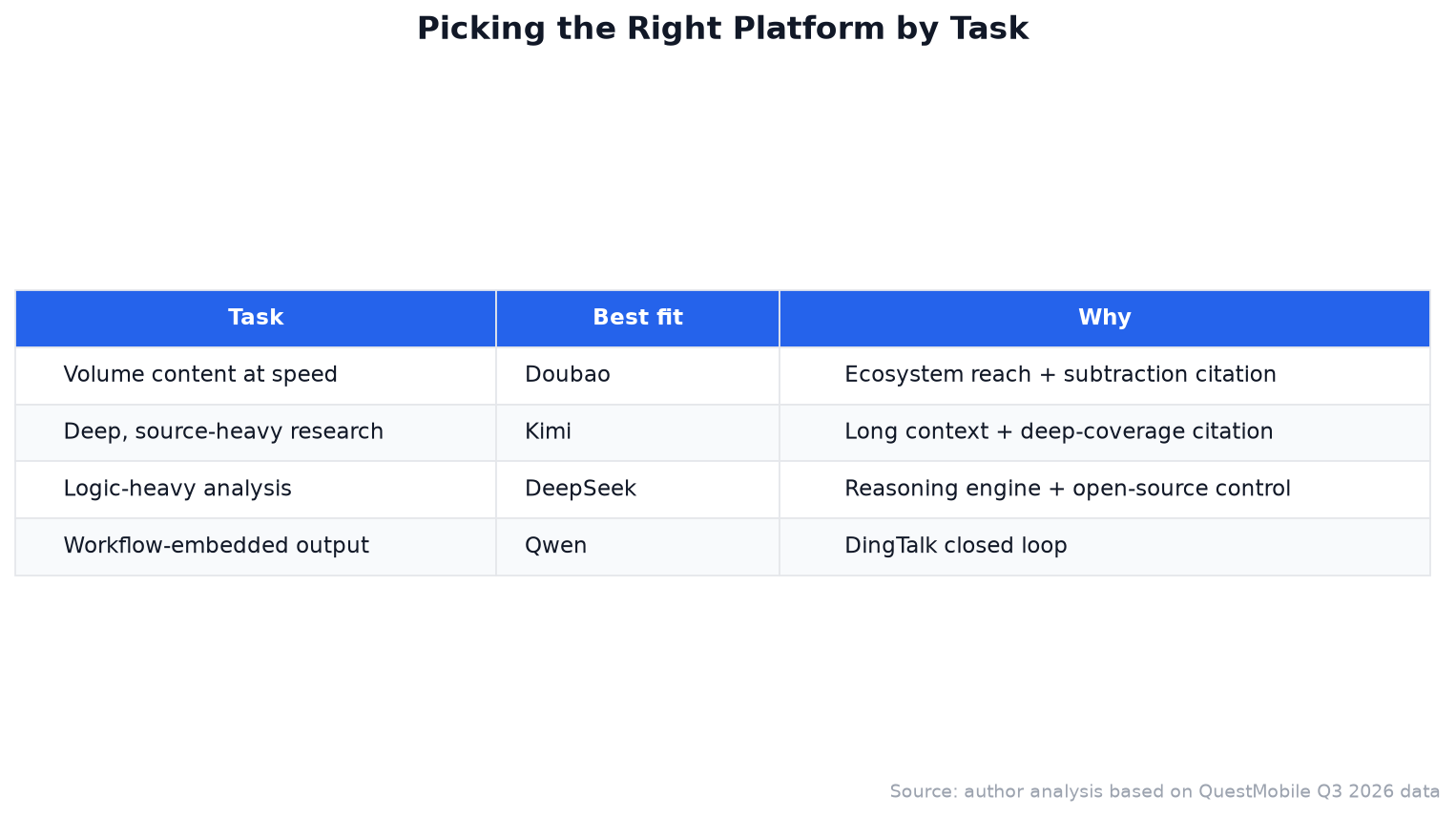
Task Best fit Why Volume content at speed Doubao Ecosystem reach plus subtraction citation for speed Deep, source-heavy research Kimi Long context plus deep-coverage citation Logic-heavy analysis DeepSeek Reasoning engine plus open-source control Workflow-embedded output Qwen DingTalk closed loop 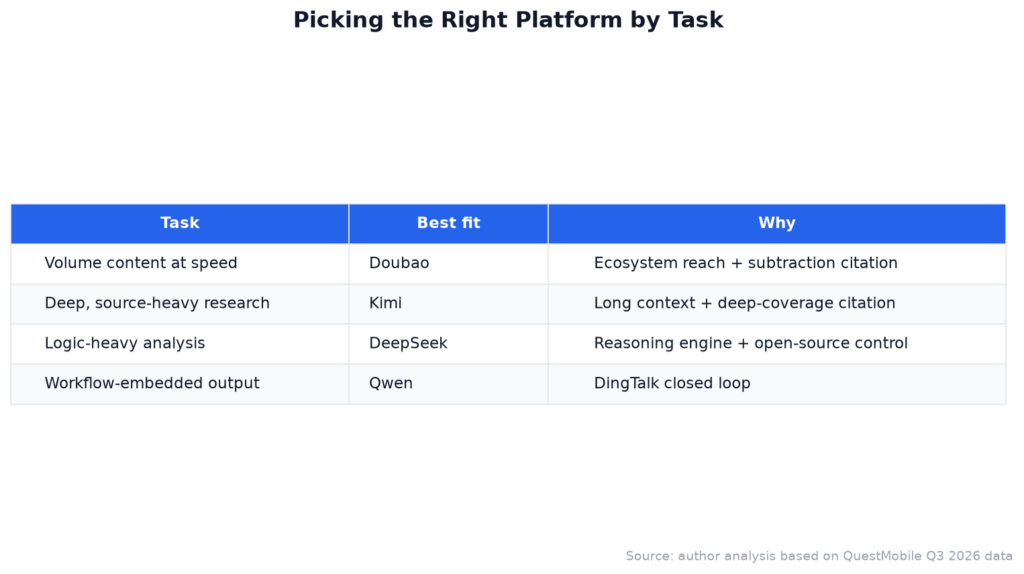
Picking the Right Platform by Task Use this as a starting point, not a rulebook. The point isn’t memorizing the rows — it’s training yourself to map a task to the right personality before you open an app.
-
What to avoid
A few traps worth naming explicitly.
Don’t pick by MAU alone. The biggest app is best at being big, not necessarily at your specific job. Kimi is the proof: fame and scale can point in different directions.
Don’t ignore citation style. If your content has to be defensible — cited, verified, attribution-clean — a subtraction-style platform’s default might quietly work against you. Match the tool’s citation personality to your trust requirements, not just its output speed.
Don’t assume one tool. The marketers who get the most out of China’s AI stack are the ones who run two or three of these, each in its own lane.
The quiet trend behind all four
Here’s the macro shift that matters more than any single platform.
As we noted up front, Chinese search apps are in decline while AI-native apps surge. The traffic is moving to assistants that answer questions directly — which means you’re no longer optimizing only for where people type keywords into a search bar. You’re optimizing for which AI platform reads your content, understands it, and chooses to cite it when it answers a user.
That’s a different game, and the four citation styles tell you the rules. Doubao and Qwen run “subtraction” — fewer sources, faster answers. Yuanbao and DeepSeek practice “steady iteration.” Kimi goes “deep coverage.” Wenxin (Baidu’s Ernie) balances the field.
-
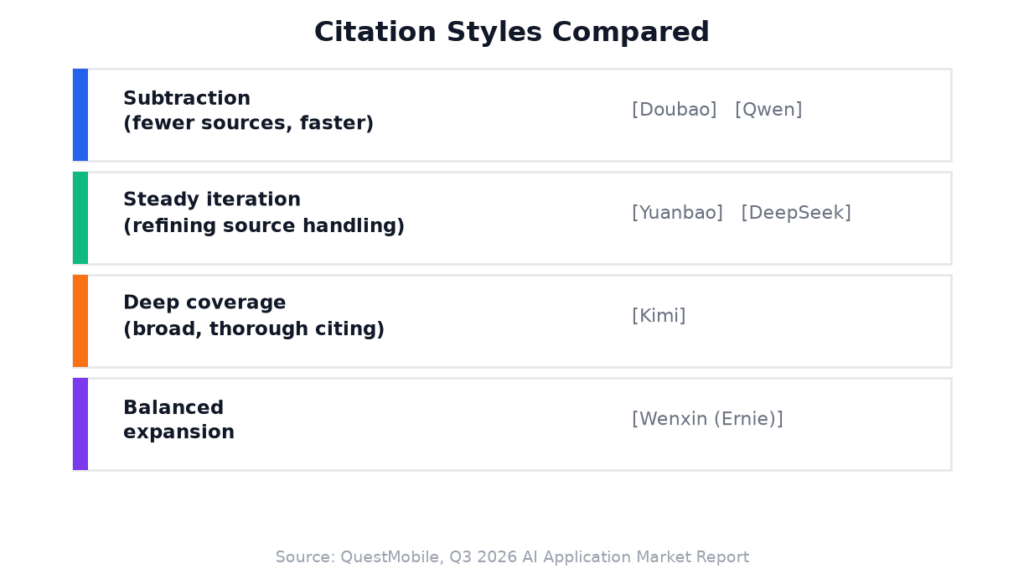
Citation Styles Compared Each platform’s citation logic becomes your new ranking factor. The platforms aren’t just tools for producing your marketing. They’re increasingly the channels through which your audience discovers anything at all.
For a marketer, the practical takeaway is to think about these assistants the way you once thought about search engines: as distribution surfaces with their own rules, preferences, and citation habits, not as interchangeable text generators.
Summary
China’s four headline AI platforms are not interchangeable. Doubao wins on reach and speed inside ByteDance’s ecosystem. Kimi wins on long-context depth — despite a reputation that far outruns its user base. DeepSeek wins on open reasoning. Qwen wins on the DingTalk office loop and is the fastest-growing of the group. Ground every choice in the task, not the hype — and keep an eye on citation logic, because it’s quietly becoming your next search-ranking surface.
FAQ
Which Chinese AI platform is best for marketing?
It depends entirely on the task. For high-volume content, Doubao; for deep, source-heavy research, Kimi; for logic-heavy analysis, DeepSeek; for workflow-embedded output, Qwen. “Best” without a verb attached is the wrong question.Is DeepSeek open source?
DeepSeek publishes open-weight models and supports a large open-source community, enabling self-hosting and fine-tuning. That’s a fundamentally different proposition from closed, ecosystem-tuned products like Doubao.Can I use these platforms outside China?
Availability varies. DeepSeek and Qwen have international offerings and open models usable globally; Doubao and Kimi are more tightly bound to Chinese platforms such as Douyin and DingTalk, and their full feature sets are less useful outside that context. Confirm current availability before committing.What’s the difference between Doubao and Qwen?
Both favor fast, subtraction-style citations, but they anchor to different ecosystems. Doubao lives in ByteDance’s world (Douyin, Feishu/Lark); Qwen lives in Alibaba’s (DingTalk, commerce). Choose by which ecosystem your work actually runs on.How do I pick the right platform?
Start with a verb. “Generate volume” → Doubao. “Understand a long document” → Kimi. “Reason through a problem” → DeepSeek. “Close a workflow loop” → Qwen. The verb, not the brand, should drive the choice.