From Traffic to Meaning: China’s 2026 Marketing Reset, Explained
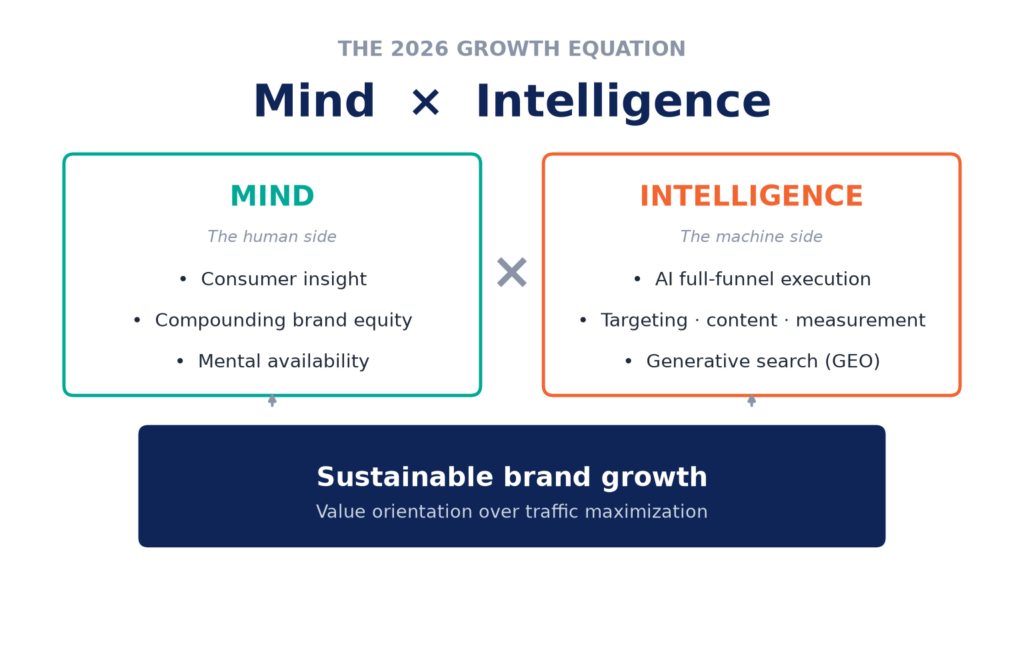
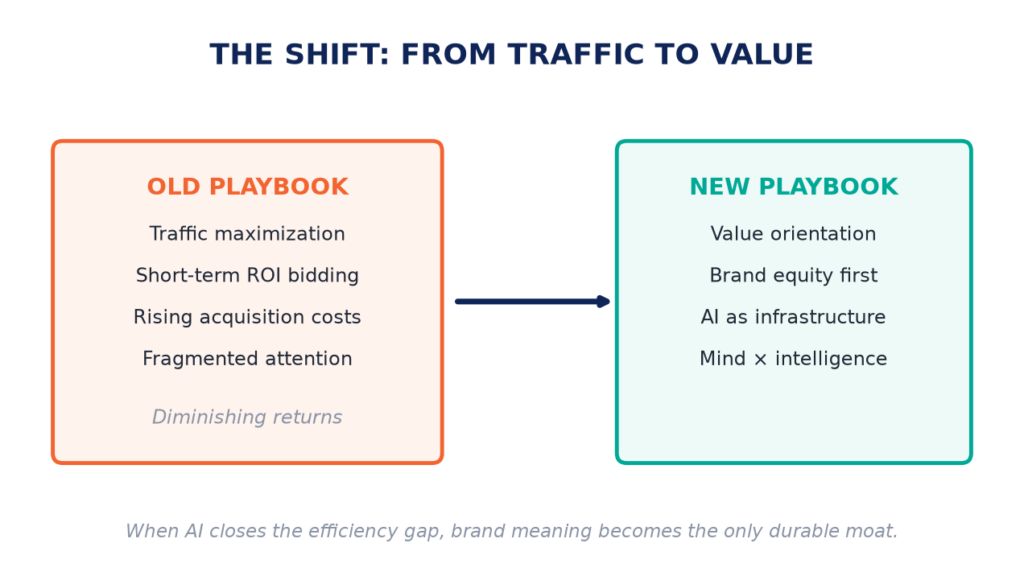
For the better part of a decade, the dominant growth formula in Chinese marketing was brutally simple: buy traffic, convert it, optimize the ROI in real time. That formula is now being retired. Heading into 2026, a different equation is taking its place — one that pairs human-centered brand building with AI-run, full-funnel execution. The shorthand being used is “mind × intelligence,” and it marks a decisive turn away from the traffic-at-any-cost era.
The Thesis, in Plain Terms
The new logic has two halves.
“Mind” is the human side — genuine consumer insight and the kind of brand equity that compounds over years rather than days. It is the recognition that a brand is not a landing page but a set of associations living in people’s heads. You cannot bid for that at auction; you can only build it. In marketing language, this is mental availability: the probability that your brand comes to mind the moment a category is mentioned.
“Intelligence” is the machine side — AI applied across the entire funnel, from targeting and creative production to content optimization and measurement. It assumes that AI will eventually commoditize execution. When any competitor can spin up campaigns, creatives, and reports at near-zero marginal cost, raw efficiency stops being a differentiator.
Put the two together and you reach the framework’s real claim: growth no longer comes from maximizing traffic, but from maximizing value per interaction. That is why “value orientation” has quietly replaced “traffic maximization” as the organizing principle of Chinese marketing.
Why Pure Performance Hit a Ceiling
For years, Chinese brands — especially direct-to-consumer and e-commerce players — optimized almost exclusively for performance. The math worked while traffic was cheap and acquisition costs stayed low. The inputs have changed. Attention is fragmenting across short-video, livestream, and social feeds. Acquisition costs keep climbing. And the performance metrics that once felt precise have started to look like vanity numbers when they fail to predict whether anyone actually remembers or trusts your brand.
The emerging consensus is that performance marketing, run through an AI-optimized machine, has become table stakes rather than an edge. If everyone holds the same tools and the same algorithms, the only durable variable left is the brand itself — the “mind” half of the equation. Chinese marketers are, in effect, arriving at what the math has been hinting at for a while: when the efficiency gap closes, the meaning gap is the only one that still pays.
Where AI Actually Changes the Game
The most concrete expression of the “intelligence” half is something Western teams still treat as experimental: generative engine optimization, or GEO.
GEO is the practice of making a brand visible not in a ranked list of blue links, but inside AI-generated answers — the responses produced by ChatGPT, Perplexity, Google’s AI Overviews, and their Chinese counterparts. The surface of search is shifting from “ten links you click” to “one answer you read.” Being cited in that answer is becoming the new page one.
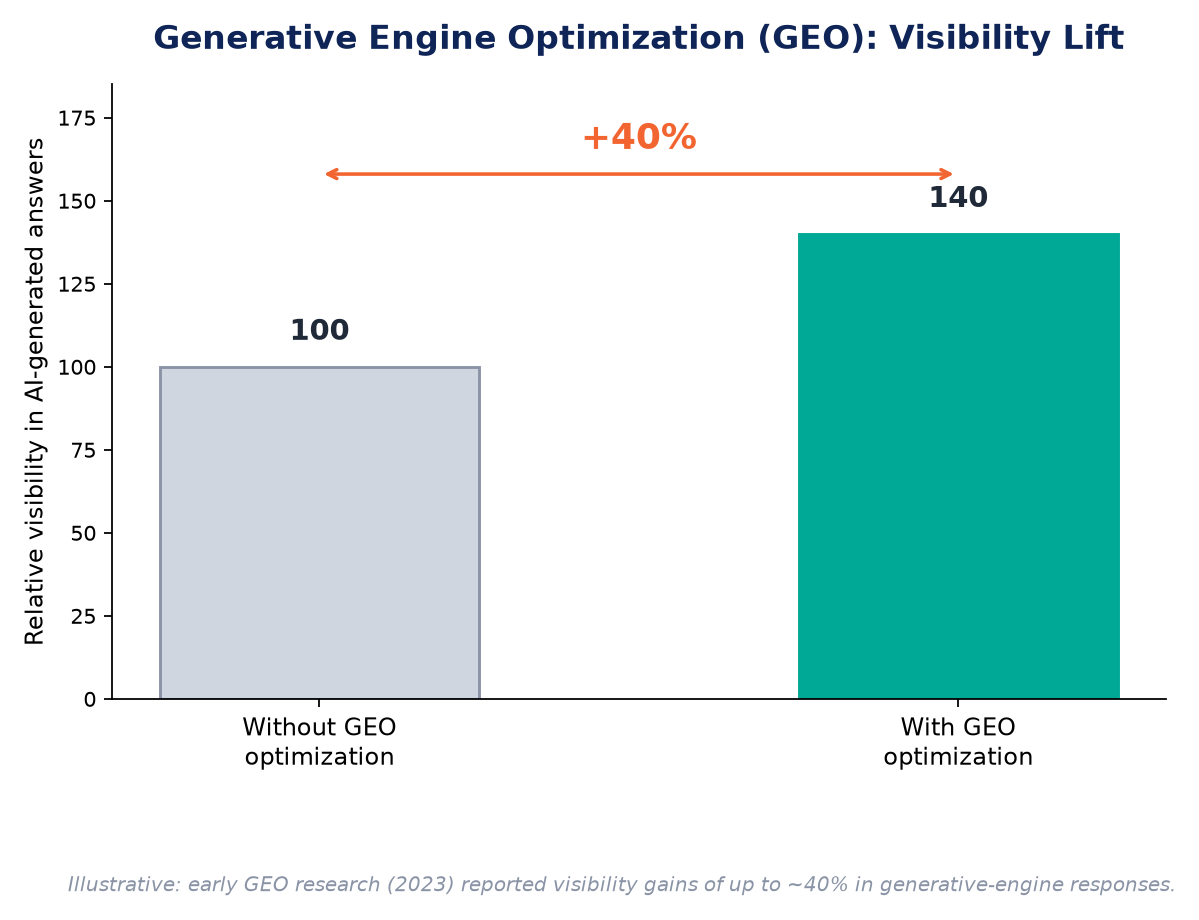
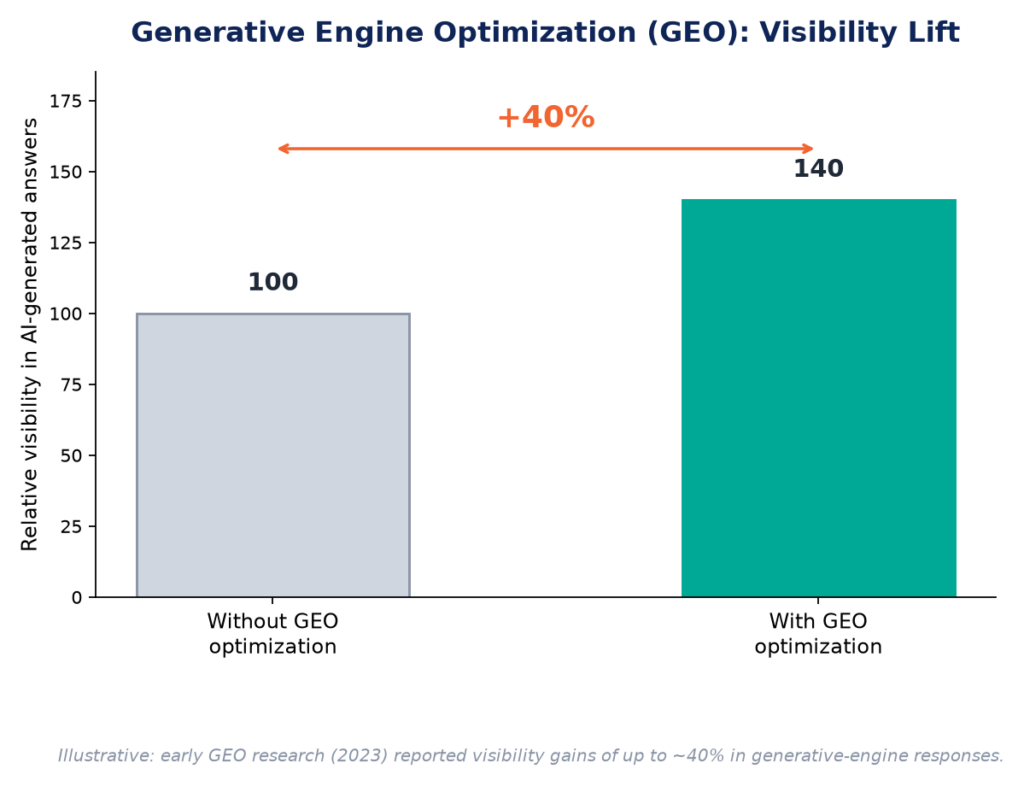
The stakes are not theoretical. Google’s AI Overviews alone crossed one billion monthly users in 2025, and the answer engines behind it are re-routing a growing share of search intent. Early academic work on GEO — research that kicked off in 2023 and has since grown into a recognized discipline — found that well-structured, quotable content could lift a site’s appearance in AI-generated responses substantially, with visibility gains reaching as high as 40% in some cases. In a market that measures every basis point of efficiency, that is a number people notice.
What distinguishes China’s approach is not the invention of the tactic but its industrialization. Chinese teams are folding GEO, AI-driven content operations, and data-fed creator ecosystems into one full-funnel system, rather than bolting them on as isolated experiments. That is the “intelligence” multiplying the “mind.”
The One Principle Worth Stealing
If you are a Western marketer watching from the outside, there is a single transferable idea buried in this framework — and it has nothing to do with adopting any specific tool.
Treat AI as infrastructure, not as strategy.
AI will flatten the cost of execution everywhere. The brands that win the next cycle will be the ones that stop competing on execution — where the machines have already caught up — and start competing on meaning: a sharp, honest insight into what customers actually want, and the patience to build an association in their minds that no algorithm can price.
China is codifying this into a playbook while much of the West still runs it as a series of pilots. The gap is not a technology gap. It is a philosophy gap — and it is closing faster than most teams realize.