China’s Marketing Agents Cross From Tools to Systems
China’s Marketing Agents Shift From Single Tools to Multi-Agent Systems
The shift, in one sentence
A year ago, the question Chinese marketers asked about AI was whether it could write a headline. The question at the 2026 industry conferences is different: can a team of agents run a real marketing workflow end to end, from insight to execution to review, without a human stitching the pieces together by hand?
That shift, from single-purpose writing tools to coordinated multi-agent systems, is the throughline of analyst commentary and conference agendas across October 2026.
What actually changed in 2026
The numbers behind the shift are no longer marginal. Tencent executives, speaking at the company’s Global Digital Ecosystem Conference in Shenzhen, said China’s daily token call volume climbed from roughly 100 billion at the start of 2024 to more than 500 trillion by July 2026, a 5,000-fold rise in about two years. The same remarks placed AI agents squarely inside professional functions: market research, business analysis, marketing planning, and campaign execution.
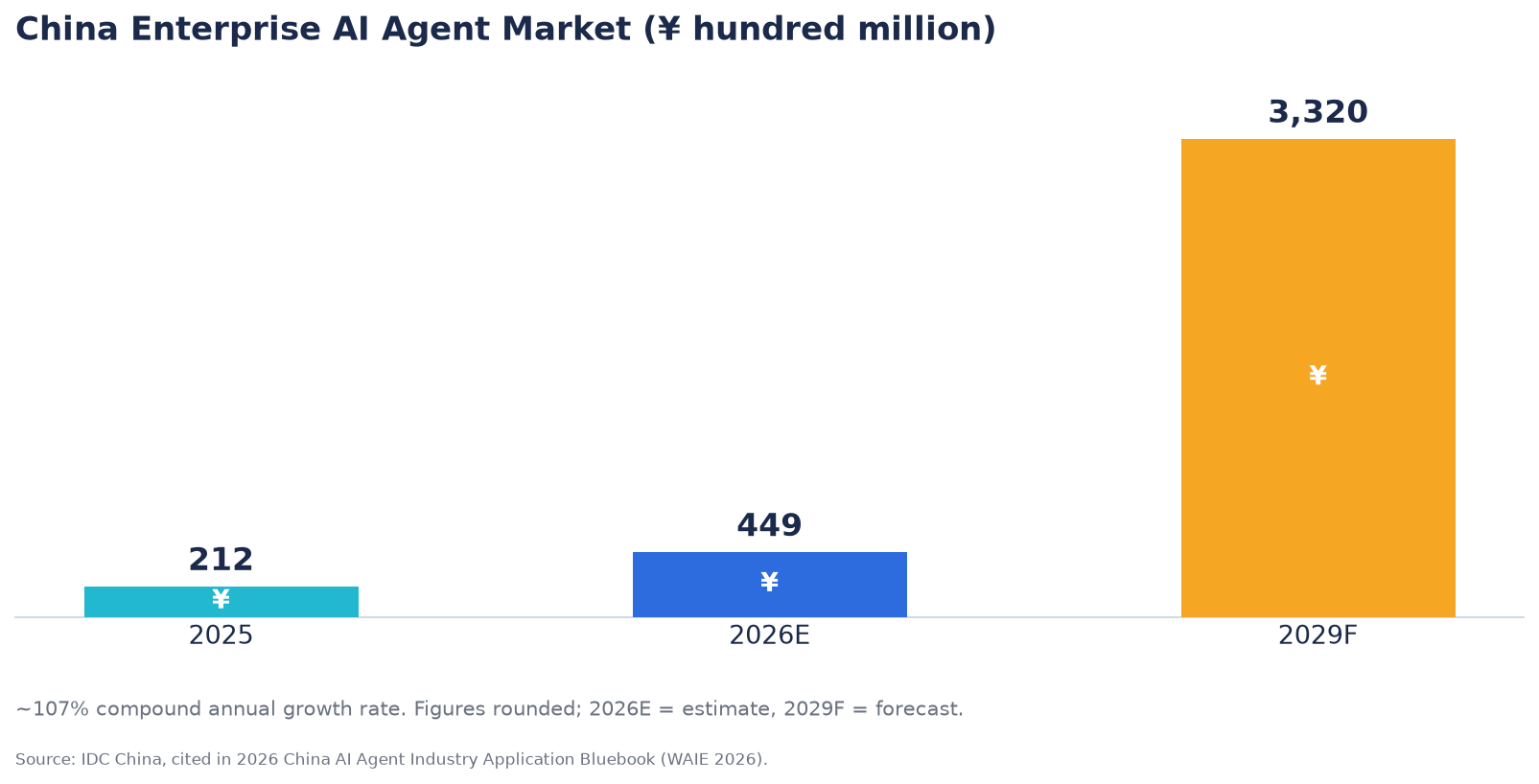
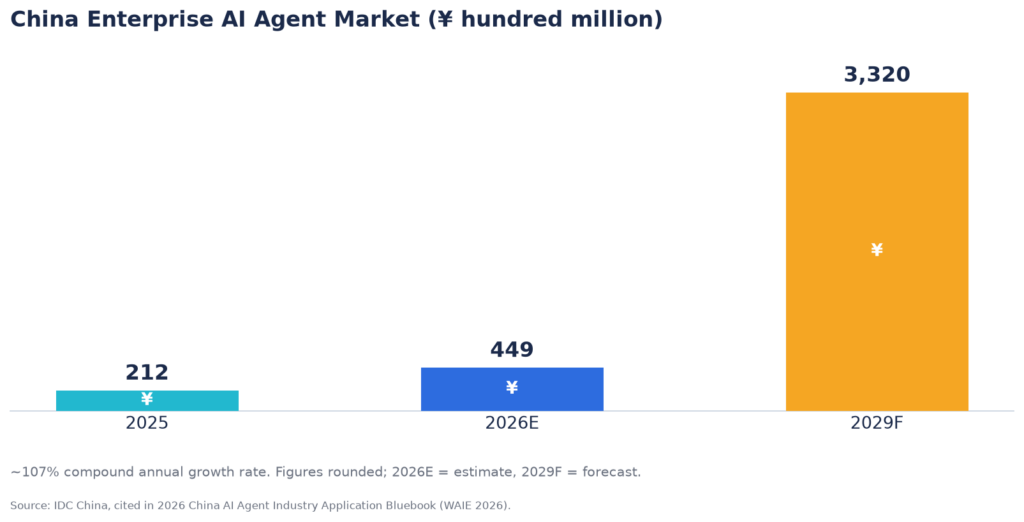
The market data runs in the same direction. IDC sized China’s enterprise AI agent market at RMB 21.2 billion in 2025, with a projected jump to RMB 44.9 billion in 2026 and a compound annual growth rate near 107%. IDC also expects the number of active agents in China to more than double, from nearly two million in 2025 to roughly five million in 2026. One caveat matters here: statistical definitions vary widely across research houses, and some estimates for the same 2026 market come in far lower. The direction of travel is unambiguous; the exact denominator is not.
That usage is no longer experimental. It has become operational.
The three workflow stages being automated
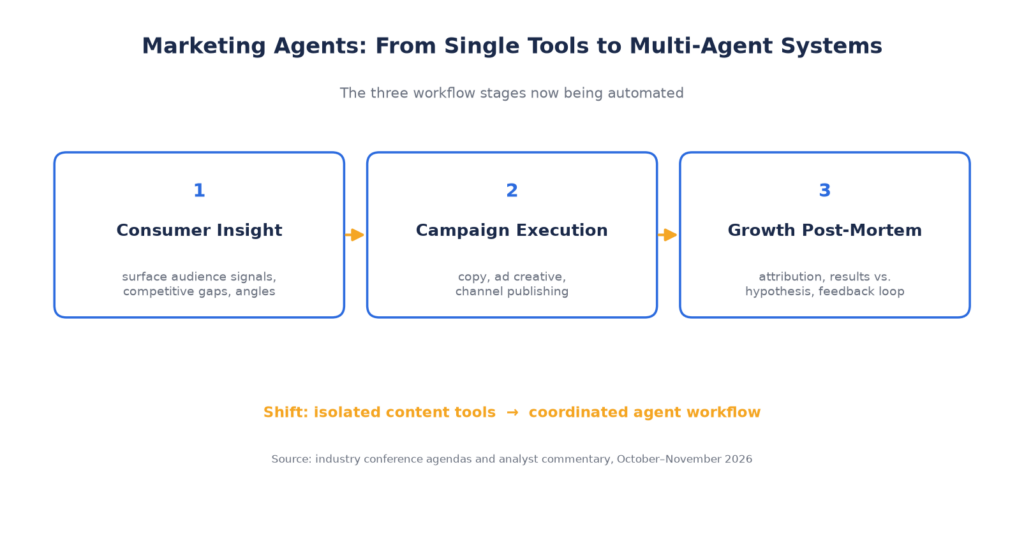
The clearest signal from this year’s conferences is that marketing agents are no longer being pitched as writing assistants. They are being organized around the stages of a campaign.
Stage one: consumer insight
The first stage to be handed to agents is research. Teams use agents to surface audience signals, competitive gaps, and content angles before a single piece of copy is written. The value claim here is speed and breadth, scanning far more source material than a human analyst could cover in the same window.
Stage two: campaign execution
Execution is where the earlier single-tool era concentrated. Content generation, ad copy, and channel publishing have been the easiest wins, and they remain the most adopted. What is new is the ambition to connect them: agents that move from a brief to a produced, placed, and versioned asset without manual handoffs.
Stage three: growth post-mortem
The third stage is what separates a system from a tool. After a campaign runs, agents are tasked with attributing results, comparing performance against the original hypothesis, and feeding findings back into the next cycle. This closes the loop that a writing tool, by definition, cannot close.
The open risk: breadth without depth
Here is the tension the conferences surfaced but did not resolve. The infrastructure to make agents useful inside a real business is still unfinished.
The gap is stark. PwC’s survey of US executives found 79% of companies adopting AI agents and 88% planning to increase AI budgets, with two-thirds of adopters reporting measurable value. Yet Capgemini’s research puts the harder number: only 2% of organizations have deployed agents at scale. Adoption is broad; depth is rare.
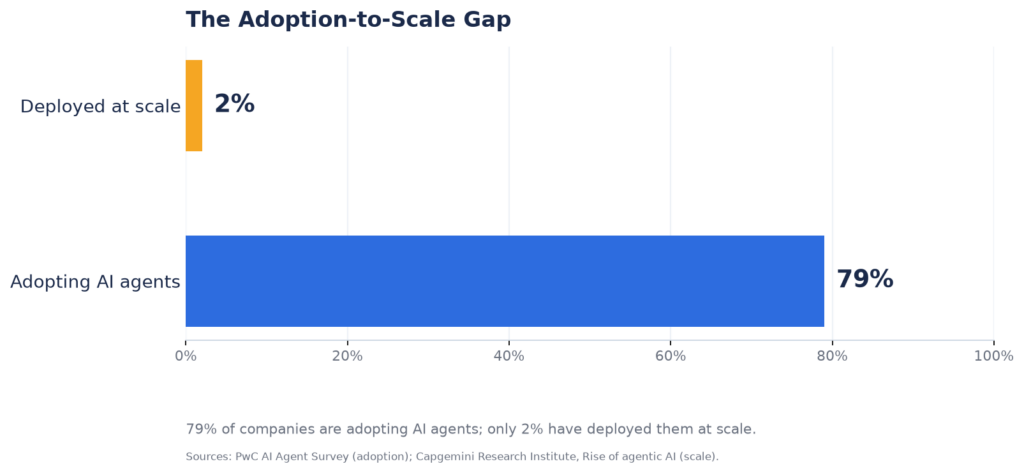
The constraint is not model quality. It is the surrounding stack: persistent memory, sandboxed execution, tool interoperability, and governance. Gartner’s data runs in the same direction, with multi-agent system inquiries jumping 1,445% between early 2024 and mid-2025. That spike measures intent, not deployment. The market has decided where it wants to go; it has not proven it can get there.
The trust problem underneath
Capgemini’s research surfaces a quieter risk. Trust in fully autonomous AI agents fell from 43% to 27% in a single year, driven by ethical concerns, a lack of transparency, and limited understanding of what agentic systems actually do. This is not a Luddite reaction. It is a rational response to systems whose decisions are hard to explain and whose failures are hard to audit.
The trust decline and the scale gap are the same problem viewed from two angles. Enterprises will not hand a workflow to a system they cannot govern, and they cannot govern what they do not understand.
What deep specialization would mean
The recurring analyst warning is that most marketing-agent deployments stall at generic assistance. A system that drafts social copy for everyone is easy to adopt and easy to abandon, because it produces output, not outcome.
Deep specialization is the harder target: agents tuned to a specific vertical, a specific channel, or a specific stage of the funnel, with access to first-party data and clear handoff contracts between them. PwC’s own guidance lands on this point: few businesses connect agents across workflows and functions, yet that connection is where the real value lies.
Why this matters beyond China
For a foreign audience, the takeaway is not about a single vendor or a single product. It is that the maturity question has moved. The interesting debate is no longer “can AI write copy”; that was settled. The open question is “can agents run inside real business systems,” and on that question, the honest answer across 2026 is: sometimes, and not yet at scale.
China is a useful leading indicator here because its adoption moved fast and its infrastructure gap is now visible. Markets that adopt quickly tend to expose the missing pieces quickly. The 2% scale figure is a global number, but the pattern of fast adoption followed by a hard plateau is easiest to read in a market that ran ahead.
Bottom line
Marketing agents in China crossed a line in 2026: they stopped being tools and started being systems. The proof is in conference agendas and executive remarks that now describe agents spanning insight, execution, and review, not just content. But the shift is uneven. Most deployments still produce assistance rather than accountability, and the gap between the 79% who are trying and the 2% who have scaled is the real story of the year.