China’s Merchants Got AI Agents for Singles’ Day. They Got the Ad Tab, Too.
Singles’ Day 2026 Sold Merchants on AI. Merchants Are Still Adding Up the Bill.
Every platform shipped an agent this year. The savings are real, and so is the suspicion that they get spent again on traffic.
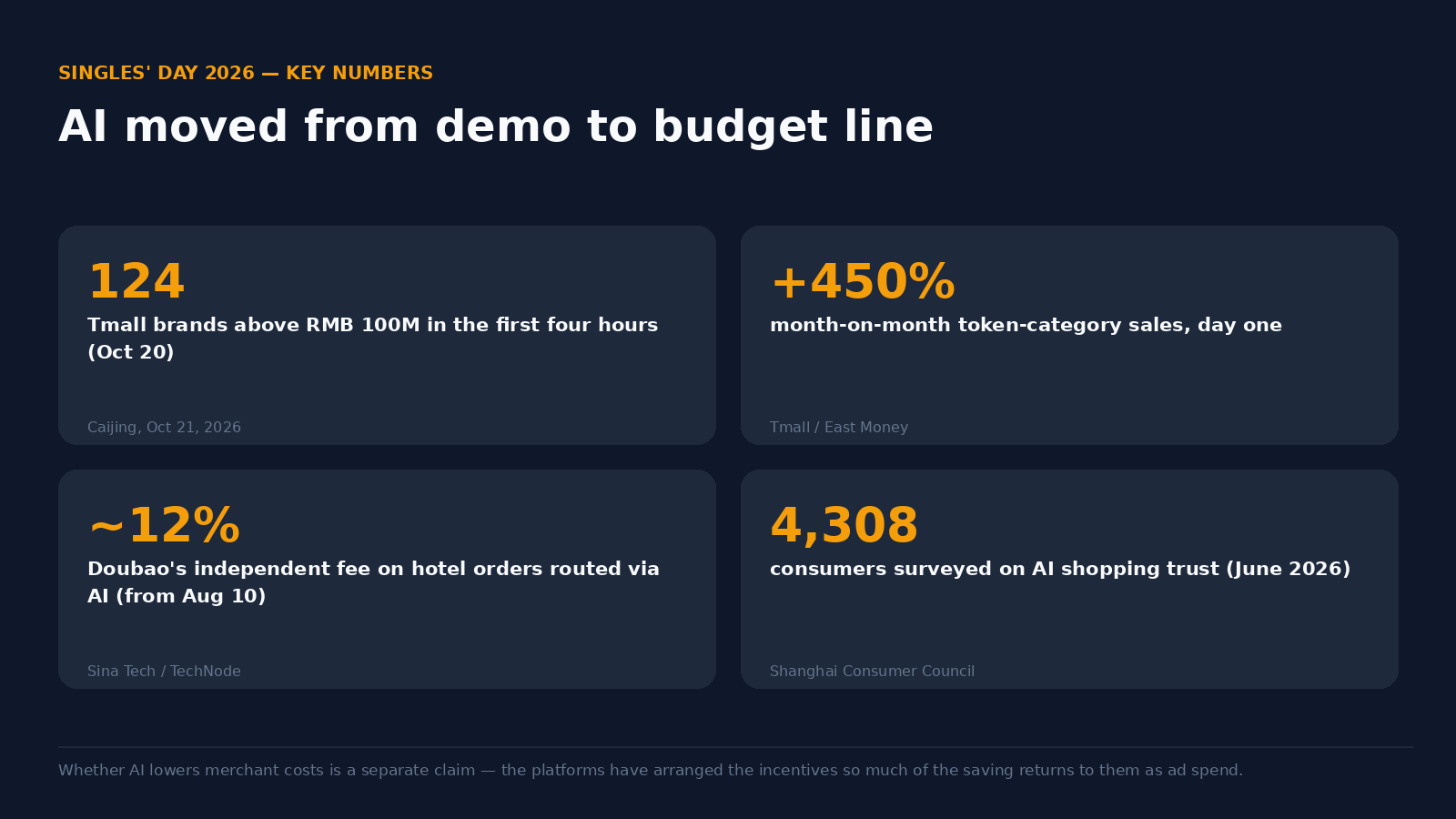
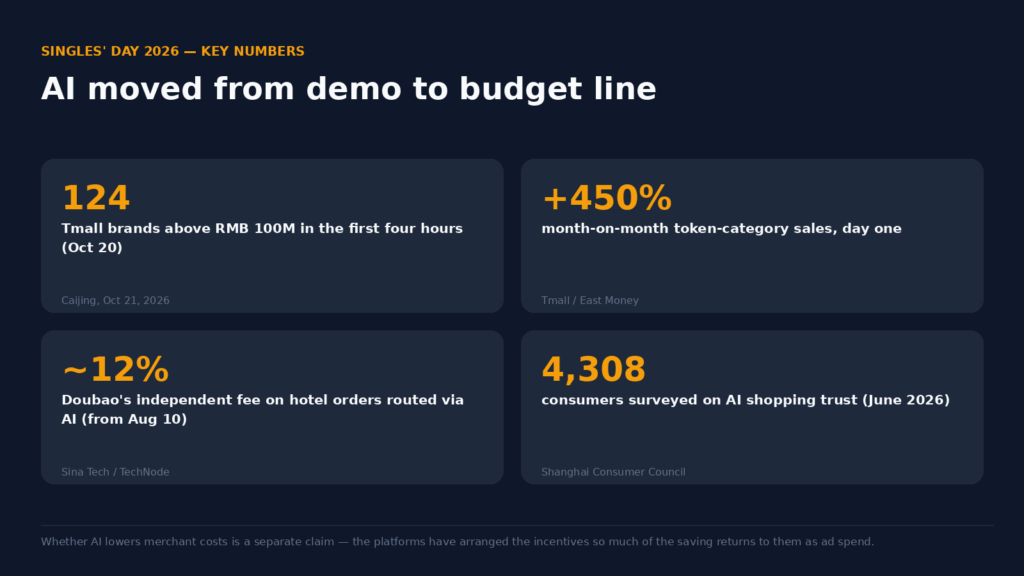
Tmall opened Singles’ Day earlier than ever in its 18th edition, starting pre-sale deposits on October 15 and flipping to full in-stock sales at 8pm on October 20. Four hours later, 124 brands had passed 100 million yuan in sales. That number is familiar. What is new is what the platforms put in merchants’ hands.
AI was everywhere this year — written into the rules, the storefronts and the fee schedules. Each of the big platforms shipped an agent of its own, and each pitched that agent as a way for merchants to spend less. The question hanging over the whole festival is whether it actually works that way.
The agents arrive
Alibaba’s Qwen app now closes a Taobao purchase inside the assistant itself, and its “shopping companion” mode reads a user’s screen while they browse Tmall and answers questions about what they’re looking at. The broader push is still forming: public reporting describes Alibaba planning to embed AI more deeply across Taobao and Tmall merchant operations into 2027, but the specific product features, testing windows and merchant uptake have no source we could verify. What is clear is the direction — the platforms want the assistant to sit between the shopper and the store.
JD leaned on AI in the parts of its operation it can measure: its logistics arm ran an upgraded “Super Brain 3.0” through the festival to forecast regional order volumes and route capacity in real time, reporting that AI-recommended delivery routes were adopted more than 90% of the time. Douyin built a Doubao operations panel into its merchant backend and made AI customer service free for the promo period, while ByteDance separately began pricing its AI recommendation channel.
The pitch is simple. Merchants without a designer can generate product images. Merchants with thousands of SKUs can batch marketing assets. Merchants with data scattered across backends can ask an agent to consolidate it.
The pitch, and the pushback
The platform argument is clean. The merchant argument is just as clean, and it starts with what the tools cost in attention. Sellers who already pay incumbents for analytics describe the new agents as a bundle of features they already own. Others have switched AI customer service off, because an assistant that answers confidently and wrongly creates work instead of removing it — and because reaching a human requires the customer to ask for one, sometimes after several wrong turns.
There is a structural problem underneath the complaints. Merchants want agents tuned to their own operating logic. Platforms want standardised products that work for everyone. Those goals produce different software, and the gap shows up as adoption that stalls once the trial ends.
Where the money actually goes
This is the part of the AI economics that gets under-reported. When content production gets cheaper, the savings do not stay with the merchant. If one store can produce ten sets of creative a day, so can its competitors. Attention does not expand to match. The price of being seen rises, and money saved on design moves into acquisition.
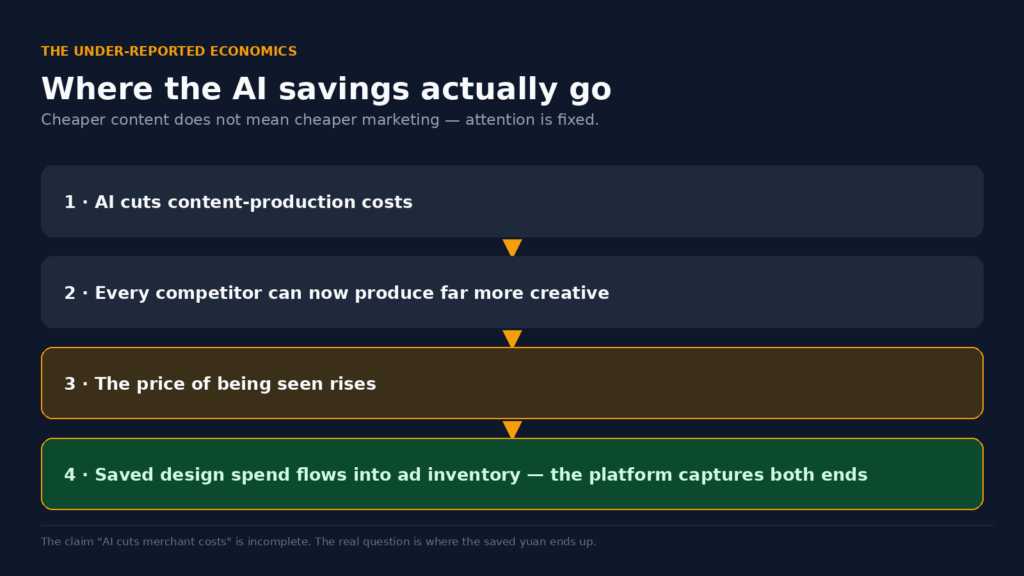
Platforms capture both sides of that loop. A merchant saves on content production inside the agent, then spends the difference on ad inventory inside the same company’s advertising business. Efficiency becomes a reason to stay inside the ecosystem rather than a reason to spend less.
ByteDance made the economics explicit this year. Since August 10, hotel orders completed through the Doubao entry — where a user asks the assistant for a recommendation and is routed to a merchant to book — carry an independent fee of about 12%, split between an 11.4% software service fee and a 0.6% payment fee. The AI recommendation is no longer a free traffic channel; it is a priced one. Alibaba did not go that far this season, but the logic is already installed.
None of that makes the tools useless. It makes the claim “AI cuts merchant costs” incomplete. The real question is where the saved yuan ends up.
Consumers adopted faster than they trust
Chinese shoppers have taken to AI buying tools well before they believe them. A Shanghai Consumer Council survey of 4,308 respondents released in June found that about 85% had tried AI-powered product selection features. Only about 16% said the recommendations accurately matched their needs.
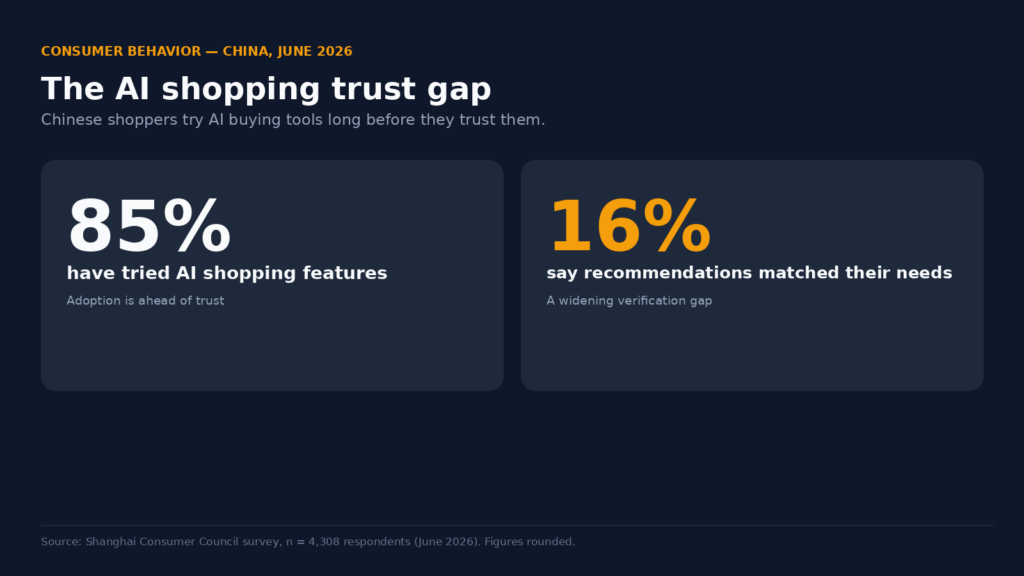
That gap — adoption way out ahead of satisfaction — is the whole problem in miniature. An assistant that answers a vague request with a confident, expensive recommendation is a sales tool, not a shopping tool, and users notice. The authors of that survey framed the consumer’s job plainly in an age of AI shopping assistants: caveat emptor, but now the buyer has to ask whose interests the assistant is really serving.
There is counter-evidence on the other side of the funnel. Adobe Analytics’ monitoring of US retail sites found that visitors arriving from AI links convert 60% better than other traffic and generate 53% more revenue per visit. That is a strong, verified argument for being present in AI answers. It says nothing about whether the answers are any good.
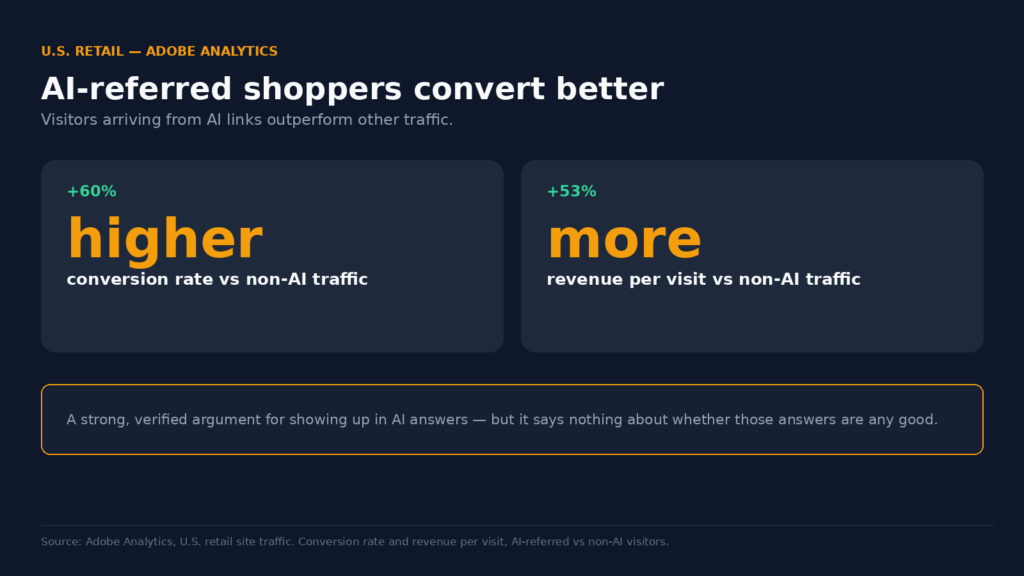
The two findings are not in contradiction. AI traffic is commercially valuable, and Chinese consumers are sceptical of it. Both can be true, because a shopper clicking a useful link and a shopper trusting a recommendation are different acts.
AI became merchandise
The strangest development of the season is that AI capability turned into a product category. Tmall and JD both began selling AI model tokens — the compute users buy to run assistants like Qwen, Zhipu and MiniMax — as monthly and annual subscriptions inside their own marketplaces, participating in the sitewide discount mechanics. Tmall reported token-category sales up 450% month-on-month on day one.
The percentage sits on a small base, and Tmall’s president has said the category will not receive dedicated subsidy for now. Read it as a channel experiment: people who need model access used to buy direct from vendors, and the platforms want that transaction inside their own order system.
Key numbers
- Tmall: 124 brands above 100 million yuan within four hours of the October 20 opening; pre-sales opened October 15
- Doubao hotel fee: about 12% combined (11.4% software service + 0.6% payment), applied since August 10
- Tmall token category: first-day sales +450% month on month
- Consumer survey, n = 4,308: about 85% tried AI shopping, about 16% found it accurate
- Adobe: AI-referred retail traffic converts 60% better and earns 53% more revenue per visit
Bottom line: AI moved from demo to budget line for merchants this Singles’ Day. Whether it lowers costs is a separate claim, and the platforms have arranged the incentives so much of the saving returns to them as ad spend. Merchants will run that arithmetic after the promo dies down — and the tools that survive will be the ones visible in a P&L instead of a keynote.