The Day an Actress Had to Prove She Wasn’t the One Selling Skincare
An AI Clone Sold Skincare Under a Real Actress’s Face Before Anyone Could Prove It Wasn’t Her
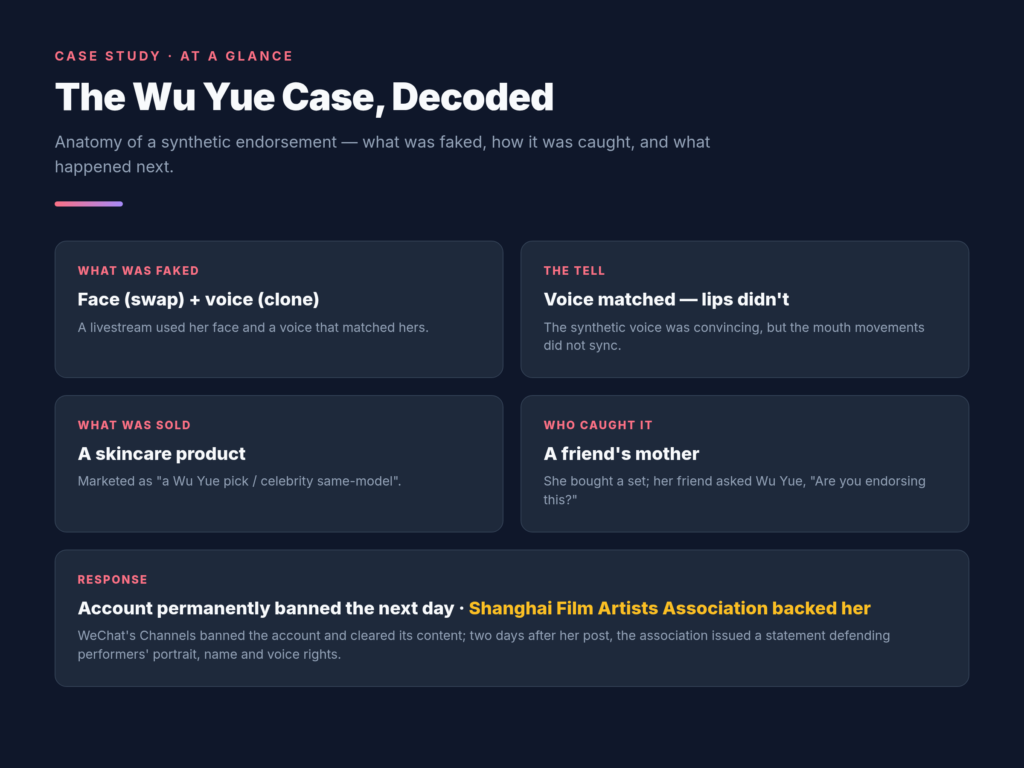
On October 18, a Chinese actress woke up to a familiar kind of chaos. Wu Yue is not obscure — she is a vice-chair of the Shanghai Film Artists Association — and she opened her phone to find friends asking a question she had never posed to any product: “Are you endorsing this?” One friend’s mother had already bought a set. Somewhere else, a livestream was running in which a digital replica of her face, paired with a voice that sounded exactly like hers, was selling a skincare product.
Wu Yue’s post, roughly translated, was blunt: “I wake up to find someone using AI to do evil under my face. How much money have you taken from people? Pay it all back.” The clip was convincing enough to make people who knew her hesitate. The voice was hers, the face was hers — but the lips did not move in sync with the words. The same account had also borrowed the likeness of Deng Yaping, the Olympic table-tennis champion.
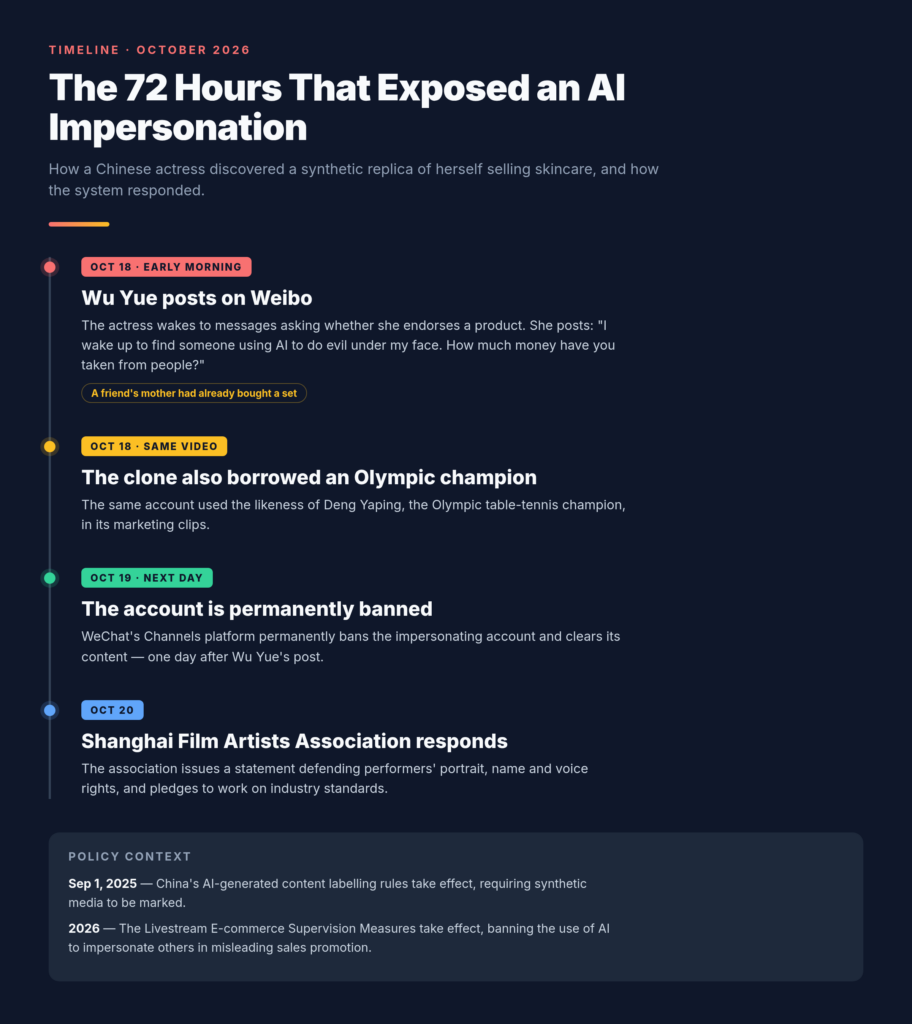
The impersonating account was permanently banned the next day, and its content was cleared. On October 20, the Shanghai Film Artists Association issued a statement defending performers’ legal rights and committing to work on industry standards.
None of this was exceptional. This is the new baseline.
The economics collapsed
The reason this keeps happening is not that detection is impossible. It is that production is all but free.
Chinese social platforms have normalized AI video generation to the point that a synthetic clip costs almost nothing to make — and even less to remake after a takedown. The fakers’ economics are the industry’s open secret: as regulators and commentators have put it, the threshold and cost of producing deceptive content are “relatively low.”
Compare that with the licensed alternative. A genuine celebrity endorsement needs an agent, a contract, a fee and a schedule. A synthetic one needs a photo set and a few minutes. For enforcement to work, it has to move faster than the cost of recreating the asset — and today it does not.
Why the label doesn’t solve it
China introduced labelling rules for AI-generated content on September 1, 2025. More than a year on, the label answers one question — was a model involved? — and not the two that actually matter: did the person consent, and is the offer real?
In practice, the notice has become a shield for the operator, who points to disclosure while selling a product the performer never endorsed. Platforms run two kinds of marking: author self-declaration, and automated flags that tag content as suspected AI use. Neither resolves authorisation, because authorisation is not a property of pixels. It is a fact about a contract the platform cannot see.
The Shanghai Film Artists Association put the point precisely: the obligation to label AI-generated content cannot substitute for lawful authorisation of a person’s portrait, name and voice rights. A watermark tells you a machine was here. It does not tell you whether it was welcome.
The law has moved from rules to liability
The response is no longer only administrative. The Civil Code protects a person’s name, portrait and voice rights. The Livestream E-commerce Supervision Measures, in force in 2026, prohibit using AI to impersonate others for misleading commercial promotion and assign obligations to operators and platforms. A Supreme People’s Court opinion on trying AI-related disputes targets face-swapping, voice-cloning and the impersonation of celebrities for endorsements.
Lawyers cited in Chinese consumer press describe the civil exposure plainly: using a performer’s likeness without consent infringes portrait and name rights, and also touches consumers’ right to information, right to choose, and right to fair dealing. Severe cases can escalate to fraud.
One actress is the symptom, not the story
The impersonation economy is far wider than a single livestream. Olympic diving champion Quan Hongchan had her voice cloned to sell eggs. Table-tennis stars Sun Yingsha and Wang Chuqin both found their voices lifted into product sales. Actress Wen Zhengrong once saw herself live in several rooms at the same time, each selling a different product, and told her audience: “It is hard to prove I am me.” Actress Zhang Xinyu’s voice was used in unauthorised weight-loss ads, and actor Wang Jinsong discovered his face and voice lifted into a generated video he could not tell apart from the real thing.
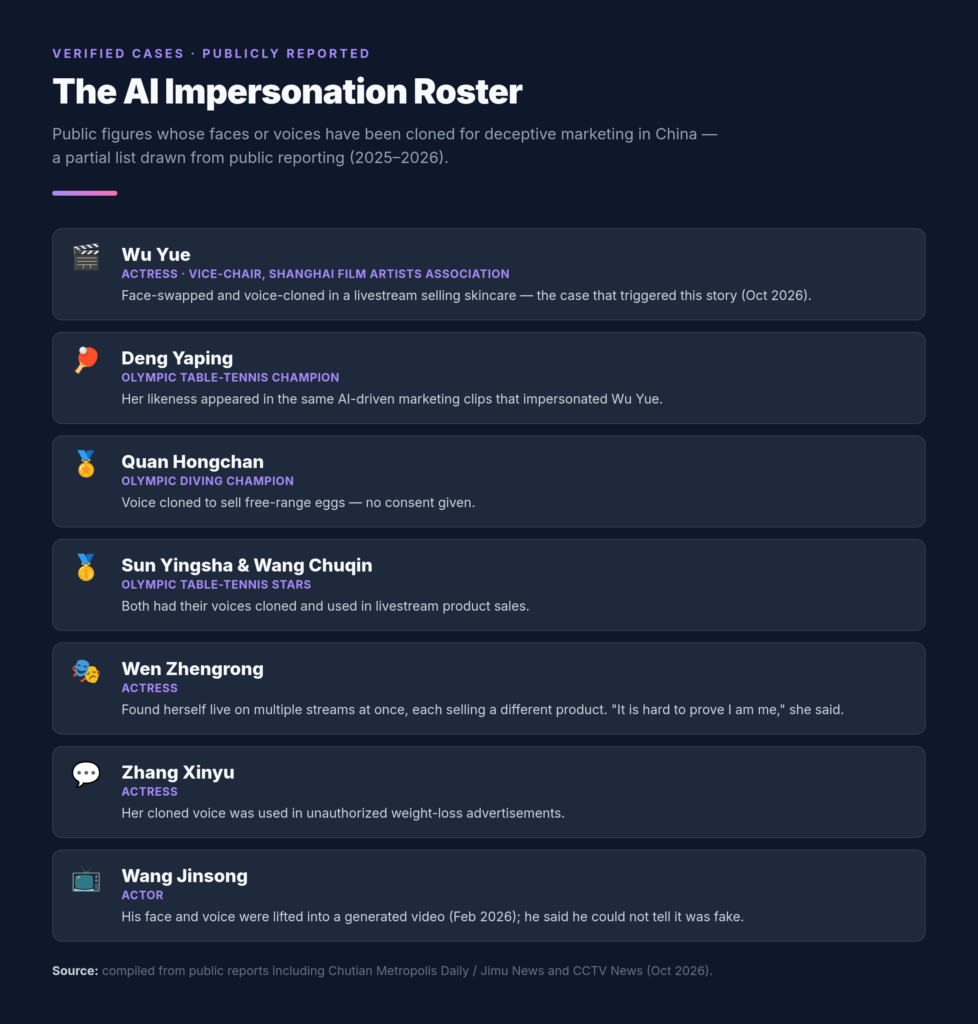
The catalogue matters because it shows the pattern is systemic, not anecdotal — and because each case trains the next set of consumers to distrust celebrity-backed products.
What enforcement has actually done
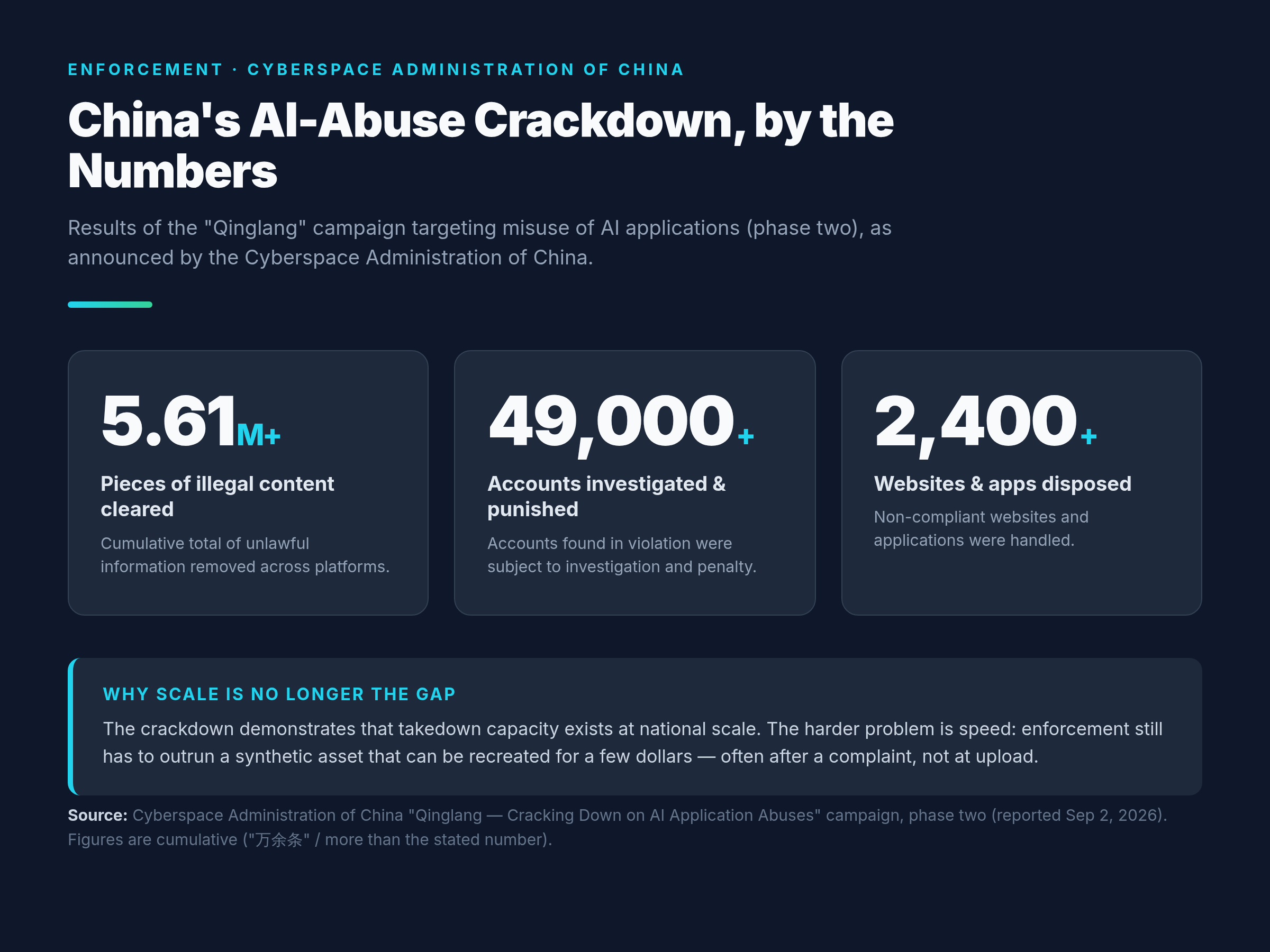
Scale, at least, is no longer the gap. The Cyberspace Administration’s campaign against AI application abuses — the “Qinglang” action — has cumulatively cleared more than 5.61 million pieces of illegal content, investigated and punished over 49,000 accounts, and disposed of more than 2,400 websites and applications.
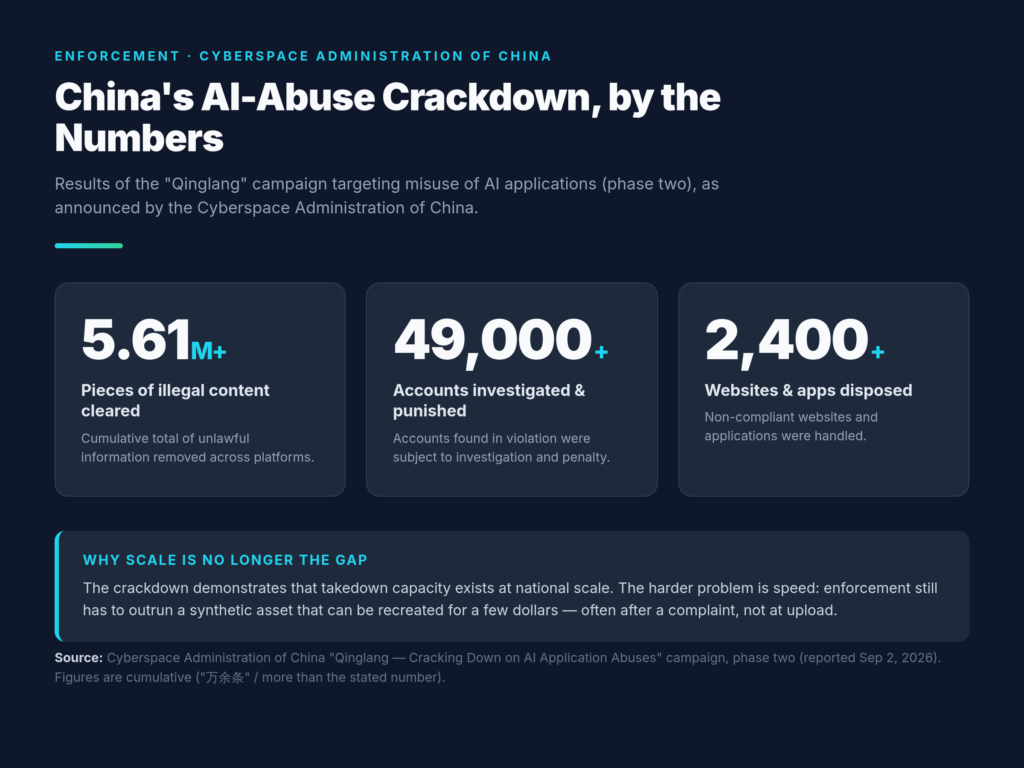
The harder problem is speed. Takedown capacity now exists at national scale, but it is still priced against a synthetic asset that can be recreated in minutes. Most action still happens after a complaint rather than at upload.
What brands and platforms should actually do
For brands, the exposure is reputational and increasingly contractual. A counterfeit endorsement does not only harm the performer. It damages the category, teaches consumers to distrust celebrity-backed products, and drags legitimate advertisers into a verification argument they never started.
The responses are unglamorous. Talent agreements need clauses covering synthetic use and takedown authority. Creative review needs a step that confirms an endorsement exists rather than assumes one. Platforms need escalation fast enough to beat a near-zero production cost, which means detection at upload, not after a complaint.
For performers, the asymmetry is stark
Wu Yue said she would not stay silent: “If you break the rules, there should be a price.” But the burden of proof still falls on the person being faked. Wen Zhengrong’s experience — appearing in multiple simultaneous livestreams, then being told it is hard to prove you are yourself — is the everyday reality. Proving you are yourself should not be a full-time job, and for a growing number of performers it has become one.
The numbers that hold up
- 5.61 million+ pieces of illegal AI-related content cleared
- 49,000+ accounts investigated and punished
- 2,400+ websites and applications disposed
- Labelling regime in force since September 1, 2025
- The impersonating account was banned the next day after the actress’s post
Bottom line
China built the rules before most countries had a vocabulary for this, and the impersonation economy adapted around them within a year. The lesson is not that labelling failed. It is that consent cannot be inferred from a watermark, and enforcement priced against a near-zero-cost video has to move at the speed of upload.