Why Chinese Shoppers Ask AI What to Buy, and Why the West Should Care
China AI Commerce: Everything You Need to Know
Chinese shoppers did not download a new marketplace in order to shop with AI. They began asking questions inside the ones they already had open.
That single change is the subject of this hub. Demand now arrives as a sentence instead of a keyword, the shortlist forms before the shelf is ever seen, and in a growing number of cases the order is completed without a page view. China calls this 人工智能电商. In English the working term is China AI commerce.
The five facts that carry the rest of this page
- Eight in ten consumers in China now use AI somewhere in the shopping process, the highest share of the eleven markets McKinsey surveyed in 2026. The United States sits at 48 per cent.
- 419 million people opened Doubao in an average month in September 2026. Alibaba’s Qwen app reached 158 million. Every AI-native app together reached 546 million monthly users, up 82.1 per cent year on year, according to QuestMobile.
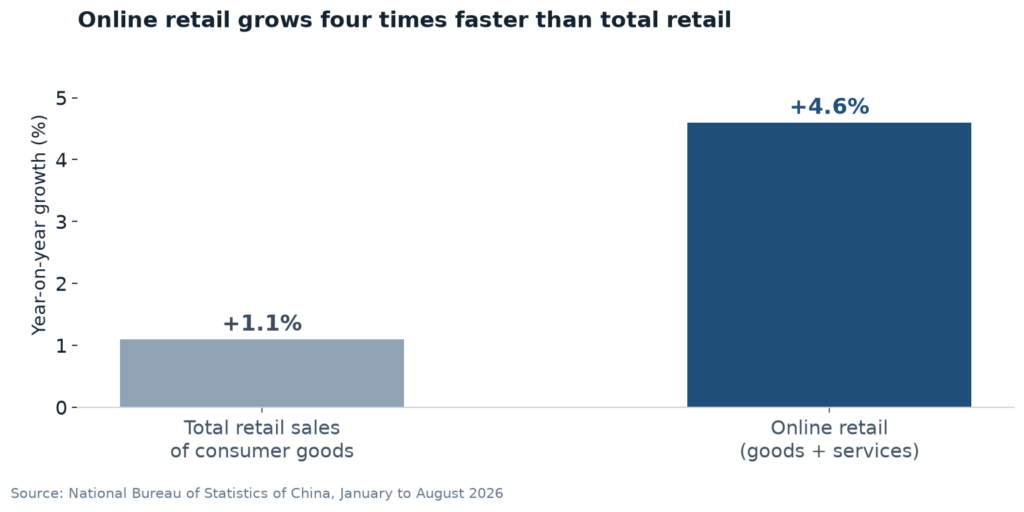
- Online retail grew 4.6 per cent to 13.48 trillion yuan in eight months, versus 1.1 per cent for total retail.
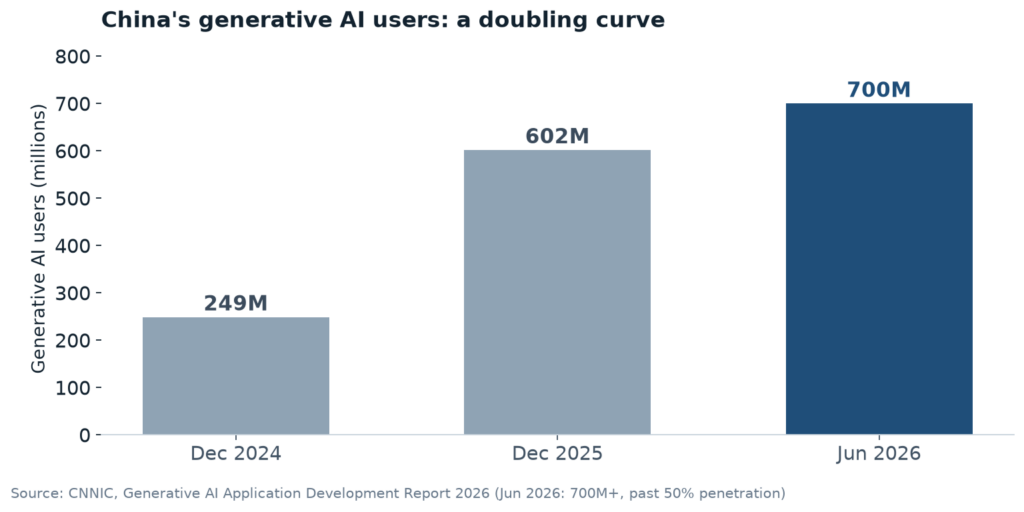
- More than 700 million people used generative AI by mid-2026, past the 50 per cent mark.
- In October 2026, nine Chinese government departments issued 18 measures to push AI into commerce.
What AI commerce means in China
AI commerce in China is the use of a large language model, inside a shopping environment, to read a request written in ordinary language, assemble a shortlist, and carry the transaction through to payment and after-sales. Three layers do three jobs: demand capture, decision support, and transaction. Anything short of the third layer is a recommendation engine with better grammar.
The three surfaces where Chinese shoppers meet a model
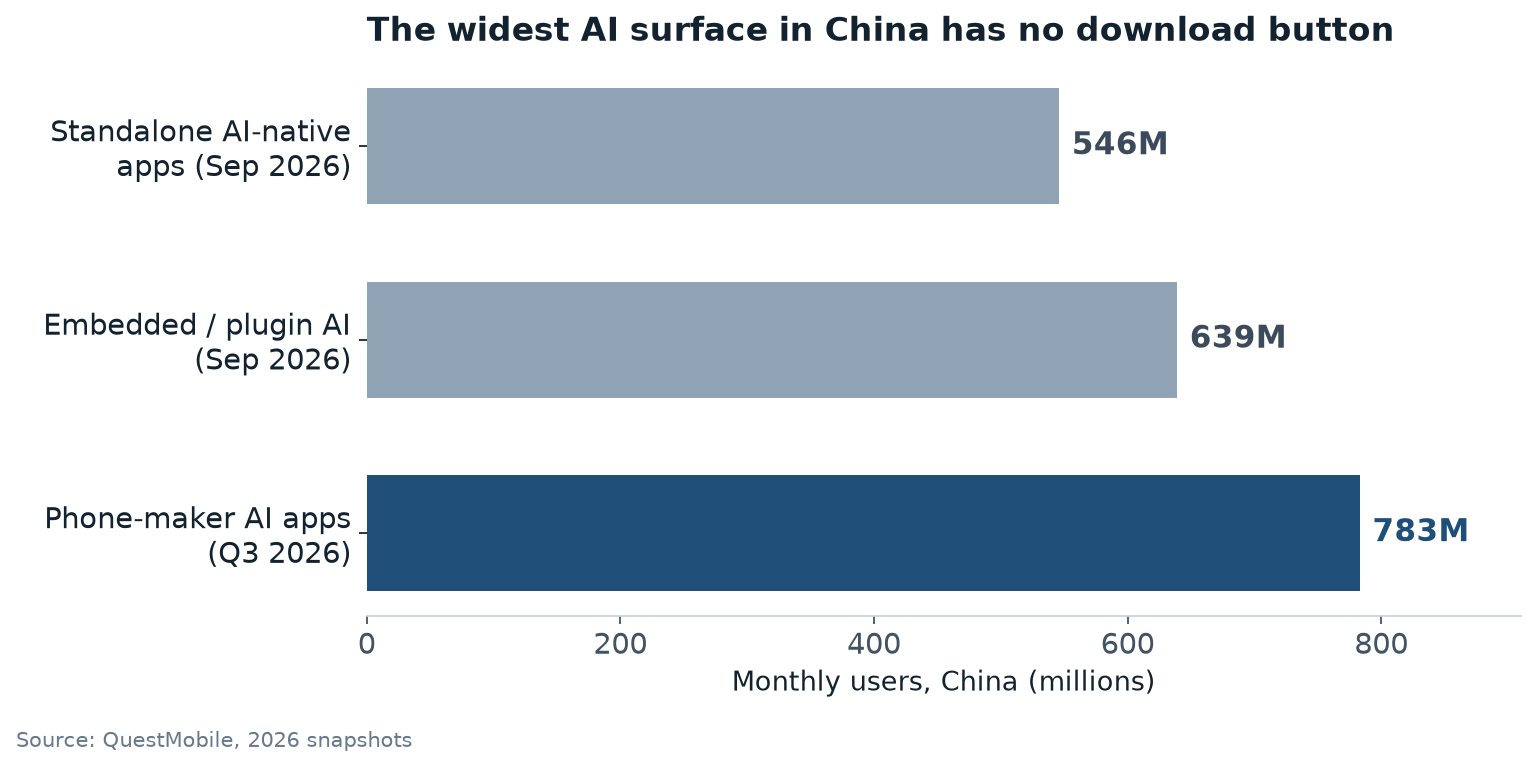
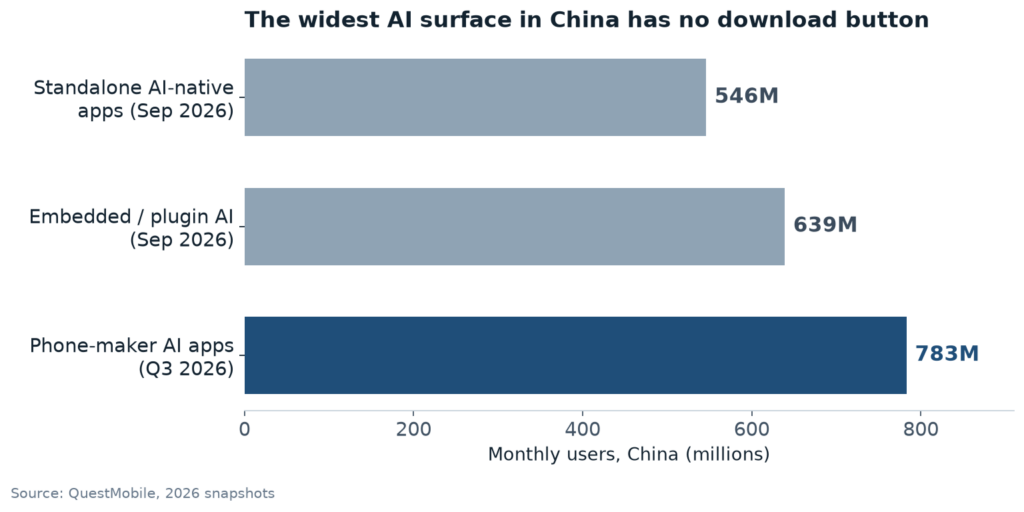
QuestMobile measures three surfaces. Phone-maker AI apps reached 783 million users in the third quarter of 2026, the widest. Embedded AI inside existing apps reached 639 million in September 2026. Standalone AI-native apps reached 546 million monthly users. The surfaces overlap, so they cannot be added. The busiest AI surface in China has no download button.
The market, in numbers that can be sourced
CNNIC counts 249 million generative AI users at the end of 2024, 602 million at the end of 2025, and more than 700 million by mid-2026, when penetration crossed 50 per cent. Roughly three-quarters of users turn to generative AI to answer questions — the behaviour AI commerce sits on.
| Measure | Figure | Period | Institution |
|---|---|---|---|
| Generative AI users in China | more than 700 million, past 50% penetration | mid-2026 | CNNIC |
| AI-native app monthly users | 546 million, +82.1% YoY | Sept 2026 | QuestMobile |
| Doubao monthly users | 419 million | Sept 2026 | QuestMobile |
| Qwen app monthly users | 158 million | Sept 2026 | QuestMobile |
| DeepSeek monthly users | 123 million, −15.2% YoY | Sept 2026 | QuestMobile |
| Usage depth | 88.2 sessions / 173.5 min per user per month | Sept 2026 | QuestMobile |
| Online retail of goods & services | 13.48 trillion yuan, +4.6% | Jan–Aug 2026 | NBS |
| Online retail of goods | 8.42 trillion yuan, +4.3% | Jan–Aug 2026 | NBS |
| Total retail sales | 32.76 trillion yuan, +1.1% | Jan–Aug 2026 | NBS |
| Consumers using AI in shopping | China 80%, India 76, US 48, France 44, Japan 37 | 2026 | McKinsey |
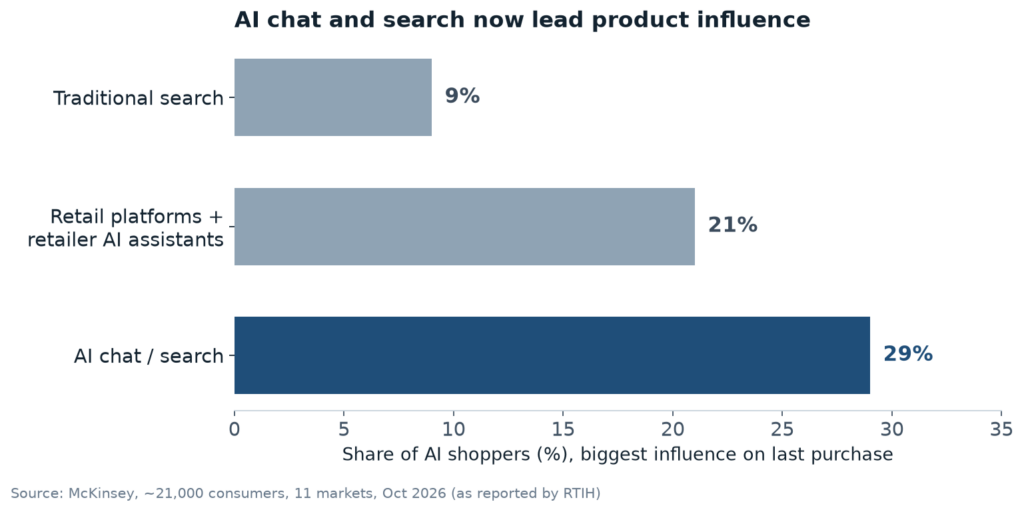
| AI as biggest purchase influence | 29% AI chat/search vs 9% search vs 21% retailer | 2026 | McKinsey |
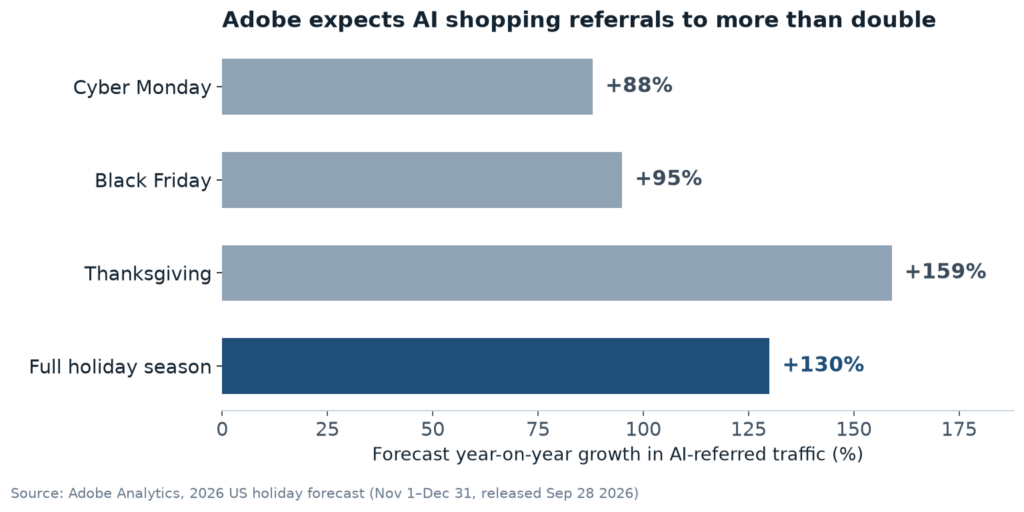
| AI-referred traffic, US retail | forecast +130% | holiday 2026 | Adobe |
| AI investment deals in China | 1,255 deals, ~250.1 billion yuan | H1 2026 | CNNIC |
| China AI core industry revenue | above 1.2 trillion yuan | 2025 | Xinhua |
| Smart glasses sales on platforms | +110% | Jan–Sep 2026 | MOFCOM |
No official series exists for AI-mediated GMV, and platforms have largely stopped publishing GMV. Any single number claiming to size China’s AI commerce in yuan is an estimate until its method is shown.
Why the dialog box arrived in 2026 and not in 2023
Demand went flat — retail up 1.1 per cent — while online kept growing at 4.6 per cent. Then supply caught up: model providers built the distribution and now need inference to pay for itself, and 1,255 AI deals worth 250.1 billion yuan closed in six months. Usage depth — 88.2 sessions, 173.5 minutes a month — supplied the habit, and the October 2026 policy removed the last objection.
Platform map: who owns the dialog box
In China the assistant is usually a tenant inside a marketplace; in the West it arrives from outside.
ByteDance connected Doubao to Douyin e-commerce in October 2025, hit public beta in March 2026, added “help you choose” in April and a full conversation-to-payment loop in May, then distributed coupons across Doubao, Hongguo and Toutiao in October 2026.
Alibaba fully connected Qwen to Taobao in May 2026, then released the Qwen Office e-commerce edition for merchants — cross-platform operations, trend insight, asset generation, ROI optimisation.
The operations layer predates the consumer-facing one: Taotian says five million merchants used its AI steward in the 2025 festival (1.5× efficiency), and JD says 30,000 internal agents ran, serving 160 million interactions.
JD and the challengers — JD’s AI purchase app syncs history but returns generic lists; SMZDM runs its own steward. Quality tracks the depth of the history each assistant is allowed to see.
What actually changes inside the funnel
The query becomes a sentence. Among AI users, 29 per cent say AI chat or search had the biggest influence on their last purchase, versus 9 per cent for search and 21 per cent for retailer platforms. Inspiration gaps wider: 45 per cent versus 23 per cent. Product data becomes the storefront, and promotion disclosure becomes a live risk. AI has also moved into electronics (38%), clothing (37%), travel (35%), beauty (34%) and groceries (32%).
The rulebook a brand has to read
The October 2026 18 measures set direction (shopping agents, operations agents, virtual storefronts). The AI-content labelling rules effective 1 September 2025 create identification duties. Platform rules on data completeness, imagery, price and coupons are the operative constraints.
China and the rest of the world: same technology, different owner
McKinsey found 80 per cent adoption in China versus 48 per cent in the US. Among US AI users, purchases completed through AI rose from 10 to 17 per cent. Adobe forecasts AI-referred traffic up 130 per cent, led by Thanksgiving at 159 per cent, while describing AI as still a small share of visits. Trust is the gate: 64 per cent of US adults would not allow an assistant to spend without approval. In China Taobao owns the answer, stock, coupon and delivery; in the West the assistant must negotiate each of them.
What a foreign brand should do before the next festival season
- Fix the catalogue first — machine-readable specs, stock, price tiers, lead times, returns.
- Write for questions in Chinese, at the length a question deserves.
- Choose the surface you can influence (Douyin/Doubao vs Taobao/Tmall vs standalone).
- Feed the platform, not just the website.
- Split AI out of organic in attribution.
- Label what you generate.
- Defend price integrity before an agent audits it.
How to measure AI commerce without fooling yourself
Track revenue per visit from AI referrers, the share of sessions with no referrer string, catalogue structured-data pass rate, and assisted conversion lift. The data pass rate is the leading indicator.
What the data still cannot tell you
No deduplicated series exists for shopping-specific AI usage in China; Adobe’s data is US-only; McKinsey’s are self-reported and quoted through RTIH; QuestMobile stops at the fifth-ranked app.
Bottom line
AI commerce in China is a new gate in front of e-commerce, built by platforms that already own the cart, the wallet and the address. For a brand outside China, the work is to make the catalogue legible, answer the sentence instead of the keyword, and decide which gate to be selected at — because being found and being selected stopped being the same job.
Frequently asked questions
Is AI replacing search in China? No — it is being wired into search; shoppers type sentences instead of keywords.
How large is China’s AI commerce market? No single credible figure; the measurable proxies are 700M+ generative AI users, 546M AI-native users, and 13.48 trillion yuan of online retail in eight months of 2026.
Will Chinese shoppers let an assistant pay? The structure invites it — the app already holds the credential — but delegation of the spending decision is not well measured.
Which platform should a foreign brand prioritise? Follow the category: Douyin/Doubao for discovery, Taobao/Tmall for considered purchases, standalone assistants for research-heavy categories.
Is this marketing or operations? Operations first; marketing inherits the consequences.