China’s “Point-Line-Plane” AI Strategy: From Slogan to a Scenario Checklist
For years, “AI+” was a slogan. On November 5, it became a deployment plan.
China’s National Development and Reform Commission (NDRC) laid out a “point-line-plane” framework for deepening the AI+ initiative. The same day, the Ministry of Industry and Information Technology (MIIT) opened public consultation on a robot product identifier code, and separately signaled a “safety-first” approach to low-altitude equipment.
The throughline is unmistakable: China is moving from “invest in AI” to “deploy AI in specific industrial scenarios” — building the regulatory and scenario plumbing to industrialize artificial intelligence, not just fund it.
The “Point-Line-Plane” Framework, Decoded
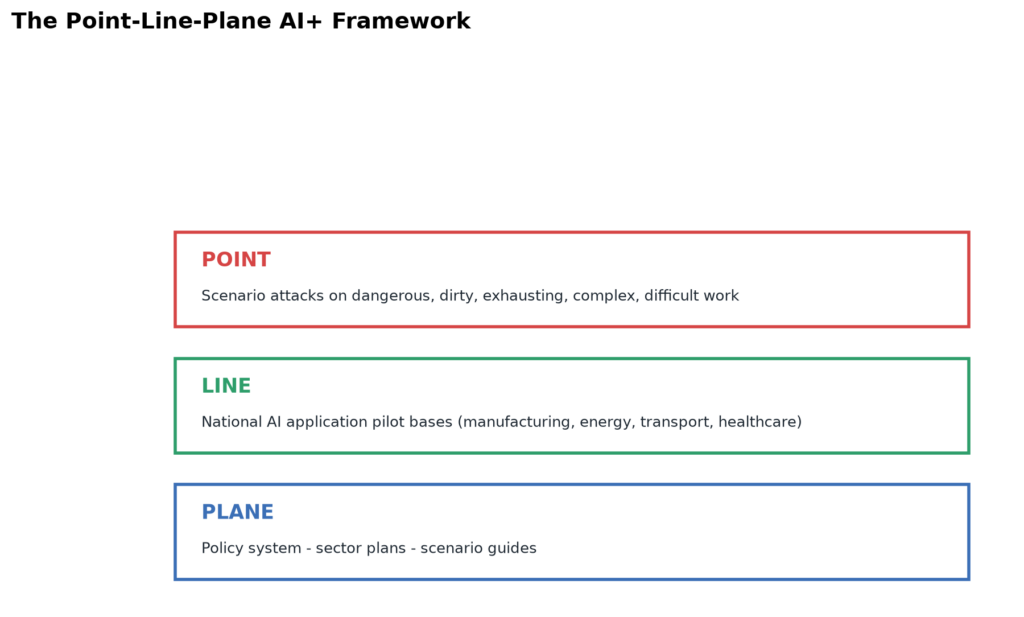
Let’s unpack the three tiers, because each one tells you something about how China intends to deploy AI.
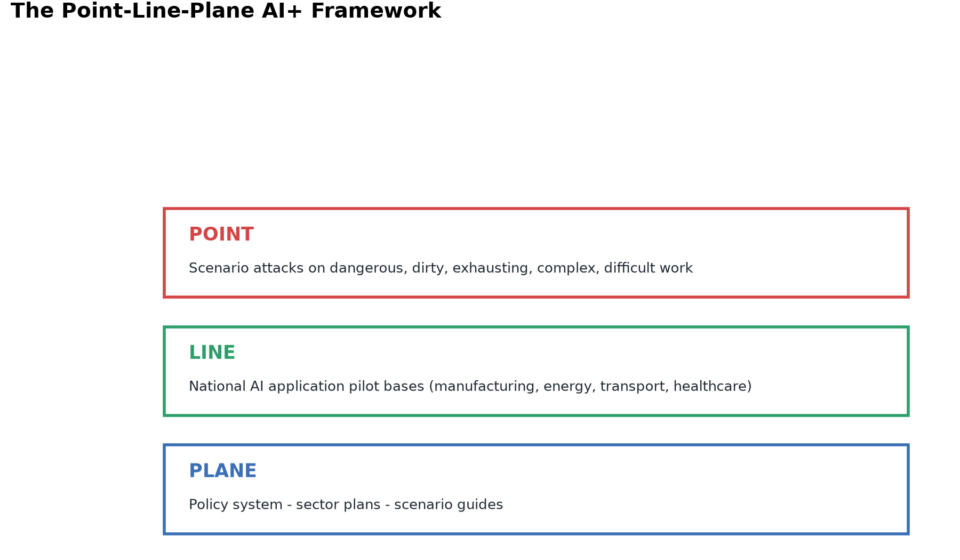
The “point” is about attacking specific scenarios. The NDRC’s framing is deliberately vivid: prioritize ” These are jobs where AI and robotics can replace human risk, and where the value proposition is easy to demonstrate
The “line” is about building national AI application pilot bases in key industries: manufacturing, energy, transportation, and healthcare. These bases are where point-level successes get scaled into industry-level adoption.
The “plane” is about the policy infrastructure: a system of AI+ policies, sector-specific implementation plans, and application scenario classification guides.
Point, line, plane — scenario, industry, policy. It’s a ladder from a single use case to a national deployment framework.
An Important Clarification: Direction, Not Decree
Here’s a precision point that matters for anyone writing about this.
The NDRC’s “point-line-plane” framework was explained at a press conference — it’s a statement of policy direction, not a single new regulation. There is no “Point-Line-Plane AI+ Regulation” that was formally enacted on November 5. What happened was the articulation of a strategy, which will be implemented through sector-specific plans and measures over time.
That distinction matters. It means the framework is a guide for how policy will develop, not a legal obligation that takes effect immediately. Enterprises watching this should read it as a roadmap, not a compliance deadline.
The Robot Identifier Code Consultation
The MIIT item is more concrete — and more consequential for robotics companies.
On November 5, MIIT opened public consultation on a draft “Robot Product Identifier Code Management Measures” . The consultation period runs from November 6 to December 5, 2026.
The purpose is standardized identification for robot products — essentially a unique code for each robot, enabling traceability, certification, and safety oversight. If finalized, it would create compliance requirements for robot manufacturers and importers.
This is the regulatory plumbing for an AI-robotics economy. Before you can certify robots for safety, you need to be able to identify them. Before you can trace a malfunction to a manufacturing batch, you need a code. The identifier system is the foundation for everything that comes after.
It’s also a signal that China is preparing to scale robotics deployment — because you don’t build identification infrastructure for a market that isn’t going to grow.
The Low-Altitude Equipment Signal
The third item — MIIT’s stance on low-altitude equipment — is separate from the robot identifier consultation, and it’s important not to conflate them.
MIIT stated that low-altitude economy development must prioritize safety, with a framework of ” Cargo before passengers, isolated operations before integration, suburban before urban.
Note the wording: this is a policy stance, not a consultation document. It’s a statement of how China intends to sequence low-altitude development, not a specific regulation. But it’s a clear signal: China wants to grow the drone and eVTOL market cautiously, with safety as the gating factor.
Why This Matters for Enterprise and Marketers
If you’re building a business around AI in China, the “point-line-plane” framework creates concrete opportunities.
The scenario-first approach means procurement will follow specific use cases — mining automation, high-altitude inspection, emergency response. Companies that can demonstrate value in those “dangerous, dirty” scenarios will find government and SOE buyers.
The robot identifier code foreshadows compliance requirements. Robotics companies should prepare for traceability and certification obligations.
And the safety-first low-altitude stance signals that drone and delivery applications will expand, but in a regulated, sequenced way.
The Bigger Picture: Industrializing AI
Step back, and China’s policy is shifting from “invest in AI” to “deploy AI in specific industrial scenarios.”
This is the opposite of the US approach, at least in tone. In Washington, the debate is increasingly about restriction — the ASI Prohibition Act, data center moratoriums, safety-first regulation (see our A1 and S1 coverage). In Beijing, the emphasis is on deployment — scenario checklists, pilot bases, identifier codes.
Both are governance plays, but they’re aimed at different objectives. The US is trying to manage risk; China is trying to accelerate deployment while building the regulatory infrastructure to do it safely.
What to Watch Next
Three things will tell you how this develops.
Watch the sector-specific implementation plans. The “point-line-plane” framework is abstract until concrete plans emerge for manufacturing, energy, and healthcare.
Watch whether the robot identifier code is finalized on schedule after the December 5 consultation closes. If it is, expect compliance requirements for robotics companies to follow.
And watch low-altitude deployment sequencing. If cargo drones start operating at scale before passenger eVTOLs, it confirms the “cargo-first” approach is being implemented.
The Bottom Line
China’s “point-line-plane” AI+ framework, the robot identifier code consultation, and the low-altitude safety stance are three separate items — but they tell one story. China is building the scenario, industry, and regulatory infrastructure to industrialize AI.
The slogans are over. The deployment manual is being written. And for anyone watching the global AI race, that shift — from aspiration to implementation — is the thing that matters most.