How AI Search Is Rewiring Buying Decisions — China vs. the West
AI search is quietly replacing the blue links in both China and the West. The behavior shift is real; the playbook is still being written.
The Quiet Collapse of the Link List
Think back to the last expensive thing you bought — a laptop, a mattress, a subscription you actually read the terms for. Did you open Google first, or did you ask a chatbot?
That answer is quietly rewriting the entire customer acquisition map.
Here is the shift in one sentence: AI search did not kill search, it changed what search gives you. Instead of ten blue links you have to click, judge, and stitch together yourself, you now get a direct answer — and often a recommendation already sitting inside it. The moment of decision has moved out of the results page and into the conversation.
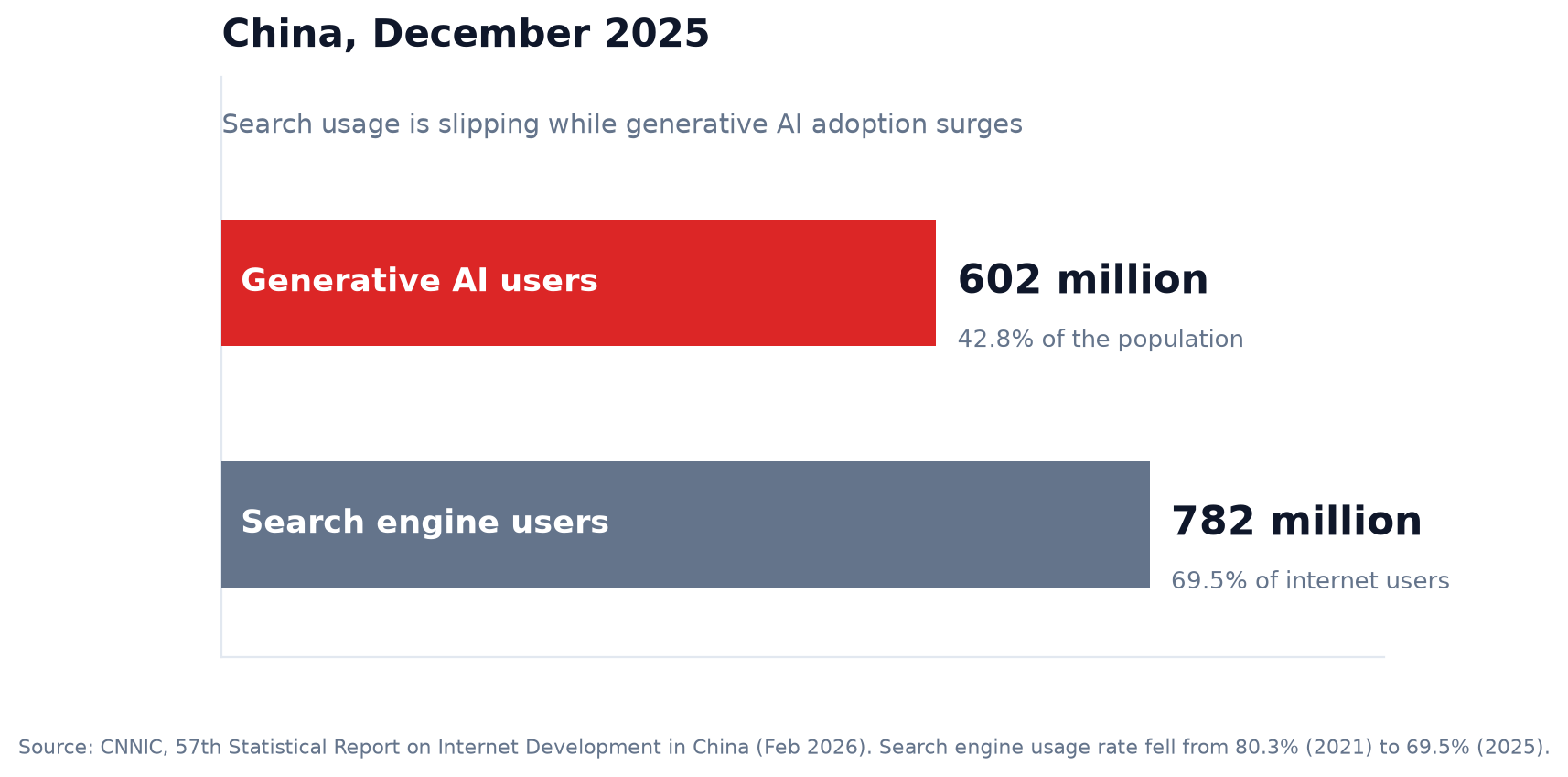
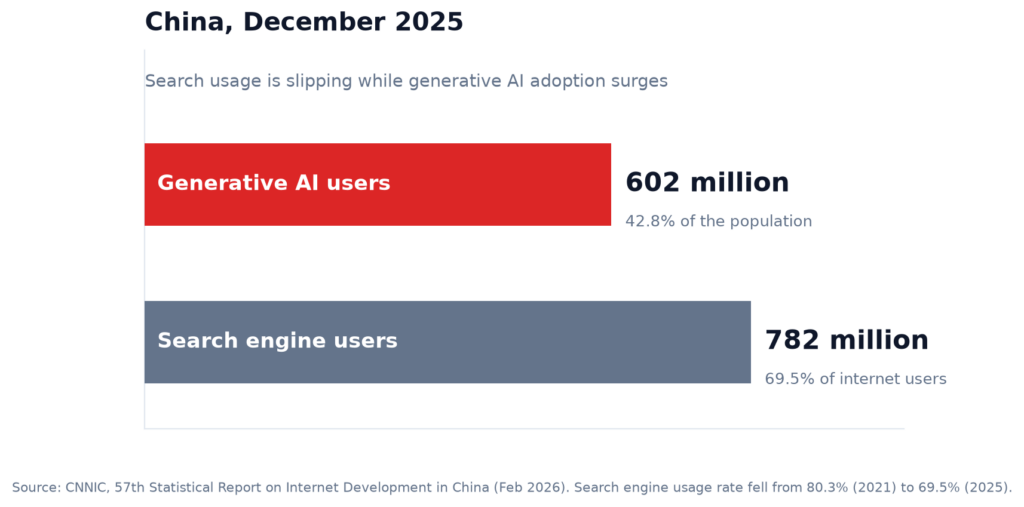
The scale is no longer speculative. By December 2025, 602 million people in China had used a generative AI product — 42.8% of the entire population, up by 353 million people in a single year, according to the 57th report from the China Internet Network Information Center (CNNIC). When nearly half a country adopts a technology in a few years, it stops being a niche behavior and starts being the default.
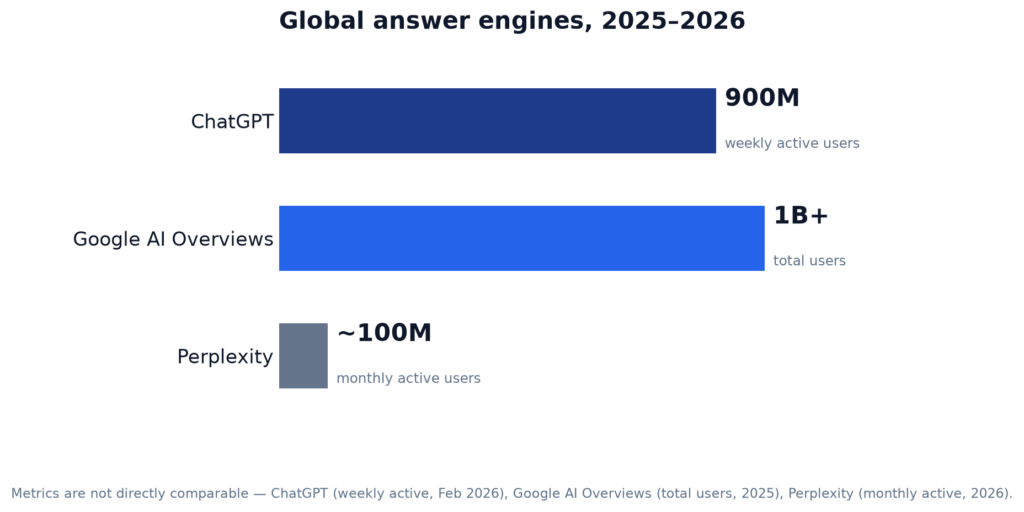
In the West, the numbers tell the same story from a different angle. ChatGPT passed 900 million weekly active users in February 2026. Google has said its AI Overviews now reach more than a billion people. Perplexity, the purest version of an answer engine, has grown to roughly 100 million monthly active users, by industry estimates.
The link list is not dead yet. But it has stopped being where decisions get made.
What AI Search Actually Changes in the Journey
To understand why this matters, you have to see what actually changed — and what did not.
A traditional search journey looks like this: you type a query, you get links, you open three or four tabs, you compare, you shortlist, you buy. The search engine’s job was to get you somewhere. It was a map, not an answer.
An AI search journey collapses that. You ask a question, and the model reads, summarizes, and compares for you, then hands back a shortlist with reasons. The engine’s job is now to get you an answer. It has become a friend who did the reading first.
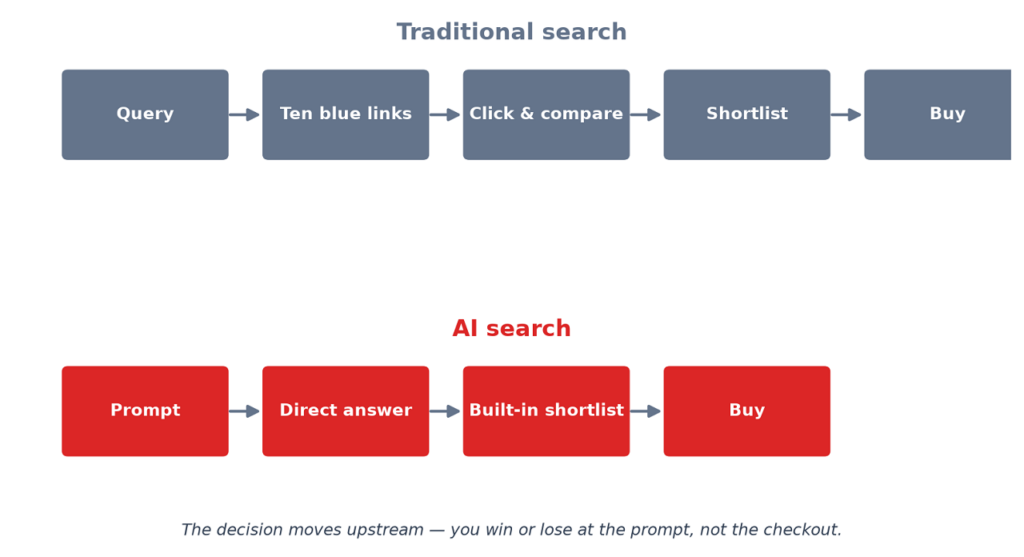
Three things change as a result. First, the number of touchpoints shrinks — the four tabs become one answer. Second, the brand that wins is no longer the one that ranked first, but the one the model chose to cite. Third, the user’s trust moves from the ranking algorithm to the model’s sources, which is a fundamentally different kind of trust.
What did not change is just as important. People still have the same underlying intent. They still want a good recommendation for a laptop or a mattress. AI search changed where and how the answer arrives, not what the person wanted in the first place.
China: AI-Native Apps Are Eating Search
China is the clearest preview of where this is heading, because the shift there is not happening inside a search box — it is happening in standalone apps.
Start with the official numbers. CNNIC’s 57th report shows that China’s search engine user base fell to 782 million people, or 69.5% of internet users, down from 80.3% in 2021. That is a decline in usage rate even as the country’s total internet population kept growing. The same report is unusually blunt about why: traditional search engine user numbers are being squeezed by AI search products, and the industry’s revenue is sliding as a result.
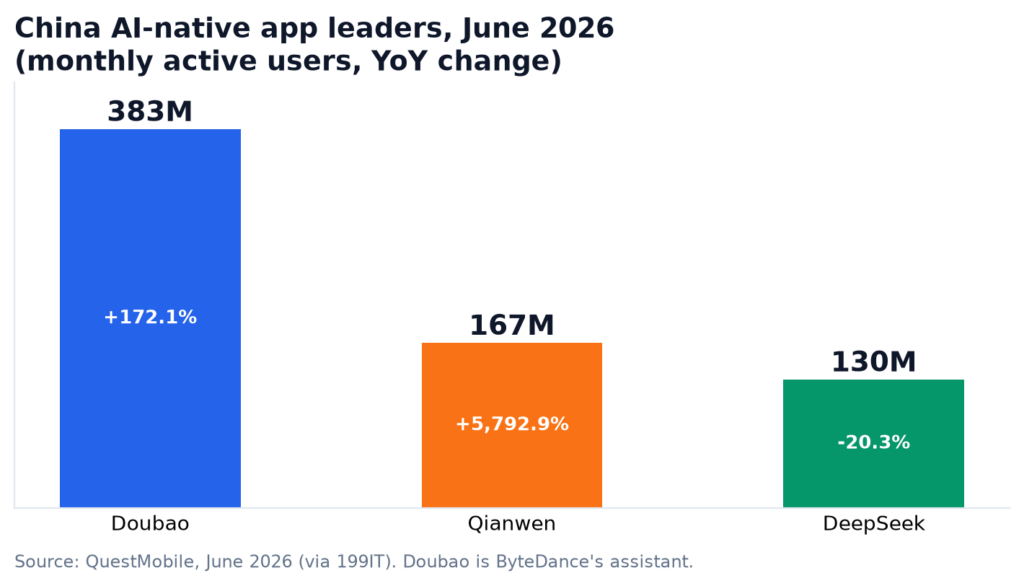
What replaced the search box? AI-native apps. ByteDance’s Doubao assistant reached 383 million monthly active users in June 2026, up 172% year over year, according to QuestMobile. Alibaba’s Qianwen hit 167 million, and DeepSeek 130 million. Across the whole category of AI-native apps, the average user opened one 92.7 times a month — up 58.3% in a year — and spent 183 minutes inside, up 40.1%.
Here is the part that should keep a Western marketer up at night. In China, people did not just add AI on top of their existing search habit. They moved the habit. A user who asks Doubao for a product recommendation is not a user you can reach through a search ad anymore. They are inside an app whose recommendation is the only shelf that matters.
The West: Answer Engines Arrive in Fragments
The West is doing the same thing, just messier — and slower.
Instead of one dominant AI-native app, the West has a pile of them: ChatGPT’s built-in search, Google’s AI Overviews layered on top of classic results, Perplexity as the dedicated answer engine, plus Claude and Gemini pushing into the same space. Each has different user bases, different citation behaviors, and different ways of surfacing brands.
The fragmentation shows up in the data. Gartner has been predicting since early 2024 that traditional search volume would drop 25% by 2026 as people shift to AI chatbots and virtual agents. And the cracks are already visible: Google’s share of global search dipped below 90% in the fourth quarter of 2024 for the first time since 2015.
None of this is a collapse. It is a slow leak. In the West, the blue link is still the default for a lot of people. But the people most likely to be researching a purchase — the high-intent, comparison-driven, ready-to-buy crowd — are exactly the ones drifting toward answer engines first. That is what makes the change economically loud even while the headline usage numbers look gradual.
Where the Decision Happens Now
If you squint at both markets at once, you see the same picture: the purchase decision has moved upstream.
In the old model, the decision happened at the end of a click journey — on your product page, in your cart, at checkout. In the new model, a meaningful chunk of the decision happens the moment a model writes your brand into, or leaves it out of, an answer.
That is the uncomfortable truth. When a user asks which standing desk or project management tool is best, and the model names three options, the shortlist was written before the user ever clicked a link. You do not lose that customer at the checkout page. You lose them at the prompt.
This is why being in the answer is rapidly becoming as important as being on page one — and in some categories, more important. The link is still the doorway, but the answer is what opens or closes it.
Trust Shifts From Ranking to Citation
Here is the subtler change, and the one most marketers are still missing.
Ranking is a form of trust we learned to ignore. When Google listed a page first, we mostly accepted it — maybe with a glance at the domain, but not much more. Ranking was the credential.
Citation is different. When a model answers, it implicitly vouches for whatever it cites. If a model recommends a tool and links to a source, the user transfers some of their trust in the model to that source. If the model skips a brand entirely, that brand might as well not exist for this user.
That flips the incentives. In the ranking world, you optimized for relevance signals. In the citation world, you optimize to be quotable — to say something clear, specific, and useful enough that a model can lift it, attribute it, and hand it to a user. Vague marketing copy ranks fine and gets cited never.
For content teams, this is the single most important reframe of the next two years. You are no longer writing to rank. You are writing to be the source an answer engine trusts.
Implications for Top-of-Funnel Content
So what does that reframe actually change at the top of the funnel?
First, your content has to answer the question, not just target it. A page that exists to capture a keyword and point users to a product is invisible to an answer engine. A page that actually answers — with numbers, comparisons, and a clear recommendation — is exactly what a model wants to cite.
Second, structure becomes a trust signal. Models cite content they can parse: clear headings, tables, direct statements, quotable sentences. A wall of prose with the answer buried in paragraph seven is hard for a human and nearly impossible for a model to excerpt.
Third, the definition of winning at the top of the funnel changes. It is no longer purely traffic. A page that earns zero direct visits but gets cited in hundreds of AI answers can drive more qualified demand than one that ranks well and is never quoted. The click is becoming a lagging indicator.
Implications for Bottom-of-Funnel Conversion
The bottom of the funnel is changing just as much, and in a more uncomfortable direction.
When a model hands someone a shortlist, you no longer control the first impression. The comparison happened before you arrived. If your product was in the answer, you inherit a warm, pre-qualified visitor. If you were not, you are fighting from behind against whoever was.
That means conversion optimization now has an upstream half. Your job is not just to convert the people who land. It is to make sure the people who land at all are the ones who saw your brand framed correctly in an answer.
There is a practical consequence here that most teams miss: you need content that defends your position. If a competitor is routinely cited in a comparison you should be winning, write the comparison yourself — with honest trade-offs, real numbers, and a clear recommendation. You cannot out-optimize a citation gap with a better landing page. The landing page never gets the chance.
Measurement Gaps on Both Sides
Now the honest part: almost nobody can measure any of this properly yet.
Referral traffic from AI answers is notoriously muddy. ChatGPT and Perplexity do send some clicks, but much of the decision happens without a click at all — a user reads an answer and searches your brand directly, or just buys. That direct-brand lift is real demand you cannot attribute back to the AI source that caused it.
On the flip side, your existing analytics are probably undercounting the damage. When a model leaves you out of an answer, nothing shows up in your funnel. There is no “lost to an AI answer” report. You just watch branded search and inbound demand erode without a clear culprit.
The practical answer is not a perfect tool — it does not exist yet. It is a different discipline. Track branded search as a proxy. Monitor how often you actually appear in answers for your money queries, manually if you have to. Treat impressions inside AI answers as a KPI even though it is a fuzzy one. The teams that win will not be the ones with perfect attribution; they will be the ones paying attention at all.
What Marketers Can Do This Quarter
Here is what is actually actionable right now, not in a year.
First, sit down and write out the ten questions a real buyer asks before choosing your category. Not keywords — questions. Then honestly check: does a useful, citable answer to each one exist in your content today? For most teams, half of them do not.
Second, make your pages quotable. Add the stat, the direct recommendation, the one-sentence takeaway a model can lift. Kill the filler. If a sentence would not be worth quoting, ask whether it is worth publishing.
Third, fix your attribution expectations. Set up branded-search tracking and a lightweight, manual check of your appearance in AI answers for your top queries. You cannot manage what you do not look at, even if the measurement is imperfect.
Fourth, in China specifically, treat the AI-native apps as their own channel. The rules are different, the ecosystems are walled, and the recommendation is everything. If you are not present where the assistant answers, you are not present.
A Two-Market Checklist
If you operate across both markets, here is the shortest version of the playbook.
In China, the AI-native app is the new search box. Optimize to be named, cited, and recommended inside the assistant ecosystem, not just indexed. The app’s answer is the shelf.
In the West, the answer is fragmented. You need to be quotable across ChatGPT, Google’s AI Overviews, and Perplexity simultaneously — which mostly means one thing: publish genuinely authoritative, structured, recommendation-ready content and let the models find it.
The common thread in both is the same. Be the source, not the result.
The One Constant: User Intent Still Rules
It is easy to get lost in the novelty and forget the part that has not changed at all.
People still want the same things they always wanted. They want a good recommendation, a fair comparison, and a product that does not let them down. AI search changed the plumbing — the prompt instead of the query, the answer instead of the links, the citation instead of the ranking. But the intent flowing through that plumbing is identical to what it has always been.
Which means the durable strategy is also unchanged, just relocated. Understand the buyer. Answer the question better than anyone. Say it clearly enough to be quoted. Do that, and you win whether the destination is a results page or a dialogue.
The teams that lose will not be the ones with bad AI tools. They will be the ones who kept optimizing for a shelf that is quietly being moved out of the room.
Summary
AI search is shifting the moment of purchase decision from the results page into the conversation — and it is happening on both sides of the world, at different speeds. China leads with AI-native apps: 602 million people (42.8% of the population) now use generative AI, search engine usage has slipped to 69.5% of internet users, and ByteDance’s Doubao alone reaches 383 million monthly users. The West is more fragmented, with ChatGPT at 900 million weekly users and Google’s AI Overviews layered over a slowly leaking classic search. For marketers, the strategic consequence is the same in both markets: trust is moving from ranking to citation, which means content must shift from ranking to being quotable. Measurement is still immature on both sides, but the teams that win will be the ones who start paying attention to their presence inside AI answers now.