1.3 Million Companies, One Lesson: China’s Digital-Human Stress Test
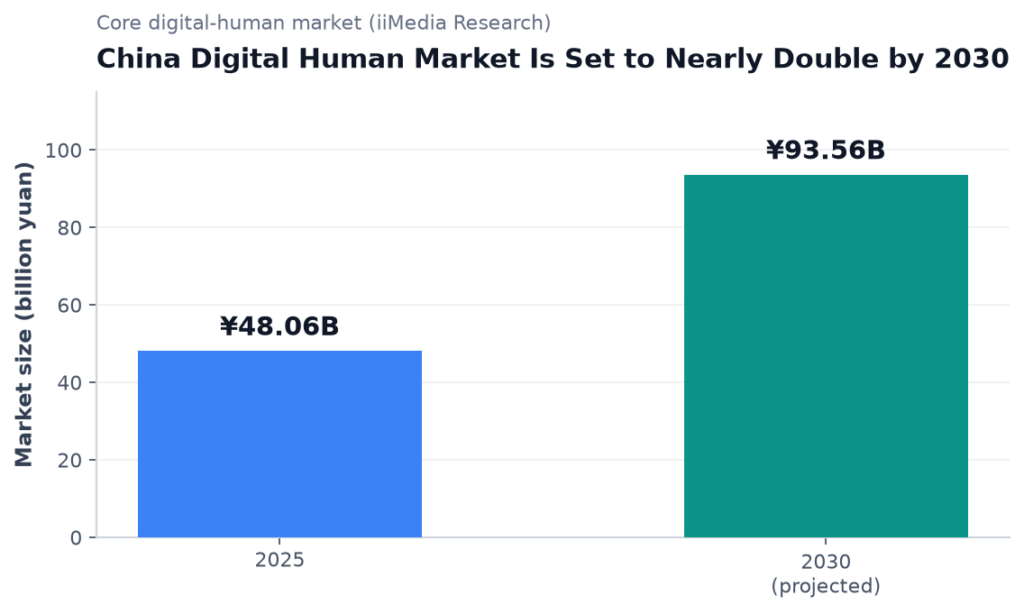
By the end of 2025, China’s digital-human market was worth roughly 48 billion yuan (about US$7 billion), and the figure is climbing fast. What matters more than the size, however, is the shape. Real-world deployment has concentrated overwhelmingly in one sector — e-commerce — where livestream selling, always-on customer service, and automated product explanation have become the default jobs for virtual presenters. The adoption data flowing through 2026 makes the pattern impossible to miss.
A Market That Reached Critical Mass Quietly
The scale is easy to understate because it arrived quickly. A 2025 study from the Communication University of China counted at least 1.3 million firms linked to the digital-human sector, with more than one million of them actively operating. Industry figures put the number of digital humans running across China’s platforms at more than 100,000 at any given time. Production costs have collapsed as well: systems can now generate a lifelike presenter from a single photograph, shrinking what once took hours of video capture and lengthy training into a near-instant process.
E-Commerce Is Where It Landed
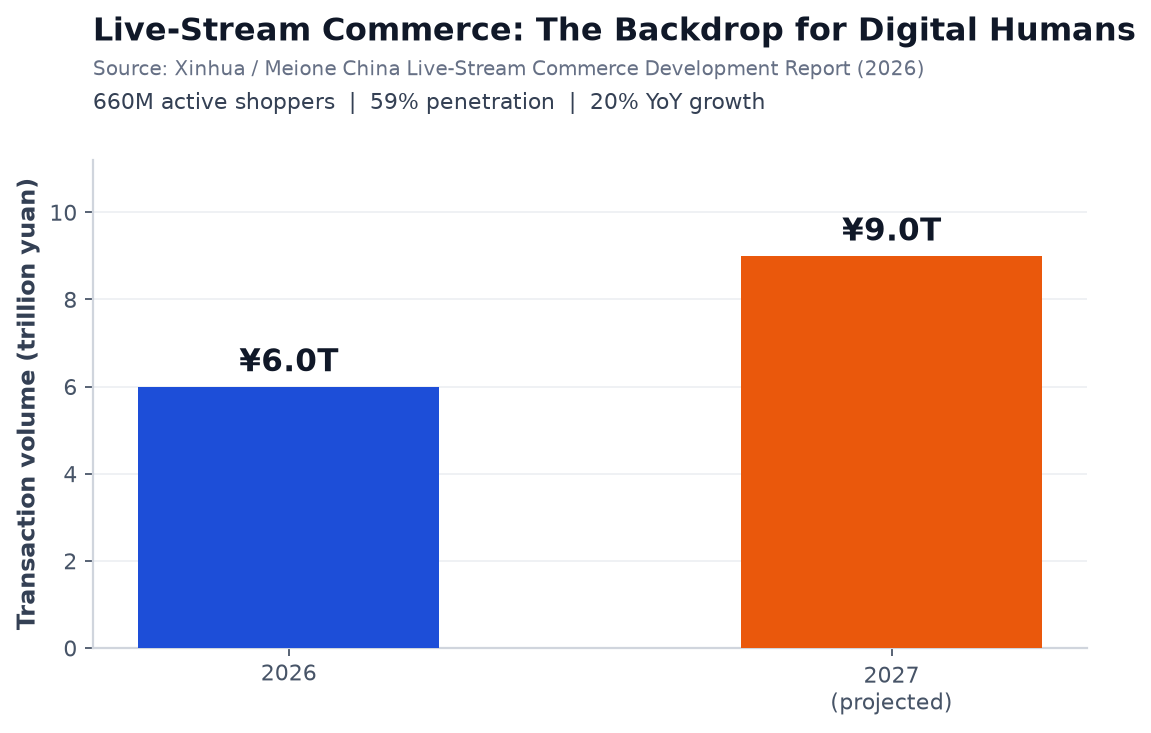
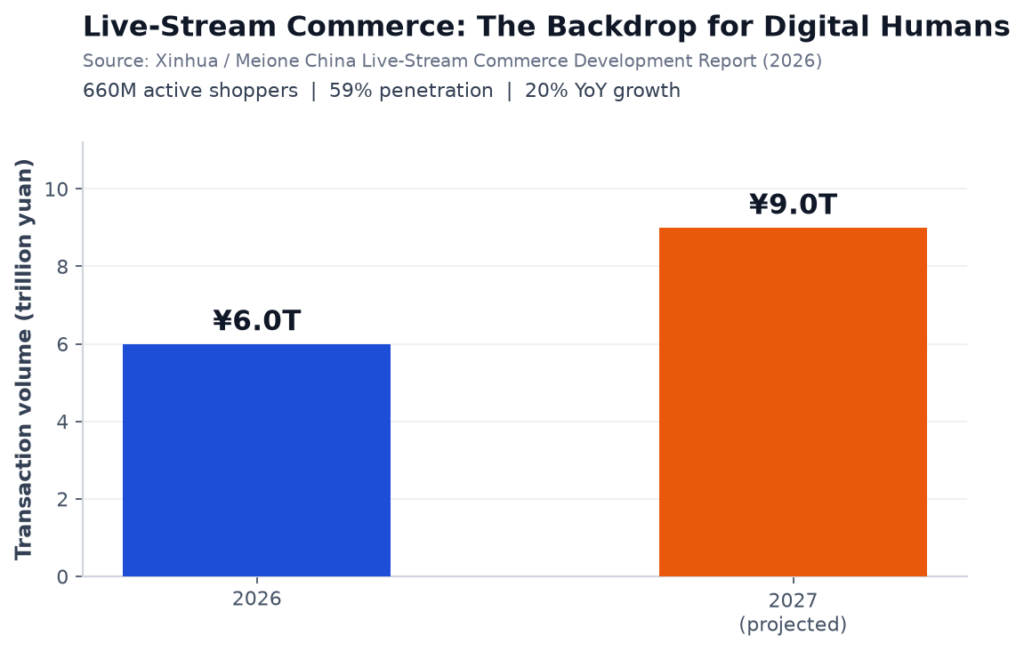
Those avatars are not spread evenly across the economy. They cluster where there is money, volume, and repetition — and nowhere in China produces more of all three than online retail. The backdrop is enormous: live-stream commerce has surpassed 6 trillion yuan (about US$826 billion) in annual transaction value, drawing 660 million active shoppers and reaching nearly 59 percent penetration, with 20 percent year-on-year growth still intact.
Why Standardized, High-Traffic Scenarios Win First
The logic of where digital humans landed becomes obvious once you look at what they are good at. An AI presenter excels at delivering the same script hundreds of times a day — the price of a jacket, the fabric of a sofa, the shipping window for a phone case. E-commerce is dense with exactly these standardized, high-frequency interactions, where the customer’s question is predictable and the acceptable answer is narrow. That is precisely the environment in which a scripted agent looks most competent.
Finance, education, and media tell a similar but shallower story. Banks have deployed virtual tellers and customer-service agents to field routine account questions. Schools and training platforms use digital instructors to deliver recorded lessons at scale. Broadcasters run synthetic anchors through overnight news updates. All of these sectors are adopting, but none carries retail’s transaction volume, and none has the same tolerance for an answer that is merely adequate.
The Cost Arithmetic
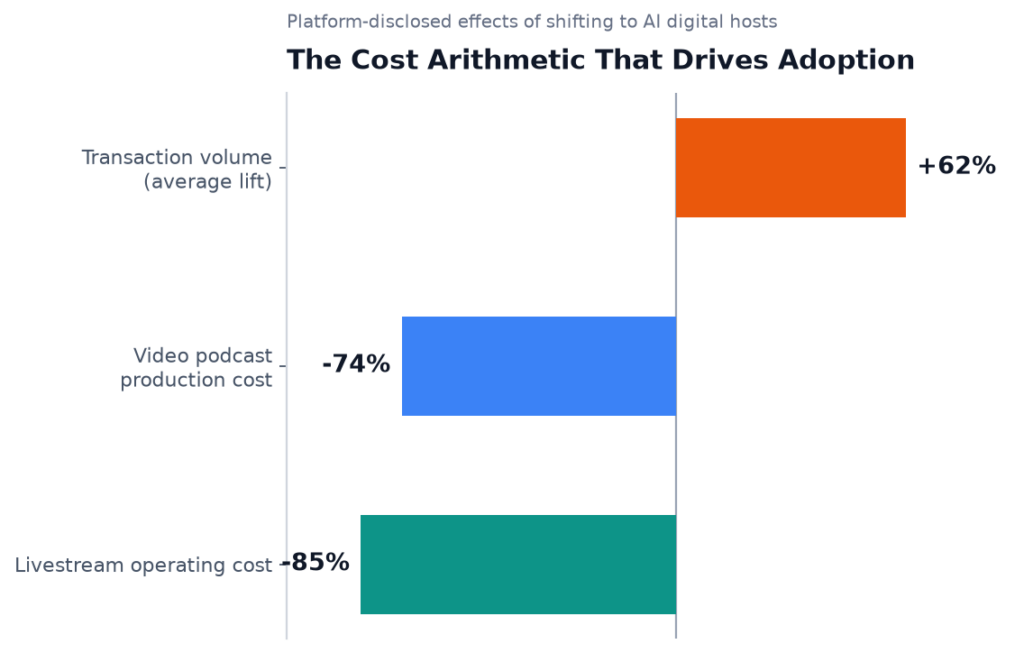
The economic case is difficult to argue with, and it is the main reason the migration has been so swift. Platform disclosures put the cost of running a digital host at 80 to 90 percent below a human presenter’s, with separate figures showing video-podcast production costs falling by roughly 74 percent. The same data suggests transaction volume rises by an average of 62 percent once a merchant shifts to around-the-clock AI hosting.
The 24/7 dimension matters more than it sounds. Chinese livestream commerce is a nocturnal business, and the hours between midnight and dawn were historically dead time for human sellers. Digital humans erased that boundary. A product can now be explained and sold at 3 a.m. by a presenter who never tires, never fumbles a line, and never asks for overtime — which is exactly why “always-on service” became the defining phrase of this market.
The Limits of a Rendered Face
The same capabilities that make digital humans cheap also mark their ceiling. What they cannot yet reproduce, sellers and shoppers keep pointing out, is trust. A human host reading a buyer’s height and weight can judge that one size will fit and another will not, and can say so in a way that builds confidence. A scripted agent answers within the bounds of its training data, which is always yesterday’s knowledge rather than today’s judgment. Many digital humans remain what industry observers call a “hot market, cold deployment” problem — script-following displays that still struggle to sustain longform, real-time conversation.
The friction is now showing up in consumer behavior. Backlash has followed influencers who quietly swapped in AI avatars, and shoppers have grown skeptical of product claims delivered by faces that have never actually worn the contact lens or tasted the snack they are praising. Purchasing decisions still rest heavily on a buyer’s faith in a real person, and that faith does not transfer cleanly to a rendered face.
Regulators Move to Keep Pace
Policymakers are moving quickly, and their actions reveal how mainstream the technology has become. Rules requiring clear labeling of AI-generated content took effect in late 2025, and the dominant short-video platforms now either ban fully AI-generated livestreams outright or demand disclosure when a digital host is on screen. Beijing has gone further, launching a pilot that issues official identification cards to digital humans — credentials stating a name, birthdate, address, and facial profile, and even allowing the avatar to hold a digital currency wallet. Shanghai earlier built a blockchain framework that gives each digital human a permanent serial number.
This is less a crackdown than an effort to impose order on a sector that outgrew its guardrails. The concern cuts both ways: supporters say registration protects intellectual property and curbs online fraud, while critics argue it extends state oversight deeper into digital life.
A Live Laboratory for the World
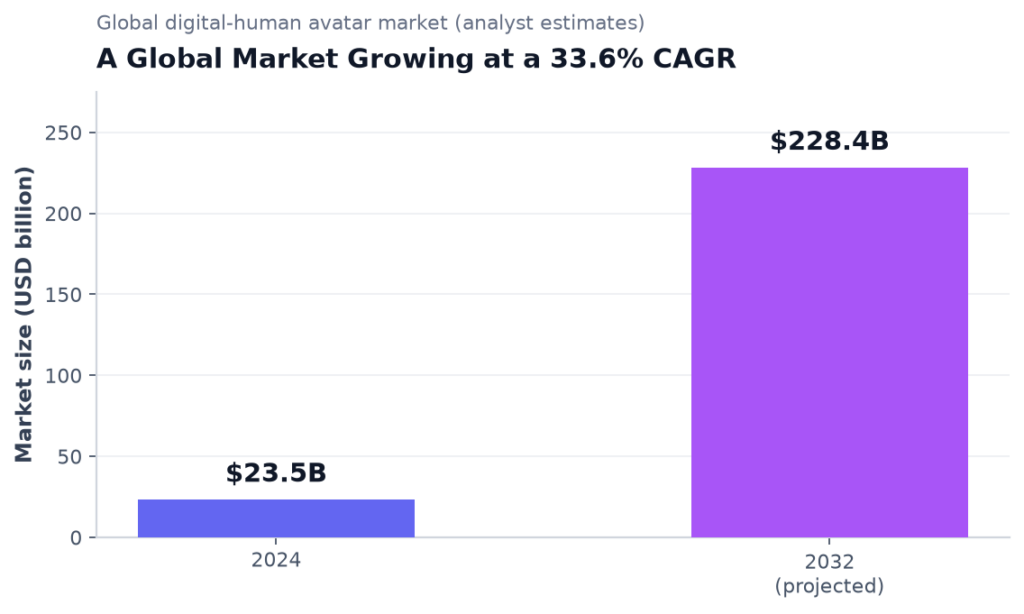
For a foreign audience, the most useful way to read these numbers is as a stress test. China is running the first genuinely at-scale experiment in replacing front-line human labor with synthetic service workers, and the results are being written in real time across its e-commerce, banking, and media systems. The global market for digital-human avatars was estimated at more than US$23 billion in 2024 and is projected to grow at a 33.6 percent compound annual rate through the early 2030s — meaning what China learns now will shape a much larger wave elsewhere.
The early verdict is mixed, and that is the honest headline. Digital humans are unquestionably cheaper, tireless, and increasingly convincing. What remains unresolved is whether the cost savings outweigh the slow erosion of human connection in the exact moments when connection is what drives a sale. For now, e-commerce has decided the trade-off is worth it. The rest of the economy is watching to see whether that bet pays off.