The 18× Gap Is a Matching Fee, Not a Discount
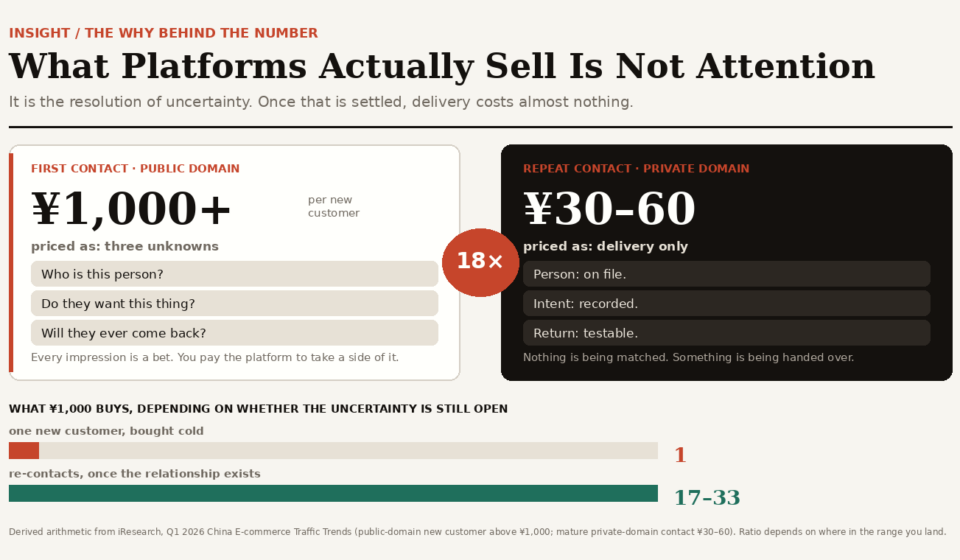
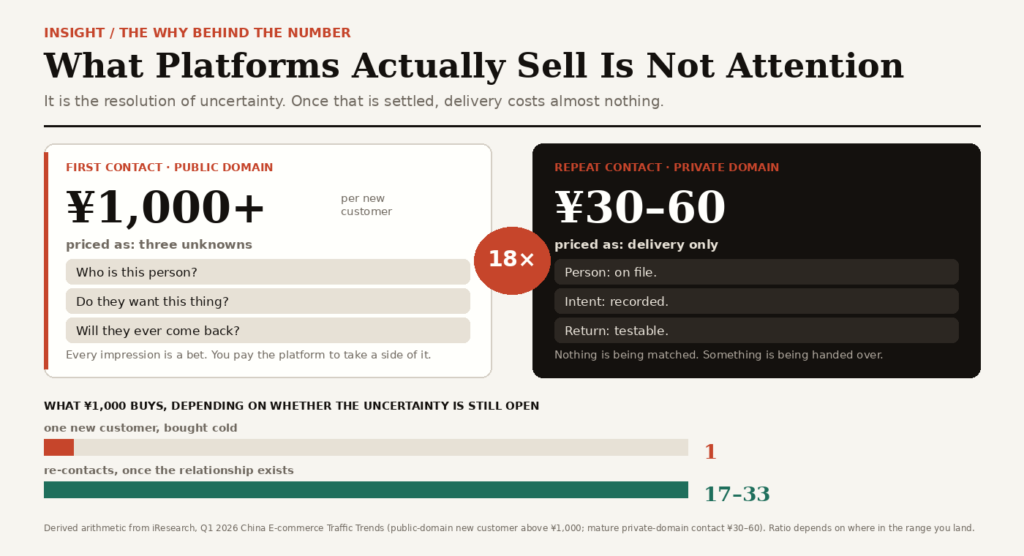
Every quarter someone trots out the number. A new customer costs a Chinese merchant more than ¥1,000 on the public platforms. A repeat message to someone who already bought costs ¥30 to ¥60. Eighteen times cheaper, same human being.
The standard explanation is that private domain is “owned,” so marginal cost collapses to the price of a server. That is true, and it explains nothing. It describes the plumbing after the fact.
Here is the mechanism underneath. A platform does not sell attention. Attention is not scarce — 1.12 billion people in China are online, and none of them are running out of minutes. What the auction actually sells is the resolution of uncertainty. Three unknowns stand between the ad and the sale: who this person is, whether they want the thing, and whether they will come back. Until those are answered, every impression is a bet, and you are paying the platform to take the other side of it.
The first purchase pays to answer all three at once. That is the expensive part, and it is expensive precisely because it cannot be avoided — a stranger’s intent cannot be discovered without paying for attempts that mostly miss.
The thirty-first contact is a different transaction. The unknowns are no longer open; they have been converted into a record. Nothing is being matched anymore. Something is being delivered. Delivery is priced by infrastructure, not by competition over scarce intent, and infrastructure is cheap.
So the 18× gap is not a discount. It is a matching fee that disappeared because the matching already happened.
Why the Reframing Pays
First, it exposes a measurement error that quietly ruins budgets. Blended acquisition cost averages a discovery cost with a delivery cost, producing a figure that means very little and drifts every quarter as the traffic mix shifts. Split the two and the picture becomes legible: discovery is a fixed bet placed per unknown, delivery is a rounding error.
Second, it tells you what the asset actually is. Not the follower. A group of fifty thousand people who bought once and then went quiet is not an asset — it is an unanswered question with a mailing list attached. The asset is the record: accumulated evidence of who wants what. Which is why data appreciates while follower counts decay.
Third, and this is the part operators resist, you cannot skip discovery. Nike tried, and paid for it in margin and in reach. Discovery is the only mechanism that generates new unknowns worth resolving. A brand that over-invests in delivery ends up sending exquisitely targeted messages to people who will never buy again.
The Question Worth Asking
Not “how do we get cheaper reach.” Cheap reach is a solved problem; that is what private domain is. The question is how much uncertainty you have actually retired. Every slice you retire is a permanent cost reduction. Every slice you leave open, you rent again next month.
That is the only number that compounds.