Selling Cars to People Who Have Already Decided
A global premium automaker spent six years building one of China’s most complete digital retail systems. Then it lost a fifth of its volume in six months. The distance between those two facts is the most useful thing in auto retail right now.
Between 2019 and 2025, BMW did most of what a global automaker is told to do in China. It set up a dedicated digital company. It launched an app that passed seven million users. It rebuilt hundreds of showrooms to a new “immersive” standard. It put a dealer operating platform into every outlet, stood up an in-house AI platform, shipped a voice assistant built on large language models, and signed with Huawei so that the roughly one in four app users on Huawei devices would get native access.
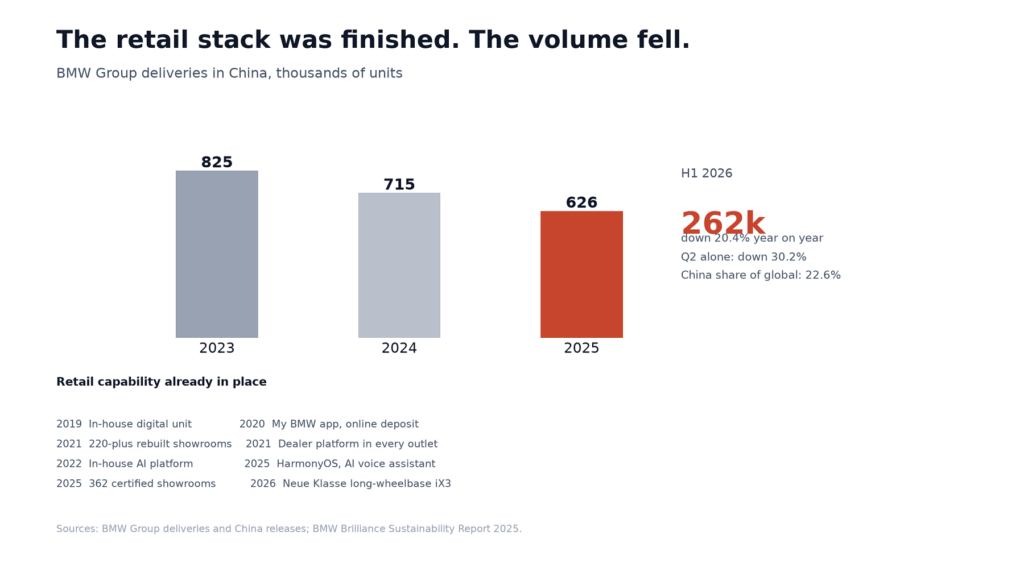
Then, in the first half of 2026, BMW’s China deliveries fell 20.4% to 261,999 vehicles. The second quarter was worse: down 30.2%. China’s share of the group’s global volume slid to 22.6% from a peak of 33.5%, and Europe became BMW’s largest region for the first time since 2013.
Those two paragraphs are usually read as a contradiction. They are not. Together they describe a category error that most global brands are still making: treating the “AI showroom” as a room, when in China it has become a layer — the layer where a purchase decision gets captured and then handed to a human being who does not repeat what the customer already knows.
BMW is the test subject here not because it failed, but because it is the cleanest natural experiment available. No Chinese EV startup has to answer the question “how do you retrofit a franchised network of 600-plus outlets?” BMW has spent six years answering it in public — and, unusually for an automaker, publishing enough detail to audit both halves of the story: the machinery, and the number.
The number first.
1. A retail stack that should have been a moat
Start with what actually exists, because the usual tellings of this story skip it.
In 2019, BMW set up Lingyue, a digital services company in China — the first such unit established by a premium automaker there. By September 2020 it had shipped the My BMW app, a China-specific build with more than 60 local functions and three sections that did not exist in other markets: community, membership and commerce. By October 2021 the app had three million users and 1.3 million monthly actives. By the end of 2022 it had passed seven million. A customer could configure a car, book a test drive, pay a deposit, track the order, book service and post in a brand community — in one place.
In parallel, BMW built the less glamorous half. SPARK, a dealer operating platform developed by Lingyue, was rolled out to every outlet by 2021, tying customer-facing requests to dealer workflows and giving management a live view of the pipeline. Its “E-workshop” feature, which let a customer watch a repair progress in the app, was being used by 77% of visiting customers within a year of launch. In late 2022, BMW deployed an in-house AI platform, BEACON, to industrialize model development across business units.
Then the physical layer. From 2021, BMW began rolling out “Lingchuang” showrooms — a standard that replaced the gray-box dealership with a five-sense retail environment, organized around a concierge desk, customer lounge, product display and dedicated experience zones. More than 220 outlets had been converted by the end of 2021. By the end of 2025, 362 dealers had been certified under a green extension of the same retail standard, which folds energy and carbon criteria into the store design.
And the intelligence layer. In March 2025, BMW China signed with Huawei to integrate HarmonyOS — the app had already entered the HarmonyOS app market in late 2024 — adding a native digital key and, from 2026, HiCar in locally built Neue Klasse cars. The new BMW Operating System X, roughly 70% of whose source code was written or optimized in China, carries a voice assistant built on large language models.
Read the list again: a super-app, a dealer operating system, a store standard, an AI platform, a voice assistant, and a domestic ecosystem partner. On paper, this is arguably the most complete retail stack any legacy automaker has assembled in China.
2. The number that didn’t follow
BMW’s China deliveries peaked at roughly 825,000 units in 2023. They fell to 714,530 in 2024, down 13.4%. They fell again to 625,527 in 2025, down 12.5%. In the first half of 2026 they fell to 261,999, down 20.4%, with the second quarter down 30.2%.
The mix tells you more than the total. New energy vehicles were 6.2% of BMW’s China deliveries in the first half of 2026. Over the same period, NEVs took 54.1% of China’s passenger-car market in the first quarter alone, and have held above 60% of passenger-car retail since April.
The price tells you the rest. BMW’s average transaction price in China was about 341,000 yuan in 2025 — below NIO and AITO, according to the pricing tracker Jielanlu. In early 2026 the company cut official prices on 31 models, with discounts on some electric flagships reaching 300,000 yuan. Dealer economics went with it: the network stood at 630 outlets in the first quarter of 2026, 33 fewer than a year earlier. Group guidance for the automotive division’s operating margin was cut from 4–6% to 1–3%, and the second quarter of 2026 came in at 2.3%. Eight thousand jobs are to go by the end of 2027.
None of that is a retail-technology failure in the narrow sense. The app did not crash. The showrooms were built. The platform shipped. What failed is the assumption underneath all of it — that a better last mile can carry a weaker middle.
3. Diagnosis one: the stack optimized the wrong mile
Here is the most consequential change in Chinese car retail, and it has nothing to do with screens.
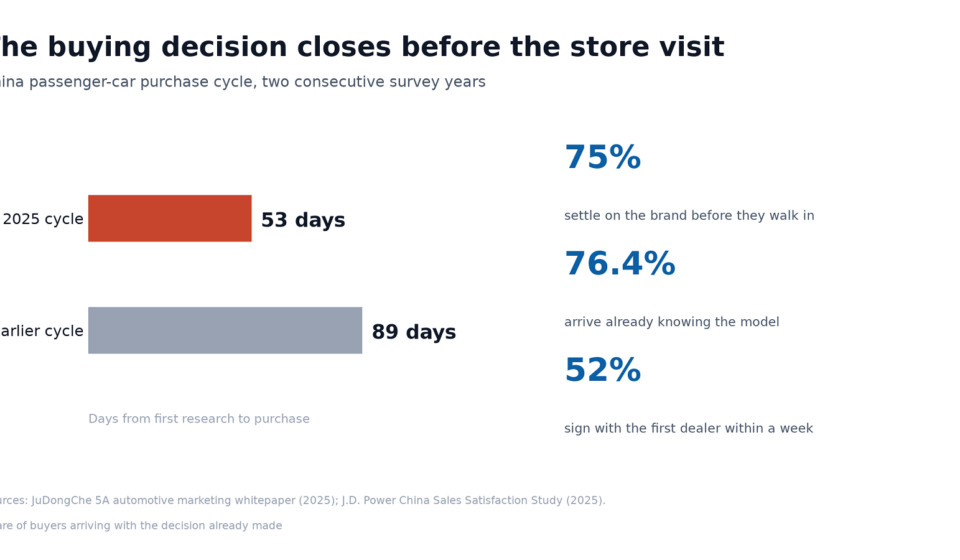
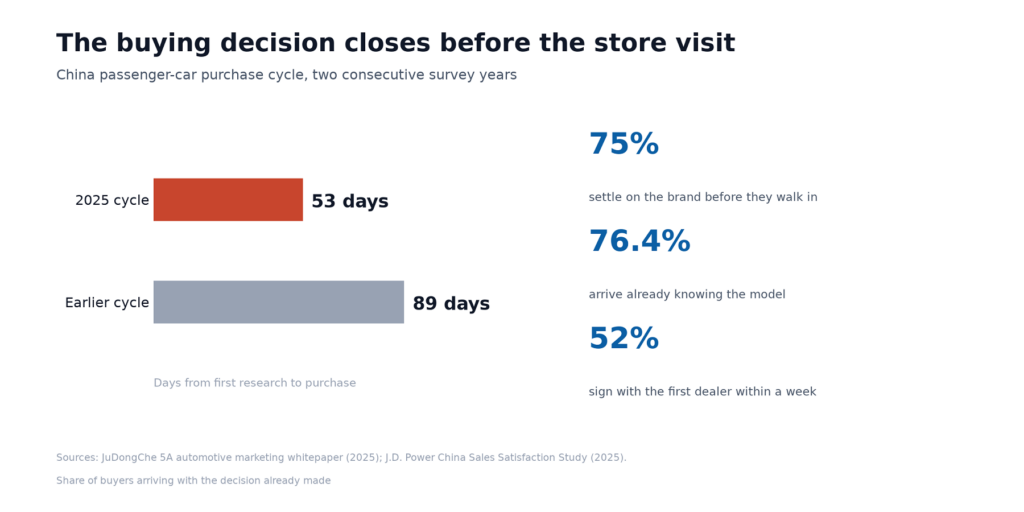
The purchase decision has compressed. China’s auto-media 5A framework, published by JuDongChe, puts the average cycle from first research to purchase at 53 days, down from 89. Three-quarters of buyers on Douyin’s platform had already settled on a brand, model and store before they walked in. J.D. Power’s 2025 China sales satisfaction study fills in the mechanism: 76.4% of buyers arrive already knowing which brand and model they want, up seven points in a year, and 52% sign with the first dealership they visit, within a week, against 40% the year before.
Sit with that. Half of your customers are not shopping in your showroom. They are confirming. And when J.D. Power asks where the journey feels worst, the answer is not the test drive or the paperwork. It is the online experience before the visit — the lowest-scoring stage for premium and mass-market brands alike.
That is the mismatch. BMW’s stack is heavy at the point of confirmation — a beautifully rebuilt room, an app that can take a deposit — and thin at the point of decision, the two or three weeks in which a buyer compares three cars across Douyin, a search box and an AI assistant. The company invested in the room the customer walks into. The customer moved the room onto her phone.
4. Diagnosis two: the floor was trained to present, not to confirm
If a customer arrives having already chosen, the salesperson’s job changes from persuasion to verification. Most franchised networks have not changed the job description, the script or the pay plan.
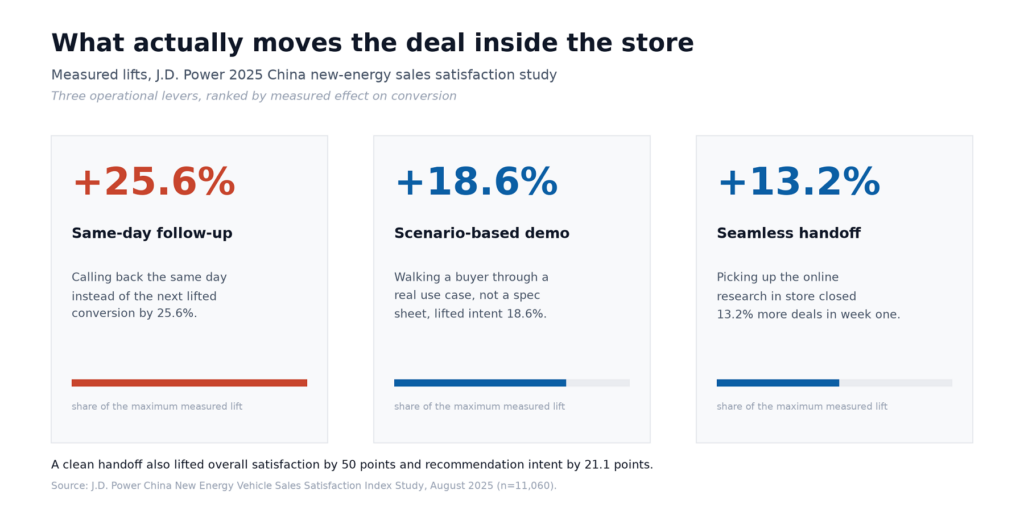
The evidence for what works is unusually specific. J.D. Power finds that a scenario-based walkthrough — talking about the school run or the camping trip rather than the torque figure — lifts stated purchase intent by 18.6%. Demand for customized test-drive routes is up 9.8%. And follow-up timing is worth more than most training budgets: when a salesperson follows up the same day rather than the next, satisfaction is 12 points higher and the share closing within a week is 25.6% higher.
Then the handoff itself. When staff accurately pick up the customer’s online research and respond to it on arrival, satisfaction rises 50 points, the share closing within a week rises 13.2%, and recommendation intent rises 21.1 points. That is not a technology problem. It is a data-continuity problem dressed as a hospitality problem.
5. Diagnosis three: the value anchor moved, and no lobby can fix that
Chinese buyers have re-priced what “premium” means. The new anchors are 800V architectures, city-level assisted driving, cockpit compute and the cadence of software updates. In Bain’s 2026 global automotive survey, 58% of Chinese buyers named technology and features as their primary consideration — above price, which remains the top factor in the US and Europe.
A brand with a 6.2% NEV mix is answering that question with a minority of its range. You can install an AI concierge by the door; if the car’s honest answer to “what does your city assistance actually cover?” is a pause, the room is irrelevant. Retail multiplies product truth. It cannot manufacture it.
This is the part global boards find hardest to hear, because it argues against the investment they have already made. The AI showroom is not a substitute for a competitive product. It is a distribution advantage that only pays when the product is at parity.
6. Diagnosis four: the network math broke underneath
A showroom is a promise that the price you see means something. In China, that promise has been under sustained attack.
The China Automobile Dealers Association counted 32,432 franchised 4S outlets at the end of 2025, down 1.4%, with 4,961 exits during the year. Joint-venture brand networks shrank 5.7%; luxury networks shrank 5.8%. New-energy brand channels grew 21%, and direct-sales plus agency models now account for more than half of those channels. In the same survey, 81.9% of dealers were selling below invoice, more than half of them by 15% or more; 55.7% were loss-making; and dealer satisfaction with automakers hit 60.8 points, the lowest ever recorded.
Read those numbers as a customer would. A store losing money on every car has three ways to survive: cut staff, cut service, or push add-ons. None of them is an experience strategy. When BMW’s network thinned to 630 outlets, the digital layer kept working — but the physical layer that gives it meaning was thinning out with it.
7. What the challengers did instead
The Chinese brands that gained share did not build better showrooms. They built shorter paths, and then used the showroom for the last hundred meters.
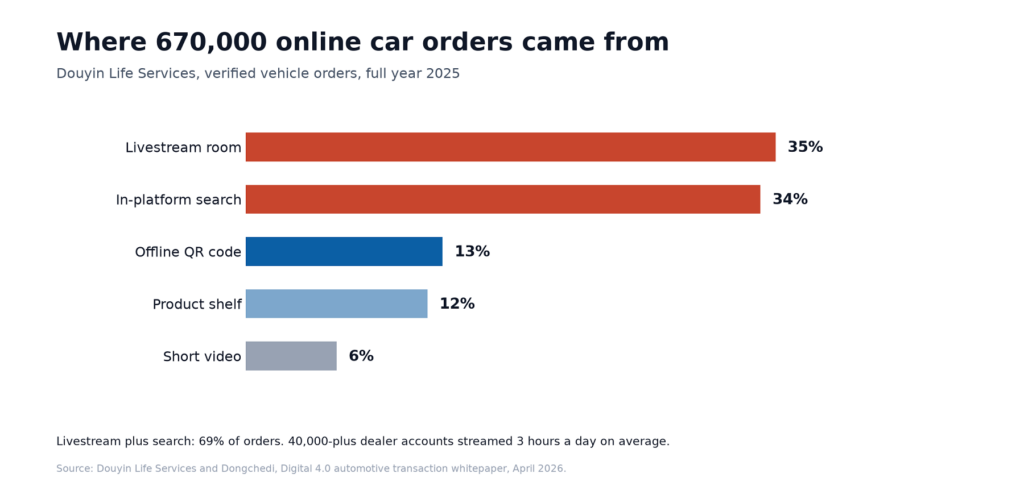
Take the transaction data first. Douyin’s life-services arm, working with Dongchedi, reported 670,000 verified vehicle orders in 2025. Of those, 35% came from livestream rooms and 34% from in-platform search — roughly seven in ten from two surfaces that barely existed as sales channels five years ago. Seventy-five percent of buyers had locked their brand, model and store before visiting. Sixty-five percent were willing to pay a deposit online to hold a price. More than 40,000 dealer accounts streamed, averaging three hours a day; one brand cleared 110 million yuan in a single month, and 267 livestream sessions passed one million yuan.
Now the physical layer, re-scoped. NIO runs 179 NIO Houses worldwide — clubs with libraries and kitchens that happen to sell cars, built to convert a test drive into a membership. Xiaomi ended 2025 with roughly 500 stores across 136 cities, 73% of them in tier-one and new-tier-one markets, opened at mall speed rather than dealership speed. Neither network is trying to be the place where the decision happens. Both are trying to be the place where it is confirmed, fast, by someone who already knows the customer’s shortlist.
And the AI layer is already in the stores, just not where global brands put it. At the China Automobile Dealers Association’s 2026 digital retail conference in Hangzhou, an executive from Tengyi Technology described 3,500 stores running AI reception assistants that handled seven times the volume of human staff, much of it overnight. The work being automated is not persuasion. It is the boring, high-volume, after-hours part: answering “what’s the price of this trim,” capturing intent, booking the visit.
8. The economics to manage instead
Most retail scorecards still track cost per lead, cost per showroom visit and closing ratio. In a 53-day, decision-first market those metrics measure the wrong thing, because they treat all visits as equal.
A better set, and one a CFO can defend:
Cost per decision captured. How much does it cost to be present at the moment the shortlist hardens? That moment is increasingly inside a livestream, a search result or an AI answer, not a showroom.
Time to decision. Days from first touch to signed order. In a market where the average cycle is 53 days and intent decays fast, shaving ten days is worth more than a point of discount.
Handoff fidelity. Does the person on the floor know what the customer already read, compared and rejected? J.D. Power’s 50-point satisfaction gap for a clean handoff is the price of getting this wrong.
Post-decision regret. Recommendation intent, service retention and residual value. In a market where luxury resale values have been under heavy pressure, this is the metric that decides the next sale.
One more, specific to intent data: in the 5A framework used by China’s auto media, the mid-funnel “A3” cohort — people actively comparing — accounts for 42% of interested users but 77% of store visits. Spending to reach everyone in a 53-day window is waste. Spending to be unmissable in the last 30 days is not.
9. Rebuilding the AI showroom: five moves
If the diagnosis holds, the rebuild is less about technology than about sequence. Five moves, in order.
Buy the decision where it closes. Livestream, search, coupon inventory and AI answers are the new top of funnel. A brand that cannot be bought inside a three-hour livestream, and cannot be quoted accurately by an assistant, has outsourced its top of funnel to whoever can.
Hand off context, not leads. A lead is a phone number. Context is a shortlist, a trade-in estimate, a finance ceiling and two objections. The store should open with “you compared X and Y, you were worried about charging” — not “let me walk you through the range.”
Retrain the floor as curators, and pay for the handoff. Same-day follow-up is worth 25.6% in conversion; scenario-based walkthroughs are worth 18.6% in intent. Those are training and incentive decisions, not software purchases. A pay plan built on volume alone will always produce a presenter.
Protect the price signal. Price inversion across 81.9% of the network does more damage to the showroom than any bad interface, because it teaches customers that the first number is fiction. Agency pricing, transparent trims and online deposit coupons are retail-design choices, not discounts.
Treat the app as a product with a roadmap. BMW’s decision to double its app release cadence was the right instinct, even if the cadence itself is not the point. The next step is harder: making the app the place where the shortlist lives, not a brochure with a service-booking button.
There is a sixth, and it is the one most global teams skip: make the brand machine-readable. If roughly 60% of buyers expect to use AI in their next purchase — 74% in China, by OC&C’s 2026 survey — then specification, price, availability and review data have to be structured for retrieval. Generative engine optimization is not a marketing side-quest. It is the new shelf space.
10. What BMW’s next act tells us
BMW’s answer to 2026 is a product answer, and it is a serious one. The Neue Klasse iX3 long-wheelbase, built in Shenyang, adds more than 100mm of wheelbase, runs an 800V architecture, claims around 900km of CLTC range, and pairs the Panoramic iDrive cockpit with locally developed AI. Global orders for the iX3 were reported at roughly 100,000, presales in China opened in August 2026, and volume production starts in the fourth quarter.
That is what a product cycle can do. It is not what a retail cycle can do. The showroom’s job in the Neue Klasse era is narrower and harder than it was in 2021: not to introduce the car, but to remove the last doubt from a customer who has already read forty reviews and watched six videos. Every element of the stack — the app, the assistant, the store standard, the dealer platform — should now be judged on one question: did it shorten the gap between what the customer believed before arriving and what they signed?
11. What this means if you don’t sell cars
The same compression is happening in furniture, appliances, insurance, education and B2B software. The pattern is identical: the decision moves to a feed, an answer or a group chat; the physical space becomes a confirmation environment; and the brand that keeps optimizing the confirmation environment wonders why conversion is falling.
Three questions worth putting on a whiteboard this quarter. Where does the decision actually close — and is that where your money is? What does the customer already know when they arrive — and does your frontline know it too? Is your floor staff paid to persuade, or paid to confirm?
Bottom line
The AI showroom is not dead. It was mis-scoped. It is not a display technology, and it is not a property strategy. It is the handoff layer between a decision made on a phone and a purchase completed in a room — and the brands winning in China treat that handoff as the product.
BMW built one of the best handoffs in the industry, then left the decision to Douyin. That is the whole story. It will repeat in every market where the phone gets there first, which is to say, every market.