Primary: Why the Cheapest Sales Force in Retail Is Also the Most Fragile
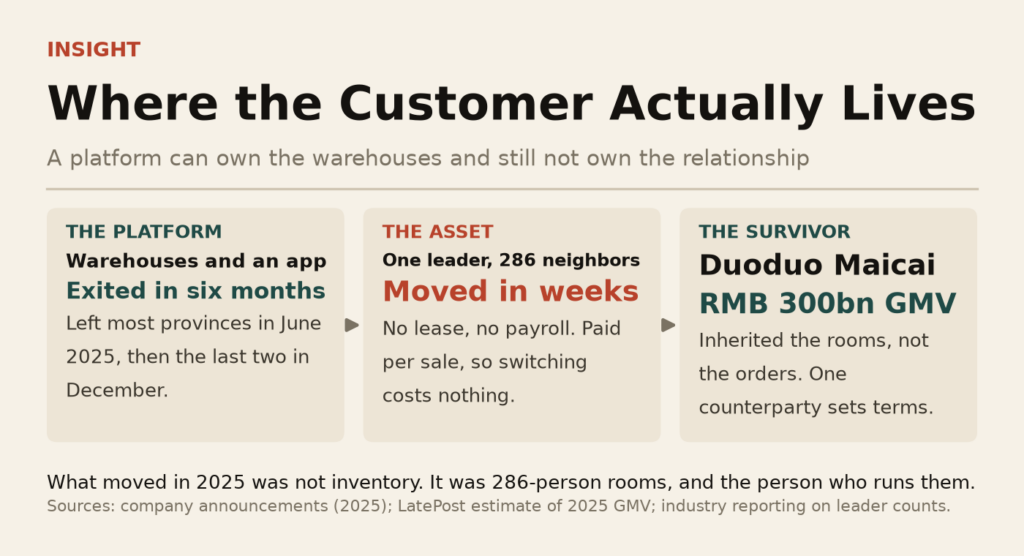
In June 2025, Meituan started switching off Youxuan in most provinces. By December the last two regions were closed, and a business it had spent years building was gone. The warehouses idled. The suppliers renegotiated. The app went quiet.
The customers kept buying groceries.
That is the part worth sitting with. What moved in those six months was not inventory, not brand equity, not a distribution network. It was the group chats, and the people who run them.
The arithmetic that makes her cheap
A platform that wants to sell groceries to a neighborhood has to pay for a warehouse, a route, a supervisor, a support desk — and it pays before the first order arrives. A group leader costs nothing until something sells. No lease, no headcount, no training budget, no recruiter. Pay her a commission and the marginal cost of opening a new community is close to zero.
This is why the model outlived the subsidies. It is not that Chinese shoppers love a bargain more than anyone else. It is that the cost structure has no fixed floor to defend. When the discount war ended, the fixed-cost businesses had to leave and the variable-cost business stayed.
The same arithmetic that makes her disloyal
A commission-only workforce is loyal to the commission.
The leader absorbs the refund argument, the neighbor who forgot to collect, the peaches that arrived soft — and she absorbs them without a salary. When the number on her screen stops covering her evening, she does the rational thing. Her asset is portable in a way a warehouse is not: the group lives in an app, the trust lives with her, and both can appear somewhere else by Friday.
In 2025 that portability was tested at national scale. When one platform withdrew, groups reappeared on another within weeks, intact. The industry calls this migration. It is closer to a change of supplier.
The discovery
Retention in this channel is rented, not owned, and the rent is the leader’s opportunity cost.
That sentence explains three things the industry usually treats as separate problems: why commissions compress as the market consolidates, why leader churn spikes right after a competitor exits, and why a platform with excellent logistics can still lose a customer it never really had.
The layer is also bigger than any one renter. Kuaituantuan, which sells software rather than groceries, is estimated to serve five to six million leaders. Regional operators such as Changsha’s Zhihua Zhiguo were adding leaders while national players were retreating. The relationship did not disappear when the platforms did. It simply changed hands.
For brands, the implication is blunt. If the relationship is rented, the rent is your media budget. Price the leader’s margin before you price the impression — and measure it by group, because that is the only unit of retention that survives a platform’s exit.
The cheapest sales force in retail is cheap for a reason. She is paid by the sale, loyal to the margin, and mobile by design. That is not a flaw in the model. That is the model.