Why a 4.6 Beats a 4.9: The Psychology Behind China’s Flawed-Review Advantage
Take a category you know well. Two review pages, same product, same price. One averages 4.9 across a few thousand reviews and has never shown a public complaint. The other sits at 4.6 and still carries the two-star reviews about a pump that leaked in transit.
Ask operators in China which one sells, and the answer that shows up in practice is the second. The reflex is to treat that as an anomaly. It is closer to a rule, and the rule has a mechanism.
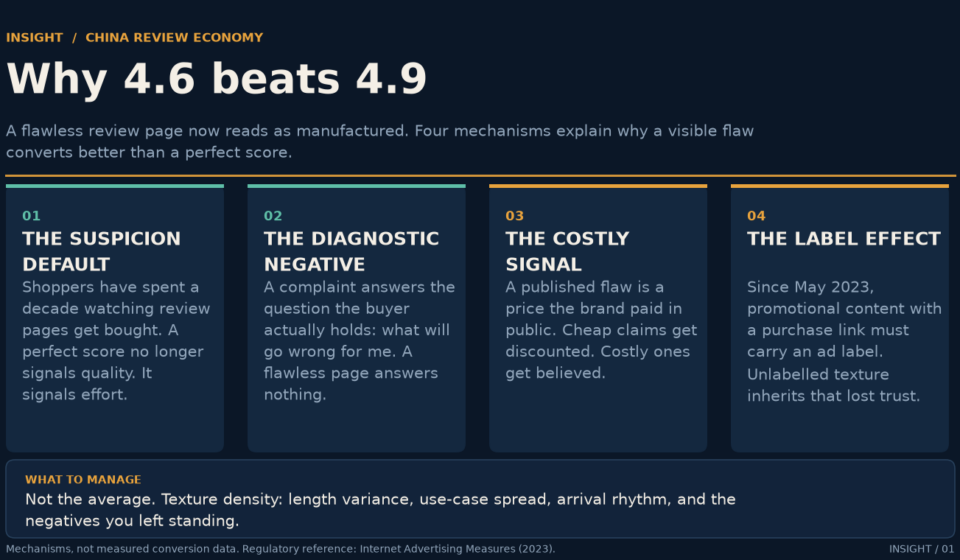
The suspicion default
Start with what shoppers have learned. Anyone buying online in China has spent a decade watching review sections get purchased — the traded five-star, the code-word recruitment, the AI-generated buyer photo. Exposure trains pattern recognition.
So a page with thousands of reviews and zero dissatisfaction no longer reads as a good product. It reads as a managed one. The absence of complaint has stopped working as evidence, because the supply of fake absence is unlimited. Perfection has become cheap to manufacture, and cheap things get discounted.
The diagnostic negative
Then there is the question the buyer is actually holding.
Nobody opens a review section wondering whether a product is nice. They open it wondering what will go wrong for them: will it fit, will it leak, will it arrive, will the seller disappear. A flawless page answers a question about the product’s virtue. A two-star review about a leaking pump answers the question about risk.
Which one gets read first? The complaint. Which one gets remembered at checkout? Also the complaint — because it is the only review on the page that told the buyer something they had not already assumed.
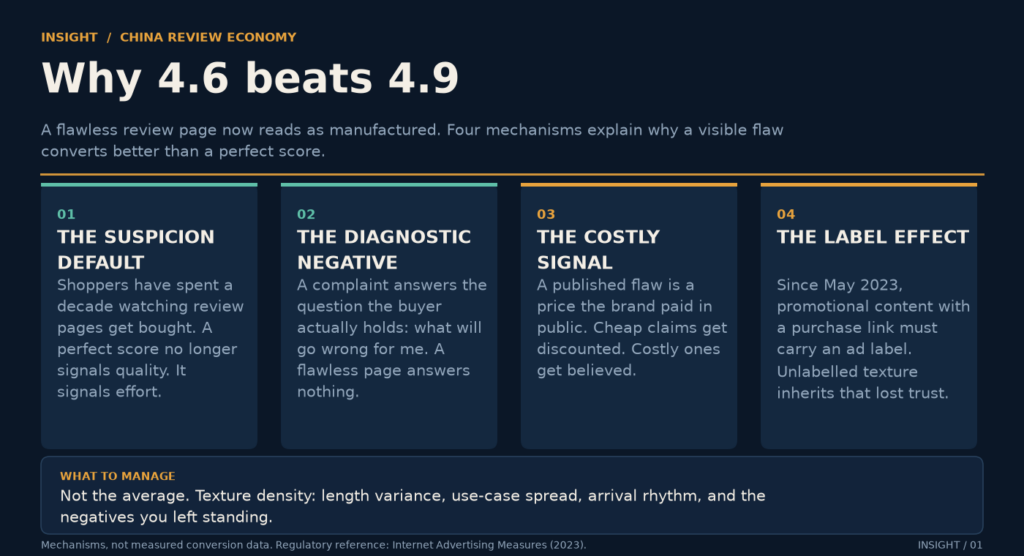
The costly signal
The third mechanism is the one operators underrate.
Publishing a complaint costs a brand something: a visible dent in the average, an argument in the reply thread, a small permanent loss on the page. Buyers know this. So when they see that a brand left the damage standing, they infer that the rest of the page is probably not manufactured — because a manufacturer would have deleted it.
Economists call this a costly signal. In review sections it works as collateral. The brand has published something it would rather not have published, and that is precisely why it is believed. A claim that costs nothing to make is a claim that costs nothing to doubt.
The label effect
Regulation reinforced the same logic.
Since May 2023, promotional content that carries a purchase link has to be visibly labelled as advertising. The label is honest and useful, and it also functions as a discount the reader applies before the first sentence lands.
Unlabelled experience — the messy, specific, occasionally irritated kind — inherits the trust the label gave up. The rule did not reduce persuasion in this market. It relocated it, from content that announces its intent to content that does not.
The trap
None of this licenses inventing a flaw.
Manufactured imperfection is a genre now, and shoppers read it the way they read a scripted apology: the detail is too tidy, the complaint too flattering to the brand, the resolution too quick, the defector too easily won back. Performed imperfection fails for the same reason performed perfection does. It is cheap to produce, and buyers can tell.
The signal only works while it stays costly. A flaw that costs the brand nothing persuades nobody.
What to manage instead
So the metric worth owning is not the average rating. It is texture density: whether reviews differ in length, in use case, in the reason someone bought; whether they arrive on an uneven rhythm rather than in one campaign week; and whether the negatives that were true are still standing where a buyer can find them.
A 4.6 with a leaking pump on the page is not a weaker asset than a 4.9 without one. It is a different kind of asset — one that has already survived being doubted, in public, before the buyer arrived.
That is the quiet trade at the centre of Chinese review management. Brands spend years buying certainty and end up with something shoppers have learned to ignore. The ones who leave a little damage visible are selling evidence instead.