Membership + Points: China’s Loyalty Playbook Beyond Discounts
Coupons taught Chinese shoppers to leave. The brands that stopped bidding on price started selling something else: the right to belong.
There are two games in Chinese retail, and from the outside they look identical.
The first one every marketer learns in week one. Cut the price. Sponsor the livestream. Stack the platform coupon on the brand coupon on the bank discount. Watch traffic spike, watch the revenue chart start to resemble a heartbeat monitor, watch the whole thing collapse the Tuesday after the subsidy ends. It works. That is the trap: it works, and then it resets to zero.
The second game is quieter. Instead of paying people to come back, you build a membership and ask them to pay you for the privilege of belonging. Not a coupon wallet. Not a points balance nobody remembers. An actual product, with a price, a promise, and a reason to renew.
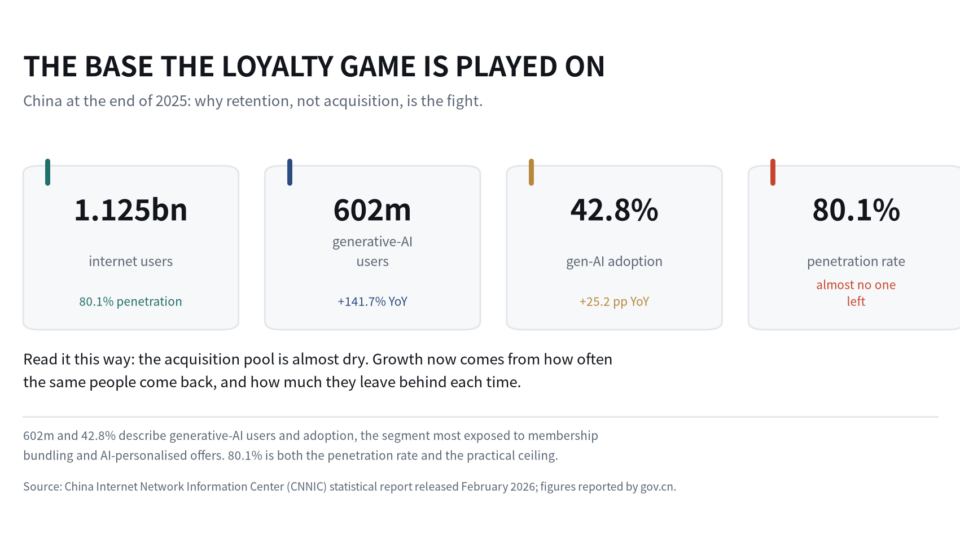
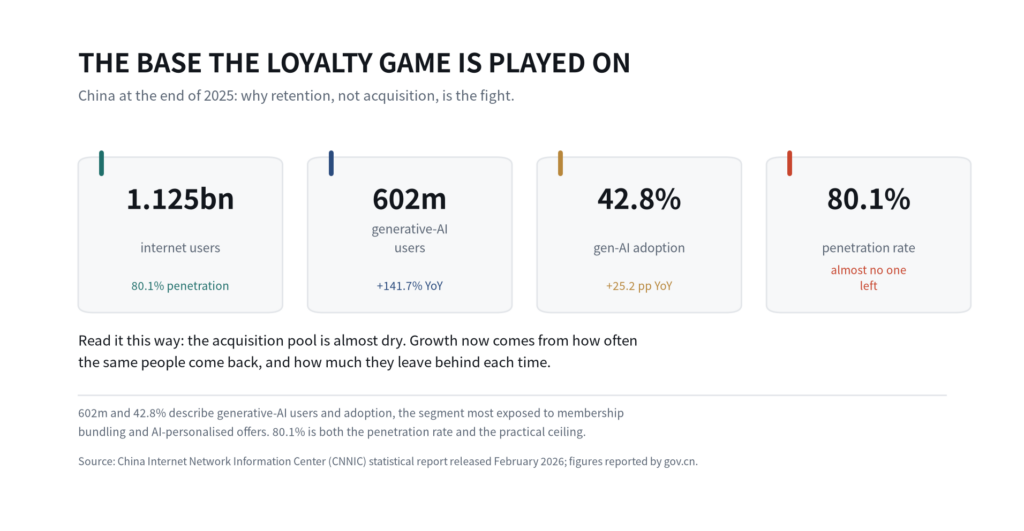
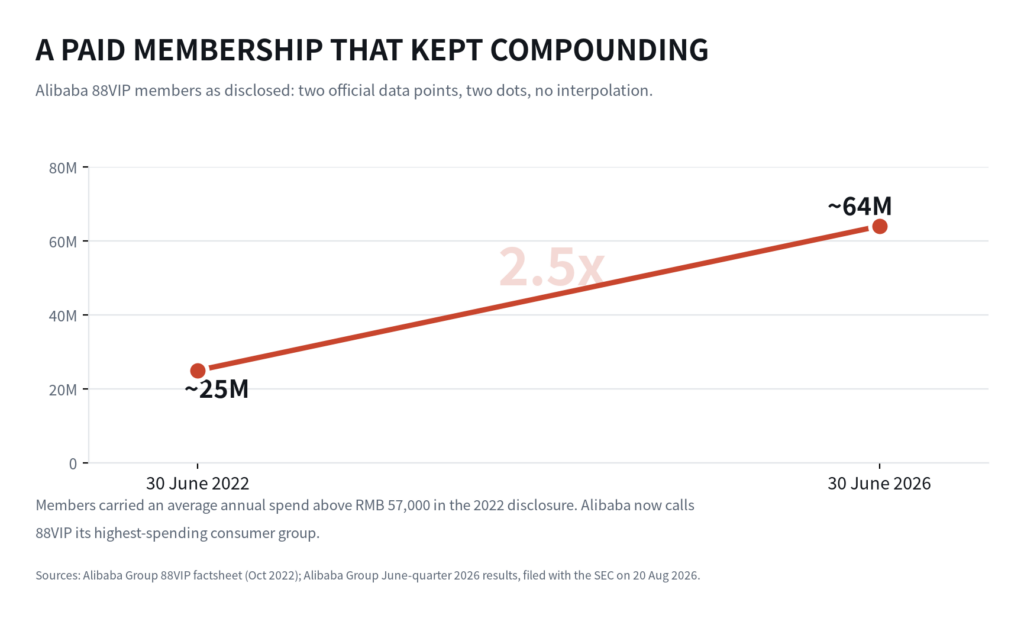
That second game is the one worth studying. Alibaba’s paid membership reached roughly 64 million members by June 30, 2026, growing at a double-digit rate year over year, and Alibaba describes those members as its highest-spending consumer group. JD has spent a decade refining the same instinct in a different shape. Meanwhile the acquisition pool has essentially dried up: China closed 2025 with 1.125 billion internet users and an 80.1 percent penetration rate.
So here is the question worth sitting with. If you cannot buy growth with discounts, and there is almost nobody left to acquire, what exactly are you selling?
Why the Discount Stopped Working
A discount buys you one transaction and rents you the customer for exactly as long as the price holds. That is the entire deal. The moment a competitor shaves a few yuan off, the relationship transfers. No goodbye, no churn survey, no exit interview.
This is not a character flaw in Chinese consumers. It is rational behavior, trained deliberately by a decade of platform subsidy wars. When every app on the phone is running a subsidy, the only sane move is to keep a finger hovering over the coupon tab.
What makes this market unusual is the scale on which that behavior happens. With more than a billion people online and four in five of them connected, there is no virgin territory to retreat into. Growth has to come from frequency and share of wallet — precisely the two things a discount destroys.
There is a second cost that rarely makes it into the deck. A discount teaches the customer to wait. Once someone learns that your price is a moving object, every full-price purchase feels like a mistake — something to be avoided with a saved search and a little patience. You are not just renting the relationship. You are training the customer to time you.
Three Numbers That Explain the Squeeze
CNNIC’s end-2025 report is worth reading twice. The headline — 1.125 billion internet users, 80.1 percent penetration — is the boring part. The interesting part sits underneath it: 602 million people using generative AI, up 141.7 percent in a single year, with the nationwide adoption rate at 42.8 percent, a jump of 25.2 percentage points.
Put those two sets of numbers side by side and a shape appears. The audience is capped. The behavior is not. A market where the population is saturated but the tooling is still moving fast is a market where retention is the only lever with any travel left in it.
This is also why the membership argument is not a niche one. When you have exhausted the addressable population, the only remaining growth is the same person buying again, buying more, and not leaving. Every loyalty program is, in the end, a machine for harvesting that arithmetic.
The Loyalty Ladder: Five Rungs, Not One
Most discussion of loyalty treats a program as a single design choice. Do you have points, or not? That framing is why so many programs stall. In China the design space is better understood as a ladder, and every rung solves a different problem.
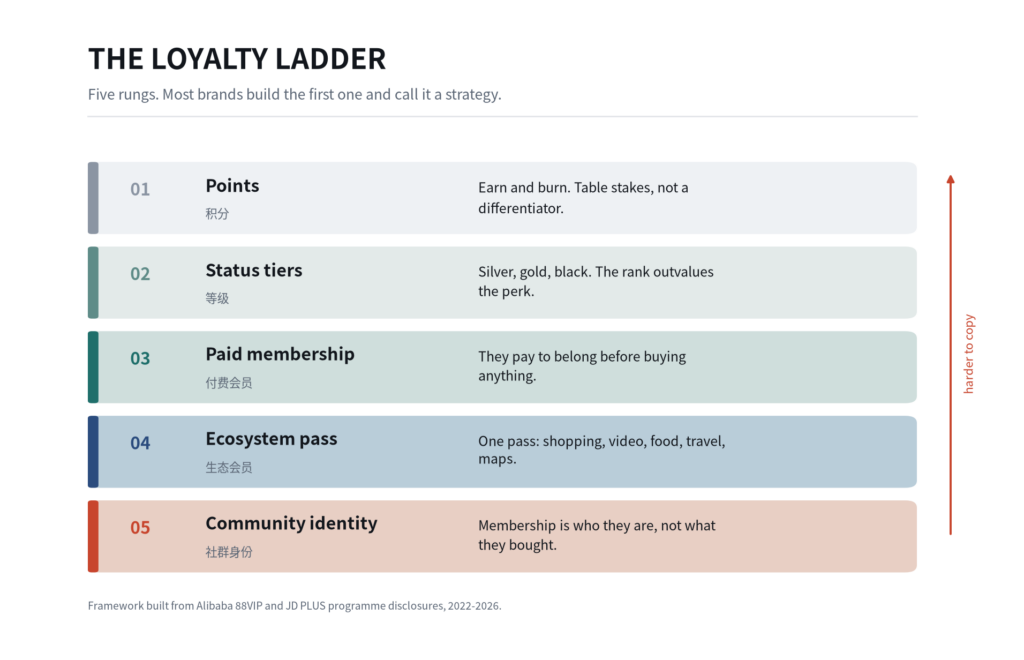
Rung One: Points
Earn and burn. Necessary, and nearly worthless as differentiation, because every platform has it. Points answer the question “why come back once more?” They do not answer “why stay for five years?”
Rung Two: Status
Silver, gold, black. Escalating perks, plus the thing that actually does the work: visible rank. Status functions because people will pay to be told they are not ordinary. The rank routinely outperforms the perk attached to it.
Rung Three: Paid Membership
The customer pays before buying anything. Counterintuitive, and the hinge on which the entire Chinese playbook turns.
Rung Four: The Ecosystem Pass
A single membership spanning shopping, video, food delivery, travel and maps. The benefit is not the discount. It is that cancelling means giving up several habits at once.
Rung Five: Community Identity
The member belongs to something. This is the only rung a competitor cannot copy with a larger budget.
It is worth being blunt about the sequence. Brands that jump straight to rung five without building rungs two and three are trying to manufacture belonging with no scaffolding underneath it. It does not hold. Belonging is what a program earns after it has been useful for long enough to be trusted.
The Counterintuitive Bit: People Pay to Be Loyal
Here is where Western instinct usually misfires. The assumption is that loyalty is something you reward. In China, it is increasingly something you sell — and customers queue up to buy it.
88VIP: A Pass That Behaves Like a Subscription
Alibaba launched 88VIP on August 8, 2018, and the date became the product name. The architecture is the interesting part. Members get a 5 percent discount across more than 300 participating brand merchants, membership privileges on platforms across Alibaba’s ecosystem — Youku for video, Ele.me for food delivery, Amap for maps, Fliggy for travel — and one-to-one dedicated customer service. Luxury houses including Gucci, Givenchy, Giorgio Armani, Vacheron Constantin and La Mer have joined the program, which tells you what kind of member it attracts.
The economics are striking. In its 2022 disclosure Alibaba reported more than 25 million members, each spending an average of over RMB 57,000 a year. By June 2026 the base had grown to roughly 64 million. That is not a discount scheme with a membership attached. It is a subscription with a shopping habit bolted on — and the habit is the product.
JD PLUS: Selling Certainty, Not Price
JD’s paid tier bundles extra rebates, coupons, exclusive prices, free shipping and returns, a lifestyle service package, VIP customer service, dedicated promotion days, online medical consultation and e-book access, with content partners including Tencent Video and iQiyi.
Alongside it sits a separate free loyalty system, Joy Score, where a high enough score can earn a rebate on the PLUS fee itself. That pairing is clever: the free system manufactures a reason to climb, and the paid tier monetizes the climb.
In January 2025 JD upgraded the paid offer with services at the center rather than price. A Lifestyle Service Package lets members redeem credits for seven services, from home cleaning and laundry to car wash and delivery. Self-operated electronics gained a 180-day replacement-over-repair policy. Unlimited free shipping was extended into the company’s on-demand retail arm.
Notice what is being sold. Not cheaper. Safer.
Warehouse Clubs: When the Fee Is the Product
Sam’s Club and Costco run the purest version of this logic. The membership fee is not a marketing cost; it does most of the work on the profit line. That lets the warehouse price goods at levels a conventional retailer cannot match, while the fee filters the customer base down to people who have already decided to commit.
Chinese shoppers, who are famously price-literate, made the model work anyway. Which tells you something uncomfortable: the objection was never to paying for membership. It was to paying for nothing.
Why Paying Makes People Stay
Sunk cost has a bad reputation in decision science, and it has earned it. Inside a membership, though, it turns into an asset. The moment someone pays, the arithmetic in their head changes. They are no longer choosing between you and a competitor. They are choosing between extracting value from a fee they already paid and wasting it. Every visit becomes a small act of self-justification.
No coupon can replicate that, because a coupon creates no commitment. It creates an expectation of more coupons.
There is a renewal effect too, and it is underrated. A member who renews once is dramatically easier to renew again, because renewal stops being a decision and becomes a habit. The first renewal is the real conversion event. Everything before it is acquisition dressed up as loyalty.
Points Are Behavioral Design, Not Accounting
If points are the fuel, most programs treat the fuel gauge as the whole dashboard. Three decisions separate programs that work from programs that decorate a homepage.
Where Members Can Earn
If points only come from spending, the program is a rebate with extra steps. Chinese programs tend to open the earning surface much wider — reviews, check-ins, content, referrals, daily missions — so that engagement itself is rewarded. Two objectives get hit at once: richer data, and a habit loop that survives the days nobody is shopping.
The side effect is underappreciated. Every non-purchase earn event is a data point, and a data point is what makes the next offer less generic. Points are a payment for attention, and attention is the raw material of personalization.
Expiry as a Metronome
Expiration is the most abused mechanic in loyalty. Too tight and it reads as a trap. Too loose and the balance becomes wallpaper. What works is rhythm: predictable, generous enough to be redeemed, firm enough to create a deadline worth noticing.
The test is simple. If a member cannot tell you roughly when their points expire without opening the app, the mechanic is not doing its job — and if they can tell you but feel cheated by it, it is doing damage.
Redemption Should Buy Identity
A branded tote bag is a transaction. A tier, an early-access window, a seat at something genuinely small and exclusive — that is identity. The best redemptions are the ones a member mentions to a friend without being asked.
The Private-Domain Layer Nobody Sees
The rung most global brands skip sits underneath the program itself: private domain. WeChat groups, mini-programs, one-to-one messaging, service accounts. Not a broadcast channel. A conversation.
The structural difference from Western CRM deserves to be stated plainly. Email is episodic and one-directional. A WeChat group is continuous and two-directional. A brand inside a group can float an offer on Tuesday morning, hear the objection by Tuesday afternoon, and adjust by Wednesday. Retention stops being a campaign and becomes an operating rhythm.
It also removes a tax. Reach inside an owned channel is not metered by an ad auction. That single fact changes the math of retention marketing more than any creative idea is likely to.
And it changes who does the work. In a group, the member talks back. Most brands are not staffed for that — no one owns the reply, so the reply arrives late or not at all. The channel is free; the responsiveness is not.
Where Global Brands Lose the Plot
The failure pattern is consistent enough to be almost boring.
Underpricing the Membership
Global teams benchmark against Prime, conclude that a paid tier is a big-company game, and launch a free points club instead. That is rung one. Engagement plateaus, and nobody can explain why.
The Bundling Wall
88VIP works because the same company owns the video, the food delivery, the maps and the travel. A single-category brand cannot copy that structure, so it has to invent a different currency — service, access, expertise, community — rather than imitating the architecture. Copying the shape without the substance produces a paid tier that feels like a fee for nothing.
WeChat as a Billboard
Broadcast-only private domain is email with a green icon. The value lives in the reply, not the send.
The Discount Reflex
When retention sags, the reflex is a coupon, which re-trains the exact behavior the program was built to cure. This is the most expensive mistake on the list, and by far the most common.
The Parts That Do Not Work
Honesty is more useful here than enthusiasm.
Membership Fatigue
Every brand now has a paid tier, and consumers are running out of patience for yet another annual fee. Differentiation is getting harder, not easier, and the fee has to keep earning its renewal.
Points as a Liability
A balance is a promise, and promises sit on the balance sheet. Programs that model redemption badly find out the hard way when the liability lands all at once.
The Compliance Line
Deep personalization needs deep data, and China’s Personal Information Protection Law is firm about consent and minimization. The programs that personalize well treat compliance as a design constraint rather than a legal afterthought.
Discount Creep
Then there is discount creep, the quietest risk of the four. Add one price-based perk to a belonging-based program and the conversion back to rung one has already begun.
What Happens Next
Three shifts are already visible.
From segments to individuals. With 602 million people now using generative AI, the cost of designing an offer for one person is collapsing. Expect benefit tiers, earn rules and even renewal pricing to be assembled per member rather than per cohort.
From single brand to coalition. Cross-brand memberships, where points and perks interoperate between non-competing brands, are the obvious next move for anyone who cannot build an ecosystem alone.
From revenue to data. The most valuable output of a mature program is not the fee line. It is first-party data: declared preferences, purchase rhythms, service history. In a market where third-party targeting keeps getting harder, that asset compounds quietly.
One more signal is worth filing away. Alibaba says its Qwen app has already given 250 million users their first AI-driven shopping experience. When discovery moves inside a conversational agent, the brands holding a real member relationship will be the ones an agent can recognize — and an agent cannot recommend a relationship it has no record of.
The Takeaway
China’s loyalty playbook did not win by discounting harder. It won by changing what the customer is buying — from a cheaper basket to a membership worth renewing, a rank worth holding, and a community worth staying inside.
If you are building outside China, the lesson is not “copy 88VIP.” You cannot; you do not own the video app, the food delivery fleet or the map. The lesson is structural. Loyalty is not a discount strategy with a points wrapper. It is a product. Price it, design it, and ship it like one.